Thursday, January 25, 2007

5255 Pairs of Latvian Mittens

The 2006 NATO Riga Summit's Latvian Mittens pages include some wonderful images, and also an image archive including 5255 mitten pictures--photos of every mitten knitted for the summit, and more. I chose these three pairs of ladies' mittens (from the Kurzeme region) somewhat randomly, because I've just started to look through the archive. It was definitely worth the trouble I took to download and uncompress the 200 Mb rar file. Each .jpg file is 600 pixels wide, a big enough image so you can see the individual stitches, and therefore, copy the colorwork charts. I have 5255 new mitten patterns, for free! (I scaled down these images for the weblog--the archive .jpgs are 40% bigger.)

Latvian lady's mitten, Kurzeme region Another Latvian lady's mitten, Kurzeme region Still another pair of Latvian lady's mittens, Kurzeme region

Wednesday, January 24, 2007

Latvian Mittens--An Amazing Library For Knitters

If you knit mittens (or socks, or do any kind of knit colorwork) you need to take a look at Latvian Mittens. You could say I found these in Rebecca's Pocket. (In fact, the mittens you would find in THIS Rebecca's pocket right now are a pretty Scandinavian design I got from Elizabeth Zimmermann's Knitting Around. But I digress.) Here's what the 2006 Rega Summit Web site says about the mittens:

Book Cover: Latvian Mittens
What will 9,000 hands have in common during the NATO Summit in Riga this November? 4,500 pairs of traditional hand-made Latvian mittens! That's what the NATO Summit Latvia Task Force has prepared for Summit guests. The mittens were specially knitted by hundreds of women and men around the country ranging in age from 30 to 86. Each pair features a unique design, utilizing a wide variety of traditional colors, patterns and symbols. For Latvians, mittens are much more than a way to warm your hands. Every ethnographic Latvian mitten tells a story, marks an anniversary and represents a specific region in Latvia (Vidzeme, Zemgale, Latgale and Kurzeme.) Some mitten designs are specially intended for weddings or other special events. There is even a rich tradition of folkloric etiquette associated with the wearing, storing and displaying of mittens.

Latvian mittens have been a hot issue for me since I first saw Lizbeth Upitis' Latvian Mittens: Traditional Designs & Techniques in 1982. It was in English and Latvian, and it didn't stay in print long. I eventually got a copy, and it is everything I like in a knitting book--lots of real mittens knitted by real people to keep warm and to delight. No "use my pricey yarn and pattern." The book cover here is a 1997 reprint from Schoolhouse Press (Elizabeth Zimmermann's publishing company), with a snazzy new cover, more mittens, and more photos.

The Riga NATO Summit site has lots of mittens you can view on-line, but I am hard-core, and I usually make my own charts from photographs, so I decided I needed to download the mitten archive, a 200 MB .rar file. (After all, I have all that data backup and storage capability now.) Of course, when I got it downloaded, I had no way to expand the .rar compression format. That's why I spent a couple of hours investigating rar and unrar resources. As usual, I have links.

  • WinRAR is the Windows compress/uncompress utility for this format. You have to pay for it, but you can try before you buy. Of course, I don't do Windows, so I moved on.
  • RAR for Linux 3.3.0 Beta 3 from Tucows. Shareware. I never got it running.
  • unRAR 2.71 from Tucows. Freeware, just the uncompression (unrar) utility, not the compression (rar)one. I never got this running either, but I came a little closer.
  • I finally figured out that I didn't have the "non-free" libraries in my /etc/apt/sources.list (I just installed Debian Sarge on this hard drive a couple of weeks ago, with much whining.) I did that, and was able to "apt-get install" the Debian rar and unrar programs.

Once I unrar-ed the archive, I found seven directories with 5255 .jpg files, all of mittens. Heaven! They are clear enough to use as charts, and the color and variety are wonderful. They use lots of interesting traditional patterns with traditional meanings. At NATO's request, however, one common design was omitted. The NATO mittens were certified "swastika-free."

Tuesday, January 23, 2007

Web Resources For Sewing Lingerie

These are my favorite lingerie-sewing resources. I have no financial interest in any of them, beyond a desire that they stay in business so I can continue to shop.

  • Sew Sassy Fabrics is my favorite source for lingerie "notions." They say of themselves:

    Sew Sassy Fabrics has been providing first quality fabrics and accessories to home sewers and cottage industries since 1987. We specialize in tricot, lace, elastic and lingerie fabrics, bra making supplies, lycra® and specialty fabrics for swimwear, activewear and costumes, and stretch fabrics containing lycra® or spandex for outer wear.

    I've been very pleased with everything I've bought from them, and I particularly recommend regular visits to Sew Sassy's sale pages. A few years ago, I got 500 yards of 3/8 inch plush lingerie elastic for $15.00. Since elastic is often the biggest expense in a lingerie project, this makes my sewing much more economical.

  • Wazoodle has a great selection of high-quality knits at good prices. Their tee-shirt grab bags are a fine source for inexpensive lingerie fabrics. I usually get one long-sleeved tee-shirt and a pair of underbritches per piece of fabric.

    Wazoodle started in 2002 as a part time business....Today we run operations in Toronto, [and] Montreal....We specialize in better quality textiles used for casual clothing, outerwear and children's wear. We occasionally dabble in finer ladies wear and home decor....We operate a retail web store at www.wazoodle.com. Our site is one of most visited fabric sites on the web, with close to a million visits each month.
  • Kwik-Sew pattern catalog. These days, I prefer Kwik-Sew patterns to the "Big Three" (Simplicity, Butterick, Vogue) I always used to browse. Kwik-Sew's patterns seem better-made and better-sized, and they include all sizes in one envelope. (I transfer my size to brown wrapping paper, and make alterations to my heart's content; or try a different size if need be. Meanwhile, I have a library of sizes in case I sew for someone else later.) Kwik-Sew has lots of lingerie patterns (for women, kids, and men, although I don't suppose you call mens' underbritches "lingerie").

    I usually pick out my patterns on this Web site, and order from Sew Sassy Fabrics or Wazoodle when I order fabric and sewing notions.

  • Dharma Trading Company has great prices on fabrics, as long as you like white and black, or you're willing to dye them yourself. (It's easy and I really enjoy it.) For lingerie purposes, they have many weights of woven silk fabric, and decent cotton jersey and cotton lycra among their knit fabrics. (I haven't yet tried their silk and hemp knits, but I'm intrigued....) They also stock dyable underwear and socks, if you prefer to dye without sewing.
  • Fay's Fashions and Fabrics has nifty value packs, grab bags of fabrics or notions. I particularly liked my elastics and lace trims.

Monday, January 22, 2007

Hillbilly Babylon: The View from Berlin

Hillbilly Babylon is the name of a Appalachian film and bluegrass music festival in Berlin. I'm not familiar with the musicians (they seem to be Europeans), but the 2006 film line-up looked quite interesting. I particularly like the Welcome page which explains Appalachia thus:

Hier setzt HILLBILLY BABYLON an. In einer Reihe von Dokumentationen zeigen wir das Bild eines sehr eigenen Menschenschlags, rau, unabhängig, oftmals sehr arm. Wir zeigen Menschen mit einem fast anarchisch anmutenden Freiheitsdenken, verbunden mit einer tiefen Religiosität und einer allgegenwärtigen Melancholie. Einen besonderen Schwerpunkt widmen wir der traditionellen Musik der Region. Moderne Country- und Bluegrass-Musik haben sich daraus entwickelt. Das alles vor dem Hintergrund einer fantastischen, naturbelassenen Landschaft. Neben den Dokumentationen zeigen wir eine Reihe von Spielfilmen, die sich auf unterschiedliche Weise mit der Hillbilly-Thematik befassen.

Here's their English version, which doesn't sound nearly as intellectual, except for the "ubiquitous melancholia."

Here, HILLBILLY BABYLON begins. In a series of documentaries we show a very unique ethnic group, coarse, independent, often very poor. We show people with an almost anarchist sense of freedom, tied with a deep religiosity and an ubiquitous melancholia. A special emphasis is placed on the traditional music of the region. It is the origin of modern country- and bluegrass-music. All this framed by a scenic, fantastic landscape. Aside from the documentaries, we show a number of feature films that deal with the hillbilly theme in different ways.

Sunday, January 21, 2007

Lingerie Sewing--Choosing a Pattern

Kwik-Sew panties pattern 2100

My scrap fabric reclamation project last month involved tee-shirt trials as well as lingerie pattern and fabric experimentation. I'm currently test-driving a dozen pair of underbritches (not all at once, mind you) in various styles, sizes, and fabrics. As with the tee-shirt pattern search, I'm trying to identify one or two favorite patterns.

I had good luck with the patterns from Kwik-Sew's Beautiful Lingerie, from Kwik-Sew pattern 2100, (at right; especially useful because it includes hip sizes from 34 to 52 inches--you could make presents for most of the adults you know) and from a discontinued Kwik-Sew lingerie set pattern. The Kwik-Sew Website says of the Lingerie book:

Kwik-Sew's Beautiful Lingerie is for everyone who loves to sew and a necessity for those who want to discover how easy and fun it is to make lingerie. With fancy laces and soft fabrics you can create beautiful lingerie that will not be duplicated.

The master patterns included in this book are for slips, camisoles, briefs, panties, teddies, nightgowns and robes. All styles are easy to make and designed for both woven and knit fabrics.Create unlimited variations. from basic to elegant. Make it for yourself or give it as a gift....The master pattern includes five sizes from extra small to extra large.

I particularly like this book because it encourages you to experiment with pattern variations, fabrics and trims, and gives good directions for sewing with knit fabric, stretch lace, and lace decoration. It's a good place to start. (If I'd bought it first, I would have saved money on several patterns I'd purchased previously.) There are no patterns or directions for bras, but I'll cover that topic in a later post.

Kwik-Sew also offers many different styles of underbritches, from long underwear to G-strings.

If you're seriously cheap and also bold about sewing projects, Leena.com has downloadable " miniature patterns in S, M, L and XL sizes." Even if you decide to buy a pattern, Leena.com's directions for sewing and embellishing are well worth a visit. Rusty Bobbin presents her own pattern review, with excellent step-by-step illustrations, and finds that she gets her best fit from a pattern traced off her favorite store bought britches.

Saturday, January 20, 2007

John Hardy Was A Desperate Little Man

On This Day in West Virginia History...African- American railroad worker John Hardy was hanged at Welch, McDowell County, on January 19, 1894. I just discovered this feature of the West Virginia Division of Culture and History. It promises to be fascinating.

If you're at all familiar with the Carter Family, or if you play the banjo in West Virginia, you know that

John Hardy was a desperate little man
He carried two guns every day
He shot down a man on that West Virginia line
You ought a seen John Hardy getting away
You ought to seen John Hardy getting away

John Hardy stood in that old barroom
So drunk that he could not see
And a man walked up and took him by the arm
He said Johnny, come and go along with me Poor boy
Johnny, come and walk along with me

John Hardy stood in his old jail cell
The tears running down from his eyes
He said I've been the death of many a poor boy
But my six-shooters never told a lie
No, my six-shooters never told a lie

The first one to visit John Hardy in his cell
Was a little girl dressed in blue
She came down to that old jail cell
She said Johnny, I've been true to you God knows
Johnny, I've been true to you

The next one to Visit John Hardy in his cell
Was a little girl dressed in red
She come down to that old jail cell
She said, Johnny, I had rather see you dead
Well, Johnny, I had rather see you dead

I've been to the East and I've been to the West
I've traveled this wide world around
I've been to that river and I've been baptized
So take me to my burying ground

John Hardy was a desperate little man
He carried two guns every day
He shot down a man on the West Virginia line
You ought to seen old John Hardy getting away

The West Virginia Songbag, edited and published by Jim Comstock of Richwood, WV in 1974, devotes many pages to the John Hardy/John Henry confusion, and includes five West Virginia versions of the John Hardy ballad. There are also several first-person recollections of John Hardy. You can see in the photo of the hanging that John Hardy was not a "little man."

Finding the Perfect Tee-Shirt Pattern

Kwik Sew 2900: knit pullover top pattern

When I made the clothesline full of tee-shirts last month, I was searching for the "perfect" tee-shirt pattern. I'd been using Kwiksew 2900 (at right), and it worked well for very soft, not-too-stretchy cotton jerseys and interlocks, as long as I made long-sleeved shirts. But with stretchier or softer knits, the results looked sloppy and unflattering, and with short sleeves, there was always too much ease in the armhole and sleeve. I tried some now-discontinued lingerie undershirt patterns, and used many pattern adjustments, but my results were hit-or-miss. Part of the problem is the wide variety of hand and stretchiness in fabrics classified as jersey, interlock, rib knits, or simply "stretch knits." The only way to deal with this is to try lots of different fabrics. It's a dirty job, but somebody's got to sew it.

This fall I tried Wazoodle.com's "most popular Tee pattern in the world," Jalie 2005 (below). I made the three-quarters-length sleeve style first. The armhole fit well, but it was much too large in the shoulders. A simple alteration took care of that, and I have my new "favorite tee-shirt pattern." The short-sleeve view works very well too. Of course, I've made my own long-sleeve pattern variation, so that I could do one-to-one comparisons. Jalie 2005 works well on all the stretchy fabrics I've tried, including interlock, thermal cotton knits, and technical wicking fabrics. I need to try it on simple tee-shirt cotton jersey, which is less stretchy than interlock or thermal knits. If it works well, this could be the one perfect tee-shirt pattern, the one to reach for when I need to make something to wear.

Friday, January 19, 2007

From the "Frontier the Yankee Made"

Henry Shapiro's 1986 book, Appalachia on Our Mind: The Southern Mountains and Mountaineers in the American Consciousness, 1870-1920, discusses how Northern missionaries drew back, in the 1870's and 1880's, from teaching and saving freed slaves in the South, and retreated into the mostly white Southern Appalachians, where education and conversions were less complicated by race relations or Klan violence. Shapiro's style is less compelling than W.J. Cash's The Mind of the South (1941), but it addresses the same issue Cash tackles in this passage:

And in this connection [regarding the way vengeful Reconstruction policies increased white Southern solidarity, hatred of the North, and hatred of blacks] we come upon a figure which deserves some notice. I mean the Yankee schoolma'am who, in such numbers, moved down upon the unfortunate South in the train of the army of occupation, to "educate the black man for his new place in the sun and to furnish an example of Christian love and philanthropy to the benighted native whites." Generally horsefaced, bespectacled, and spare of frame, she was, of course, no proper intellectual, but at best a comic character, at worst a dangerous fool, playing with explosive forces which she did not understand. She had no little part in developing Southern bitterness as a whole and, along with the peripatetic Yankee journalist, contributed much to the growth of hysterical sensibility to criticism. But nowhere was her influence more important than at the point with which we are engaged.

For if she was not an intellectual, the South, with its vague standards in these matters, accepted her as such. It saw her, indeed, as a living epitome of the Yankee mind, identified her essentially with the Northern universities, took her spirit for that of the best intelligence beyond the Potomac, read in the evils springing abundantly from her meddlesome stupidity categorical proof that Northern "theory" was in toto altogether mad. And so she served as a distinct power in bringing Southern fear and hate to explicit focus in the purely ideological field--in setting up as definite a resistance to Yankee thought as to Yankee deeds.

From The Mind of the South, Book II, Chapter 1: "Of the Frontier the Yankee Made" by W. J. Cash

If this connection is valid, the ambivalence and bitterness that some people feel concerning Appalachian identity can be traced to Reconstruction, a policy whose effects historians tend to minimize in the Southern Mountains. James Dickey comes down on the side of the Yankee schoolmarm. Who'd have thought it?

Thursday, January 18, 2007

Appalachia: A Strange Place and a Peculiar People

Book Cover: All that is Native and Fine

I've found these two academic books very interesting as I cruise the bookshelves, reading about Appalachia. They were published 20 years ago, and I don't know how the "Appalachian Studies" folks view them these days, but they explain some attitudes that have puzzled me.

All That Is Native and Fine: The Politics of Culture in an American Region by David E. Whisnant. 1986. University of North Carolina Press. ISBN 0807841439. This is an academic book on "systemic cultural intervention" and its effects on Appalachian communities in the late ninteenth and early twentieth centuries. Whisnant describes the way urban Americans, interested in the European idea of Volkskultur, identified the Southern Appalachians as a backwater in which otherwise lost Anglo-Saxon folkways and folk arts had been preserved in pure form. They also identified their rural "informants" as needy, and they proposed to collect and preserve the cultural heritage at the same time they brought them the benefits of urban education, morality, and capitalism. This book focuses on the consequences, intended and otherwise, of this meeting of two "cultures." It's a slightly dry read, but the data are fascinating, and there are some great photographs. I recommend it to anyone interested in Appalachian traditional music (or other arts). How much of what we accept as "traditional" is really traditional? What does "traditional" mean?

Book Cover: Appalachia On Our Mind

Appalachia on Our Mind: The Southern Mountains and Mountaineers in the American Consciousness, 1870-1920by Henry D. Shapiro. 1986. University of North Carolina Press. ISBN 0807841587. This book is also about how outsiders have discovered Appalachia, described it, and decided it needed to be fixed, by them. This isn't one of the "capitalist exploitation" histories focusing on material change, but rather an exploration of how outsiders have defined Appalachia by their own lights, sometimes accurately and sometimes not, and used their own definitions as justification for intervention of all sorts, from missionary work to nature preserves. Except for a few stylisitic affectations (I was ready to scream the twentieth time he used the phrase "a strange place and a peculiar people"), this is an interesting and readable scholarly book.

Wednesday, January 17, 2007

Sugar Maples In a Row

Very large sugar
maple

There is a big stand of sugar maple on our ridge, the progeny of three old trees in a long abandoned fence row. I had plans to sugar this winter, but never bought the necessary equipment. Given the topsy-turvy winter weather, who knows whether we'll have cold nights and warm mornings, or when the sap will decide to rise?

One of our neighbors, a die-hard maple syrup fan, cooks down his sap on his kitchen stove and cans his syrup one pint at a time. It takes 30 to 35 gallons of sap to make one gallon of syrup, so he must boil off about four gallons of water for each of his pints. I imagine they have no problems with dry winter skin at his house.

Another very large sugar
maple

Tuesday, January 16, 2007

Server Side Includes For Spice Ridge 2.0

I seem to be on a long do-it-yourself kick. Computer upgrades, sewing projects, and now, upgrading my "Web presence." It's way past time to work on my Spice Ridge pages. They are currently static html, coded by hand in Emacs. While reinstalling Debian Sarge on my new, extra-large hard drive this past weekend, I happened upon a .deb package for html helper mode. This really improves the Emacs html mode, and upgrades it so you can use cascading style sheets much more easily. Thus, I am newly prepared for the project.

For quite a while I've known I needed to start using server side includes. The Web pages are getting complex enough that updating is an unpleasant chore, and I know (in a sort of theoretical way) that it could be made much simpler with SSI. To that end, I have added a "Last updated" line to my home page (and so far, only to my home page). Here are some excellent SSI tutorials I've been reading.

Monday, January 15, 2007

A Poet Points to PHP Tutorials

You never know what you'll find on Sherry Chandler's weblog. It's usually poetry, thoughtful political commentary, Kentucky history, and writer's comments on writing. I didn't expect to find good PHP tutorials (and she probably didn't intend to point to them) but there you go. She linked to an interesting toy on Miss Fortune's Cookies, one that generates "peculiar aristocratic titles" like "Reverend Countess Bootsie the Indecisive of Lower Bumhampton," and there, on her "About" page, were links to PHP tutorials she recommends.

Isn't it interesting how things just turn up when you need them?

Sunday, January 14, 2007

Three Days Backing Up: A Tale of Woe

Three days spent on data backup. The good news is, my data are backed up (redundantly). The bad news is, I spent three days doing it. I ordered a 160 Gb internal hard drive (Seagate, 160 Gb Ultra-ATA, definitely not bleeding edge equipment) a couple of weeks ago, with the intention of putting it in an external drive case I already had. I'd been using that case for a year or better, swapping a 10 Gb and a 20 Gb hard drive in and out when I wanted to back up the data on my eMac. The new drive was going to save me the trouble of swapping drives (not a quick process, as the case was not made for this) and allow a back up of the entire 40 Gb eMac drive.

What I eventually learned: The case (the board, the firmware, some part of the case) is incompatible with my new drive. I can't use it in the case with the eMac or the Linux boxen. Along the road to this new knowledge, I took apart two Linux boxen, reformatted several hard drives repeatedly, reinstalled Debian stable several times (I lost count) and tried every possible configuration of hard drive jumpers.

The new drive isn't going to waste. It's now the master drive in a Linux box, and I've backed up the "critical data" over my LAN, using ftp. This freed up another 20 Gb hard drive for the external drive, so I can now swap between two 20 Gb's and a 10 Gb. It's not a pretty solution, but I can load lots of photos onto the newly-improved Linux box. I did consider replacing the hard drive in the eMac, but you have to remove about half the guts of that cute little gum-drop-shaped machine, including the cathode ray tube, to get to the hard drive. I'm just not woman enough for the job.

As usual, I collected some links along the way.

  • Articles: Using an external USB hard drive. This is the way my installation should have worked.
  • Advice on buying an external hard drive from MacOS Hints. This is, essentially, what I did.
  • External USB hardrive not mounting after update. Various suggestions are offered, tried, and discarded. The thread ends with this puzzling and uninformative result:
    The external HD is now working again. After trying all the other routes I finally switched the power switch off on the drive and started the Mac, then switched the power to the drive on and it mounted. Perhaps the drive needed to reset itself but thankfully it works now.
    Some of the problems I had with the Mac disappeared when I restarted it whenever I changed drives in the external case. My Linux boxen have similar issues, and the easiest way to handle them is a reboot.
  • Can't format external hard disk. Been there. Failed to do that.

Saturday, January 13, 2007

More Chemistry Links

I spent Thursday and Friday immersed in chemistry review and computer chores. Everything takes longer than you think it's going to in both endeavors. Here are some more chemistry links, mostly because I don't have a better place to keep them.

Wednesday, January 10, 2007

How I Spent My Christmas Vacation

Several years ago, when I started sewing more with knit fabrics, I read that you should save even small scraps, because they could be used for small projects, including garment embellishments and lingerie. This was probably not advice I needed to hear, given my tendency to save any piece of fabric that is colorful, costly, of interesting texture, or large enough to "make something someday." This past December, in my period of much sewing and little writing, I proudly used up half my knit fabric scraps. Half! That amounted to one bushel basket packed tight with leavings from past sewing projects, and a number of ready-to-wear turtlenecks and tee shirts that failed to fit or flatter.

This clothesline full of knit shirts represents part of the scrap fabric extravaganza. The rest became lingerie. I have tastefully refrained from sharing these.

Tuesday, January 09, 2007

Snow Day

Snowy day on Droop Mountain, January, 2007

Given this winter's weather so far, I thought it would be wise to document that we had some snow in January. School was canceled, although I hear that the snow didn't actually stick to the ground in Hillsboro or Marlinton. Of course, Princess works every day, regardless of the weather.

Princess at work in the snow

Monday, January 08, 2007

Last Winter's Compulsive Stitching Project

Patchwork window quilts, west window

I have a history of compulsive winter sewing projects. Here are some of the window quilts I made last winter. I can proudly announce that I used about a bushel of rayon scrap fabrics that are generally "useless" for quilting projects. I expect they'll rot away by and by, but I learned about foundation piecing and machine quilting, and I didn't spend more than $10 on materials. The curtains also serve their intended purpose, and keep the house warmer on those cold winter nights. (We had some last winter.)

Patchwork window quilts, east window

Sunday, January 07, 2007

Baby Got a New Pair of Shoes

moss-covered boot

I bit the bullet and switched to the new, improved Blogger this week. I tried to keep up with the changes by altering the page template by hand, but it was just taking too long. I've said goodbye to my comfortable old blogging shoe, and moved on. The "labels" funtionality will be worth it.

cracks on an old boot, filling with moss

Tuesday, January 02, 2007

More Flannel Shirts for 2007

Three new flannel shirts on the clothesline

I have roused myself from December's compulsive sewing frenzy, but I have little to blog about except the results of said frenzy. I liked my new flannel shirt from November so much I ordered some plaid flannel from Wazoodle.com and proceded to make three more. This is a break with tradition for me, because I tend to lose the urge to sew before the fabric comes in the mail. Only two of the shirts are for me; the second red flannel number was made as a gift.

Flannel shirt detail

Monday, January 01, 2007

A Little Sock-Knitting for the New Year

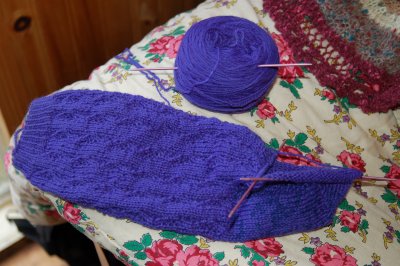
Although I've billed this as a knitting blog, there has been precious little knitting in 2006, other than small repair and redesign projects. However, I recently started a pair of socks in Browns Sheep Farms sport weight wool (not sure of the official name--it was a remnant from Appalachian Baby Design days.) The pattern is called "Little Wave" in Barbara G. Walker's Second Treasury of Knitting Designs. It's a six-stitch repeat that forms a sort of rib, with a traveling twist-stitch zig-zag on a garter-stitch ground. It makes very nice socks. In Walker's book, the pattern is given for back-and-forth knitting. I had to rewrite it for myself in circular knitting, so here's my revision, for those who may want to use it in four-needle socks.

R1: *Knit all stitches*
R2: *Knit 4, purl 2*
R3: *Knit 3, Left Twist, Knit 1*
R4: *Knit 3, Purl 1, Knit 1, Purl 1*
R5: *Knit 4, Left Twist*
R6: *Knit 3, Purl 2, Knit 1*
R7: *Knit all stitches*
R8: *Knit 3, Purl 2, Knit 1*
R9: *Knit 4, Right Twist*
R10: *Knit 3, Purl 1, Knit 1, Purl 1*
R11: *Knit 3, Right Twist, Knit 1*
R12: *Knit 4, purl 2*

Barbara Walker's Right Twist: Knit 2 together, leaving stitches on left-hand needle; insert right-hand needle from the front between the two stitches just knitted together, knit the first stitch again. Slip both stitches from the needle together.

Barbara Walker's Left Twist: Skip one stitch, knit into back of next stitch; then insert right-hand needle into backs of both stitches (skipped stitch and next stitch) and knit two together in back of stitches.

Thursday, December 21, 2006

Bigfoot Visits the Greenbrier

Last week, a friend told me about the Bigfoot Research Organization (BFRO) and their recent trip to Pocahontas County. BFRO says of itself:

As a result of the education and experience of its members and the quality of their efforts, the BFRO is widely considered as the most credible and respected investigative network involved in the study of this subject.
It seems these respected investigators had a Class 1A sighting of Bigfoot the middle of this past October. Although their West Virginia Expedition, Oct. 2006 Field Notes point out that "Bigfoot/sasquatch field research also bears a tricky responsibility...knowing which information to not release publicly, such as specific locations in sensitive areas, or any other information that could be used by people with violent intentions," their pictures and accounts show they camped in Watoga State Park, and hiked the Greenbrier River Trail, in our part of the county. In October, these parks are high traffic areas for leaf peepers and mountain bikers, and local folks (apparently including Bigfoot and family) like to get out and enjoy the pretty fall weather too. Although several of my neighbors practically live in the woods, winter and summer, without seeing anything more exotic than mountain lions, the BRFO party had no sooner stepped away from their camp site than they were assaulted by a band of rock-throwing Bigfoots (Bigfeet?).

On this expedition indicative sounds were heard each day within a five mile radius of the base camp. On Saturday night a group of thirteen (13) participants said they were approached and intimidated by 2-3 sasquatches on a trail along a tributary of the Greenbrier. The incident lasted 2 hours. During the encounter there was one brief Class A sighting by Patty Lee (NC-BFRO) when the headlamp of Olof Seaman (VA-BFRO) briefly illiminated a large sasquatch as he (Olof) moved along a trail back towards his group. Those who were present came away very excited (some were slightly traumatized) by the encounter. They were unanimously adamant that the sasquatches were trying to keep them "herded" together, by skillfully throwing large rocks in the paths of those who tried to separate and move away from the group. After two hours the activity ceased.
Peter, Paris and Neal Hammons

Now, rock-throwing primates are not in short supply locally, and word got around in the grapevine about BFRO's visit in advance. Perhaps Bigfoot overheard it in Hillsboro.

I would have advised any Bigfoot seekers to follow Burl Hammons advice and head to Fallen Timbers, at the head of the Cherry River where Pete and Paris Hammons, (pictured here) and their father, Jesse, encountered the Yayho. These men were born and raised in the woods in the mid-1800's, and lived by hunting. If they didn't know what some large animal was, it must have been a rare creature indeed.

Tuesday, December 05, 2006

Procrastination Is the Thief of Time

I've discovered that chemistry is a lot more interesting than I thought it was when I was taking courses in college, or when I was struggling to acquire lab skills ASAP in a series of different government research facilities. It makes all the difference in the world to have time to think about the subject. That is, once again, what I don't have enough of. And yet, I find myself putting off writing my lecture notes for Thursday night. Here are some suggestions for things to do instead of chemistry "homework."

  1. Search the Internet for useful and informative Web sites concerning chemistry. (See Monday, December 4 post)
  2. Write blog posts reminiscing about college days.
  3. Write lecture notes, homework, and exams for math and Information Technology classes. (The text for the math course is called "Math and Meds." How many times have you wished you had some meds to go with your math?)
  4. Notice that the kitchen is increasingly cleaner and more orderly. How is this happening? Could this be because those short breaks for tea and snacks are not so short after all?
  5. Make mental lists of sewing pattern alterations you'd like to try, socks you need to knit, recipes you need to write down.
  6. Blog about procrastination.

Monday, December 04, 2006

Let's Get Chemical

Today was the first day we had to turn up the wood stove and burn some serious firewood this season. While I was dreaming, last month, of curling up with The Education of Henry Adams, I have instead found myself writing lecture notes for the chemistry class I'm teaching. Now, I took three years of chemistry in college, and I worked in molecular genetics labs for ten or more years, but electron orbitals, redox, and radioactive isotope decay are things I've never had to explain to anyone else. That's a whole different level of intensity, and chemistry was never a favorite topic of mine. The text for the course seemed a little thin on some topics, so today I've been digging for links to fill in my memory gaps. Here's what I've found helpful:

  • General Chemistry Online from Fred Senese of the Chemistry Department of Frostburg State University. This is an attractive, fast-loading, very complete Web resource for chemistry students. This is the first place I'll be going for references.
  • ThinkQuest Library index for Chemistry has Web pages on many chemistry topics, suitable for high school and early college students. The quality is high on the topics I've read through so far, and I was amazed to discover that these are written by students as part of a project sponsored by Oracle Education Foundation's ThinkQuest.

    ThinkQuest inspires students to think, connect, create, and share. Students work in teams to build innovative and educational websites to share with the world. Along the way, they learn research, writing, teamwork, and technology skills and compete for exciting prizes. Sponsored by the Oracle Education Foundation, the competition offers a unique project-based learning experience to students and teachers across the globe. Everybody wins by having their completed websites published in the ThinkQuest Library, a rich online resource visited by millions monthly.

  • ChemTutor is a text-based reference, with very good information. I wasn't able to find out who is responsible for it, and I found that curious. Still, it's a good resource. It describes itself thus:
    Basic chemistry help is available here for high school or college students. Chemtutor begins with the fundamentals and gives expert help with the most difficult phases of understanding your first course in chemistry. Chemtutor is not necessarily a complete text for your course or a complete outline, but we are proud to offer some insightful help in the parts of primary chemistry that have been, from our experience, the hardest for students to grasp.
  • The Biology Project from the Department of Biochemistry and Molecular Biophysics, University of Arizona. This site includes tutorials for someone needing to review basic chemistry for the biological sciences. They are well-done, and short enough to avoid discouraging the chemo-phobe.
  • Curiosities Related to Chemistry from the Chemistry Teaching Resources, created by Knut Irgum and maintained by Svante Åberg at Umeå University, S-901 87 Umeå, Sweden. "This is an attempt to present a comprehensive list of chemistry teaching resources on the Internet." Sadly, quite a few of the links are dead, including the one I most wanted to revisit, that of some engineers at a Purdue University barbecue, lighting charcoal with liquid oxygen. Alas, it seems Perdue no longer wishes to display this early example of Internet viral video. (I first saw it about 11 years ago.) However, there are still links to alchemy, science jokes, and silly things students say to teachers. Lots of fun.

Friday, December 01, 2006

A Post a Day Keeps a Body In Motion

NaBloPoMo icon

I posted something to my weblog every day in the month of November. I hope this qualifies me to display some sort of emblem of accomplishment in my template, although our intrepid facilitator is still working on this. There is also a drawing for prizes for NaBloPoMo-ers, but I am afraid the prizes just drive home to me how old, unhip, and uncool I am. Ironic sock monkeys, gourmet dog treats, and free psychic readings via phone just don't hold a lot of attraction for me. I hope the people who win these prizes enjoy and appreciate them.

For my part, this exercise made me raise the priority of my personal writing projects. I was hoping it might free up some suppressed creativity, make me see my writing in a new light, or show me some previously unidentified topic that I want to write about. As far as I can tell now, it just got me posting every day, even when I didn't really have time, or a complete idea, or something worthwhile to say. I don't see any November posts about new, intriguing topics, or special insights into anything. Wait--I have three posts about internal combustion vehicles. I've never posted about things automotive before. What can this mean? Am I trying to get in touch with my inner grease monkey? Well, anyway, it's something new for me. And consider this: November is over, and I'm writing a new post. Perhaps a habit is born.

Because I was successful with this month-long commitment to a project, I have been thinking of trying it again. I have decided that, for the month of December, I will practice a tune a day (concertina, banjo, piano accordion, whatever feels right). While I have the technology to share this over the Web, I will refrain from doing so. (The definition of a gentleman is, after all, "A man who can play the accordion, but doesn't.") I might, if it seems the least bit interesting, list my December tunes in weekly blog entries.

Thursday, November 30, 2006

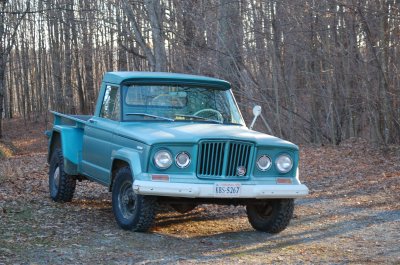
1966 Jeep Gladiator

1966 Jeep Gladiator

November seems to have been my month to write about classic vehicles. First Our New 1946 Ford Tractor, then the Hudson Super Wasp, and now this 1966 Jeep Gladiator, which came to visit us for Deer Season (the official holiday of West Virginia). This is in original condition, and had only 28,000 miles on it when our friend bought it from a little old lady who only took it to her hunting camp on Sundays. Isn't that color something?

Wednesday, November 29, 2006

Projectile Points

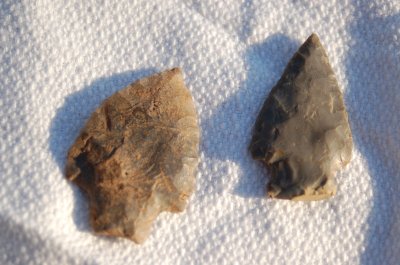
Projectile points from Droop Mountain and Caesar Mountain

The point on the left came out of our garden here five years ago, while the one on the right came from tilling a garden on Caesar Mountain about 30 years ago. They are both about two inches long. Both are still sharp enough to cut skin. (Don't even ask....) Someone who knows more than I do about such things tells me they are from the Archaic period, she guesses about 3000 years ago, and that they came from a flint quarry in what is now Greenbrier County. I haven't had too much luck finding out how these things (arrowheads? they seem very large for arrows) are classified through my local library, so I did some Internet poking about, and found these references.

Tuesday, November 28, 2006

Trilobite Hunting

My West Virginian trilobite

I collected this little trilobite alongside a road in the Eastern Panhandle of West Virginia in 1985. I wish I knew the locality but my field notes for that period of my life are quite sketchy. It was in the fall, and it was a cold, dreary day, but any details useful in finding the spot again are long lost. Check Paleoblog for an interesting sketch of trilobite hunting at the Earth's core. This is clearly a warmer climate than that I hunted in. If I were she, I would have put on my Daisy Mae outfit, for a less formal, more practical cartoon-lady look.

Monday, November 27, 2006

New Shirts on the Line

new shirts on the clothesline

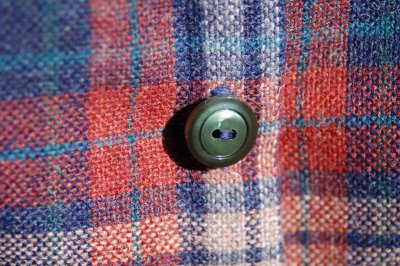
Here are the menswear shirts I've made in the last week. As three of them are relatively bold plaids, I tried some of the plaid-matching tips I accumulated earlier. The one that made the biggest difference for me was using a walking foot. I was able to avoid those annoying quarter-inch mismatches at the center fronts. I submit these nicely matched fronts, and their vintage buttons, for your inspection. This is probably the only time the shirts will be buttoned, as I usually wear them over a tee shirt or thin sweater, as a jacket. These were all recycled, flea market or otherwise salvaged fabrics.

center front button band center front button band on plaid jacket wool jacket, center front and button

Sunday, November 26, 2006

Waking Up Above the Fog

Foggy morning on Locust Creek, but clear on Droop

It often happens that the morning dawns bright and clear on top of Droop Mountain, but Hillsboro and the Little Levels District are shrouded in dense fog.

Saturday, November 25, 2006

Appalachian Origins, Revisited

For today's new insight into Appalachia, I need to thank Michael J. Ryan of Paleoblog for passing along a New Origin for the Appalachian Mountains. The original article is Acatlán Complex, southern Mexico: Record spanning the assembly and breakup of Pangea by R.D. Nance, et al. Geology 34:857-860 (2006). Dr. Ryan quotes from the press release:

According to the conventional map of 420 million years ago, two main land masses were separated by the Rheic Ocean. In the south sat Gondwana, a supercontinent consisting of South America, Africa, India, Australia and Antarctica. To the north was Laurussia, made up of North America, Greenland, Europe and part of Asia. The old map showed the Acátlan Complex attached to Laurussia. The complex broke off Gondwana about 80 million years earlier, drifted toward North America along with the other land masses, closing an older ocean, known as the Iapetus Ocean, as it did so. The collision created the Appalachian Mountains.

The new map looks rather different. Based on the new evidence the Acatlán Complex collision with Laurussia actually occurred about 120 million years later. The rocks once existed on an ancient ocean floor, but this ocean has proven to be the Rheic, not Iapetus as previously thought.

Same trilobites, different ocean.

Friday, November 24, 2006

Henry Adams on Southern Intellect

Blue bearded iris

In my on-going attempts to understand how people see Appalachia, and perhaps also the rural South, I give you this interesting excerpt from The Education of Henry Adams. It came to my attention as a quote in W.J. Cash's The Mind of the South. I include here a bit that came before Cash's quote, and a bit after, to show that Adams was not writing a meer screed against the Southern intellect, but finding fault with his own education. I hadn't read Adams' book since my undergraduate days ("Science and the Literary Imagination," Iowa State University, Winter term, 1977), and I'd forgotten what a strange, engaging book it is. Something else for the long winter evenings by the wood stove, perhaps.

Into this unusually dissolvent medium, chance insisted on enlarging Henry Adams's education by tossing a trio of Virginians as little fitted for it as Sioux Indians to a treadmill. By some further affinity, these three outsiders fell into relation with the Bostonians among whom Adams as a schoolboy belonged, and in the end with Adams himself, although they and he knew well how thin an edge of friendship separated them in 1856 from mortal enmity. One of the Virginians was the son of Colonel Robert E. Lee, of the Second United States Cavalry; the two others who seemed instinctively to form a staff for Lee, were town-Virginians from Petersburg. A fourth outsider came from Cincinnati and was half Kentuckian, N. L. Anderson, Longworth on the mother's side. For the first time Adams's education brought him in contact with new types and taught him their values. He saw the New England type measure itself with another, and he was part of the process.

Lee, known through life as "Roony," was a Virginian of the eighteenth century, much as Henry Adams was a Bostonian of the same age. Roony Lee had changed little from the type of his grandfather, Light Horse Harry. Tall, largely built, handsome, genial, with liberal Virginian openness towards all he liked, he had also the Virginian habit of command and took leadership as his natural habit. No one cared to contest it. None of the New Englanders wanted command. For a year, at least, Lee was the most popular and prominent young man in his class, but then seemed slowly to drop into the background. The habit of command was not enough, and the Virginian had little else. He was simple beyond analysis; so simple that even the simple New England student could not realize him. No one knew enough to know how ignorant he was; how childlike; how helpless before the relative complexity of a school. As an animal, the Southerner seemed to have every advantage, but even as an animal he steadily lost ground.

The lesson in education was vital to these young men, who who, within ten years, killed each other by scores in the act of testing their college conclusions. Strictly, the Southerner had no mind; he had temperament He was not a scholar; he had no intellectual training; he could not analyze an idea, and he could not even conceive of admitting two; but in life one could get along very well without ideas, if one had only the social instinct. Dozens of eminent statesmen were men of Lee's type, and maintained themselves well enough in the legislature, but college was a sharper test. The Virginian was weak in vice itself, though the Bostonian was hardly a master of crime. The habits of neither were good; both were apt to drink hard and to live low lives; but the Bostonian suffered less than the Virginian. Commonly the Bostonian could take some care of himself even in his worst stages, while the Virginian became quarrelsome and dangerous. When a Virginian had brooded a few days over an imaginary grief and substantial whiskey, none of his Northern friends could be sure that he might not be waiting, round the corner, with a knife or pistol, to revenge insult by the dry light of delirium tremens; and when things reached this condition, Lee had to exhaust his authority over his own staff. Lee was a gentleman of the old school, and, as every one knows, gentlemen of the old school drank almost as much as gentlemen of the new school; but this was not his trouble. He was sober even in the excessive violence of political feeling in those years; he kept his temper and his friends under control.

Adams liked the Virginians. No one was more obnoxious to them, by name and prejudice; yet their friendship was unbroken and even warm. At a moment when the immediate future posed no problem in education so vital as the relative energy and endurance of North and South, this momentary contact with Southern character was a sort of education for its own sake; but this was not all. No doubt the self-esteem of the Yankee, which tended naturally to self-distrust, was flattered by gaining the slow conviction that the Southerner, with his slave-owning limitations, was as little fit to succeed in the struggle of modern life as though he were still a maker of stone axes, living in caves, and hunting the bos primigenius, and that every quality in which he was strong, made him weaker; but Adams had begun to fear that even in this respect one eighteenth-century type might not differ deeply from another. Roony Lee had changed little from the Virginian of a century before; but Adams was himself a good deal nearer the type of his great-grandfather than to that of a railway superintendent. He was little more fit than the Virginians to deal with a future America which showed no fancy for the past. Already Northern society betrayed a preference for economists over diplomats or soldiers- one might even call it a jealousy- against which two eighteenth-century types had little chance to live, and which they had in common to fear.

Nothing short of this curious sympathy could have brought into close relations two young men so hostile as Roony Lee and Henry Adams, but the chief difference between them as collegians consisted only in their difference of scholarship: Lee was a total failure; Adams a partial one. Both failed, but Lee felt his failure more sensibly, so that he gladly seized the chance of escape by accepting a commission offered him by General Winfield Scott in the force then being organized against the Mormons. He asked Adams to write his letter of acceptance, which flattered Adams's vanity more than any Northern compliment could do, because, in days of violent political bitterness, it showed a certain amount of good temper. The diplomat felt his profession.

The Education of Henry Adams, Chapter 4, "Harvard College"

Thursday, November 23, 2006

Buckeggy?

White tailed deer, doe and fawn

I learned a new word this week: Buckeggy. I asked the people who used it how they would spell it, and, while no one had seen fit to write it until now, this was the consensus (although it might be hyphenated). It refers to what happens when an otherwise calm person sights a big buck while deer hunting, and gets too excited to aim and shoot. It affects kids and seasoned hunters alike. It seems to work like stage fright, and it has little to do with experience.

Happy Deer Season!

Wednesday, November 22, 2006

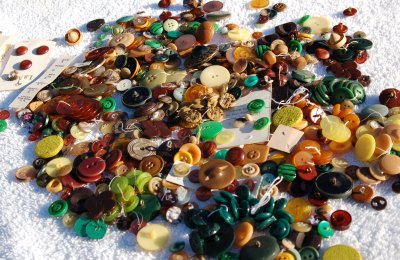
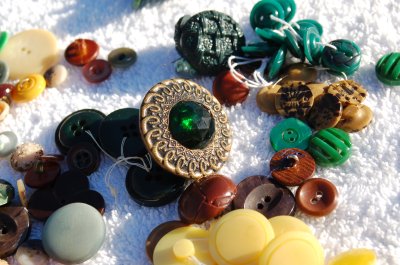
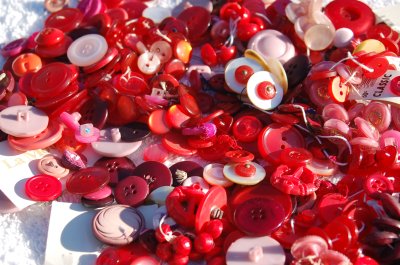
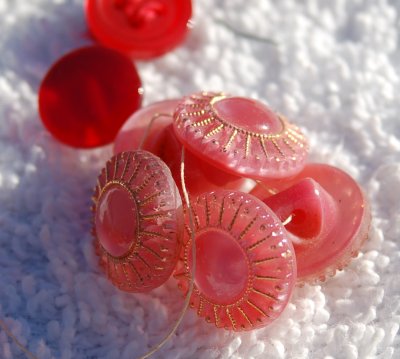
My Biography In Buttons

Buttons, brown, yellow, and green

I spent an hour yesterday going through my button supply, looking for shirt buttons. I keep most of them in plastic zip lock bags, sorted by color, and yesterday, out of curiosity, I weighed the bags on my old kitchen scale. The main collection weighs 12 pounds, and I have a jar of white shirt buttons I didn't bother to include in that total. It's a lucky thing I hoard sewing notions, as good buttons are hard to find these days.

An antique button

The core of my button stash is inherited from my mom, who taught me to sew. I remember her running the Singer Featherweight at the kitchen table, pausing to showing me how to use a needle and thread on flannel shirt scraps. There's probably a law against giving preschoolers needles now, but I was hooked on textiles early. Most of the buttons are salvaged from worn-out clothes or left over from previous sewing projects. My mother pointed out some that came from her grandmother's dresses, and more from her own mother's wardrobe. (Someday I'll show you a few of the cotton scraps for quilts, spanning the 1890's to 1990's. The hoarding of sewing notions runs deep in my family.)

Part of the red button collection

Mom died ten years ago last month. She suffered dementia her last year, but even after she couldn't recognize people or speak, she would still reach out to visitors, and touch the buttons on their coats.

1950's era pink plastic buttons

Tuesday, November 21, 2006

My Persistent Assistant

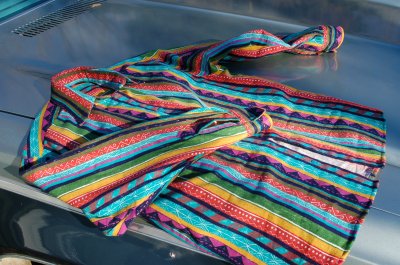
Flannel menswear shirt, on the hood of the El Camino

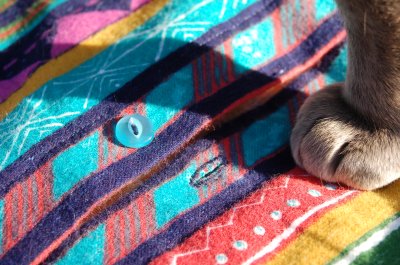
Here's the flannel shirt I started yesterday, displayed on the hood of my '77 El Camino. This is some flannel I bought several years ago in a junk shop where we were looking for tools. Washed and sewn, it looks better than I expected, especially considering its $2 price tag. I was especially pleased to find a nice color match in my vintage button collection.

Flannel shirt, button detail with paw

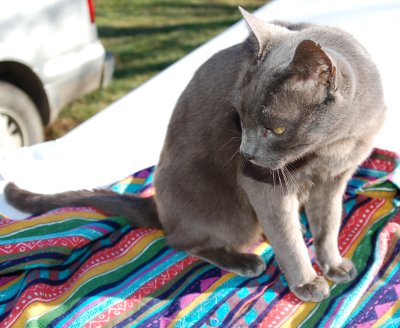
Of course, grey paws go well with any ensemble.

Flannel shirt, with grey cat

Monday, November 20, 2006

A Return to Textiles

KwikSew Men's Shirt Pattern

For the first time since early August, I've done some sewing. All my fiber arts web-rings notwithstanding, there hasn't been much textile activity on my weblog. I dyed some socks purple, I spun some burdock-laden fleece, but that's about it. No knit hats or velvet scarves for the local craft shop, no socks or mittens or new cardies for me.

Book Cover: Shirtmaking

Today, I sewed myself a flannel shirt. The summer before last, I immersed myself in shirtmaking, trying nifty techniques from David Page Coffin's Shirtmaking: Developing Skills for Fine Sewing. I tried all sorts of patterns, and made shirts for men and for women. I was pleased to find I remembered the techniques I wanted to use, in that "motor-memory" way.

Although the shirt is for me, I used Kwik-Sew pattern 2777, a men's oxford shirt. I skipped the front buttonband, because this is where my shirts show wear first, and I made different cuff plackets, from the pattern in the Coffin book. I think they make a tidier finish. I've tried many women's shirt patterns, and made scads of different alterations in the search for a perfect fit, but when it comes to a flannel shirt, I've gotten my favorite fit by simply sewing up a men's shirt with no fitting alterations at all. I'm not sure why. There seems to be a mystery involved in the fit of a shirt yoke.

Sunday, November 19, 2006

Calico Relish, For Cucumbers or Zucchini

To my surprise, my recipe posts have been getting visits and comments. This a favorite sweet pickle relish. It's good on hotdogs, and in potato salad and cold meat salads, such as ham, venison, and roast beef. It's easy and reliable, unlike many pickle recipes.

CALICO RELISH

4 c. ground onion
10 c. ground zucchini or cucumbers
5 tbsp. salt
2 1/4 c. vinegar
1 tbsp. nutmeg
1 tbsp. allspice
4 c. sugar
1 tbsp. cornstarch
2 tsp. celery seed
1/2 tsp. black pepper
1 tbsp. dry mustard
1 tbsp. turmeric
1 c. hot banana peppers, chopped
   (or about 2 tbsp. crushed dried red pepper)

Combine onions, zucchini and salt. Let stand overnight. 
Drain and rinse in cold water, then drain again. Place in 
large kettle, and add remaining ingredients. Bring to a 
boil; cook for thirty minutes. Place in hot sterilized 
jars; place sterilized lids and bands on jars, screwing 
bands tight. Makes about 5 pints.

I usually make a double batch, and waterbath can for 
15 minutes, so that the jars seal more reliably. The 
hot peppers and the allspice were my addition to the 
original, which came from "Favorite Recipes of Home 
Economics Teachers" (1975).

Saturday, November 18, 2006

Caesar Mountain and Viney Mountain

Our house from the new addition to the place

This week I found something interesting in Pocahontas Times' "Fifty Years Ago" feature which quotes from editor Cal Price. In 1956, Price wrote about a bit of history which I'd heard about often, but for which I had no reference. Because the "Pocahontas Times News Archives is now Paid Access only," I will quote the article at length.

An Old Timer

In a law suit at the October term of the Circuit Court reference was made to the Massenbird land lines. So, the question, what about such land lines on Droop Mountain, anyway?

Well, around the year 1839, a man named George Massenbird died at his home on Droop Mountain. He was a native of England, and had lived here for a good many years. He owned Caesar Mountain and Vina Mountain, and other land. The tradition is that these mountains were given to and named for two Massenbirds slaves-Caesar and Vina Freeman.

However a casual search of the records shows only one transaction. This is a deed from John and Jane Blair to George Massenbird for 250 acres. The date is August 29, 1829, and the consideration is $120.

In the year 1842, there is a Court record of the appraisement of property left by the late George Massenbird. No mention is made of real estate. The appraisement of personal items amounts to $19.62. 1/2. However, bonds payable in dollars were appraised at about $2600. There was in addition a bond appraised at 500 English pounds sterling. This was due from the estate of one of George Breckenburg, of Skendleby, England.

The personal items, appraised at $19.62 1/2 brought $12.71 1/4 at the sale. Here are the purchasers and items:

  • Nancy Ware bought two bunches of newspapers at 3 1/2 cents and 2 1/2 cents; wearing apparel at $1.34.
  • Sarah Freeman two lots of newspapers at 7 1/4 cents.
  • John Hill, 6 numbers of Methodist magazines, 16 cents; Watson's Wesley 34 cents.
  • Walton McClung, 7 numbers of Methodist magazines, 20 cents.
  • Thomas Casebolt, 8 numbers of Methodist magazines; 21 cents; one slate, 26 cents.
  • James Keener, Doctor Clark's sermons, $1.75.
  • Thomas Hill, Doctor Clark's Life, 38 cents; Doctor Clark's Commentary, $8.

George Massenbird was a native of England. Further than that, there is meager tradition of him, other than he lived the life of a country gentleman and at the end he gave freedom and land to his servants.

Caesar Mountain and Viney Mountain are ridges connected to Droop Mountain.

Friday, November 17, 2006

Pocahontas County Links

My original goal for my Website and for this weblog was to provide a counterbalance to the commercial view of Pocahontas County exemplified by The Pocahontas County Convention and Visitors Bureau (PCCVB) and Snowshoe Mountain Resort. I've assembled Pocahontas County link collections before, but I've never been satisfied with them. However, in the spirit of NaBloPoMo, I'm working with a deadline, and am therefore less fussy.

Here are some informative links about the county, mostly the work of people who live here. They are not slick, but they give a truer picture of the place than sites for tourists.

Thursday, November 16, 2006

Spiders, Past and Present

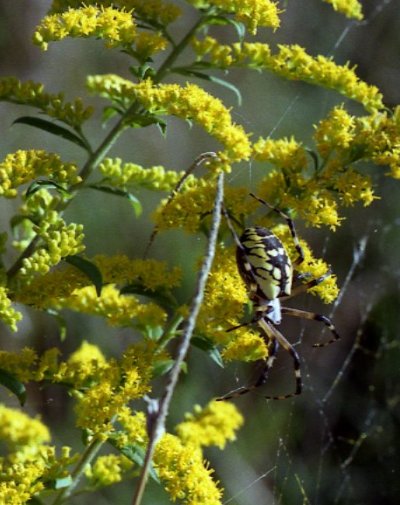
Orb weaving spider on goldenrod

I came across this on Slashdot the other day: "Build a Web spider on Linux: A simple spider and scraper collects Internet content." After reading through, I thought, "Wow! I could do that!" It's now on my (excessively long and ambitious) list of "Do It Yourself" projects. I was surprised to find that IBM's Web site includes developerWorks: IBM's resource for developers, and that this includes interesting how-to's and projects for a hobby-hacker such as myself. I was particularly interested in Web development: Resources for Web 2.0, Ajax, wikis, PHP, mashups, and other Web projects." It's quite a change from my mental picture of "Big Blue" as a bloated, arrogant presence sucking the blood out of small businesses and individual computer users. (Based on my experiences in the 1980's and early 1990's.) Thanks, IBM!

Orb weaving spider on goldenrod

Wednesday, November 15, 2006

Claude Levi-Strauss in the Fifth Grade

St. John's Wort flower

Just because I've been working in elementary and middle schools doesn't mean I haven't been expanding my cultural horizons. A few weeks ago, a professional dance company visited Marlinton Middle School. I was working with special needs fifth graders in their classroom, so I went to the gym with them to continue my mentoring. (It usually went like this: "Sit down!" "Pay attention!" "Sit down! Please!") The dancers had an interesting, age-appropriate program, and the kids were fascinated, if puzzled.

In homage to Brazil, the company presented a short dance called "Black Beans and White Rice." I expected some snappy Brazilian music to accompany a visual interpretation of Arroz com Feijao (Rice with Beans). It was much stranger than that. The dancers were accompanied by a recording of a lady reading an essay about Claude Lévi-Strauss and The Raw and the Cooked: Introduction to a Science of Mythology. It wasn't a rhythmic reading of poetry, it didn't feature dance-able background music. A lady (with a standard college-lecturer speaking style) read a long essay discussing the national dish of Brazil in a structuralist context.

I can't really tell you how the dance went. The kids enjoyed it, but I was distracted by a flashback to the 70's when, as a college senior, I took a graduate seminar in linguistic anthropology. We read The Raw and the Cooked: Introduction to a Science of Mythology by Claude Lévi-Strauss, along with some Piaget, some Chomsky....I was completely baffled. I read the texts, and diligently tried to understand them, but the class discussion featured a lot of terminology along the lines of this course description: Claude Levi-Strauss: The Structural Study of Myth. I had the feeling that the professor and the graduate students were talking in some sort of code. I couldn't even figure out how to ask them questions.

Subsequently, I've had this experience many times. Most often, the code-talkers are trying to make their area of expertise seem more complex and important than it actually is. Web 2.0 and education theory are two topics that have a considerable literature in this style, but there are offenders in every discipline. Looking back, I doubt the anthropologists were trying to exclude me. The students were practicing their fluency in technical jargon of their field, a skill every graduate student must acquire. If I had been less shy, and had asked stupid, clueless questions, I think they would have tried to help.

Food, however, is a universally-intelligible language. Here are some attempts to elucidate the structure of feijão.