Showing posts with label garden. Show all posts

Tuesday, June 19, 2012

How the Camera Got Knocked Down


We went to the first annual Highland County Old Time Fiddlers' Convention last weekend, and left our cherry trees unattended. When we got home, we found the trail camera dangling upside down from its tree. Fortunately, we were able to reconstruct what happened. Bear sees camera....


Bear investigates camera....


Camera gets a tree bark closeup.


This bear visited earlier, but caught wind of the ripe cherries instead of the digital camera.

Wednesday, March 21, 2012

Early Lettuce--Cute Cotyledons


I planted a little patch of lettuce in early February. Most years, such early plantings are unsuccessful--they sprout and freeze, or get washed away in heavy rain, or they mold. This year, the rain did wash all the seed into low spots, but it looks like I might get a bit of early lettuce. It needs thinning, as soon as the plants are big enough to grab hold of.

Saturday, February 04, 2012

The Early Grasshopper Catches the Radish

Garden seeds came in the mail today, and, because the ground is bare and workable, I raked some damp soil loose and planted beets and radishes. That's where I found this guy.

This is shockingly early for little grasshoppers here. He was not only hatched and growing, but warm-blooded, quick, and hard to photograph. I foresee a good year for garden pests (but not for gardeners).


Sunday, January 29, 2012

An End to Peaches


The Tree Year 2011 was a sadly inauspicious year for trees on our ridge. The stag-horn sumac trees did not fare well in the summer, and this happened in the spring. This poor peach tree has been struggling for years, but every once in a while it would produce a small crop of flavorful (gnarly-looking) fruit. This spring, the wind took it down. I'm saving the last freezer-bag of peach pie filling for a special occasion.


Friday, January 27, 2012

New USDA Plant Hardiness Zone Map


This week the USDA Agricultural Research Service released its new Plant Hardiness Zone Map. Strangely, I discovered this, not through the agriculture and gardening sites I follow, but through Mother Jones magazine's Blue Marble Blog. Julia Whitty points out:

The new map is interactive, which is cool, and based on a much finer data scale than the old one, which is great. And guess what. It shows that things are getting warmer. The USDA managed to pretty much bury that fact in Bureaucratese in their press release...Compared to the 1990 version, zone boundaries in this edition of the map have shifted in many areas. The new map is generally one 5-degree Fahrenheit half-zone warmer than the previous map throughout much of the United States. This is mostly a result of using temperature data from a longer and more recent time period; the new map uses data measured at weather stations during the 30-year period 1976-2005. In contrast, the 1990 map was based on temperature data from only a 13-year period of 1974-1986.

The interactive USDA Plant Hardiness Zone Map lets you select a state and "zoom in" to see surprisingly fine-grained detail. I've already zoomed in on every place I've ever tried to garden.

Tuesday, February 22, 2011

Sprouting Onion Seeds

I've never sprouted onion seeds before, and I didn't expect them to be so curly and cute. I hope these will give us better success than we've had with onion sets here. The garden catalog called this variety "Walla Walla," and promised they'd do great things.

Friday, January 01, 2010

A Garden of New Year's Wishes

A little iambic pentameter for the New Year:

May the New Year be like a garden fair
With flowers of joy, and free from weeds of care;
Good fortune, as the smiling sun to bless
Your every effort with complete success.

This card was sent to Florence Williamson at her parents' home near Williamson, Iowa in honor of the 1910 New Year, postmarked Snyder, Oklahoma, Dec. 23, 1909. The message says Hello, Florence! Here is wishing you a Merry Xmas and Happy New Year. We are having zero weather with snow for several days. We are all well & hope this will find you all the same. With love and best wishes, 1909, Theresa Wiginton, Snyder, Okla.

Monday, October 12, 2009

Purple Peppers

Our garden had mixed success this year, but one crop I was very pleased with was the Black Hungarian Peppers I ordered from Seed Savers Exchange. I've tried several times to start peppers from seed, but this is the first year I had anything to harvest. The peppers start out a dark, eggplant shade, but turn red when they're ripe.

They're good-flavored mildly hot peppers, but the thing I liked best about them was the way the plants looked as they were growing. The seedlings are nearly black (leaves and all; sorry I didn't think to take a picture last spring!), and the even the blossoms have that purple pigment.

Check out those black anthers!

Sunday, March 22, 2009

Impatient for the Growing Season

Most springs, the daffodils surprise me, but this year, I've been waiting for them.

The potatoes in the kitchen are also anxious to get the garden started.

Wednesday, January 14, 2009

Seed Catalog Fantasies

As the weather gets really really cold, I'm daydreaming about starting this year's garden. The Internet makes this a particularly hazardous exercise, because I am not limited by the garden catalogs which come in the mail. I can covet plants from all over the world. Seed Savers Exchange is a particular favorite for these fantasies.

An old-time variety potato sampler--20 pounds representing eight varieties for $67.50. Ah, if only the weather and the tater bugs were not such unforgiving variables!

Butterfly weed--I really love milkweeds, but with house building, the "landscaping" is not ready for store bought perennials.

Prickly Caterpillars--I'd love to grow these, but I'm not sure what they're for. Seed Savers says "Low-growing plants make a nice ground cover and are sure to be the best conversation piece in your garden. In days past, caterpillars were added to salads to surprise unexpected diners, but not meant to be eaten, mostly because they are so hairy. Try growing in containers, if space is tight. Great historic novelty that should be grown in every garden."

Sunday, October 05, 2008

More Messages From the Kingdom of Vegetables

I picked the last cabbage from our garden for cole slaw last week. These red cabbages made small but tasty heads. It was the vivid color that sent me outside in mid-chop to take some pictures.

There's something a little hypnotic about the sliced cabbage pattern. My parrots are very fond of cabbage, but they were afraid of the red cabbage cores--they wouldn't even go in their cages until I removed the scary vegetables. What do you suppose the cabbage told the parrots?

Saturday, October 04, 2008

Famous Wolf River Apples

Ever since I moved to Pocahontas County, people have been telling me about the old-time apple variety "Wolf River." This was once a popular variety, but most trees have died out. Apple fans say of them, "One apple, one pie." Last week, a neighbor brought us some Wolf River apples--the three red ones in the picture. The green apple is a normal-sized variety. I've been assured that these are smallish specimens. I really like the color and texture of the skin. I'll be cutting into these today, but I had to catch a picture of them first.

Tuesday, September 02, 2008

Sunflowers

This spring's cool, wet weather caused many of our garden seeds to rot in the ground. We replanted, but had some space left over. These sunflowers grew from the contents of our bird feeder.

Saturday, August 30, 2008

Lycopersicomancy

Lycopersicomancy: Divination through tomatoes. It stands to reason that someone who tries to read messages in Tater Bug markings and mouse scratchings would stop and look at this tomato and wonder what it means.

This year, I tried an old-time tomato variety called "Cherokee Purple." We've been very pleased with the tomatoes, which are dark red with green shoulders. The only thing is, most of the plants produce double, triple, and I-don't-know-how-many fused tomatoes, growing in strange spirals.

A local character is supposed to have remarked, at the sight of something strange, "It's a sign. I don't know what it means, but it's a sign." That's the way I feel about these tomatoes. On one hand, perhaps they have predicted correctly a good tomato yield--blight-free, insect resistant plants and firm, juicy, dark-fleshed tomatoes--delicious fresh and excellent in sauces. On the other hand, they might foretell the End Times.

Whatever the message, I had to make up the term Lycopersicomancy. The Romans had no tomatoes, not for salads, sauces, or augury. It wasn't until long after Latin dropped out of daily use that Europeans named these American fruits lycopersicum, which means "wolf peach." When I checked spelling on the scientific name at the USDA Plants Database, I was surprised to discover that we're back to Linnaeus's name, Solanum lycopersicum L. Botany Photo of the Day explains (with taxonomic references):

The scientific name for the tomato in general use for over two hundred years was Lycopersicon esculentum. However, molecular studies in the past fifteen or so years have helped to shift the name back to the one originally assigned by Linnaeus, Solanum lycopersicon.

Wednesday, July 09, 2008

The Shape Of Peaches To Come

We're still picking cherries, but my eye is wandering to other fruit trees in the yard. These peaches are tiny but delicious, provided they remain on the tree until they ripen in the fall.

Monday, June 30, 2008

A Big Year For Cherries

Our cherry trees are having a big year. In the nine summers we've lived here, this has only happened once before, in 2006. That year was notable for the very large bear who dropped by daily to satisfy his sweet tooth. We may have managed to scare him off with loud noises, or perhaps he only switched to the night shift and left when the cherries ran out.

If you're wondering where I am, I'm probably pitting cherries. These are small, sour, white-fleshed cherries, ideal for pies and jelly, too small for the cherry pitter, too delicious to leave entirely to the varmints. I'll be on the porch, watching the birds (cedar waxwings and scarlet tanagers as well as the usual robins and woodpeckers) consume the unreachable cherries. Perhaps this year's sunflower seed aficionado will come back for some desert.

Sunday, June 29, 2008

Tater Blossom

Potatoes bloom often enough, but this year's planting of Kennebecs is sending up large, handsome flower stalks. If only more of them had come up....

Sunday, April 13, 2008

Tomato Review and Prospectus

My tomato seeds have sprouted, and have joined the broccoli and red cabbage seedlings on the windowsill. This year, I tried two varieties that have done well for me in the past, and two new ones.

Of all the tomatoes I grew last year, the only ones that did well for me were the Amish Paste from Seed Savers' Exchange. Here's their photograph and description:

Amish Paste Tomato
Amish Paste Tomato. Heirloom discovered in Wisconsin. Produces 6-8 oz. red fruits that are oxheart to almost teardrop-shaped. Meaty fruits are juicy and have really outstanding flavor. Good for sauce or fresh eating. Indeterminate, 85 days from transplant.

Here's what happened in our garden:
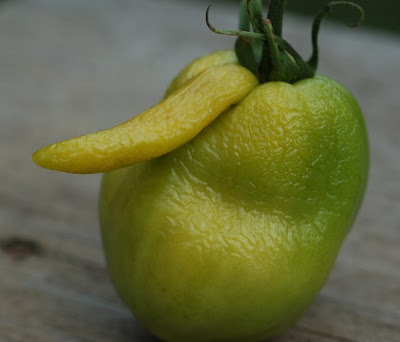
Amish paste tomato with extraneous appendage

The disquieting distortions of these tomatoes, combined with the poor growing season, discouraged me from saving the seeds. (I did, however, can 40 quarts of salsas and sauces. They tasted fine.) I ordered a new packet of these tomatoes this year. The other heirloom varieties I tried, Hillbilly and Spitze, didn't seem worth another try. The Hillbilly is a "potato-leaf variety." The tater bugs confirmed for me that the leaves resemble potato plants chemically as well as visually, and there was significant leaf damage on some plants. The Hillbillies were fairly productive, but the flavor wasn't great. This was probably due to the weather, but I decided to try something different this year. The Spitzes grew lush, beautiful vines, but they didn't produce many tomatoes, and they were the only variety to blight last year. This is just not the right tomato for Droop Mountain.

I started a packet of Brandywine Tomatoes. I've had reasonably good luck with these in the past, but I didn't have any seed left after last year.

(Sudduth's Strain) Brandywine first appeared in the 1889 catalog of Johnson & Stokes of Philadelphia and by 1902 was also offered by four additional seed companies, but soon disappeared from all commercial catalogs. Our best selling tomato and one of the best tasting tomatoes available to gardeners today. The seed of this strain was obtained by tomato collector Ben Quisenberry of Big Tomato Gardens in 1980 from Dorris Sudduth Hill whose family grew them for 80 years. Large pink beefsteak fruits to 2 pounds. Incredibly rich, delightfully intense tomato flavor. Indeterminate, 90 days from transplant.

My experiments this year will be a short season variety, Bloody Butcher, and Cherokee Purple, a variety that just sounded interesting.

Bloody Butcher Very early and high yielding variety. Great full tomato flavor and exceptional dark red color. Fruits are borne in clusters and average 4 oz. Indeterminate, 65-70 days from transplant.

Cherokee Purple Introduced to other SSE members by North Carolina member Craig LeHoullier in 1991, seed obtained from J. D. Green. Unique dusty rose color. Flavor rivals Brandywine, extremely sweet. Productive plants produce large crops of 12 oz. fruits. Indeterminate, 80 days from transplant.

Friday, April 11, 2008

Instant Gardening Gratification

The broccoli seeds I planted Tuesday had already sprouted yesterday morning. I used to get very frustrated by the process of starting seeds indoors. Most of the houses I've lived in have been cold and drafty in winter, and I've been more likely to see mold growing on top of the soil than the desired seedlings.

All that changed when we got a big dehydrator for our shitake mushrooms. I set the dehydrator for 85 degrees (F) and within 48 hours the cabbage and broccoli germinate. The tomatoes generally take a day or two longer.

This morning I found a few tiny sprouts there too. I've moved the cole crops to a window sill. The tomatoes will probably benefit from another warm day in the dehydrator, but they'll have to come out of the dark by tomorrow, too. In previous years, I've kept the seedlings in the dehydrator with a grow-light, but the extra heat doesn't seem to speed their growth, just their germination.

Aren't the root hairs wonderful?

Thursday, April 10, 2008

Remembering Cabbages Past

The warm weather and the school vacation have given me the chance I needed to start seeds for our garden. Last year, I ordered heirloom garden varieties from Seed Savers Exchange. I like to save my own garden seeds from year to year, and I looked forward to sampling some of the interesting vegetables I saw on their beautifully-illustrated Web site.

Unfortunately, a cold wet spring gave way to a hot, dry summer last year. It's a good thing we don't depend on what we grow as our sole food supply, or we would have starved out. I grew enough beans to save as seed, but the broccoli bolted, the cabbage was puny and so bitter we couldn't eat it, and the tomatoes did truly bizarre things.

Hope once again triumphs over experience, and this year, I ordered more Seed Savers' seeds. I started these handsome cole crops:

Calabrese Broccoli. Brought to America by Italian immigrants in the 1880s. Popular market variety. Tight heads can grow up to 8" in diameter. After the central head is harvested, side shoots follow. 58-90 days from transplant.

I grew this broccoli last year, and it was quite good, although most of the plants dried up and didn't make heads. Between the Tarnished Plant Bugs, cabbage butterflies, and Harlequin Bugs, there wasn't all that much left for us.

Harlequin bug, adult

Year after year, I've bought cabbage plants at the local stores. Sometimes the cabbage turns out to be brussel sprouts, sometimes it's just some odd-ball variety I wasn't looking for. The last few years, I haven't even been able to find cabbage seed for the varieties that do well for us. That's why I have high hopes for these lovely plants:

Mammoth Red Rock Cabbage. Introduced in 1889. Solid round heads are 8" in diameter and weigh 7 pounds. Red throughout, vigorous and uniform, small to medium core, sure cropper, fine flavor. Excellent for cooking, salads and pickling. 98 days from transplant.