Wednesday, October 19, 2005

Haunted Pocahontas County: Denmar

Autumn clouds over Locust Creek

Another Pocahontas locality recorded as "haunted" is the old Denmar State Hospital. A lot of the older people here on Droop Mountain and Caesar Mountain worked there at one time or another. It is just a short distance away, on the Greenbrier River. I've heard stories about places in the hospital where no one wanted to go alone. One floor in particular made people uncomfortable, and there are stories of inexplicable voices and footsteps. The structure is now a prison. I visited there once, and found the bars slamming shut behind me disturbing enough to drive away thoughts of paranormal phenomena. Here's the WVghosts.com report:

West Virginia Colored Tuberculosis Sanitarium, Denmar
Nearly 1000 African-American women and men spent their last days suffering with Tuberculosis at this isolated location in Pocahontas County and nearly 300 of them are permanently laid to rest here. This is a very isolated and active paranormal location. In the mid 1990's the location was renovated and turned into a correctional facility and is not available for the public to visit.

There's another, more informative article about the Colored Tuberculosis Sanitarium. (No discussion of ghosts is included.)

Deaths at the West Virginia Colored Tuberculosis Sanitarium at Denmar. West Virginia History Volume 56 (1997), pp. 88-121.
The West Virginia Legislature created the State Colored Tuberculosis Sanitarium in 1917. The Maryland Lumber Company sold 185 acres of land and numerous buildings in Denmar, Pocahontas County, to the West Virginia Board of Control. According to the 1918 West Virginia Legislative Hand Book, black tuberculosis patients, who were West Virginia residents, were eligible for admission to the sanitarium provided they could pay for their care. The Hand Book noted: "The reasonable expenses of poor persons admitted at the request of the authorities of any municipal corporation or county, shall be paid by such municipal corporation or county." The sanitarium admitted its first patients on January 31, 1919.

Monday, October 17, 2005

The Much-Cited Greenbrier Ghost

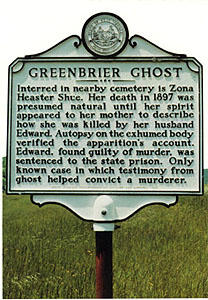
A state highway marker west of Lewisburg (in nearby Greenbrier County) commemorates the "only known case in which testimony from [a] ghost helped convict a murderer....Interred in a nearby cemetery is Zona Heaster Shue. Her death in 1897 was presumed natural until her spirit appeared to her mother to describe how she was killed by her husband Edward. Autopsy on the exhumed body verified the apparition's account. Edward, found guilty of murder, was sentenced to state prison." Katie Letcher Lyle, who wrote this article is also the author of Man Who Wanted Seven Wives: The Greenbrier Ghost and the Famous Murder Mystery of 1897. Ms. Lyle used contemporary sources to check facts, and points out that, road signs not withstanding, the testimony concerning the ghost was introduced by the defense in an attempt to make the prosecution's case look foolish.

Book Cover: The Man Who Wanted Seven WivesBook Cover: The Man Who Wanted Seven Wives

What makes this a Pocahontas County story is the provenance of Trout Shue, incorrectly identified as "Edward" on the highway marker. Mr. Shue's parents lived on Droop Mountain, and Trout lived there with his second wife, Lucy, who died suddenly after eight months of marriage. Trout later moved to Greenbrier County and married Zona Heaster, who also died suddenly a few months after her marriage. The present day Shues who live on Droop are Trout's relatives, and the story is well-known here and in Greenbrier County.

Book Cover: Greenbrier Ghost

Another Web version of this story is available from Applit as part of a children's writing exercise. It's taken from another book about the case, The Greenbrier Ghost by Dennis Deitz (1990).

Sunday, October 16, 2005

Haunted Pocahontas County

Since I moved to Pocahontas County I've heard quite a few ghost stories. The storytellers have a variety of attitudes about their narratives. Some of them think they're amusing anecdotes about rural superstition, some of them think they are judgements from God Almighty, but most of them are like me. They aren't sure what to make of it. It could be hallucinations, it could be spirits of the dead, it could be some sort of cosmic trick. I have formed no hypothesis, scientific, philosophical, or religious, to explain these phenomena, but I have experienced a couple of ghostly apparitions myself. I remain puzzled, and therefore, I remain interested, hoping, I suppose, to find an answer.

That's how it happens that I keep a collection of local ghost stories. With Halloween coming up, I thought a little series of "Poca-HAUNT-as" County anecdotes might be appropriate. From the Marlinton Gargoyle to the Droop Mountain Battlefield to the Greenbrier Ghost, the stories center around Droop Mountain and the Greenbrier River. I don't know whether this reflects my sampling base of operations (I live on Droop, not far from the river) or whether the Civil War battlefield represents some sort of "psychic epicenter."

Book Cover: Last SleepThe Droop Mountain Battlefield has so many ghost stories associated with it that Terry Lowry, in his 1996 book Last Sleep: The Battle of Droop Mountain November 6, 1863 devotes the final chapter to "The Ghosts of Droop Mountain." He offers this explanation:

While it is fairly common for ghost stories to arise out of Civil War sites, Droop Mountain probably ranks near, or even at the top, of such areas to spawn wild-eyed stories of ghosts, apparitions, headless soldiers, illusions, and the like. Due primarily to its somewhat isolated, rural location, Droop Mountain battlefield has been the scene of many unexplained happenings since the Civil War battle that took place there in 1863. This is not unusual, considering fog "often rolls over the mountain in waves, there one minute, gone the next," creating an eerie atmosphere conducive to tales of ghosts and the supernatural.

Friday, October 14, 2005

Phoresis

Pipevine Swallowtail larva

Phoresis. That's what this caterpillar was experiencing as I photographed him. I found him tearing across my porch at top speed, and nudged him onto my finger and then on to the pear tree for a short photo session. He was in a hurry. When these large caterpillars are about to pupate, they become restless, leave the plants where they've been feeding and start looking for a safe place to dissolve into a morphogenic soup and reassemble into a winged creature. Phoresis is movement from place to place, as in electrophoresis (where molecules migrate differentially through a gel in response to electrical current).

I was particularly pleased to see this fellow, because he answered a question that's been on my mind since I moved here: Are those irridescent butterflies I see so often Pipevine Swallowtails or Spicebush Swallowtails? I haven't been able to find either Aristolochia or spicebush anywhere around here, but the butterflies are abundant. The caterpillars of the two species are nothing alike, and this fellow is definitely a Pipevine Swallowtail. That's Battus philenor, (Linnaeus) as near as I can tell. (I got it off the Internet, not from an authoratative text.) While trying to figure out the correct genus name (My old books here at the house use Papilio.), I found these interesting Web sites.

Addendum: After I posted this, I saw that Fred of Fragments from Floyd had posted his own swallowtail larva photo. His caterpillar sat tight. Evidently it was done with phoresis.

Thursday, October 13, 2005

In the Garden

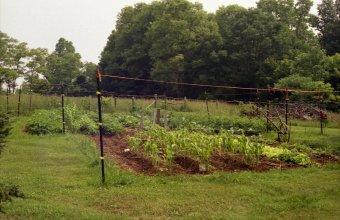
We've started mowing off the garden. It's hard to believe the weedy, rotting mess we're working on now was this well-groomed patch of hopes and dreams back in July. I took photos because this was the best-tended, best-weeded garden I'd ever been a party to.

I've been thinking about how words mean different things to different people. This fenced-in vegetable patch comes to mind of when I hear the word "garden." In England, the thing people call the "garden" is all the cultivated ground surrounding a house. I was continually confusing people there by praising their beautiful backyards. (I wonder what that conjured up for them.)

As a child, I was fascinated by the hymn "In the Garden." I assume, now, that the author pictured, and meant us all to picture, an English-style garden. I called the thing pictured above a garden. I knew the roses mentioned in the hymn must have been in a nearby flower bed.

I come to the garden alone,
While the dew is still on the roses;
And the voice I hear,
Falling on my ear,
The Son of God discloses.

And He walks with me, and He talks with me,
And He tells me I am his own,
And the joy we share as we tarry there,
None other has ever known.

I imagined Jesus getting soft garden dirt in his sandals as he carefully stepped over the row of beans, the row of tomatoes, into the cucumber patch....Everybody likes a nice garden, and the Lord would surely not step on good produce.

Tuesday, October 11, 2005

More Tony Hillerman

Book Cover: Skeleton Man

I just finished Tony Hillerman's Skeleton Man (Joe Leaphorn/Jim Chee Novels) 2004. I am now up to date on my Hillerman reading. (I wrote about The Sinister Pig September 13. Now that we're all very well acquainted with the cast of characters, Hillerman is keeping our interest in the plot by bringing in new territories, and interesting facts about the Southwest. In this case, the new territory is the Grand Canyon, and the interesting true story is the June, 1956 airliner collision over the canyon, which "triggered the creation of the Federal Aviation Administration and its flight safety rules." As always, the mystery is artfully plotted, and the characterizations are succinct but adequate. His craftmanship is unsurpassed.

Saturday, October 08, 2005

History of Textile Arts in Pocahontas County, Episode 2

Here's the reference to the things Carie Stulting, Pocahontas County fiber artist, knitted for her family. I had thought it was in The Exile, by Pearl S. Buck, the source I quoted earlier this week. Instead, it is from Fighting Angel: Portrait of a Soul by Pearl S. Buck. (p. 138)

Carie knitted our stockings and sweaters and little cuffs she called wristlets.

That's so brief, I feel the need to include the knitting missionary ladies, although it has nothing to do with Pocahontas County. Speaking about the old-school Presbyterian adherence to the Pauline doctrines about women, Buck describes the missionary wives in China.

...the inevitable result of this religious subjection of women was to breed in them an irrepressible independence and desire for self-expression, born of their innate and unconscious sense of injury and injustice. All subject people so suffer. If men were wise they would give women complete freedom and their rebellions would dissipate into mildness and uncertainty.

But in these repressed, strong, vigorous missionary women the blood ran high. Their very faces were stormy and hewn into lines of determination and grimness, with more often than not a touch of humour. There was a good deal of pathos about them, too, particularly among those not yet quite old, who still longed for a little pleasure or were interested in a new dress or what 'the styles' were at home. If one were to choose between the men and the women, the women would have won for the look of strong patience in their eyes and for the stubbornness upon their lips. And in mission meeting, though only the men could rise and speak before the assembly, beside every man sat his woman, her hand ready to grasp his coat tails. How many times I have seen a man leap to his feet, his grizzled beard working, his eyes flashing, and open his mouth to speak, only to sit abruptly, subdued by a strong downward pull upon his coat tails. There would be a vigorous whispered conference between man and woman. Sometimes he was as stubborn as she, and if he could not say what he wanted, he would say nothing. But more often he stood up again after a few moments, the fire gone from his eyes, and clearing his throat, he would begin to speak, and his voice came out as mild as a summer wind. They all knitted, those women, while their men gave reports and passed laws of the church and made prayers. Their strong hard fingers flew while they had to remain mute. Into those stitches went what curbed desires and stubborn wills and plans! They would have burst, I think, without that vent. (p. 170)

Dosen't that make Madame Dufarge seem like a lightweight?

Wednesday, October 05, 2005

Dr. Bootsie Reads Some Chick Lit

Book Cover: The Nanny DiariesBook Cover: The Nanny Diaries

Earlier this week, I read The Nanny Diaries: A Novel by Emma McLaughlin and Nicola Kraus. I was at the Hillsboro Library, looking for a reference in a Pearl S. Buck book, and there it was. I was so surprised to see it here in Pocahontas County that I checked it out. I understand it's been enormously popular, and I've been thinking about why that should be.

It's your basic "job from Hell" story, something most of us have told at some time in our lives. As we irritate our nearest and dearest with our narratives, they inevitably ask us why we don't stand up to the demonic employer or find a new job. If we have self-respect, job options, a green card, we take the advice. If we are very young, very enmeshed in the situation, or very desperate, we persevere, our self-image takes a beating, and eventually we get fired anyway. Our young narrator, "Nanny," takes the second route. Presumably, the authors, who seem to have based the character on themselves, have learned from their experience. Clearly, they have profited.

While it's fun to tell one's own "job from Hell" story, it's no fun at all to listen to someone else's rant. These authors have somehow gotten their huge, enthusiastic audience to join with them in the fun of trashing the demonic employer. They lost me about 75 pages into the book, but then I'm much older than either the 21-year-old nanny or the 35-year-old evil mother/boss/New York socialite. I've also had the "job from Hell" several times, and I knew all the stages before they came up in the book. "Quit now....quit now, before they humiliate you more," I kept saying, but then there would have been no best-selling novel.

You've got to hand it to the Ms's McLaughlin and Kraus: They are market-savvy. Did the book have more merit than that? Two things keep me from answering with a flat "no." First, there were all those nanny and governess quotes from classic literature--Jane Eyre, "Romeo and Juliet", Gone with the Wind, Peter Pan, "The Cherry Orchard." These were chilling in context. I've got to reread Jane Eyre, because I don't remember this quote:

You should hear mama on the chapter of governesses: Mary and I have had, I should think, a dozen at least in our day; half of them detestable and the rest ridiculous, and all are incubi--were they not, mama?

Second, I think the horrors of Mrs. X's dissolving marriage may foreshadow Nanny's relationship with her Harvard Hottie, who lives in the same apartment building as Mr. X. Mr. X replaces his wives every few years, and young H.H. has been watching this since childhood. Nanny believes Mrs. X is jealous of her new relationship. In my experience, bosses like Mrs. X don't even see their employees as fellow humans, let alone feel envy or jealousy toward them. Nanny is youthfully oblivious to the future, while Mrs. X is oblivious in her self-absorbed misery. Are the authors subtly drawing connections here? These are the things I like best about the book.

Tuesday, October 04, 2005

History of Textile Arts in Pocahontas County, Episode 1

Peviously, I threatened to begin a history of fiber arts in Pocahontas County. I have been collecting snippets of information. Pearl S. Buck, born but not raised here, published her mother's childhood recollections of her Hillsboro home in The Exile (1936). As a woman writing about women's lives, Buck delivers plenty of details about domestic economy. In this passage, the textile arts are the medium through which she reveals one side of her mother's character.

The postwar period in the life of the little West Virginia town [called Hillsboro now] was one of deep spiritual fervor coupled with necessarily ascetic living. This atmosphere was the air which she breathed in her youth, and which forever placed a check upon a nature that was at heart sensuous and beauty-loving. But it gave also the opportunity for experience of many sorts and in this her varied mind delighted. I remember her saying once, "I have done every kind of work needed to maintain life and I am glad of it. After the Civil War there were no shops, nothing to be bought. We grew our own flax and we spun linen thread and made our own sheets and table cloths and inner clothing. We dyed our dresses from cotton and linen thread we had made ourselves and we wove it. I learned to know what colors could be made from different herbs and barks and from roots of many kinds. Sometimes our experiments were failures and we had to wear them just the same. And we sheared sheep and washed the wool and carded it and spun it and wove it. I am glad I learned how to do everything."

Sunday, October 02, 2005

Teaching Myself New Tricks With The GIMP

I've been using the Linux flavor of the GIMP to prepare photographs for my Web pages and this web log. I don't really know how to use it, and I don't know the first thing about Photoshop, so I'm a completely naive user. In theory, this should make it easier, because I don't have to "unlearn" anything. In practice, however, I have some expectations based on my ancient experience with MacDraw, and I spent about a couple of hours last weekend trying to make a little arrow and paste it over the top of a photo. I couldn't do it. That was when I decided to actually learn the GIMP. Here are some links I found promising.

  • The GIMP. "The GIMP is the GNU Image Manipulation Program. It is a freely distributed piece of software for such tasks as photo retouching, image composition and image authoring. It works on many operating systems, in many languages."
  • Gimp-Savvy.Com This Web site is a keeper. Besides the book (item below), there is an archive of copyright-free photos.
  • Grokking the Gimp is an intermediate/advanced guide written by Carey Bunks and published by New Riders. It is available in its entirety on this web site under an open publication license, both as html and as a tarball. You can also order the ink and paper book. The online version comes complete with an interactive searchable database.
  • GimpTalk.com: Ultimate GIMP Resource center and community forum "GT (GimpTalk.com) was formed in Dec 2004, in a hope that it will help the gimp users and will provide quality tutorials & resources, along with a good community forum where gimp users can discuss/help each other. Site is currently maintained by Ali Imran (CEO GimpTalk)." Tons of tutorials.
  • Gimp Users Group "Welcome to the, by far, largest collection of Gimp arts and tutorials anywhere on the Internet! Right now our galleries contain 2571 pictures, 220 textures, and we have 214 members! Further, we offer 18 Script-Fu scripts."
  • The Gimp Tutorials Pointer Page "This page is to help not only to find a particular tutorial, but also to promote the creation of more tutorials as well as providing an easy index to some examples of what the GIMP can do for you."
  • GIMPguru.org "is a resource for those using the GNU Image Manipulation Program (GIMP) to edit photographs. Please check out our comprehensive suite of image editing tutorials."

Friday, September 30, 2005

Everything Old Is New Again

Book Cover: Traditional Scandinavian Knitting

I got a new knitting book--the first one in a year. (I've been showing great restraint, always reminding myself that I don't play with all the toys I have already.) Sheila McGregor's Traditional Scandinavian Knitting (1984) was long out of print, but it's back, and quite reasonably priced (in contrast to most of the new books aimed at today's many novice knitters). Here's the blurb from the back:

An expert on traditional Scandinavian knitting explains the distinctive craft's origins, its various types, and techniques, in this classic guide. Sheila McGregor's in-depth treatment ranges from the regional styles of Norway, Sweden, and Denmark to those of the North Atlantic Islands of Faeroe and Iceland. Vibrant patterns for an array of garments include: Jerseys; gloves and mittens; stockings; and caps. Illustrated with 191 black-and-white and 19 color pictures, this volume is well known and prized among longtime practitioners of the craft. Its return to print will delight a new generation of knitting enthusiasts.

Book Cover: Traditional Fair Isle Knitting

My copy of McGregor's The Complete Book of Traditional Fair Isle Knitting is the original British version, and I've had it since the early eighties. I sold my Alice Starmore books on eBay last year--they turned out to be just so much eye candy as far as I'm concerned. This is the book that I turn to every time I knit color work of any kind, and I've spent hours pouring over the photos and patterns. I'm giving my new book the same treatment. Hey, look! Eleven ways to decrease for the top of a cap, on page 156. Let's try 'em all! Stocking heel turnings I've never seen before. Twined knitting! Z-twist yarn!

Monday, September 26, 2005

John D. MacDonald: My Ft. Lauderdale Vacation

Book Cover: Lonely Silver Rain

When I was putting together the list of Web pages for Tony Hillerman a while back, I also found a few for another favorite genre author, John D. MacDonald. When I feel the need for a long mental vacation, I get out my 21 Travis McGee novels and visit him and Meyer in Ft. Lauderdale, 1960's style. This was especially theraputic when I was waiting for my committee to read my dissertation. Here are some Internet resources I found interesting.


  • Authors and Creators: John D. MacDonald. It mentions that he also wrote as John Wade Farrel, Robert Henry, John Lane, Scott O'Hara, Peter Reed, and Henry Reiser. (1916-1986). This page focuses mainly on Travis McGee trivia.
  • John D. MacDonald Bibliography. When I was trying to accumulate all the Travis McGee books, I had a hard time finding a list. I found one here, along with many other MacDonald novels. I haven't read more than six of them, but I enjoyed them all. The writing is engaging, he draws characters and situations economically but effectively, and the plots are solid, complex, and satisfying.
  • The John D. MacDonald Homepage. "Here you will find some information on John D. MacDonald, a list of titles, the 1996 Conference Review, and the JDM Bibliophile. The JDM Bibliophile was the oldest continuously- published magazine in the United States devoted to a single crime fiction author. It was first published in the mid-Sixties by Len and June Moffat. It has ceased publication."
  • The Travis McGee Series. A well-done fan page.

Here's the list of Travis McGee novels I once struggled so hard to accumulate.

  1. The Deep Blue Good-By (1964)
  2. Nightmare in Pink (1964)
  3. A Purple Place for Dying (1964)
  4. Quick Red Fox (1964)
  5. A Deadly Shade of Gold (1965)
  6. Bright Orange for the Shroud (1965)
  7. Darker Than Amber (1966)
  8. One Fearful Yellow Eye (1966)
  9. Pale Gray for Guilt (1968)
  10. The Girl in the Plain Brown Wrapper (1968)
  11. The Long Lavender Look (1970)
  12. A Tan and Sandy Silence (1971)
  13. Dress Her in Indigo (1971)
  14. The Scarlet Ruse (1973)
  15. The Turquoise Lament (1973)
  16. The Dreadful Lemon Sky (1975)
  17. The Empty Copper Sea (1978)
  18. The Green Ripper (1979)
  19. Free Fall in Crimson (1981)
  20. Cinnamon Skin (1982)
  21. Lonely Silver Rain (1984)

Thursday, September 22, 2005

Boring, Self-Concious Post About Blogging

When I started this web log, I resolved to post every other day, to not natter on endlessly and self-referentially about the blogging process, and to always include some little nugget of "content" that would inform or amuse. It wasn't long before I failed on all counts. I had three seven-day work-weeks in a row, and soon fell behind in my posting. When I had a little leisure to devote to the web log, I began to tweak the Blogger templates instead of posting. This was educational, but not very blog worthy. (I was surprised how inefficient, how wasteful of bandwidth the templates are. I should write my own. If only I hadn't spent so many hours playing with them already!) Oh, I also got approved for the Knitting Blogger Webring. Go ahead, push my button!

Over at Hoarded Ordinaries, Lorianne has kindly provided a link to her teaching web log. I really enjoyed following this last school year. I fantasized about having an able and willing group of students working at that level. Whenever I snag a capable writing student, I have to tell him or her, "Go take the GED exam!" I'm currently working with a young lady with several barriers to self-expression. I think she has lots of potential, but all communication is a physical struggle for her. My focus is finding technological solutions for her. I can't help but envy Lorianne a little bit.

Monday, September 19, 2005

Caterpillars in the Garden

Labor Day was a good day for caterpillars. I found a couple of these sphingids ignoring the tomatoes and potatoes and chowing down on a solanaceous weed. These fellows grow up to be sphinx moths, sometimes called hummingbird moths because they resemble hummingbirds in size, shape, and behavior. I'm not a big lepidopteran fan, but I always enjoy these big moths.

Addendum: As an insect taxonomist, I'm always reluctant to slap a specific epithet on an insect if I haven't checked the key characters. I'm reasonably certain that these critters were tobacco hornworms (Manduca sexta), but I didn't grab them and check the keys. I confess I also failed to identify the host plant by examining floral characteristics. The worms ate that part of the homework, so I can't tell you if they were on nightshade, or on some Physalis species. I am a lazy naturalist. I am overcome with guilt.

Sunday, September 18, 2005

Redhat

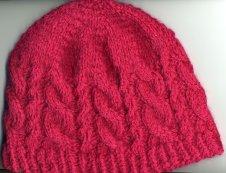
red cabled hat

You might expect from the title that this post will be about Linux, but it is actually just another finished hat picture. Knit of an interesting chunky Navajo-plied wool yarn, it is currently on consignment at the Appalachian by Design shop at the Greenbrier Resort. (See my September 2 post.) I know the cable-theme is getting a bit repetitious; I'm a little tired of it too, but it is a great way to use some of my odds and ends of strange yarns. I don't need to swatch these hats; I simply start from the top, a la Barbara Walker, increase every other round until the top measures between five and six inches across, then stop increasing and start knitting a pattern that will draw up, yet be stretchy. Ribs work well, and so do cables. Ever since I applied to join the Knitting Blog Webring, I feel the need to keep a knitting entry prominent on the lead page. I'm not sure what effect this has on people browsing for something about Pocahontas County. That is where I do my knitting, but does it have broader significance? Maybe something about the history of knitting in Pocahontas County. Don't laugh. I have data.

Friday, September 16, 2005

Arachne in the Garden

Garden spider on goldenrod

On Labor Day, I rested from my canning labors long enough to check the garden for more tomatoes, cucumbers, and squash. What I found there was more faunal than floral. It was a good day for spiders and caterpillars. This beauty was hunting on a patch of goldenrod, so I had to get my camera. I believe she qualifies as both as a nature photo and as a fiber artist in her own right.

Tuesday, September 13, 2005

Tony Hillerman: A Sense of Place

It's been a few weeks since I read a book, but the last one I read was Tony Hillerman's The Sinister Pig. I have been a fan since Jack Shaefer's son Carl recommended him, back in the early 1980's. Hillerman has an amazing command of his format, and he gives you a vivid sense of his people and places with a few apt phrases. I don't read a lot of genre fiction these days, but Hillerman never fails to please. There are several interesting Internet sites with lists of books, sample chapters, and essays by and about Hillerman.

Friday, September 09, 2005

He Gets NO Spam!

I've been enjoying the This Week In Tech podcasts since they began in the spring. Living on top of Droop Mountain, I don't have many opportunities to go hang out with the sys admin's on the loading dock anymore, and Leo Laporte, Patrick Norton and John C. Dvorak fill this void in my life. Dvorak recommends the program thus:

"If you like listening to five blowhards and a weenie ramble on and on about cool stuff in the news, then this is the hour long weekly show for you. The fact is the five blowhards are knowlegeable, even the weenie. (He knows who is he is)."
Is he fun, or what? And he gets no spam.

Wednesday, September 07, 2005

Some Open Source Accessibility Resources

I've been on an Internet fact-finding mission, looking for anything that could make computer use easier for people with limited mobility and motor control. Of course, I always like to find open source and freely available solutions if possible. Here are some promising things I've found so far.

  • Dasher "Dasher is an information-efficient text-entry interface, driven by natural continuous pointing gestures. Dasher is a competitive text-entry system wherever a full-size keyboard cannot be used." It's available for Windows and Linux. Debian's "apt-get" apt-got it for me, and it's also on the Ubuntu live CD, so my student and I can try it out on her computer easily.
  • Linux Accessibility Resource Site"A summary of the work of the Linux Accessibility community. Currently edited by David Bolter and hosted by the Adaptive Technology Resource Centre (ATRC)" Every resource I've checked out from this list has been a good one.
  • GOK is an open source on-screen keyboard. "The gok project aims to enable users to control their computer without having to rely on a standard keyboard or mouse. Many individuals must control the computer using alternative input methods. Using innovative dynamic keyboard strategies, and leveraging gnome 2's built-in accessibility framework, the gok will make control more efficient and enable use of the gnome 2 desktop. With the right hardware support and the gok individuals will have full access to applications that support the AT SPI, and therefore, full access to the functionality these applications provide." This is also apt-get-able, and I've been experimenting with it, too.

Sunday, September 04, 2005

Variety Through Dyeing

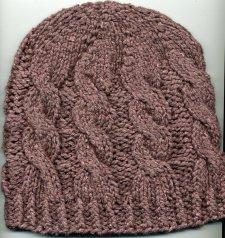
In hat-knitting mode, I've been using up a small stash of Chelsea Silk (65% silk, 35% wool) in a sort of natural heathery brown-blue-red. Because I didn't want to have three or four identical hats (my slogan is "Unique handknits") I tried dyeing one of them. I used a quarter teaspoon of pink Jaquard Acid dye, enough water to float the hat, and a quarter cup white vinegar. I cooked it all day in my second-string crock-pot (reserved for fiber dying), and I'm pleased with the results. Unfortunately, I have no better idea what to call this color than I had for the original undyed hat. Mauve?