Showing posts with label flora. Show all posts

Sunday, April 08, 2012

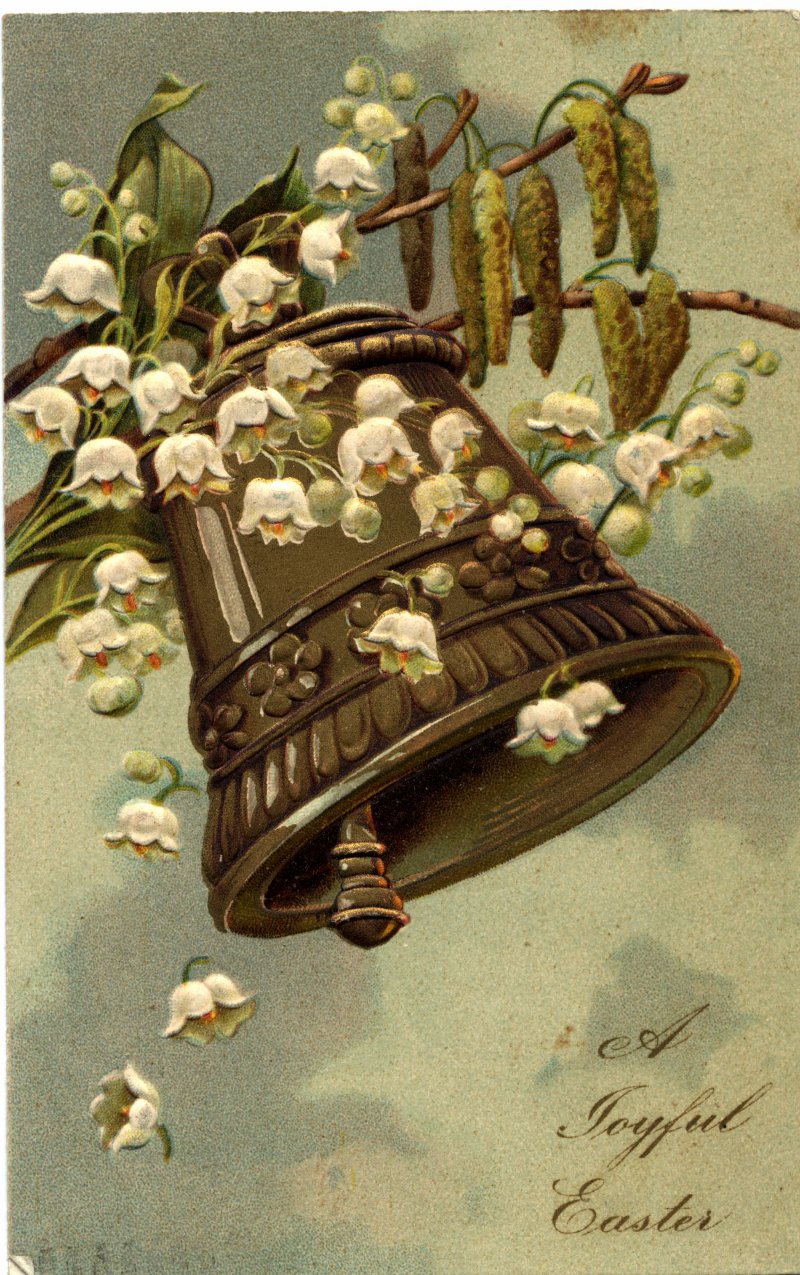
A Joyful Easter, With Catkins

Another holiday postcard from my grandmother's album--an Easter bell with alder catkins and lilies-of-the-valley, postmarked "Prescott, IOWA, MAR 28 ?PM, 1908." It reads:

Dear Florence, How are you getting along? I made garden last week, that is, I planted some lettuce and radishes and raked the yard Saturday. Can't you come down for Easter? We are going to color some eggs Saturday evening after the children go to bed. Good bye. Susie


Wednesday, March 21, 2012

Early Lettuce--Cute Cotyledons


I planted a little patch of lettuce in early February. Most years, such early plantings are unsuccessful--they sprout and freeze, or get washed away in heavy rain, or they mold. This year, the rain did wash all the seed into low spots, but it looks like I might get a bit of early lettuce. It needs thinning, as soon as the plants are big enough to grab hold of.

Monday, March 05, 2012

The Chaff Which the Wind Driveth Away

I've been reading philosophy and ecology papers, trying to get ahead of my students on the fly with courses I took over mid-semester. Since my personal flight from academia, I have kept up on ecology literature, but philosophy, not so much. I'd be in better shape if the topic were "biology and the literary imagination," or "aesthetics of natural history," or "nature, prose, and poetry." In fact, I'm sneaking in all the Aldo Leopold and Rachel Carson I can manage, on the grounds that they are much cited in environmental ethics texts.

Thus, Prairiemary's recent blog post, Meanings of Vegetal Life fit right in with my current reading lists. Mary's introduced me to Deleuze and Guattari in the past, although I can't claim to understand postmodernism enough to explain it in my own words. In this blog post, she reprints a call for manuscripts on "Critical Plant Studies: Philosophy, Literature, Culture."

The goal of the Critical Plant Studies, a new book series at Rodopi Press, is to initiate an interdisciplinary dialogue, whereby philosophy and literature would learn from each other to think about, imagine, and describe, vegetal life with critical awareness, conceptual rigor, and ethical sensitivity....Ethically stated, the aim of the book series is to encourage an incremental shift of cultural attitudes from a purely instrumental to a respectful approach to vegetal beings.

I suspected this overlaps with environmental ethics topics I've been reading about, but I really couldn't imagine how, so I tracked down what I could find by the book series editor, Michael Marder. He has a 2012 publication in Peace Studies Journal entitled Resist Like a Plant: On the Vegetal Life of Political Movements. Here's the abstract:

This brief article is an initial attempt at conceptualizing the idea of political movement not on the basis of the traditional animal model but, rather, following the lessons drawn from vegetal life. I argue that the spatial politics of the Occupy movement largely conforms to the unique ontology of plants and point toward the possibility of a plant-human republic emerging from it.

This is where I run into trouble with modern philosophers. How is this anything more than a search for a metaphor? And isn't this already an ancient trope? Here are King David's botanical similes from Psalm 1, verses 3 and 4:

And he shall be like a tree planted by the rivers of water, that bringeth forth his fruit in his season; his leaf also shall not wither; and whatsoever he doeth shall prosper.

The ungodly are not so: but are like the chaff which the wind driveth away.

This famous simile has moved into politics, from spiritual to protest song: Just like a tree that's planted by the water./ I shall not be moved. Perhaps I can use this to justify shifting the course emphasis from ethical theory to literature. The whole Deleuze and Guattari: Concept of the Rhizome seems to me to rest on an inartful metaphor. I think a "stolon" would better represent lateral, multidirectional movement of ideas.

Saturday, February 04, 2012

The Early Grasshopper Catches the Radish

Garden seeds came in the mail today, and, because the ground is bare and workable, I raked some damp soil loose and planted beets and radishes. That's where I found this guy.

This is shockingly early for little grasshoppers here. He was not only hatched and growing, but warm-blooded, quick, and hard to photograph. I foresee a good year for garden pests (but not for gardeners).


Sunday, January 29, 2012

An End to Peaches


The Tree Year 2011 was a sadly inauspicious year for trees on our ridge. The stag-horn sumac trees did not fare well in the summer, and this happened in the spring. This poor peach tree has been struggling for years, but every once in a while it would produce a small crop of flavorful (gnarly-looking) fruit. This spring, the wind took it down. I'm saving the last freezer-bag of peach pie filling for a special occasion.


Friday, January 27, 2012

New USDA Plant Hardiness Zone Map


This week the USDA Agricultural Research Service released its new Plant Hardiness Zone Map. Strangely, I discovered this, not through the agriculture and gardening sites I follow, but through Mother Jones magazine's Blue Marble Blog. Julia Whitty points out:

The new map is interactive, which is cool, and based on a much finer data scale than the old one, which is great. And guess what. It shows that things are getting warmer. The USDA managed to pretty much bury that fact in Bureaucratese in their press release...Compared to the 1990 version, zone boundaries in this edition of the map have shifted in many areas. The new map is generally one 5-degree Fahrenheit half-zone warmer than the previous map throughout much of the United States. This is mostly a result of using temperature data from a longer and more recent time period; the new map uses data measured at weather stations during the 30-year period 1976-2005. In contrast, the 1990 map was based on temperature data from only a 13-year period of 1974-1986.

The interactive USDA Plant Hardiness Zone Map lets you select a state and "zoom in" to see surprisingly fine-grained detail. I've already zoomed in on every place I've ever tried to garden.

Friday, January 20, 2012

Flora, For a Change

Lately, this blog has been heavy computer troubles and sewing project catch-up posts. There's more of both to come. This morning glory from last August is offered for a change of pace. I love the dusty pollen in the corolla.

Sunday, January 15, 2012

Tree Year 2011 Recap: Sumac Season

The Tree Year My blogging habit crashed and burned last year, but I continued to take sumac pictures for Tree Year 2011, at least until summer's dry weather killed the small trees I was photographing.

I waited until the end of April to see the buds relax and swell.

These leaves were unfolding on May 21.


By June, most of the trees were leafy, although some new shoots were still growing.


The inflorescences are not as pretty as the red winter fruiting bodies. This is full bloom on June 21.

I had never looked close at sumac inflorescences before.


And then, they all dried up and died--the small, reachable sumacs, that is. Around here, sumacs are adventitious woody shrubs that pop up in old fields and die back after a short time. I had hoped for a series of fall foliage colors, like we had in 2004. I was going to finish off the year with this:


When we read Indian Summer in school, the whole concept of "crimson forest" was a mythical thing in my mind, like dragons and fairy godmothers. Yes, sometimes a leaf might turn yellow or red, but mostly, they turned brown and blew away.

Along the line of smoky hills
The crimson forest stands,
And all the day the blue-jay calls
Throughout the autumn lands.

Now by the brook the maple leans
With all his glory spread,
And all the sumachs on the hills
Have turned their green to red.

Sometimes, I knew, trees could blow away. The Kansas part of "The Wizard of Oz" was all too real--I was in high school before I could bear to watch it on TV. But "sumachs on the hills...turned their green to red" was some sort of literary conceit. Boy did I get a surprise when I moved "back East." I believe sumac sometimes glows in the dark come autumn.
Sunday, March 27, 2011

Snowy Setback--2011 Tree Year

The Tree YearAfter several warm days that made the lilac and rose bushes pop new leaves, winter weather returned.

This is the same snowstorm that caught Sherry on her way home from West Virginia. Bourbon County had a sunny, snow-melting day today, but here on Droop, the snow persists.

Friday, March 11, 2011

Dormancy--2011 Tree Year

The Tree YearIt's snowing again today, and the sumac buds are tight shut still.

Like other smooth-barked tree species here, the sumacs have lots of lovely lichens.

Wednesday, March 09, 2011

Late Winter Sumac--2011 Tree Year

The Tree YearYesterday's sky did not promise spring, and this morning we had snow and sleet. Robins have been visiting the sumac fruits, but the main customers there are our red-bellied woodpeckers.

Lately, they have been rather rough in their foraging, and pieces of the fruiting bodies are scattered on the ground under the trees.

I wonder whether they enjoy these dry, furry fruits, or if they're the last choice here at the end of winter.

Tuesday, February 22, 2011

Sprouting Onion Seeds

I've never sprouted onion seeds before, and I didn't expect them to be so curly and cute. I hope these will give us better success than we've had with onion sets here. The garden catalog called this variety "Walla Walla," and promised they'd do great things.

Wednesday, February 09, 2011

Crochet Ye Roses While Ye May

I knit to create clothing, but the thing I admire about crochet is the variety of pure embellishment you can produce. I especially enjoy crochet floral motifs, like this cabbage rose, a standard feature in Irish crochet. I wanted to make some Irish crochet-style leaves to go with it, but I couldn't find a pattern in my collection.

Suzanne Thompson's Curious and Crafty Readers blog came to my rescue, with her Corrugated Leaf Tutorial. It was exactly the way to make the leaves I knew from my grandma's collection of doilies and do-dads. Poking around on Suzanne's blog, I found lots of wonderful crochet flower designs and directions. Some of them are the usual fanciful geometric shapes, but many have details that make them look like real, specific flowers--pansies, poppies, daffodils, primroses. And the leaves--ferns, palms, pine boughs. It's too cool.

She has some of these in a book: Crochet Bouquet: Easy Designs for Dozens of Flowers. It's so moderately priced at Amazon that I put it right on my wishlist. Suzanne's blog even gives you instructions for converting your copy to spiral-bound format.

Thursday, January 27, 2011

State of the Sumac--January 2011

The Tree Year

Here's my latest post for The Tree Year. (I think Das Baumjahr has a better ring to it...I may switch.)

The sun came out to make the trees sparkle this afternoon, so I thought it would be a good time to document the State of the Sumac for January, 2011. This particular stag horn sumac has its lowest fruits 12 or 15 feet off the ground, and it's at the bottom of a snowy, icy, steep hill, so the best I can do today is this full-length portrait, complete with plenty of snow-coated red fruit clusters.

Like Sherry's dad, folks around here call this small tree/large shrub "shoe-make." They regard "sumac" as an affectation. It really isn't a case of me "getting above my raisin'" though, because my raising on the prairie didn't include this peculiar tree. I only know its name from field guides and botany classes.

This smaller, distressed sumac has been growing by an abandoned gate for many years, but it hasn't gotten more than 15 feet high. It has some lovely lichens, and I can get a bit closer to those peculiar clusters of fuzzy red sumac fruits.

Here you can see that the birds have been working on the dried fruits. One of the clusters is picked nearly clean.

Monday, January 24, 2011

Knitted Fuchsia Flowers in Ivory Silk

These socks are the fourth pair in my series of "Disappointing Silk/Wool Yarns by Rowan." By that, I don't mean the socks are disappointing, just that the silk/wool blends were not pleasant to knit. The heathery blue yarns were known as "Grainy Silk," and the solid colors (seen above and here) were "Silkstones." They looked luscious in the skeins, but the strands break easily and are inelastic in the knitting. In the wearing, they stretch out and don't spring back, making for slouchy socks. Fortunately, the silk/wool blend is warm and toasty to wear, and I don't mind slouchy socks.
The yarn is just too string-like for Fair Isle patterns, twist-stitch patterns, cable patterns, or any of my other sock-knitting preferences. This time, I thought I would try a bit of open-work, and find out whether I like wearing lacy socks.
The pattern I went with is from Barbara G. Walker's A Treasury of Knitting Patterns. It's found in her "Patterns Made with Yarn-Over Stitches" Chapter (page 149 in my edition), and it's called "Fuchsia Pattern." I'm assuming it's after the lovely pendant flowers, not the color.
If I were naming the pattern, I'd be inclined to call it Virginia Bluebells, but, according to Ms. Walker: This is a popular pattern in traditional knitting, known in some form or another throughout Europe. This particular version is German. Perhaps that is reason enough to name it after a flower that is itself named after a Bavarian botanist, Leonhart Fuchs.
In any case, the pattern is easy and makes a pretty ribbing. I will soon know whether I like wearing socks knit with sizable yarn-over "holes."

Thursday, January 20, 2011

Ice Storm, Iowa, 1954

Here are more surprises from my mom's box of Kodachrome slides. 1954 is a guess--my parents lived in this house from about 1952 to 1956. You can see why southwestern Iowa winters are so hard on trees.

Sunday, January 16, 2011

2011: The Year In Trees

Marvin and Sherry clued me in to this interesting project, The Tree Year. Here's how it works:

The Tree Year

How to start:

  1. Pick a tree – either one you like a lot or one that you see every day on your way to work or that happens to live on your balcony.
  2. Observe it: every day or once a week or less. What grabs your attention? What kind of animals are and what kind of plants grow on it?
  3. Write about your observation, make sketches or take photographs and share it with us.

Now, I could get totally hung up at step 1, "Pick a tree." I am overwhelmed by my choices here on Droop Mountain. I was feeling a little panicky about picking a "good one." And what if my tree blew down in a high wind, or became firewood? However, the FAQ's inform me that we can "change the project idea [so] that it fits you." In fact, I see on the Tree Year site that Marvin has picked both a persimmon tree and a sweet gum tree.

Sherry has chosen a dogwood, another awesome tree. Before all the "good" trees are taken, I'm gonna call Staghorn Sumac! There's a stand here close to the house, and it does so many interesting things. Check these lichens on a sumac branch (from a post here in February, 2009). I'll probably never get a photograph of the pileated woodpeckers eating sumac fruits, but they do dine there regularly.

Thanks, Marvin and Sherry, for alerting me to this, and thanks to The Tree Year for the idea.

Wednesday, January 12, 2011

The Violets Bear It Away

Here's a picture of my grandmother, Florence Williamson Hunt, the postcard collector in my family. The postcard album I've been using to decorate my holiday postings for the last few years is something Florence put together while living with her parents on their farm, prior to her marriage in her early 30's. In this photograph, she's moved to town (Creston), widowed, and in her 70's.

Grandma had an extensive flower garden at "the house in town," and she had a large collection of African violets on her window sills. As a little girl, I fixated on these flowers with fuzzy foliage, and I've tried to grow them myself with limited success.

Fortunately, the office and bedroom in our new house have plenty of winter sunlight, and my current crop of African violets has been blooming quite cheerfully. I have Grandma's crocheted table toppers scattered among the houseplants.

Friday, December 24, 2010

Periwinkles for Christmas

I don't know whether periwinkle flowers are traditionally associated with Christmas, but the floral holiday cards in my grandma's collection are favorites of mine. This one is postmarked "Bridgewater, IOWA", and reads "From your Cousin Margaret. Merry Christmas and Happy New Year."

Tuesday, March 23, 2010

Shopping, Crochet, and Spring Wildflowers

I believe I stated a while ago that I had plenty of crochet patterns and books on hand, that there was no need for me to spend any money on this new pursuit, or to acquire more stuff to clutter the new house. When I found a big gap in my collection of crochet hook sizes, it didn't seem outrageous to buy a set of large-ish steel crochet hooks at Wal-Mart. They wouldn't take up much space, and they only cost seven dollars--not as much as many new hobbies require, surely?

A few weeks later, shopping online for a replacement flashlight, we found what we wanted on Amazon. Just a few dollars short of the free shipping minimum, I dipped into my "Wishlist" and added on Beyond-the-Square Crochet Motifs: 144 circles, hexagons, triangles, squares, and other unexpected shapes by Edie Eckman.

Although I'm nickle-and-diming my way out of my frugality promises, I am very pleased with this book. It's hardback and spiral bound, and the colorful example motifs fulfill my yen for new eye-candy. I'm pleased to have both text directions and diagrams, and I've learned some new-to-me techniques. There's also a section at the back on how to design your own unique motifs. That's something I'd never even thought about before, but that is one of the truly cool things about crochet--you can go wild and just try things. (With knitting and the sort of sewing I usually do, you need to plan ahead more.) I'm really pleased with this book, and here are some of the motifs I've made so far.

Eckman's book shows all the motifs in colorful sport-weight yarn, so of course I'm trying them in some rather coarse crochet cotton thread (using my new Wal-Mart steel hooks). A couple dozen of the ecru squares at the top of this post would make a handsome table runner, I think. I like how open this square is, compared to the granny squares we're used to seeing sewn into afghans and blankets.

These motifs remind me of dogwood blossoms. I think I'll sew them onto my next pair of slippers, with some little gold buttons in their centers.

These white motifs are two variations on a theme. I think they both look floral in crochet thread, like some small spring ephemeral--perhaps wood anemones?