Showing posts with label music. Show all posts

Tuesday, January 18, 2011

Cromwell Marching Band, White Cat, and Oldsmobile

I vividly remember what the Cromwell Band uniform smelled like, although I cannot describe it now any more than I could then. The cat does not appear well pleased by it either. I do not remember my flute being that large in relation to my arms. Below, the band is assembling for the 1963 Thanksgiving parade. These slides were a surprise--I don't remember Mom taking these pictures.

Sunday, June 28, 2009

Clark Kessinger Video

A few weeks ago, Larry Ayers, of "Riverside Rambles" posted a link to Norman Blake's version of "Done Gone". I started gathering URL's about my own experiences with that tune (including how it helped me get my banjo fixed for free), when I came across this video of West Virginia's Clark Kessinger, performing at the Newport Festival. I have a number of his recordings (including "Done Gone"), but I'd never seen him in action before.

Whatever I meant to say about Larry, Norman Blake, "Done Gone," and Clark Kessinger has vanished from both brain and hard drive, but Mr. Kessinger's fiddling is well worth a link.

Tuesday, April 21, 2009

Yew Piney Mountain

You never know what you'll run across on line; I found Pocahontas County musician Pam Lund playing banjo with fiddler Dave Bing on "Yew Piney Mountain." The Yew Mountains, aka the Yew Pine Mountains, are in the Cranberry Wilderness Area here. The fiddle may catch your ear first, but listen for Pam's banjo. No muss, no fuss, just as good as it gets.

Monday, January 19, 2009

Near the Relief Office I See My People

It's wonderful to hear Pete Seeger singing Woody Guthrie's "This Land is Your Land" at yesterday's concert at the Lincoln Memorial. I got all choked up watching this, and tonight, I'll probably dream I see Joe Hill again, alive as you and me. Here are all the lyrics, including the last two gritty ones Pete sings here, from Arlo.net, Arlo Guthrie's web site.

It seems HBO had this removed from YouTube. You may be able to watch the video here, but I can't tell--no computer here will play that format.

THIS LAND IS YOUR LAND 
words and music by Woody Guthrie

Chorus:
This land is your land, this land is my land
From California, to the New York Island
From the redwood forest, to the gulf stream waters
This land was made for you and me

As I was walking a ribbon of highway
I saw above me an endless skyway
I saw below me a golden valley
This land was made for you and me

Chorus

I've roamed and rambled and I've followed my footsteps
To the sparkling sands of her diamond deserts
And all around me a voice was sounding
This land was made for you and me

Chorus

The sun comes shining as I was strolling
The wheat fields waving and the dust clouds rolling
The fog was lifting a voice come chanting
This land was made for you and me

Chorus

As I was walkin'  -  I saw a sign there
And that sign said - no tress passin'
But on the other side  .... it didn't say nothin!
Now that side was made for you and me!

Chorus

In the squares of the city - In the shadow of the steeple
Near the relief office - I see my people
And some are grumblin' and some are wonderin'
If this land's still made for you and me.

Chorus (2x)

Here's a Wikipedia image showing Pete, entertaining at the opening of the Washington labor canteen, sponsored by the United Federal Labor Canteen, sponsored by the Federal Workers of American, Congress of Industrial Organizations (CIO). Photograph by Joseph A. Horne, February 1944. There's Eleanor Roosevelt seated between two sailors, near the center.

Friday, November 21, 2008

78 RPM to MP3's: Amazing Music Collection

Here's another person giving away something wonderful for free on the Web: My Collection of Recorded 78 RPM Records - Free MP3 Downloads. There's a layer of "password protection" to get to it, (He gives you the user name and password.) and here's what he's posted:

The following is a list titles recorded from my collection of 78 rpm records. All of them are linked to MP3 files and will play what was recorded. No sound enhancement, just what was recorded. Right now, there are 3,877 titles on this page linked to mp3's.

You're bound to find something interesting!

Tuesday, July 15, 2008

Red Wing--She's Stickin' To the Union Too

The tune "Red Wing" (in G major) is popular among the Old Time musicians we know around here. Every time I hear it, I think of Woody Guthrie's "Union Maid." I knew that was a parody, so I used the wonders of the Internet to track down the original lyrics. I found these and more at All about "Red Wing" by Perfessor Bill Edwards. First, the lyrics:

 "Red Wing"
Words by Thurland Chattaway, Music by Kerry Mills

Verse 1: There once lived an Indian maid, a shy little prairie maid,
Who sang a lay, a love song gay, as on the plain she'd while away the day;
She loved a warrior bold, this shy little maid of old,
But brave and gay, he rode one day to battle far away.

Chorus: Now, the moon shines to night on pretty Red Wing,
The breeze is sighing, the night bird's crying,
For afar 'neath his star her brave is sleeping,
While Red Wing's weeping her heart away.

Verse 2: She watched for him day and night, she kept all the campfires bright,
And under the sky, each night she would lie, and dream about his coming by and by;
But when all the braves returned, the heart of Red Wing yearned,
For far, far away, her warrior gay, fell bravely in the fray.

Chorus: Now, the moon shines to night on pretty Red Wing,
The breeze is sighing, the night bird's crying,
For afar 'neath his star her brave is sleeping,
While Red Wing's weeping her heart away.

"The Perfessor" also provides audio samples of the original music, which is somewhat different than the banjo tune I play. He explains the musical changes and describes the early history of the composition..

Frederick Allen (Kerry) Mills (M) and Thurland Chattaway (L) - 1907: Mills, who has been credited with writing the first compositions that set the standard format for published cakewalks, spent twenty years trying to keep up with current musical trends and fads. With this piece he was addressing a craze for Native American (Indian)-themed compositions established in 1902 by the publication of Hiawatha by Charles N. Daniels (as Neil Moret). So Mills composed a standard pop tune and titled it with a Native American name, supplying a cover to match the theme....

....Red Wing...was published in at least three different forms. The first was as an intermezzo, a popular three-sectioned piano composition format. This version of the piece features a rarely-heard trio which was excised when he commissioned Thurland Chattaway to retrofit lyrics representing an "Indian Fable" to go with the tune. The other two versions of the piece are represented by the song sans trio, and the song with a male "quartette" section tacked on to the chorus. Why this is such a little known fact is in part because the song versions outsold the intermezzo by an overwhelming margin (the song was reprinted in later years while the intermezzo was all but forgotten), and because of an odd decision (or non-decision) by Mills to use an identical cover for all versions regardless of the content....

...following Red Wing's publication (1908), a 24 year old Native American girl from the Winnebago reservation started to break into films, eventually making some with the venerable D.W. Griffith. She was also a star in the first silent adaptation of the novel Ramona. Her name just happened to be Princess Redwing (one word). There is no definitive evidence either way as to any connection with the titling of Mills' composition, but the timing was, perhaps, fortuitous for both. It is not too likely that she openly endorsed the piece, as from the 1930s until her death at 91(?) in 1974, Princess Redwing was an advocate and spokesperson for Indian rights, and also fought against stereotypes of Native Americans....

Just because it's what will always spring to mind when I hear the tune, here are Woody Guthrie's lyrics:

There once was a union maid, she never was afraid,
Of the goons and the ginks and the company finks;
And the deputy sheriffs who made the raid.
She went to the Union hall, when a meeting it was called,
And when the company boys came round,
She always stood her ground.

Chorus:
    Oh you can't scare me, I'm stickin' to the Union,
    I'm stickin' to the Union, I'm stickin' to the Union.
    Oh you can't scare me, I'm stickin' to the Union,
    I'm stickin' to the Union till the day I die.

This union maid was wise to the tricks of the company spies,
She couldn't be fooled by the company rules,
She'd always organise.
She'd always get her way when she struck for higher pay,
She'd show her card to the National Guard,
And this is what she'd say:

Chorus:

You girls who want to be free just take a tip from me!
Get you a man who's a union man
And join the Ladies' Auxiliary.
Married life ain't hard when you've got a union card.
A union man has a happy life
When he's got a union wife.

Chorus
  

According to Songs of Work and Protest by Edith Fowke and Joe Glazer, the third (unfortunately condescending) verse was added by Millard Lampell, one of the Almanac Singers, with whom Guthrie first performed the song. I came across this substitute from a Maritime Union of Australia Web page documenting Songs and chants for the MUA & Community Assembly Picket Lines in a 1998 action.

A woman's life is hard, even with a Union card,
She's got to stand on her own two feet,
Not be the servant of a male elite.
It's time to take a stand, start working hand in hand,
For there's a job that's just begun & a fight that's got to be won.

I like that bit about not being a servant of a male elite.

Wednesday, October 24, 2007

The Schoolhouse On the Hill

Schoolhouse on the Greenbrirer

October's deep blue skies and colorful leaves always make me think of this Carter family song. My parents, aunts and uncles, and most of my cousins fondly remembered their days in one-room schoolhouses, and this song evokes for me a sweet, second-hand nostalgia that seems entirely appropriate for autumn.

I learned this song from the Sara Carter's singing in the June, 1933 session in Rounder Records' "Complete Victor Recordings" series. I've not seen the original 1907 shape note songbook; these are the lyrics as I hear them, and I may have misunderstood some words. The imagery is unusually vivid for a turn of the century sentimental song.

The Schoolhouse On the Hill
Fond memory paints its scenes of other years,
Brings me their memory still,
And bright amid those joyous scenes appears
The schoolhouse on the hill.

Chorus:

     Oh, the schoolhouse that stands upon the hill--
     I never, never can forget.
     Dear happy days are gathered 'round me still--
     I never, never can forget.


There hangs the swing upon the maple tree,
Where you and I once swung.
There flows the spring, forever flowing free
As when we both were young.

(Chorus)

There climb the vines and there the berries grow
Which once we prized so high;
And their ripe clusters glisten in the glow
Of rich October skies.

(Chorus)

School was in session until the 1960's in this schoolhouse, although it is on the Greenbrier River, not on a hill. Some of the students came to school in boats. That must have made vivid memories.

Wednesday, August 22, 2007

Accordion Universe

I don't understand why some musical instruments strike people as funny. If you dropped an accordion and a banjo off the Empire State Building, which would hit the ground first? Who cares? What's the difference between an accordion and a chainsaw? You can tune a chainsaw. That's the spirit of this article: Accordionists in D.C.: They Aim To Squeeze by Joshua Zumbrun, Washington Post Staff Writer (Saturday, August 18, 2007).

Despite the mockery, it's good to see the accordion get a little attention and respect.

Imagine a universe exactly like ours in every way but for a lone exception: There is only one type of music. Accordion music.

This week, such parallel universes have collided.

The rift in the cosmic fabric could be found at the Holiday Inn Commonwealth Ballroom in Old Town Alexandria, site of the 60th annual Coupe Mondiale, the World Cup of accordion competitions for younger players.

In Accordion Universe, all music is powered by the swaying bellows pulling air in, pushing it out. There's the familiar oompa-oompa-oompa of polka everywhere, yes, but the instruments also can play whimsical pop and mournful ballads. All types of music, in fact, with the soft drone of the keyboard being pushed to and fro.

The scene at the hotel on Tuesday night for the competition's opening performance is much like any international gathering. A melange of languages wafts through the lobby; bags droop below the eyes of jet-lagged travelers. But our universe ends and this universe begins as someone pushes a birdcage bellman's cart through the doors; it's laden not with suitcases but a pile of accordion cases. At the end of the hallway, accordionists are practicing a difficult riff. And in the rooms, strains of accordion jazz and accordion pop and accordion polka mix with spoken French and Chinese and Danish.

"The soundtrack of life is full of accordions," says Faithe Deffner, the U.S. delegate to, and vice president of, the Confederation of International Accordionists, which stages the Coupe Mondiale every year. "People don't see accordions very much, but they're always in commercials, television, movies."

Tuesday, June 19, 2007

Concertina Potatos?

Frozen concertina potatoes box

I had a wonderful time at the Maury River Fiddler's Convention in Buena Vista, Virginia over the weekend. I got to play the concertina quite a bit, and I thought it was working pretty well with the string band instruments. I noticed this box in the trash there, though, and it puzzled me. "Generation 7 Fries Concertina Frozen Potatoes." Are they Concertina-Frozen potatoes or Concertina-Potatoes, sold frozen?

Monday, May 28, 2007

Good Picking at Vandalia Gathering

Larry's guitar student, Jake Ryder, placed first in the Flatpick Guitar "Youth" category at the 2007 Vandalia Gathering yesterday. His mom, Mrs. A over at Country Life, filmed the performance and put it on Youtube. Jake's in the eighth grade, and he's a mighty fine picker, in my opinion. Here he is playing "Beaumont Rag" (first video) and "Whiskey Before Breakfast" (second video).

Oh, and just in case you're wondering, that's Larry S. Combs playing backup for Jake. Did I mention Larry gives guitar lessons?

Tuesday, May 22, 2007

Looking Forward to Vandalia Gathering

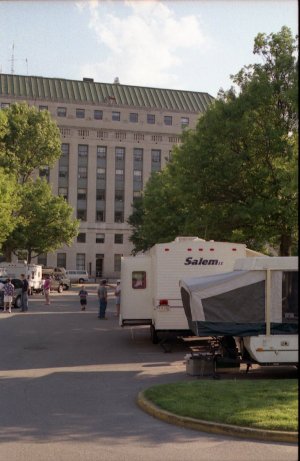
Camping at Vandalia, view of the DMV

On Memorial Day weekend, May 25-27, the Cultural Center and State Capitol grounds will be the site of the 31st Vandalia Gathering--the state's annual celebration of the traditional arts, music, dance, stories, crafts and food of West Virginia. The free festival's unique blend of ethnic and cultural heritage combines an atmosphere as comfortable as a family reunion with the excitement of a state fair....

For those who love the sounds of traditional music or would like to be introduced to it, Vandalia Gathering can fit the bill. Concerts and contests fill the weekend, and impromptu musical jam sessions spring up all over the grounds. At any moment, a shade tree becomes the site of a lively performance as strolling musicians stop to join in on a favorite tune....

Vandalia Camping: Railroad tracks and interstate

Every Memorial Day weekend, we pack up our little camper and leave beautiful Pocahontas County to camp out in a parking lot next to an interstate highway, some railroad tracks, and the West Virginia Department of Motor Vehicles in Charleston. A surprising number of people agree that Old-Time's a Good Time at the Vandalia Gathering, and I'd have to say that it's a lot more fun than West Virginia's State Fair, which is located in Lewisburg, much closer to our home than Charleston. West Virginia's Department of Culture and History has the 2007 Schedule on its Website.

Wednesday, May 02, 2007

John Henry Was A Steel-Drivin' Man

I've already written about John Hardy this year, so it's only fair to mention a new book about the similarly-named West Virginia ballad character, John Henry. A Washington Post article Tale of Folk Hero Wins New Award For Arts Writing by Bob Thompson (Washington Post Staff Writer) April 26, 2007 alerted me to its existence, and I hope interlibrary loan can track it down for me.

When Scott Reynolds Nelson set out to write "Steel Drivin' Man: John Henry, the Untold Story of an American Legend," he couldn't have dreamed his book would win the National Award for Arts Writing. For one thing, the award hadn't been invented yet....

The National Award for Arts Writing is the newly hatched brainchild of the Arts Club of Washington, which will present it to Nelson at a dinner next month....The two other finalists were Ross King for "The Judgment of Paris: The Revolutionary Decade That Gave the World Impressionism" and Julie Phillips for "James Tiptree, Jr.: The Double Life of Alice B. Sheldon," a biography of the pseudonymous science fiction pioneer. The judges were poet Rita Dove and novelists Joyce Carol Oates and Alan Cheuse....

While researching his previous book [Nelson] stumbled onto reports from the board of the Virginia State Penitentiary in Richmond that told, he writes, "a terrible story about railroad work." In the early 1870s, black convicts were leased to the C&O Railroad, which was running a line across the Alleghenies. Many died doing tunneling and other work for the C&O.

Later, Nelson got interested in African American work songs and was drawn to the ballad of John Henry and his fatal contest with a steam drill. One day he ran across an old photograph of the Richmond penitentiary that showed "a large white building in the center." He found himself suddenly putting two disparate bits of information together: a conversation he'd had with an archivist about nearly 300 skeletons discovered near the penitentiary buildings, and a stanza from one version of the song:

They took John Henry to the white house,
And buried him in the san'
And every locomotive come roarin' by,
Says there lays that steel drivin' man . . .

Hypothesizing that the building in the photograph was the "white house" in question, Nelson checked penitentiary records and found a "John Wm. Henry" who'd been sent to work on the C&O. More research supported--though it cannot prove--his belief that he'd found a legend's origin.

Sunday, April 08, 2007

Easter Snow

When I lived in Our Nation's Capitol, I heard a lovely Irish air called "Easter Snow," sung with English lyrics. Today, we have Easter snow on Droop Mountain, which motivated me to look up the tune. I discovered this entry in The Fiddler's Companion: A Descriptive Index of North American and British Isles Music for the Folk Violin and Other Instruments. by Andrew Kuntz.

EASTER SNOW. Irish, Air (3/4 time). G Major. Standard. AAB. Caoimhin Mac Aoidh explains the title is an English version of the Gaelic name Diseart Nuadhain, a placename in north Roscommon which can today be found in the form of Estersnow, a Boyle rural district. Mac Aoidh states that Petrie appears to have literally translated the English back into Irish as "Sneachia Casga" as an alternate title. The same air is to be found in Brendan Rogers manuscript collection (in the Irish Traditional Music Archive) noted from the performances of attendees at the Feis Ceoil competitions held in Belfast in 1898 and 1900. The musical family the Dohertys of Donegal had a different air by the same title, and the great Donegal piper, Tarlach Mac Suibhne, played a different air than the Dohertys. Mac Suibhne's playing of "Easter Snow" was recorded by the Dublin Evening Telegraph in 1897, when he was one of seven pipers at the first Feis, held in that city (the title in the newspaper was "Sneachta na Casga"). Finally, regarding this tune, Mac Aoidh notes that fiddler John Doherty personified "Easter Snow" as a woman, Ester Snow, whom he maintained was over six feet tall, very beautiful, and had skin as white as snow (leading to her name). Source for notated version: the Irish collector P.W. Joyce, 1864. Ó Canainn (Traditional Slow Airs of Ireland), 1995; No. 105, pg. 89. Stanford/Petrie (Complete Collection), 1905, vol. III, No. 1123.

The Balladeers website provides these English lyrics, which may or may not go to the air described above. They are, however, related to the lyrics I heard sung a few years ago.

EASTER SNOW
(Christy Moore)

Chorus:
Oh the Easter snow
It has fade away
It was so rare and so beautiful
Now it's melted back into the clay

Those days will be remembered
Beyond out in the Naul
Listening to the master's notes
As gently they did fall
Oh . . . the music
As Seamus he did play
But the thaw crept over the mantle white
And turned it back to clay

Chorus:
Oh the Easter snow
It has fade away
It was so rare and so beautiful
Now it's melted back into the clay

He gazed at the embers in reflection,
He called up lost verses again,
He smiled with a roguish recollection,
While his fingers gripped the glass to stem the pain
When knocked on his door was always open
With a welcome he'd bid the time of day
Though we came when the last flakes were melted
While it lay upon the ground we stayed away

Chorus:
Oh the Easter snow
It has fade away
It was so rare and so beautiful
Now it's melted back into the clay

A discography is provided for Irish Traditional Music Tune Index Tune ID# 3444 (Easter Snow) in Irish Traditional Music Tune Index. Alan Ng's Tunography. Some of the recordings are still "in print."

Wednesday, June 21, 2006

In the Money, and Out Again

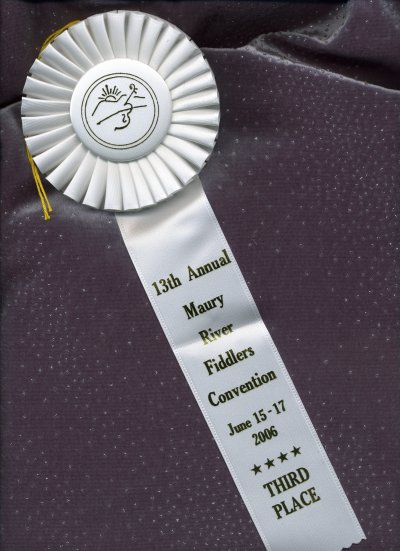
Maury River Fiddler's Convention prize ribbon

I entered the autoharp contest at the Maury River Fiddler's Convention last Thursday, as planned. I played "Chinkypin," it went pretty well, and I was tickled to get my camping fee refunded, in cash, immediately after I played. There were quite a few autoharp contestants, so I didn't harbor any illusions about winning. Imagine my surprise to find I'd finished in the money--third, to be precise. This was my first contest, and I have the feeling that it will be like that first free taste of an addictive drug.


On another exciting note, the phone company called me last week to let me know DSL is available in our area. They installed it Monday, and within an hour, the power went out and stayed out for eight hours. I couldn't help thinking this was the Universe reminding me that I still live in a remote, rural area, DSL notwithstanding. Since then, I've been busy working on my home network. I've been backing up data, updating my Debian installations, and tightening up security on the Mac. I'm just beginning to appreciate the many things I never investigated before due to lack of bandwidth. Yesterday, I downloaded Flashplayer, and was able to watch someone else's kitty take a drink of water from the tap on YouTube. The Internet is truly a miraculous tool!

Sunday, June 11, 2006

I Auto Practice My Autoharp

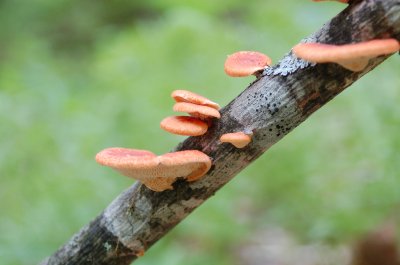
a little polypore from Swago, May 12, 2006

I hadn't intended to keep a photo blog, although recent trends contradict this. I have nothing against photo blogs, mind you. If I had broadband access, I'd probably follow lots of them. As it is, several of the weblogs in my "Blogroll" load so slowly that I often read the text and skip the photos.

Lately my self-allotted computer time has been taken up with photography and music matters. I've copied some vinyl and some audio tape to mp3's, and I've acquired a much-longed-for digital camera. These new projects have led to back-up and storage issues, which led to Linux updates, which led to hardware updates, which led to reorganizing my computer work area.... I'm almost done with this, I hope.

The computer audio projects were spurred by the start of the festival and picking season. This coming weekend, we are going to The 13th Annual Maury River Fiddlers' Convention in Buena Vista, Virginia. Our camping buddies, Mud Hole Control, won the Old-Time Band contest last year, and this year are the featured house band. We are always honored to be their hangers-on, and are particularly pleased that they are being honored.

Attendees who participate in the music contests get a discount on camping fees, so I signed up. Obviously, there is no concertina contest, but there is an autoharp contest, and that is an instrument I can play. (My banjo skills are not ready for prime time--more like early Sunday mornings when the infomercials come on.) That's what I've been spending my indoor hours on since the Vandalia Gathering--practicing two fiddle tunes on the autoharp. I'm going to play "Chinquapin" and/or "The Red-Haired Boy." They're not sounding too bad, but since I spent a couple of days working in the garden, my hands are getting very sore from practicing. Ironically, I took up the autoharp twelve years ago because it was the only instrument I could play wearing the carpal tunnel wrist braces necessitated by my bioinformatics job. Today I wish I still had the braces, but I think my ferret buried them not long after I moved to Pocahontas County.

If you're interested in the ins and outs of autoharps, I recommend these resources.

  • Cyberpluckers' Autoharp Page. I participated in the Cyberpluckers mailing list in the mid 1990's, and discovered that autoharp players are a particularly friendly, helpful group of people.
  • Orthey Autoharps. These are really really good instruments. By strange chance, I'm lucky enough to have one (It was a custom-made left-handed instrument ordered by someone who subsequently decided she didn't like the autoharp after all, and....)
  • The Autoharp Web Ring will lead you to most Internet resources.
  • Autoharp Quarterly is an excellent publication, and has lots of good stuff on the Web as well.

Friday, June 02, 2006

Camping in Charleston for the Vandalia Gathering

Camping at Vandalia, view of the DMV

Last weekend, we took our pop-up camper to Charleston to the Vandalia Gathering, the premier West Virginia traditional music festival. Other festivals in West Virginia are bigger, but are often dominated by out-of-state musicians. If you place in a Vandalia music contest, (and many of our friends and neighbors did just that this year), you're one of the bright lights of West Virginia music for sure.

Our annual trip to the State Capitol Complex is a strange one. We live on beautiful Droop Mountain, and as we drive to Charleston on Friday, we meet the Charleston/Huntington traffic on its way to Pocahontas County to camp for the Memorial Day weekend. When we arrive, we put up our camper in this scenic location. In the top photo, you see the back of the Department of Motor Vehicles building. In the next photo you see how conveniently we are located to the railroad tracks and the interstate. It's a testimonial to the festival's fine music that we who live in "God's Country" camp on asphalt in the heat of the low country to participate.

Vandalia Camping: Railroad tracks and interstate

I had a particularly good time in the picking sessions this year. I got to play quite a bit with musicians I admire. Because I play concertina (not an integral part of Appalachian string band music), I don't jump in unless invited, and I was tickled pink to be included. I've been much more interested in learning more tunes and practicing since I've been home.

This year we also picked up a guitar and string bass from the repair shop. My bass has been out of commission for so long I've forgotten what little I knew about playing, so I've been trying to get back in the groove with that as well.

Monday, May 01, 2006

Ramps, Camping, and Old-Time Music

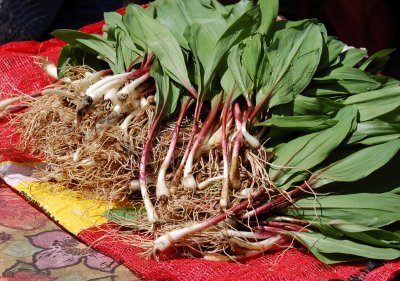
Ramps in their native habitat

Last weekend, we returned to Williams River to dig ramps, cook them, play music, and camp with our friends from Greenbrier County. In the last five years that I've gone, it's always been cloudy, rainy, cold, or snowing. This past weekend was sunny and delightful, and I took lots of pictures.

Above, you see ramps in their native habitat; here this includes some lovely dutchman's britches. Below are washed ramps, ready to cut up and cook, and below that, you see some of the cooking crew at work.

Ramps are more than a tasty spring treat; they are an Appalachian cultural phenomenon, and I'm afraid I'm not qualified to explain it. I'm just pleased to participate. As you can see, they are a sort of wild leek, and they are delicious cooked in eggs, potatoes, meatloaf, or on their own, as a vegetable dish. They are good raw, too, but they linger on your breath and your skin for days, like garlic, but much more pungent, so you need to make sure all your family eats them raw at the same time.

Ramps washed and ready to cut up Ramp cleaning crew

Monday, April 24, 2006

Technology, High and Low

I've spent another week absorbed in technology. I've been researching why the sound acts strange on an old laptop, and upgrading my hardware with some more memory. It isn't interesting to report, but I do seem to become obsessed with a problem until it's solved. On a pleasurable note, I finally bought a digital camera, and it arrived Friday evening. Learning how it works is much more fun than tracking down the culprit in an IRQ conflict on that senescent laptop.

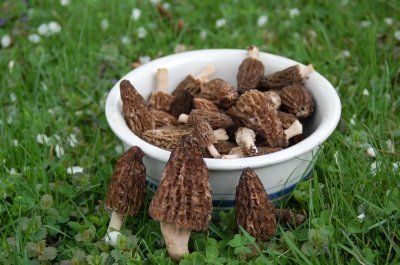
Friday morning we looked for mushrooms on Williams River. We found these black morels. I photographed them Saturday morning, after I got the new camera up and running, during a lull in the rain. The white petals are from the pear tree in the yard. Saturday night we enjoyed morels in a white sauce over pasta.

A bowl of black morels

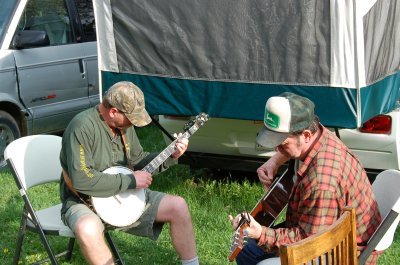
We had company on Saturday afternoon--quite an unusual occurrence. As a result, some nice traditional tunes were picked in our yard. The camper is popped up because we are working on an intractable electrical problem.

Tim and Larry picking some tunes in the yard

Thursday, February 23, 2006

Banjo: Sly Plot of the Devil or Vestigial Remnant of High Culture?

Book Cover: Finding Her Voice--Illustrated History of Women in Country Music

I had read in several sources, including Finding Her Voice: Women in Country Music, 1800-2000, that William Wells Newell (1900, The Journal of American Folklore) and Emma Bell Miles (1904, Harper's Magazine) were the first to publish articles about traditional Appalachian music. That's why I was surprised to find these paragraphs in John Fox's 1898 million-seller novel The Little Shepherd of Kingdom Come. Fox seems to see the music as a metaphor for the mountaineers: "Rude, rough, semi-barbarous, if you will, but simple, natural, honest, sane, earthy--and of the earth whence springs the oak and in time, maybe, the flower of civilization." He often describes the hill people as if they were some raw material--soil to grow the fine civilization of the Bluegrass, or a commodity to be exported to the Bluegrass and molded into noble citizens like our boy Chad Buford. Significantly, Fox was involved with the Jellico coal mines, which also moved raw materials from the Appalachians down to the flatlands, where civilization turned it into money for the mine owners. With one of the first best-sellers of the twentieth century, I reckon you could say he found a way to export the mountaineers and turn a profit, too.

But I digress. Here is the earliest description I've seen of traditional Appalachian music and dance, along with an interesting suggestion that it reflects a remnant of noble culture, rather than a pernicious pastime for the missionaries to stamp out.

"Who was that a-pickin' that banjer?"

It was not often that Dolph showed such excitement, but he had good cause, and, when he saw Chad standing, shamefaced and bashful, in the middle of the floor, and Melissa joyously pointing her finger at him, he caught up the banjo from the bed and put it into the boy's hands. "Here, you just play that tune agin!"

Chad shrank back, half distressed and half happy, and only a hail outside from the first of the coming guests saved him from utter confusion. Once started, they came swiftly, and in half an hour all were there. Each got a hearty welcome from old Joel, who, with a wink and a laugh and a nod to the old mother, gave a hearty squeeze to some buxom girl, while the fire roared a heartier welcome still. Then was there a dance indeed--no soft swish of lace and muslin, but the active swing of linsey and simple homespun; no French fiddler's bows and scrapings, no intricate lancers, no languid waltz; but neat shuffling forward and back, with every note of the music beat; floor-thumping "cuttings of the pigeon's wing," and jolly jigs, two by two, and a great "swinging of corners," and "caging the bird," and "fust lady to the right CHEAT an' swing"; no flirting from behind fans and under stairways and little nooks, but honest, open courtship--strong arms about healthy waists, and a kiss taken now and then, with everybody to see and nobody to care who saw. If a chair was lacking, a pair of brawny knees made one chair serve for two, but never, if you please, for two men. Rude, rough, semi-barbarous, if you will, but simple, natural, honest, sane, earthy--and of the earth whence springs the oak and in time, maybe, the flower of civilization.

At the first pause in the dance, old Joel called loudly for Chad. The boy tried to slip out of the door, but Dolph seized him and pulled him to a chair in the corner and put the banjo in his hands. Everybody looked on with curiosity at first, and for a little while Chad suffered; but when the dance turned attention from him, he forgot himself again and made the old thing hum with all the rousing tunes that had ever swept its string. When he stopped at last, to wipe the perspiration from his face, he noticed for the first time the school-master, who was yet divided between the church and the law, standing at the door, silent, grave, disapproving. And he was not alone in his condemnation; in many a cabin up and down the river, stern talk was going on against the ungodly 'carryings on,' under the Turner roof, and, far from accepting them as proofs of a better birth and broader social ideas, these Calvinists of the hills set the merry-makers down as the special prey of the devil, and the dance and the banjo as sly plots of the same to draw their souls to hell.

(page 42, chapter III)

Monday, February 06, 2006

Now Play It Like You Mean It

I was looking for a reference on the Internet the other day, and I found this, a peripherally related topic. This is from Roadside Theater's Web site, an essay entitled Art in a Democracy, by Dudley Cocke. (Text from The Drama Review, Fall 2004, Social Theatre, Vol. 48, Issue 3)

Locating Oneself in a Tradition

Thirty-odd years ago, a famous folksinger from California came to the coalfields of central Appalachia to perform in a high school auditorium. A big crowd was on hand as a local string band opened the concert. The local band, rising to the occasion, had the audience's rapt attention. The famous folksinger followed with some success. Backstage, she made a point to congratulate the local band on their performance, noting that she, too, often sang from the same Appalachian song book. She went on to say how keenly the audience had been listening to their music and wondered what their secret was. "What is that little something extra you seem to have?" she asked repeatedly, each time more emphatically. The local band looked at the floor as she pressed for an answer. Finally the fiddle player spoke up, "Well ma'am, the only difference that I could tell was that you were playing out front of them ol' songs, and we were right behind 'em."

Aha! I said to myself. This person is getting close to that indescribable something that traditional Appalachian string bands have that is missing in so many "revivalists'" performances. Perhaps he's defined it for me. Then, he goes on to quote Ralph Ellison.

Ralph Ellison deftly spins the fiddler's point:

There is a cruel contradiction implicit in the art form itself. For true jazz is an art of individual assertion within and against the group. Each true jazz moment (as distinct from the uninspired commercial performance) springs from a context in which each artist challenges all the rest, each solo flight, or improvisation, represents (like the successive canvases of a painter) a definition of his identity: as individual, as member of the collectivity, and as link in the chain of tradition. Thus, because jazz finds its very life in an endless improvisation upon traditional materials, the jazzman must lose his identity even as he finds it. (Ellison [1964] 1995:234)

Don't get me wrong, now. I admire Ralph Ellison up one side and down the other. "True jazz moment" versus "uninspired commercial performance" sounds like he's getting to the heart of the matter. I just have no idea how "each solo flight" is like "successive canvases of a painter," or is a definition of the musician's identity. Maybe it's true, but I'm no wiser than before.

Maybe you can't do better than John Blisard, who advises aspiring musicians: "Now, play it like you mean it."