Showing posts with label Pocahontas County. Show all posts

Friday, June 01, 2012

Latest Bigfoot Sighting on Droop Mountain (Or Is It the Mothman?)

Our game camera pictures have been plentiful, and much alike. These deer visit regularly. However, Monday morning, the camera caught this:


Seconds later, whatever it was, it was gone.


Was it a bear having a bad hair day? Was it the the Mothman? (If so, he's a long way from Point Pleasant.) We decided it was probably Bigfoot. After all, the BFRO's 2006 sighting on the Greenbrier River Trail was so convincing that they mounted a return expedition in 2008. Of course, we can't rule out the possibility that it was the Yayho, as described by Burl Hammons.

Monday, January 23, 2012

Digitization Policies for the Web

Apropos of the SOPA/PIPA controversy last week, I've revised my short paper on digital copyright issues written for a local history project a few years ago. The website where it was posted has since been shut down, so I'm re-posting it here for my own reference. Even without SOPA/PIPA, modern copyright law has a stifling effect on preserving genealogy and local history, while profiting no one. "Orphan works" still under copyright, are being lost because they cannot legally be curated or shared on the Internet.

Pocahontas County Historic Preservation Project: A First Draft of Digitization Policies

Goals of the Digitization Project
  • To facilitate preservation of historic materials through digitization.
  • To make freely available as much material as possible, over the web and through local libraries, museums, and historic sites.
  • To behave in a scholarly, courteous, and responsible manner to those who create or donate historic materials and to those who wish to access such material for noncommercial purposes. This must include acting in accordance with copyright, property, and privacy laws.

Digitization has tremendous potential to enhance preservation of historic materials, and to make all types of information available to interested parties around the world at little cost. However, it also presents novel problems in intellectual property rights. Who owns the rights to reproduce materials, and what may be done with the digital copies? There have been many changes in intellectual property rights law in the last 20 years, and there are few simple, straightforward answers to these questions.

I believe there are some cases in which we can use materials without fear of infringing anyone's rights.

  • Text and photographs published prior to January 1, 1923 are considered in the public domain. At least one item of interest to our project, William T. Price's Historical Sketches of Pocahontas County, has been scanned by the Google Books Project, and is freely available at their website in pdf and ascii text files.
  • Works of the United States Government, and other government-generated writings, as described by the West Virginia Division of Culture and History.
  • Any work that was neither published nor registered as of Jan. 1, 1978, and whose author died before 1933 entered the public domain on Jan. 1, 2003, unless it was published on or before Dec. 31, 2002. (U.S. Copyright Office, see passage in Appendix.)
  • Unpublished works that have been donated, along with their copyrights, to the Historical Society, the Genealogy group, or the Library system. (See the "Deed of Gift" references in the Appendix.) For example, if a diary and some family snapshots are donated by the creator's heir, along with explicit permission to share and reproduce, we may legally digitize and post these on the Web site.
  • Our own photographs of three-dimensional artifacts, with the permission of the artifact owner.
  • Descriptions of the materials in our local collections, using the Archon archive content management system to list our holdings on the Web, even where we cannot find the copyright owner or obtain permission. We can display excerpts of text or images as long as we comply with the Fair Use Doctrine. (Described by the Copyright Office, see Appendix.)
  • Digital copies of unpublished works under copyright protection can be made (up to three copies) by a library for preservation purposes, but they cannot be posted on the Internet, or otherwise displayed or distributed. (Section 108 of the U.S. Copyright Code, see Appendix for a link.)

Items that may not be available for digitization or publication on a Web site include:

  • Studio and professional photographs where the photographer was still living as of January 1, 1933. The person who commissioned the photo did not get copyrights at purchase. These remained with the photographer, unless explicitly surrendered.
  • Photographs and papers found and donated to the Historical Society. Although these organizations have legal ownership of the physical objects, copyright does not automatically convey with the object.
  • Published materials under copyright protection where the copyright holder is unidentifiable, unavailable, or unwilling to give permission for digitization.

To proceed with the digitization project, we need to identify which materials we have legal right to digitize, obtain permission to use materials where necessary, and determine how we want to share our own materials.

  • We need to identify copyright holders for materials already in possession of the Historical Society, the Pearl Buck Birthplace, and the libraries. Where this is known, we can request permission to digitize and share materials.
  • As we gain access to new materials, we need to get permission in writing to digitize and share the materials. There are several "Deed of Gift" templates available for us to use in developing our own permission form. (See "Deed of Gift" in Appendix.) It will be important to make sure this form does not sound ominous, intimidating, or excessively technical, lest it have a "wet blanket" effect on offers of information.
  • We need to spell out our copyright for the Web site. I suggest a Creative Commons Attribution-Non-Commercial license, but this will only apply to materials where we own the copyright (for example, things the Historic Preservation Officer writes while "on the clock;" new photographs of historic locations and objects taken specifically for the digitization project, etc.) Where we use materials by permission with attribution, we have no authority to grant permission to another party.

  • The possibility of print publications such as books, calendars, and recordings has been discussed, especially as a form of fund raising for the support of the various institutions involved. Copyright issues must be considered especially carefully for such projects, as they are more carefully examined in for-profit situations.

Appendix: Quotations From Pertinent Sources

Copyright Office On Protection of Digital Rights

Pertinent information from the United States Copyright Office Frequently Asked Questions:

It is illegal for anyone to violate any of the rights provided by the copyright law to the owner of copyright. These rights, however, are not unlimited in scope. Sections 107 through 121 of the 1976 Copyright Act establish limitations on these rights....One major limitation is the doctrine of "fair use," which is given a statutory basis in section 107 of the 1976 Copyright Act....

A party may seek to protect his or her copyrights against unauthorized use by filing a civil lawsuit in federal district court. If you believe that your copyright has been infringed, consult an attorney. In cases of willful infringement for profit, the U.S. Attorney may initiate a criminal investigation....

If you use a copyrighted work without authorization, the owner may be entitled to bring an infringement action against you. There are circumstances under the fair use doctrine where a quote or a sample may be used without permission. However, in cases of doubt, the Copyright Office recommends that permission be obtained....

....Uploading or downloading works protected by copyright without the authority of the copyright owner is an infringement of the copyright owner's exclusive rights of reproduction and/or distribution. Anyone found to have infringed a copyrighted work may be liable for statutory damages up to $30,000 for each work infringed and, if willful infringement is proven by the copyright owner, that amount may be increased up to $150,000 for each work infringed. In addition, an infringer of a work may also be liable for the attorney's fees incurred by the copyright owner to enforce his or her rights.....

....Photocopying shops, photography stores and other photo developing stores are often reluctant to make reproductions of old photographs for fear of violating the copyright law and being sued. These fears are not unreasonable, because copy shops have been sued for reproducing copyrighted works and have been required to pay substantial damages for infringing copyrighted works. The policy established by a shop is a business decision and risk assessment that the business is entitled to make, because the business may face liability if they reproduce a work even if they did not know the work was copyrighted....

....In the case of photographs, it is sometimes difficult to determine who owns the copyright and there may be little or no information about the owner on individual copies. Ownership of a "copy" of a photograph the tangible embodiment of the "work" is distinct from the "work" itself the intangible intellectual property. The owner of the "work" is generally the photographer or, in certain situations, the employer of the photographer. Even if a person hires a photographer to take pictures of a wedding, for example, the photographer will own the copyright in the photographs unless the copyright in the photographs is transferred, in writing and signed by the copyright owner, to another person. The subject of the photograph generally has nothing to do with the ownership of the copyright in the photograph. If the photographer is no longer living, the rights in the photograph are determined by the photographer's will or passed as personal property by the applicable laws of intestate succession.....


Materials In the Public Domain

When U.S. Works Pass Into the Public Domain provides a chart to clarify the rules. The simplest entry indicates that works published prior to January 1, 1923 are in the public domain. Complexity increases from there.

The Copyright Office explains how unpublished works may enter public domain: Certain Unpublished, Unregistered Works Enter Public Domain.

Certain works that were neither published nor registered for copyright as of Jan. 1, 1978, entered the public domain on Jan. 1, 2003, unless the works were published on or before Dec. 31, 2002.

Under the 1909 Copyright Act, works that were neither published nor registered did not enjoy statutory protection, although they were protected under common law in perpetuity as long as they remained unpublished and unregistered. But under section 303 of the 1976 Copyright Act, works that were created but neither published nor registered in the Copyright Office before Jan. 1, 1978, lost their common law protection and acquired a statutory term of protection that was the life of the author plus 50 years, amended in 1998 to life plus 70 years.

As a result of the 1976 Copyright Act, any of the works in question whose author had died over 50 years prior to 1978 would have entered the public domain after Dec. 31, 1977. To provide a reasonable term of copyright protection for these works, and in light of the fact that these works had enjoyed perpetual protection under common law, Congress extended their term by at least 25 more years. Congress also encouraged publication by providing an additional 25 more years, extended in 1998 to 45 more years, of protection if the work was published on or before Dec. 31, 2002.

That first 25-year period expired on Dec. 31, 2002. Any work that was neither published nor registered as of Jan. 1, 1978, and whose author died before 1933 entered the public domain on Jan. 1, 2003, unless it was published on or before Dec. 31, 2002. If the author died in 1933 or later, the work will be protected for 70 years after the author's death, due to the passage of the Sonny Bono Copyright Term Extension Act in 1998.


Fair Use Doctrine

A discussion of the Fair Use Doctrine, by the U.S. Copyright Office

Section 107 contains a list of the various purposes for which the reproduction of a particular work may be considered “fair,” such as criticism, comment, news reporting, teaching, scholarship, and research. Section 107 also sets out four factors to be considered in determining whether or not a particular use is fair:

  1. the purpose and character of the use, including whether such use is of
    commercial nature or is for nonprofit educational purposes;
  2. the nature of the copyrighted work;
  3. amount and substantiality of the portion used in relation to the copyrighted work as a whole; and
  4. the effect of the use upon the potential market for or value of the copyrighted work.

The distinction between "fair use" and infringement may be unclear
and not easily defined. There is no specific number of words, lines, or notes that may safely be taken without permission. Acknowledging the source of the copyrighted material does not substitute for obtaining permission.

The 1961 Report of the Register of Copyrights on the General Revision of the U.S. Copyright Law cites examples of activities that courts have regarded as fair use: quotation of excerpts in a review or criticism for purposes of illustration or comment; quotation of short passages in a scholarly or technical work, for illustration or clarification of the author's observations; use in a parody of some of the content of the work parodied; summary of an address or article, with brief quotations, in a news report; reproduction by a library of a portion of a work to replace part of a damaged copy; reproduction by a teacher or student of a small part of a work to illustrate a lesson; reproduction of a work in legislative or judicial proceedings or reports; incidental and fortuitous reproduction, in a newsreel or broadcast, of a work located in the scene of an event being reported.

Privacy and Publicity Issues

Library of Congress Privacy and Publicity Issues:

While copyright protects the copyright holder's property rights in the work or intellectual creation, privacy and publicity rights protect the interests of the person(s) who may be the subject(s) of the work or intellectual creation. Issues pertaining to privacy and publicity may arise when a researcher contemplates the use of letters, diary entries, photographs or reportage in visual, audio, and print formats found in library collections. Because two or more people are often involved in the work (e.g., photographer and subject, interviewer and interviewee) and because of the ease with which various media in digital format can be reused, photographs, audio files, and motion pictures represent materials in which issues of privacy and publicity emerge with some frequency....

While copyright is a federally protected right under the United States Copyright Act, with statutorily described fair use defenses against charges of copyright infringement, neither privacy nor publicity rights are the subject of federal law. Note also that while fair use is a defense to copyright infringement, fair use is not a defense to claims of violation of privacy or publicity rights. Privacy and publicity rights are the subject of state laws. What may be permitted in one state may not be permitted in another. Note also that related causes of action may be pursued under the federal Lanham Act, 15 U.S.C. P 1125 (a), for example, for unauthorized uses of a person's identity in order to create a false endorsement.

While an individual's right to privacy generally ends when the individual dies, publicity rights associated with the commercial value connected with an individual's name, image or voice may continue. For example, many estates or representatives of famous authors, musicians, actors, photographers, politicians, sports figures, celebrities, and other public figures continue to control and license the uses of those figures' names, likenesses, etc.


How Libraries Manage Copyright Issues Pertaining to Their Digital Collections
Library of Congress

How the Library of Congress handles copyright issues on its Web site, as explained by the United States Copyright Office FAQ's:

I saw an image on the Library of Congress website that I would like to use. Do I need to obtain permission?

With few exceptions, the Library of Congress does not own copyright in the materials in its collections and does not grant or deny permission to use the content mounted on its website. Responsibility for making an independent legal assessment of an item from the Library's collections and for securing any necessary permissions rests with persons desiring to use the item. To the greatest extent possible, the Library attempts to provide any known rights information about its collections. Such information can be found in the "Copyright and Other Restrictions" statements on each American Memory online collection homepage. If the image is not part of the American Memory collections, contact the Library custodial division to which the image is credited. Bibliographic records and finding aids available in each custodial division include information that may assist in assessing the copyright status. Search our catalogs through the Library's Online Catalog. To access information from the Library's reading rooms, go to Research Centers.

Library of Congress "Legal" Page

Whenever possible, the Library of Congress provides factual information about copyright owners and related matters in the catalog records, finding aids and other texts that accompany collections. As a publicly supported institution, the Library generally does not own rights in its collections. Therefore, it does not charge permission fees for use of such material and generally does not grant or deny permission to publish or otherwise distribute material in its collections. Permission and possible fees may be required from the copyright owner independently of the Library. It is the researcher's obligation to determine and satisfy copyright or other use restrictions when publishing or otherwise distributing materials found in the Library's collections. Transmission or reproduction of protected items beyond that allowed by fair use requires the written permission of the copyright owners. Researchers must make their own assessments of rights in light of their intended use.

If you have any more information about an item you've seen on our website or if you are the copyright owner and believe our website has not properly attributed your work to you or has used it without permission, we want to hear from you. Please contact OGC@loc.gov with your contact information and a link to the relevant content.


West Virginia University Libraries

How West Virginia University University Library regulates use of its archives, physical archives: Rules for the Use of Library Materials in the West Virginia and Regional History Collection


Some materials in the WVRHC are protected by copyright laws and other restrictions. The researcher assumes all responsibility for possible infringement of copyright and/or other literary, artistic, property or privacy rights in the act of copying or in the subsequent use of the materials copied....The reproduction of any collection in its entirety is prohibited.

Any publication, exhibition, or other public use of materials reproduced must properly credit the source from which a copy is made. The basic credit line is "West Virginia and Regional History Collection, West Virginia University Libraries"....Researchers are not permitted to photograph any materials in the WVRHC. To order photographs, users may inquire at the reference desk about policies, forms and fees.


West Virginia History Online Digital Collections has rules that offer us a model on proper usage: Notes on Rights and Reproductions. Their West Virginia History OnView: Photographs From the West Virginia & Regional History Collection is the sort of online archive we hope to produce.


West Virginia History OnLine digital resources are available for use in research, teaching, and private study only. These materials may NOT be used for publication or exhibition, downloaded and placed on another server where they can be publicly accessed, or utilized in any other public manner without the express written permission of the West Virginia and Regional History Collection. Such permission may be granted only by a curator of the WV&RHC or by the Dean of WVU Libraries. Any reproduction of materials from this site must properly credit the source of the materials. For archives and manuscripts, the proper credit line includes the full name of the collection, plus "West Virginia and Regional History Collection, West Virginia University Libraries." For works of art, the proper credit line includes the names of the artist and artwork, plus "West Virginia and Regional History Collection, West Virginia University Libraries."

Some Materials in the WV&RHC and on this web site are protected by copyright laws and other restrictions. The researcher assumes all responsibility for possible infringement of copyright and/or other literary, artistic, property or privacy rights in the act of copying or in the subsequent use of the materials copied.


Deed of Gift Forms

Local history research organizations such as libraries, museums, and historical associations, can protect themselves against inadvertent copyright violations by obtaining permission to display and use material at the time it is donated. If your organization accepts gifts (items), then it needs a Deed of gift form.

Here are two other sources for Deed of Gift formats:

Copyright Concerns For Libraries

There are special rules for libraries and digital copying. Section 108 of the U.S. Copyright Code is a graphic presentation of these rules, provided by Copyright advisory network, a site about the latest developments in digital collections and archives.


Modes of Managing Copyright Issues

Online Resources for Further Reading

Saturday, February 05, 2011

Marcellus Shale Extraction in West Virginia

The Charleston Gazette blogs recently featured this link: The industrialization of rural West Virginia caused by the Marcellus Shale gas play. It's well worth a look. There's been some speculation on mineral rights in Pocahontas County recently, and this slideshow has some practical information on what hydrofracturing the Marcellus shale looks like from the surface.

A few years ago, Marcellus Shale gas was unrecoverable, and West Virginia was a relative backwater in the oil and gas industry. The new techniques of high-volume hydraulic fracturing and horizontal drilling have made a sea change in all of that. The Marcellus Shale is now the second largest field of gas -- in the WORLD. It is twice the size of the gas fields in Saudi Arabia. Major oil companies like Exxon are buying up gas resources here. Conventional shallow wells that cost $300,000.00 to drill have given way to 6 to 8 horizontal wells drilled from one well site. And each horizontal well costs $3 Million or more to drill. This drilling causes an exponential increase in surface disturbance, water use and waste disposal. It also requires compressor stations and staging areas and greatly increases demands on roads and other infrastructure.

The slideshow is on the WV Surface Owners' Rights Organization (WV SORO) Website. They introduce their resources with this:

West Virginia is second only to Texas in the number of active oil and gas wells in the country. New drilling permits have more than tripled in recent years and West Virginia surface owners have very few rights to protect them from drillers unless they also own the minerals beneath their land. If you live in one of the state's oil and gas producing counties you know about the polluted streams, needless destruction of timber, lost home sites, careless road building and ruined pastures caused by drillers.

Friday, February 26, 2010

Visiting the Old Med School Boarding House, 1907

From the Susan A. Price collection of the Pocahontas County Historical Society: Susan A. Price, Handwritten on back: "1203 Madison Avenue, Baltimore, Md. Boarding house in my old Medical School days. The picture taken in June, 1907, when I was resident physician at the Weston State Hospital."

Sunday, January 17, 2010

A Peek at My Scanning Project

I've been scanning materials from the Pocahontas County Historical Society archives since this past summer, and the last few days, I've been working on an annual report for the project. Most of the scans are hard to read handwriting, but there are a few photographs. This is Susan A. Price, daughter of my old pal, William T. Price, sometime after she graduated from the Womens' Medical College of Baltimore in 1903. The photo was taken in Marlinton, perhaps in her sister's home, which is now houses the Historical Society's museum. She served as a physician in several mental hospitals, and lived and worked for many years in Williamsburg, Virginia, where she was avidly interested in historical preservation of that city.

Gotta love the outfit--especially those elbow-length kid gloves. Doesn't she look like the cat that ate the canary? Here's another photo taken the same day, showing more detail of her dress, and a more contemplative expression. I suspect that if I had that outfit, I too would read with those gloves on. In fact, I probably wouldn't take off the hat.

Thursday, November 19, 2009

I Fall Out With Reverend Price

Have you noticed that every time I mention William T. Price on here, I fall silent for a long time afterwards? No? It's true. Because I've spent so much time with Reverend Price in the last year, I've tried really hard to like him, or empathize with him, or admire him. For example, he was ready with a sermon for any occasion, complete with some appropriate but relatively obscure Bible verses. Always prepared; always professional--that's surely admirable. He faced many hardships--long days in the saddle, riding from church to church to deliver those professional and polished sermons; the hardships of the Civil War; the vague but looming career disappointment in the years following the war--surely I could conjure some sympathy.

But no. I can't turn my attention away from his apparent snobbery, his Jesus-free Calvinistic sermons, and his disdain for careful editing. It always leaves me in a funk. It's passages like this one (from his Civil War diary) that keep me cranky:

Upon resuming my journey...I saw a solitary person approaching at a brisk, headlong trot. He was mounted on a very ordinary looking horse. The saddle and saddlebags were old and much worn, his shoes were of some home tanned leather, coarse and heavy, very need of the attention of a cobbler, while his clothing was of plain homespun jeans. His loosely fitting coat was threadbare and out at the elbows, and his crumpled slouch hat nearly concealed his shaggy eyebrows beneath which blazed a pair of piercing and inquisitive eyes, such as are seldom seen in a life time and never to be forgotten. He rather abruptly stopped me in the road by a stentorian inquiry whether I was from Beverly.

"How is the vote?"

"I think Secession has the majority"

"Do you say the Secession candidate is ahead? I have the honor to be that candidate."

And this was really so: the successful candidate for the Virginia House of Delegates was before me, elected by the counties of Randolph and Tucker. What a comment upon the democratic tendencies of our political institutions when candidates to be popular should dress like the Biblical Gibeonites and behave accordingly. One of the blessings of this civil war, we may hope, will be to inaugurate a happier era by sweeping the depraved and vicious from the political arena, or teach them to prize their political privileges by choosing the best, not the worst looking of men for their rulers.

Thursday, October 15, 2009

On(line) to Grafton: A Civil War Journal

For the last few months I've been scanning documents from the Pocahontas County Historical Society's archives. I'm still working my way through the William T. Price family collection. The oldest material I've worked with is from the 1840's, and it does give a glimpse of our local area at that time--not an easy or comfortable time and place.

This week, Reverend Price's Civil War journal, which he published in 1901 as "On to Grafton," is "serialized" on our Pocahontas County History web site. Rev. Price was a Virginian, and like most of the people in this area, approved of secession. Here's what he had to say about "The Cause" on his second day out on the Grafton campaign:

Early in the afternoon I reached Huttonsville in Randolph County where I found the people much excited and worried, and wearied to the verge of exhaustion by attention to soldiers a day or two before. Some persons seemed very desponding of the final outcome....I tried to cheer them up by saying to them that the cause of Virginia is a just one, such as the God of Hosts would approve. We might be slain in battle but never conquered....The question then was whether we should sustain the usurption of power and draw the sword against our friends, or whether it should be resisted and stand on the defensive. If let alone no blood would be shed, but if assailed then battle for all that is near and dear to the noble heart.

Moreover in my table and fireside conversations I tried to impress the minds of all that the question now is whether Virginia shall have the privilege of self government and regulate our taxes according as our interests and social institutions require, or whether we are to have our laws made for us, and enforced by rulers, whose popularity at home is in direct proportion to their hatred of us and abuse of our social and political institutions.

As a seminary trained minister, Rev. Price's opinion on which side the Lord of Hosts would approve must have carried some weight. I find myself anachronistically despondent reading (and transcribing) all the pre-battle puffing up. I want to tell them, "No! Don't! Just stay home--it's going to be worse than you can even imagine." There is, of course, no talk of slavery at all. It appears that it was not considered polite to mention it. Rev. Price and all the other writers of this time use the word "servant" when they must talk of people owned as chattel. It's a nicer word, and it's in the Bible, so it must be OK.

Friday, June 19, 2009

Hillsboro Makes the Atlantic Monthly

Hillsboro, my mailing address, got a brief feature last month in The Atlantic Magazine online: Taking Comfort in Small Joys. The series, correspondent Christina Davidson's "Recession Road Trip," has this mission:

For the next four months I will travel the back roads and State highways through the 48 contiguous United States, uncovering stories of economic survival and endurance. In diners, bars, bingo halls and coffee shops, I seek those Americans who have lost everything--except hope.

The tone of the Hillsboro piece is complementary--

...within the state, the ruggedly self-sufficient culture that endemic poverty has engendered represents strength and independence--a thing of pride for residents. Most importantly--for the purposes of this project--that natural state of being for West Virginia has acted as a kind of buffer against some of the heartbreak and despair the recession has visited upon wealthier parts of the country.

One hopes that the accuracy of her subsequent articles will be better. She has several errors of fact (one per paragraph, by my count), such as mistaking the West Virginia household income for the per capita income, making West Virginia sound like a financially flush place. Still, I do like her take-away message:

Valuable recession lessons can be gleaned from the West Virginia experience: Never buy what you don't need. And learn how to can.

Thursday, May 21, 2009

Diane Saunders Critiques American Presidents' Fiddle Playinig

I've been spending more time with Historical Sketches of Pocahontas County by William T. Price (1901) over at Pocahontas County History, and I just posted my favorite account from the "Biographic" section. Here is the narrative portion:
Diana Saunders, p. 201, Historical Sketches of Pocahontas County by William T. Price (1901)

Soon after the war of 1812 there came to our county one of the most interesting and eccentric personalities that our older people remember anything about, Mrs Diana Saunders, late of Rocky Point on Dry Branch of Swago. She was the widowed mother of four children, Anna, Eleanor, Cyrus, and Isaac. Her cabin home was built near the head springs of Dry Branch, almost in speaking distance of the Rocky Point school house, and just below....

But few persons have left their impress upon the writer's memory more vividly than Mrs Diana Saunders. As to her personality, she had been formed in "Nature's choicest mould" and in her youth must have been the peer of Edgar Allen Poe's "rare and radiant maiden." The writer recalls one or more of her granddaughters as among the most perfect models of feminine form and feature that he has observed anywhere.

From the way Granny Saunders used to speak of Jim Madison, Jim Monroe, and Tom Jefferson, and wonder how such finicky, limber-jointed, red headed, fiddling and dancing customers had ever been made Presidents of our United States, it is inferred that her blooming youth must have been passed in Orange and Albermarle atmosphere.

The writer was frequently told by his lamented mother that when he was an infant about six weeks old he had the whooping cough so severely that he was given up to die. As a last resort Granny Saunders was sent for in all haste, and when she arrived the baby was to all appearances cold and dead. The doctress ordered a tub of hot water, plouted the baby in, soaked him awhile and gave him a good rubbing. She then called for a razor and a goose quill, scarified the little body between the shoulders, inserted the quill and gave him a blowing up until the infant began to blow for himself. He came to and recovered, and has been blowing seventy years on his own hook, figuratively speaking. There have been times in his life when the writer has felt rather regretfully that Granny Saunders managed her case so well as to keep him from dying at that safe time. Now, however, he feels thankful to God for what she was able to do. He deems it a most wonderful privilege to have lived the life the Supreme Being has allotted to him. Though this life has been humble and obscure, full of mistakes and blunders, still, blessed be His Holy name, for life and its wonderful hopes for the hereafter, when the Lord comes.

It would be hard to exaggerate the useful services Performed by Mrs Saunders for a half century or more, when there was no resident physician nearer than the Warm Springs or Lewisburg. For years and years her time was virtually spent in the homes of the suffering. Stormy nights, swollen, raging mountain streams and torrents were braved by this heroic woman to be with the sick in their distress.

While it is true the most of her services were rendered in scenes over which the thickest veil of privacy should be ever drawn, yet it may not be out of good form to say that she never lost her self possession. The patient might be to all appearances in extremis, with less than a step between her and death in the throes of of maternity, all present convulsed with grief and apprehension except Granny Saunders. She would dip her pipe in the ashes, ejaculate prayers along with the puffs of smoke, and sit down by the patient: "Hold on old girl, we can't spare you yet; pick your flint and try it again. I have been praying for you, and the good Lord Almighty never goes back on his word to old Granny Saunders."

In the course of an hour or so, Granny Saunders looks up the "old man." When she finds him she opens her arms as if to embrace him. He draws back exclaiming, "Oh Granny, don't do that!" "Well, you ugly beast, if you won't let me kiss you, come in and see what a pretty thing the good Lord has sent your old woman. How it could be so pretty no one could tell without seeing the mother!"

One of the most praiseworthy traits in the character of this grand woman was her abhorrence of "doggity ways," as she would tersely put it. She was greatly worried by the way a young man seemed to be treating a girl in whom she felt a motherly interest. Appearances seemed to indicate that the "young rascal of a puppy" had plucked the rose, but left the thorn with her heartbroken young friend; or in other words bad fooled her upon a promise of marriage.

One day, it seems, the young man met her in the road, and he said: "Granny Saunders, if you do not quit talking about me as I hear of you doing, I shall have to sue you for slander.

The old lady cleared her decks for action, rolled up her sleeves and shook her fist under his nose. "I am ready for you here, at the court house, or anywhere else, outside the bottomless pit. There is where pups like you are bound to go, so I will not promise to have anything to do with you there. I cannot blame a Beaver Dam evening wolf for coming over here and stealing a lamb, for it is built that way, and can't know any better, but when I see a customer like you, with good looks, good natural sense and belonging to a decent family, guilty of things the Old Boy would be above doing, I must tell you, I do say I must tell you the dirtiest, yellow, egg-sucking dog in all Pocahontas is an angel to what you are. If the devil knows you as I do, and thinks of you as I do, he will put you on one of his hottest gridirons all by yourself, as not fit company for any other lost soul."

Granny's words seem to have been "winged ones." The suit was never brought for slander, he mended his ways, looked through his Bible and found a verse in Paul's writings that convinced him that the easiest way out of the tangle would be to marry as he had promised.

If there could have been kept a faithful record of all her doings and sayings it would have made a book by itself, nothing like it in extant literature. She had an entertaining story of the time the troops were on the march to Yorktown, and about Washington stopping at the yard fence and calling for water. Her mother sent her out with bucket and gourd, fresh from the well, and watered the thirsty general and staff attendants. "They took their water, and I tell you they all drank a few, and then the grandees rode away with high heads and stiff upper lips, looking at me as if they thought it was about all that I was fit for, to handle the water gourd for their pleasure."

She had many stories that thrilled the little folks. One was about a child being born in 1775 that only lived a few minutes. Before it died it said just as plainly as could be spoken by a grown person:

"A warm winter and a cold spring,
A bloody summer and a new king!"

One of her most popular lullabys had this refrain:

"Sleep all day and cry all night,
Whippoorwill, whippoorwill."

Persons yet living remember the reply she once made to the salutation, "Well, Granny, how are you today?"

"Poorly enough, to tell you truth. O dear, I am just here and that is all. I have pains in my face, pains in my ears, pains in the top of my head, at the back of my neck, between my shoulders, in my arms, in my breast, in my body, in my knees, in my ankles, in both my big toes." Then pausing a moment as if trying to think of more places for pains, she would raise her eyes toward heaven and devoutly exclaim, "But praise the Lord, bless His Holy Name, I have a good appetite!"

Late in the fifties or early in the sixties, she went to make her home with Isaac and Anna, on New River, where she died fifteen or twenty years ago, aged about a hundred and three years as most of her acquaintances believe. Dear old friend, the Creator has not sent many like her to our part of the world as yet.

Tuesday, May 12, 2009

Sycamores and Pioneers

I'm still pecking away at Historical Sketches of Pocahontas County, making a search-able, sort-able version on Pocahontas County History for the genealogy researchers. I have about 70 more "sketches" edited and waiting to go into Drupal. Some of them have brief stories included, others are just lists of descendants.

Last week, Sherry Chandler shared some fascinating excerpts from her reading on Kentucky history, including Samuel Shepard's diary entries, in which he notices a family encamped inside a hollow sycamore tree. As it happens, our most famous local history story involves Marlinton's founders, Marlin and Sewell, and how one of them came to spend the winter living in a sycamore.

Jacob Marlin and Stephen Sewall, p. 105, Historical Sketches of Pocahontas County by William T. Price (1901)

The first persons of English or Scotch-Irish antecedents to spend a winter in what is now Pocahontas County, were Marlin and Sewall. This was the winter of 1750-51. Their camp was in the delta formed by Marlin Run and a slough or drain near the east bank of Knapp's Creek.

In the course of time--having agreed to disagree--they separated and were found living apart, by Colonel Andrew Lewis, Marlin in the cabin and Sewall in a hollow tree. Upon expressing his surprise at this way of living apart, distant from the habitation of other human beings, Sewall told him they differed in sentiments and since the separation there was more tranquility, or a better understanding, for now they were upon speaking terms, and upon each morning "it was good morning, Mr Marlin, and 'Good morning, Mr Sewall!'"

Under the new arrangement, Sewall crossed the slough, and instead of building another cabin, went into a hollow sycamore tree on the west margin of the slough, quite near where the board walk now crosses, and about in line with a walnut tree now standing on the east bank of the drain and the court house.

The lower part of this tree bore a striking resemblance to a leaning Indian tepee. The cavity could shelter five or six persons, and the writer has been often in it for shade or for shelter from rain or heat. At the top of the cone, some eight or ten feet from the ground, the tree was not more than twenty inches in diameter, and at that height was chopped off about the year 1839, to avoid shading the crops. Thus the stump was left, a great convenience for shade or shelter, until it disappeared during the War, being probably used for a camp fire.

These persons differed, Sewall told Colonel Lewis, about their "relagian." There is a traditional hint that "immersion" was the theme of contention. But it is more than probable that one was a conformist and the other a non-conformist to the thirty-nine articles of the English rubric. This is known to have been a very live question of those times, both before and after.

This new arrangement did not last long, and Sewall in search of less molestation about his religion, withdrew about eight miles to a cave at the head of Sewell Run, near Marvin. Thence he went forty miles farther on to Sewell Creek, west Greenbrier, and was found and slain by Indians. How impressively this illustrates the evils of religious controversy, so called.

"Against her foes religion well defends, 
Her sacred truths, but often fears her friends. 
If learned, their pride: if weak their zeal she dreads 
And their heart's weakness who have soundest heads;
But most she fears the controversial pen, 
The holy strife of disputatious men, 
Who the blest Gospel's peaceful page explore, 
Only to fight against its precepts more." 

It is moreover interesting in this connection to recall the fact that on the banks of Marlin's Run is the burial place of a little child that was dashed to death by an Indian warrior in 1765, when overtaken by a party of Bath and Rockbridge men, seeking to rescue Mrs Mayse, her son Joseph, an unmarried woman with an infant in her arms, a Mr McClenaehan, and some other captives. This burial place is a few rods diagonally from the east angle of Uriah Bird's barn on the margin of the rivulet. The infant corpse was buried at the foot of the tree where it had been found a few minutes after its death. The burial took place just a few hours later, before the pursuers set out on their return. The grave was dug with hunting knives, hatchets, and naked fingers. The little body laid in its place very tenderly, and the grave partly filled with earth. The covering of the grave was completed with rather heavy stones, to prevent foxes or other animals from getting at the remains.

Thus died and was buried the first white child known to history west of the Allegheny Mountains.

Joseph Mayse, 13 years old, was rescued at that same time, somewhere between the Island and the mouth of Indian Draft. In 1774 he fought in the battle of Point Pleasant, where he was wounded, and after suffering from the injury for forty-six years, his leg was amputated. He recovered, and lived a number of years thereafter, a busy man of affairs. He died "serene and calm," April, 1840, in the 89th year of his age.

In the Richmond Dispatch, April 14, 1901, it is stated that the last survivor of the Point Pleasant veterans was Ellis Hughes, who passed away at Utica, O., in 1840, over ninety years of age. In early manhood he may have lived in the Lower Levels of our county. Now if it was known what month Hughes died in, it could be decided who was the last one of the veterans to bivouac in those "silent tents" that Glory "guards with solemn round."

Monday, May 04, 2009

Historical Sketches of Pocahontas County In the 21st Century

The last few weeks I've been spending a lot of time with Historical Sketches of Pocahontas County by William T. Price (1901), which is now available on Google Books. You can download the pdf file, and for a while you could also grab the unedited OCR version of the text, although this doesn't seem to be available anymore.

About 400 pages of this tome record are genealogical records, interspersed with short reminiscences about the early settlers in Pocahontas County. Because so many people are looking for this information, I'm converting it into html on our website, Pocahontas County History. Over the years, I've encountered unattributed quotes from Reverend Price's book on many different genealogy websites, and last summer I discovered that WPA employees had typed out long passages from the 1901 book in the late 1930'a and early 1940's. Some of these typists identified their source, while others did not, but these typescripts have been appearing here and there on the Internet as well, never with proper attribution.

I must confess, the more time I spend with the late Reverend Price (pictured above), the more exasperated I become with some of his bad editorial habits; however, I don't want his work floating around the Interwebitubes without proper attribution. Besides, with Drupal set up for decent search engine optimization, more people should be able to find their ancestral names and places once the worthy reverend's words are rendered into hypertext markup language. (Worthy ancestors being the only kind he bothered to catalog.)

Sunday, May 03, 2009

Gear Shifting and Fragmentation

Hudson Super Wasp hood ornament

I've never been great at shifting gears mentally, so my current work configuration offers me a real challenge. I'm teaching courses in chemistry, statistics, and Microsoft Word 2007, while developing a new course for beginners in Excel spreadsheets. Meanwhile, I'm still the county historic preservation officer, which means I'm maintaining two online databases, digitizing content, looking for grants, and planning museum and archive curation. These are part-time jobs, and don't, in theory, add up to more than a 45-50 hour work week.

In theory, theory and practice are the same, but in practice, they are different. In practice, I have a hard time thinking, "OK, that's it for biochemistry this week. Now I'm going to update Drupal and proof-read a genealogy text. After that, I'll write an exam for the junior college computer students, and then, cook supper." It should work, but it doesn't. I'm still thinking about gene promoter and enhancer sequences as I retype sections of the "The Descendants of Thomas Galford." Later, I'll be thinking about the ravages of the Civil War on the Allegheny Front's inhabitants as I try and think how to test students' understanding of formatting features in word processing. And eventually, as I think about hanging intents and margins, I'll probably dump too much pepper in the mashed potatoes again.

I shouldn't complain about having paying jobs, and I do like variety. Nevertheless, I feel as if my mental gears are in danger of being stripped.

Tuesday, April 21, 2009

Yew Piney Mountain

You never know what you'll run across on line; I found Pocahontas County musician Pam Lund playing banjo with fiddler Dave Bing on "Yew Piney Mountain." The Yew Mountains, aka the Yew Pine Mountains, are in the Cranberry Wilderness Area here. The fiddle may catch your ear first, but listen for Pam's banjo. No muss, no fuss, just as good as it gets.

Wednesday, March 04, 2009

Plunging Head First Into the Twentieth Century

Last week, we tried to enter the twenty-first century. We hadn't wanted to rush into it, but it does look like it might take off. Because I'm teaching college courses in Beckley one day a week and driving home late at night on deserted roads, we decided to get a cell phone for emergencies. There's no cell service here on Droop, but people in Marlinton seem to use them, and every single shopper in the Lewisburg Wal-mart is talking to some ethereal presence, rather than watching where she's pushing that cart. Surely a prepaid cell phone (like the ones the hitmen are always using on the TV police dramas) would be a good idea.

We bought the recommended model in Marlinton, and brought it home, only to discover it had no battery. So we went back to the store and exchanged it. The second phone charged successfully, but it failed half-way through activation. We drove all over Marlinton, the south side of Droop Mountain, and all the way to Frankford, where we got a strong signal, but the phone still wouldn't activate. The nice young tech support man (in the Philippines, I think) was very apologetic, but unable to help. I'll be taking the phone back on Friday.

Today, I ordered the The ARRL Ham Radio License Manual, which, I am assured, is All you need to become an Amateur Radio Operator. Our neighbors are long-time ham radio operators, and keep one in their car for emergencies. The AARL (American Radio Relay League) was founded in 1914. Clearly, we are plunging headfirst into a new century. We're just a little confused about which one.

Sunday, February 08, 2009

Pocahontas History Goes Live

It's got an URL now, and there's something relevant on its index page: Pocahontas County History has gone live on the Web. After all the time I've put into Drupal and the study of archive management arcana, I had hoped to have something more to show for my time. Still, I've got an actual mission statement and some relevant Pocahontas County links, so I guess it beats a "Coming Soon!" page.

If you see typographical errors, factual errors, or can think of a better title for the website, let me know.

The next thing I'll roll out is the Archon database, with its slender but well-organized catalog of Pocahontas County Historical Society archives. (Barring unforeseen disasters, which are common.) After that, Drupal, and then some cool old pictures and local history.

I hesitate to forecast how quickly this will happen because unexpected (but not unwelcome) things have been happening here on the ridge. This project's time line had the content management systems already in place by now.

Friday, January 09, 2009

Rural Surgeons--Endangered Species

This caught my attention last week: Shortage of General Surgeons Endangers Rural Americans by David Brown Washington Post, January 1, 2009. In Pocahontas County, like much of rural America, doctors are few and hospitals are far away, so of course, I read the article. Imagine my surprise to find that they chose to profile the general surgeon from my hometown, Creston, Iowa.

...Robert Kuhl has started his chores, too. The first is fixing the broken hip of a 94-year-old widow who fell the night before. Like so many of the 7,500 people in Creston, she would rather have the operation where she lives than in a big city miles away.

Through an incision in her thigh, Kuhl will saw off the broken end of the femur and replace it with a metal one that fits the joint socket. The procedure is called a hemiarthroplasty. Kuhl is the only person in an 80-mile radius who can do it. It will take him about 90 minutes.

I've never met Dr. Kuhl (I left the state for grad school about the time he started his practice in Creston.), but he replaced my mother's hip 16 years ago, and she made a remarkable recovery. A big part of it was treatment close to home, which, according to this article, is bound to become a scarcer commodity.

For the one-quarter of Americans who live outside metropolitan areas, general surgeons are the essential ingredient that keeps full-service medical care within reach. Without general surgeons as backup, family practitioners can't deliver babies, emergency rooms can't take trauma cases, and most internists won't do complicated procedures such as colonoscopies. But various forces -- educational, medical and sociological -- are making them an endangered species....More than half of rural general surgeons are older than 50, and a wave of retirements is expected in the coming decade.

Thursday, November 06, 2008

Textile History and the Battle of Droop Mountain

Today is the anniversary of the 1863 Battle of Droop Mountain. The reenactors visited last month, when the weather is more likely to be pleasant, but 145 years ago, the Yankees were bombarding our ridge with cannon fire, and the Confederate troops were dug in across the road, where you can still see the remains of their earthworks in Droop Mountain Battlefield Park.

Pearl S. Buck's novelized biography of her mother, Caroline Stulting Sydesntricker, The Exile (1936) includes an account of that battle, a major event in Carie's childhood memories. This book is out of print, unfortunately, because I think it is one of Buck's best works, and its it gives a vivid impression of time and place. Here's a favorite excerpt:

The postwar period in the life of the little West Virginia town [called Hillsboro now] was one of deep spiritual fervor coupled with necessarily ascetic living. This atmosphere was the air which she breathed in her youth, and which forever placed a check upon a nature that was at heart sensuous and beauty-loving. But it gave also the opportunity for experience of many sorts and in this her varied mind delighted. I remember her saying once, "I have done every kind of work needed to maintain life and I am glad of it. After the Civil War there were no shops, nothing to be bought. We grew our own flax and we spun linen thread and made our own sheets and table cloths and inner clothing. We dyed our dresses from cotton and linen thread we had made ourselves and we wove it. I learned to know what colors could be made from different herbs and barks and from roots of many kinds. Sometimes our experiments were failures and we had to wear them just the same. And we sheared sheep and washed the wool and carded it and spun it and wove it. I am glad I learned how to do everything."

This has been my standard of textile austerity for the Civil War era, but not long ago, I ran across an excerpt from Godey's Lady's Book, 1866, entitled Dress Under Difficulties: American Civil War Fashions in the South During the Blockade. Whoever wrote this had a different definition of austerity.

Let those who have never experienced it set their imaginations to work and conceive, if they possibly can, what must have been the condition of ladies in society - and very gay society, too - cut off for four years from their supplies of new dresses, shoes, gloves, linen, buttons, pins and needles, ribbons, trimmings and laces, not to mention the more urgent necessities of new bonnets, hoop-skirts and fashion-plates! How we patched and pieced and ripped and altered! How we cut out, and turned and twisted; how we made our new dress out of two old ones; how we squeezed new waists out of single breadths taken from skirts which could ill spare a single fold; how we worked and strained to find out new fashions and then worked and strained a little harder to adopt them - all these things form chapters in the lives of most of us, which will not be easily forgotten. Those who wish to learn economy in perfection, as well as those who interest themselves in curious invention, will do well to study the experience of the blockaded devotee of fashion.

Tuesday, November 04, 2008

Election Day Wishes

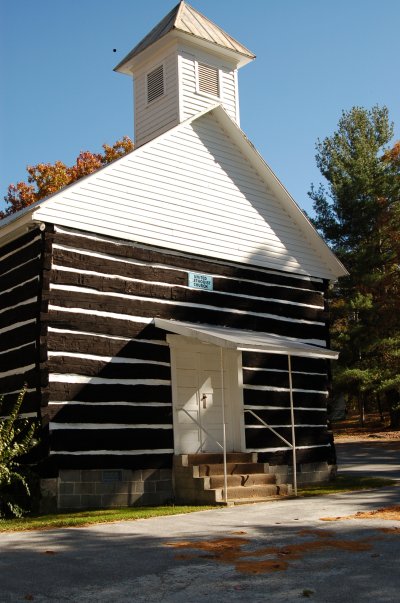
Mt. Olivet Methodist Church, Droop Mountain, WV

This picturesque old church is our polling place on Droop Mountain. I am so glad Election Day is here. I heartily wish that all the TV "journalists" who have covered the election for the last two years will be unemployed tomorrow, and that their positions will be filled by actual reporters who go out and gather information about events of the day.

I also wish unemployment on all misogynist campaign staffers, pundits, and commentators, whatever their gender or political affiliation. I don't care whether they called an older candidate "shrill" and "shrewish," or a younger candidate a "bimbo." They are ashamed to be called "racist;" why should "sexist" still be OK? Unemployment would give these people time to reflect on this contradiction, and would free up gainful employment for those who deserve it more.

I also hope that everyone else will exercise the franchise in a stress-free, pleasant voting experience.

Friday, October 17, 2008

Archives and Digital Collections

Along with selecting, installing and testing archival databases, I've been trying to learn the archivist-lingo, so that I may understand the best ways to proceed with cataloging and digitizing the history-related collections around Pocahontas County. (Hence many hours in front of the computer screen, yet no blog posts.) Here are some of the things I've been reading lately.

Helpful Resources for Archive and Collection Management

Exemplar Archives

More References

Saturday, October 04, 2008

Famous Wolf River Apples

Ever since I moved to Pocahontas County, people have been telling me about the old-time apple variety "Wolf River." This was once a popular variety, but most trees have died out. Apple fans say of them, "One apple, one pie." Last week, a neighbor brought us some Wolf River apples--the three red ones in the picture. The green apple is a normal-sized variety. I've been assured that these are smallish specimens. I really like the color and texture of the skin. I'll be cutting into these today, but I had to catch a picture of them first.