Tuesday, November 14, 2006

Cucumber Sandwiches: Culinary and Social Implications

This summer, I had a few extra cucumbers. Not enough to make pickles or relish, too many to peel and eat. I remembered enjoying cucumber sandwiches one rainy summer day in Scotland, but I couldn't recall what was on them. That's how I happened to put together this strange collection of links. For the record, it was butter, not cream cheese, on the sandwiches I enjoyed, and they were not, I don't believe, excessively effete.

  • Cucumbersandwiches.org
    We are a community open to clergy-husbands of all Christian denominations. We aim to build each other up; and provide a space to consider the issues surrounding the ordination and continuing ministry of our wives.
  • Roni's cucumber sandwiches
    cream cheese, mayo and dry Italian dressing  
    8oz cream cheese
    1/2 c. mayo
    1 pkg. dry Italian salad dressing(1pkg. makes 8oz. dressing)
    3-4 medium size cucumbers
    1 loaf bread your choice
    
  • Esther's Cucumber Sandwiches

    I grew up in England in a household where we had cucumber sandwiches for tea very often; we also used to take them for seaside picnics. Here is the recipe of my grandfather's housekeeper, Esther King:

          Ingredients:
    
        * 1 thin cucumber
        * 1 loaf brown bread, sliced
        * 1 stick sweet butter
        * salt and pepper to taste 
    
    Peel cucumber and slice in paper-thin rounds. Salt rounds lightly 
    and place in colander for 15 minutes to drain. Press to release 
    water; pat dry with paper towels.
    
    Spread sliced bread (bakery whole wheat is closest to English Hovis) 
    with softened sweet butter. Put 2 layers of cucumber slices on bottom 
    slice, salt and pepper to taste, and top with another buttered slice. 
    Press lightly with palm of hand. Cut all crusts off with a sharp 
    knife. Cut sandwiches in half diagonally.
    
  • B's Cucumber Pages: The Cucumber Recipe File

    Here's some ideas of things to do with cucumbers when you're in the culinary mood. All the recipes I find or receive, I post.

  • Cucumber sandwich, from Wikipedia

    The traditional cucumber sandwich is composed of paper-thin slices of cucumber placed between two triangular slices of lightly buttered white bread....

    Cucumber sandwiches contain little protein and so are generally not considered sustaining enough to take a place at a full meal. This is deliberate; cucumber sandwiches have historically been associated with the Victorian era upper classes of the United Kingdom, whose members were largely at leisure and who, therefore, could afford to consume foods with little nutritive value. Stereotypically, cucumber sandwiches formed an integral part of a polite afternoon tea. (By contrast, people of the era's lower working classes were thought to prefer a coarser but more satisfying protein-filled sandwich, in a "meat tea" that might substitute for supper.)

    Some writers have attempted to draw out an association between the daintiness of the sandwich and the perceived effeteness of the British aristocracy. Cucumber sandwiches are often used as a kind of shorthand in novels and films to identify upper class people, occasionally in a derogatory manner. In addition, the sandwiches were once considered appropriate delicacies to offer to visiting clergy, in times when such visits were still a common feature of English middle class life.

    The popularity of the cucumber sandwich reached its upper-class zenith in the Edwardian era, when cheap labour and plentiful coal enabled cucumbers to be produced in hotbeds under glass through most of the year. With the declining popularity of tea as a meal in the United Kingdom, largely a result of the increasing proportion of women working outside the home, there was a corresponding decline in the popularity of cucumber sandwiches, but they are still frequently served at teas, luncheons, and gatherings. They are now increasingly popular in the UK due to the hotter and longer summers, and the range of variants of accompaniments from take-away sources (e.g. supermarkets etc.) are large - hence they are a popular lunchtime snack for workers. Most English cricket clubs supply malt vinegar and ground pepper to dash inside the sandwich and this is the simplest form commonly used in England.

Monday, November 13, 2006

Exploring Applique

I've been experimenting a bit with machine applique. Here are a few links I found with nice, simple applique designs suitable for novice users such as myself.

  • Free Applique Patterns - free sewing patterns - free patterns!
    Our free applique patterns are just waiting for you to print them and cut them out of your favorite materials! The free sewing patterns are simple and easy to sew. These applique patterns are also great to use for applique on quilts. Join Free Applique Patterns newsletter to be notified when more free patterns are posted on this site. Happy sewing!
  • Quiltmaker.com lots of simple applique patterns from Quiltmaker print magazine
  • Cats Who Quilt
    Since this crazy page went up eight years ago, thousands of cat-loving quilters have written to tell me about their cat fabric stashes, their cat quilt patterns--and of course, their cats. I had no idea what a collective nerve I was striking in cyberspace when I came up with this page. I've heard from quilters as faraway as Australia and the Far East telling me how they were snatching up cat print fabrics, just like I am, to make into a cat quilt "someday." You'll find on this Web site links to cat quilt patterns around the Web...news of cat quilting fabric swaps...tips on how to search for out-of-print cat quilt patterns...plus stories of real-life cat quilters.

Sunday, November 12, 2006

Ambrose Bierce in Pocahontas County

Ambrose Bierce visited Pocahontas County on at least two occasions--the first on December 13, 1861, when he was among the Union troops engaged in the Battle of the Top of the Allegheny, and the second time years later, before he published this piece, A Bivouac of the Dead in 1903.

Away up in the heart of the Allegheny mountains, in Pocahontas county, West Virginia, is a beautiful little valley through which flows the east fork of the Greenbrier river. At a point where the valley road intersects the old Staunton and Parkersburg turnpike, a famous thoroughfare in its day, is a post office in a farm house. The name of the place is Travelers' Repose, for it was once a tavern. Crowning some low hills within a stone's throw of the house are long lines of old Confederate fortifications, skilfully designed and so well "preserved" that an hour's work by a brigade would put them into serviceable shape for the next civil war. This place had its battle--what was called a battle in the "green and salad days" of the great rebellion. A brigade of Federal troops, the writer's regiment among them, came over Cheat mountain, fifteen miles to the westward, and, stringing its lines across the little valley, felt the enemy all day; and the enemy did a little feeling, too. There was a great cannonading, which killed about a dozen on each side; then, finding the place too strong for assault, the Federals called the affair a reconnaissance in force, and burying their dead withdrew to the more comfortable place whence they had come. Those dead now lie in a beautiful national cemetery at Grafton, duly registered, so far as identified, and companioned by other Federal dead gathered from the several camps and battlefields of West Virginia. The fallen soldier (the word "hero" appears to be a later invention) has such humble honors as it is possible to give.

His part in all the pomp that fills
The circuit of the Summer hills
Is that his grave is green.

True, more than a half of the green graves in the Grafton cemetery are marked "Unknown," and sometimes it occurs that one thinks of the contradiction involved in "honoring the memory" of him of whom no memory remains to honor; but the attempt seems to do no great harm to the living, even to the logical.

A few hundred yards to the rear of the old Confederate earthworks is a wooded hill. Years ago it was not wooded. Here, among the trees and in the undergrowth, are rows of shallow depressions, discoverable by removing the accumulated forest leaves. From some of them may be taken (and reverently replaced) small thin slabs of the split stone of the country, with rude and reticent inscriptions by comrades. I found only one with a date, only one with full names of man and regiment. The entire number found was eight.

In these forgotten graves rest the Confederate dead--between eighty and one hundred, as nearly as can be made out. Some fell in the "battle;" the majority died of disease. Two, only two, have apparently been disinterred for reburial at their homes. So neglected and obscure is this campo santo that only he upon whose farm it is--the aged postmaster of Travelers' Repose--appears to know about it. Men living within a mile have never heard of it. Yet other men must be still living who assisted to lay these Southern soldiers where they are, and could identify some of the graves. Is there a man, North or South, who would begrudge the expense of giving to these fallen brothers the tribute of green graves? One would rather not think so. True, there are several hundreds of such places still discoverable in the track of the great war. All the stronger is the dumb demand--the silent plea of these fallen brothers to what is "likest God within the soul."

They were honest and courageous foemen, having little in common with the political madmen who persuaded them to their doom and the literary bearers of false witness in the aftertime. They did not live through the period of honorable strife into the period of vilification--did not pass from the iron age to the brazen--from the era of the sword to that of the tongue and pen. Among them is no member of the Southern Historical Society. Their valor was not the fury of the non-combatant; they have no voice in the thunder of the civilians and the shouting. Not by them are impaired the dignity and infinite pathos of the Lost Cause. Give them, these blameless gentlemen, their rightful part in all the pomp that fills the circuit of the summer hills.

  • For detailed information about the battle, visit West Virginia Archives and History's The Battle of the Top of the Allegheny on December 13, 1861 from the West Virginia Legislative Hand Book (1928).

    This is an article about the Battle of the Top of Allegheny, fought in. Pocahontas County, December 13, 1861, between the forces of the Union under Gen. R. H. Milroy, and the forces of the Confederacy, under Gen. W. W. Loring, Col. Edward Johnson, commanding....

  • The Ambrose Bierce Appreciation Society

    This page is dedicated to one of the most under appreciated authors and journalists of all time: Ambrose Gwinett Bierce. "Bitter Bierce" was quite famous in his day, but now only a core following of academics and curmudgeons know about him. And that is a shame. He is most often found in "Quotable Quotes" lists or signature files....

  • The Ambrose Bierce Project

    The Ambrose Bierce Project is an online forum and resource for the study of Ambrose Gwinnett Bierce (1842-1914?), the American soldier, topographer, journalist, and writer.

    Bierce is an important, if underappreciated, presence in American literary history. He is today celebrated especially for his considerable powers as a satirist, and for his mastery of the short story genre. His incomparable writing has compelled many scholars to rate Bierce among America's finest prose talents.

    As a hypermedia project, the ABP strives to bring together Bierce scholars and students from around the globe. Here participants and contributors will exchange ideas, weigh literary analyses, and review new works of scholarship.

    Dear me. The "look and feel" of this site is stunning, but questionable grammar and words like "hypermedia" give me pause.

Saturday, November 11, 2006

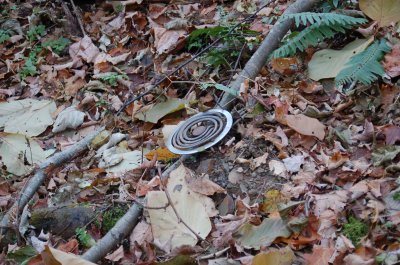
Habitat Photo, Electric Burner

electric stove burner in its native habitat

I think the season for edible mushrooms has passed, but the electric stove burners are starting to ripen. You can see here that they spread above ground by runner, like strawberries.

I looked all around the mountain side, but didn't find any dumped garbage or old farm trash piles. I'm completely puzzled.

Friday, November 10, 2006

The Lord Loves Good Grammar

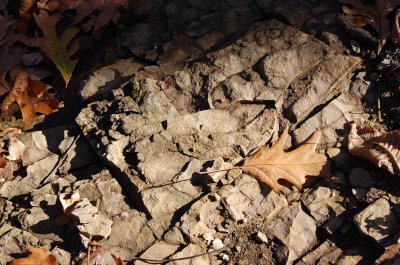
Chert on Droop Mountain

Recently I found a link to Blogs and God's Youth on a blog that aimed to ridicule Christian fundamentalists. It is a publication of the The Restored Church of God, a denomination that started as The Radio Church of God, and I'm a little suspicious of churches that focus on broadcast media. I didn't expect to agree with them, especially because I've tried to use blogging as a way to encourage teenagers to write. However, after seeing my students abandon their creative writing projects on Blogger in favor of smutty exchanges on MySpace, I find myself quoting with approval:

People naturally want to make a mark in this world; they want to make a difference, and many believe blogs will allow them to do this. However, most blogs, especially by teenagers, serve as nothing more than public diaries. (Of course, there is nothing inherently wrong with a personal diary, as long as it is kept private.) Certainly, professional weblogs can make a positive difference within some elements of society. However, teen blogging does not.

.....There should never be a need to use slang or any type of wrong words. We are commanded to put off filthy communication (Col. 3:8). What type of communication have you used? Certainly not all of it could be considered clean and pure.....The contents of blogs can often best be described as "trashy" and express shallowness....simply a mindless form of entertainment....He that has knowledge spares his words: and a man of understanding is of an excellent spirit. Even a fool, when he holds his peace, is counted wise: and he that shuts his lips is esteemed a man of understanding (Prov. 17:27-28).

Idle words can make you appear foolish. How do you think God feels about the mindless blogging that is occurring?...The words of the Lord are pure words: as silver tried in a furnace of earth, purified seven times (Psa. 12:6). How many blogs follow this example?....There should never be a need to prattle on about your life on the Internet.

....In the end, blogging for personal expression is a waste of time. Of course, communicating one on one with people and building friendships and your personality is not a waste of time....you can and SHOULD maintain friends the "old-fashioned" way, through actual personal contact, as well as letter writing, emailing or instant messaging.

Now, after wading through dreary, unintelligible postings on MySpace and FaceBook, this is the Church of God message I like best: Instant Messaging: Communicating in the 21st Century

It has become common to allow sloppy, improper spelling and grammar to creep into online communication. Spawned by text messaging on cellphones, "text speak" can appear in instant messaging. Text speak is a kind of new language--one that you should avoid! The more you use it, the more it will become second nature. By typing full sentences that are grammatically correct, you are training yourself to be a more effective writer and communicator. Writing will become natural to you. This improves other areas of life--especially when writing essays in school. Apply this principle to emails to further accelerate your writing and spelling ability....Instant Messaging with others from around the world can be a wonderful way to develop friendships, learn about other cultures and much more!

Thursday, November 09, 2006

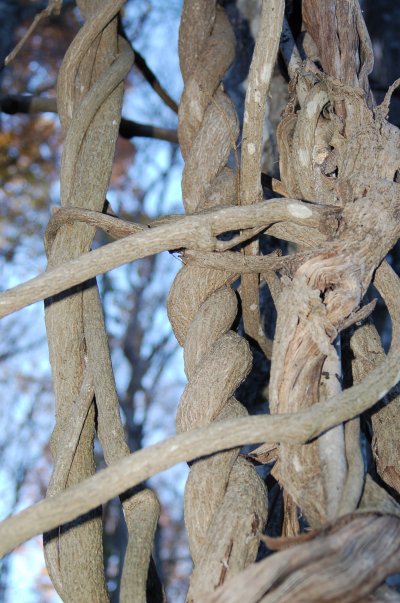
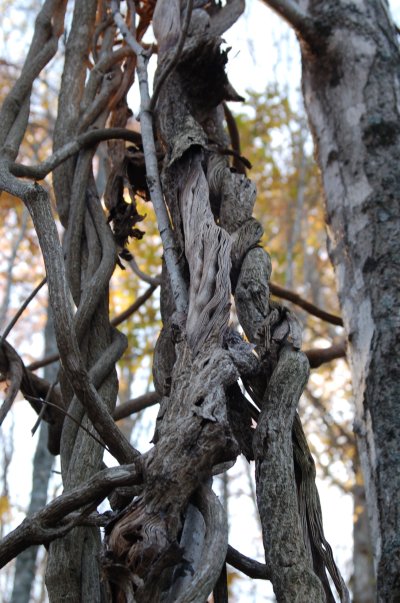
Through the Grape Vines

Wild grapes on the ground

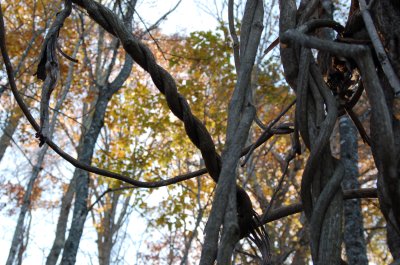
This was a great year for fruit on Droop Mountain. Our peach, pear, and cherry trees set fruit, and the wild raspberries and blackberries did too. Most years there aren't many wild grapes, but this year, there were too many for the birds to consume, and they have dropped to the ground, still sweet and sky-colored.

Grapevines Grapevines Grapevines

Wednesday, November 08, 2006

Fleece Hat Patterns for Free!

One of the advantages to the Nablopomo is, for me, the way it's pushing me to post my small link collections that have been languishing in my "Blogstuff" directory. Before the substitute teacher job ate my life, I was working on expanding my collection of hand-made hats. Many people find wool and mohair hats itchy, and I thought I'd expand into hypoallergenic fleece fabrics. Here are some nice, free hat patterns.

Tuesday, November 07, 2006

Election Day on Droop Mountain

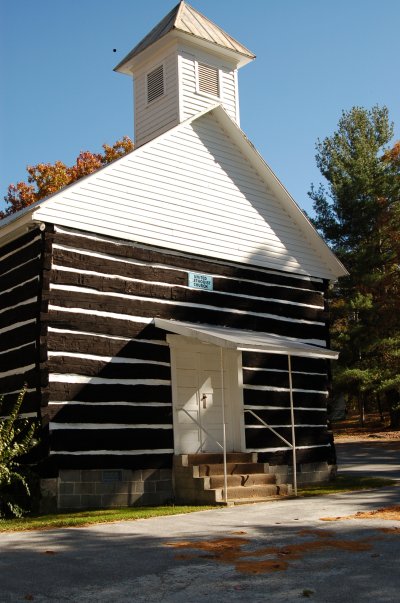
Mt. Olivet Methodist Church, Droop Mountain, WV

Here's our polling place on Droop Mountain. The intriguing structure is a Methodist church, but no one I've asked has been able to tell me much about its history. My previous polling place in Takoma Park, Maryland was also a church--Our Lady of Sorrows. She seemed an appropriate saint for politics.

Monday, November 06, 2006

Funnel Cake Recipes

I had an odd idea for holiday snack food, and found myself collecting funnel cake recipes from the Web. I haven't tried one yet--I need to get over the Halloween candy I got at the middle school last week--but I would recommend the Berks County recipe collection for a variety of home cooked treats.

The recipes are similar, but there are so many batter variations--no sugar, sugar, honey--it's hard to know where to start. Given that confections usually take some practice before you perfect the technique, I could be frying funnel cakes from now until Christmas. By the time I get the recipe just right, my arteries could be completely hardened. Is there such a thing as "too much information?"

BerksWeb, Berks County Authentic Berks County recipes, Pennsylvania Dutch cooking
Funnel Cake The Amish call this fried dough cake 'drechter kuche.' * 3 to 4 cups of flour * 3 eggs * 2 cups milk * 1/4 cup sugar * 2 teaspoons baking powder * 1/2 teaspoon salt * powdered sugar for topping * vegetable oil for deep frying - heat to 375 degrees Beat the eggs, then add the sugar and milk. Sift 2 cups of flour, the salt, and the baking powder and add to the milk, sugar, and egg mixture. Mix while adding more flour until the batter is smooth and not too thick. The funnel should have an opening of at least 1/2 inch and be able to hold around a cup of batter. Put your finger over the bottom and add about a cup of batter. Remove your finger and allow the batter to pour into the center of the oil. Be careful, the oil may splash! Gradually swirl the batter outward in a circular motion, or criss-cross back and forth to make a cake about 7 or 8 inches round. We used to draw our initials to personalize our cakes! Check it with a pair of tongs and turn it when the bottom becomes golden brown. When both sides are done, remove with tongs and let it drip on a paper towel. Funnel cake is often served with powdered sugar on top. You could also use molasses, maple syrup, or fruit preserves. Enjoy!
Amish-Dutch Funnel Cake
1 egg
2/3 cup milk
2 teaspoons granulated sugar
1 1/3 cups all-purpose flour
1/4 teaspoon salt
3/4 tablespoon baking powder

Heat deep fat to 375 degrees F.
Beat egg and add milk.

Sift sugar, flour, salt and baking powder together. 
Add egg and milk mixture and beat until smooth. Pour batter 
into funnel, holding finger over bottom. Allow batter to run 
out of funnel into deep fat. Make swirls in fat from center out. 
Cake may be made to size wanted. Fry until golden brown. 
Drain on paper towels. serve with confectioners' sugar.
Mill Creek Manor's Funnel Cakes from Gerrardstown, West Virginia
Ingredients:
    2 eggs, beaten
    1-1/2 cups of milk
    2 cups sifted flour
    1 teaspoon baking powder
    1/2 teaspoon salt
    2 cups cooking oil 

Combine eggs and milk in mixing bowl. Sift together the flour, 
baking powder, and salt. Add to egg mixture; beat until smooth 
with rotary beater. Test mixture to see if it flows through a 
funnel easily. It it is too thick, add more milk. If it is too 
thin, add more flour. In an 8-inch skillet, heat oil to 
360 degrees (or until a drop of the mixture sizzles when dropped 
into the oil). Covering the bottom of the funnel with a finger, 
pour a generous amount of the mixture into the funnel. Release 
your finger and let the batter flow into the oil in a spiral 
shape. Fry until golden brown, about three minutes. Using a wide 
spatula or tongs, turn cake carefully and brown on the other side. 
Cook one minute more. Drain on paper toweling and then sprinkle 
with confectionery sugar. Serve with hot syrup or canned apple 
pie filling that has been warmed.
Whole Wheat Funnel Cake recipe

1   c  Whole wheat flour
1 1/4   ts  Salt (optional)
1/2   ts  Baking soda
3/4   ts  Baking powder
2   ts  Honey
1     Egg
7/8   c  Milk; warm
    Oil for deep frying
    Honey or maple syrup

Sift together all the dry ingredients and then add the 
honey, egg, and the milk. Beat until smooth. Heat about 
2 inches of the oil in a large cast-iron skillet. To test 
the correct temperature, drop a small piece of dough into 
the oil. If it floats to the top and bubbles appear around 
the edges, you are ready to make the funnel cakes.
 
Hold your finger at the bottom of the funnel and pour in 
some batter. Then, using a spiral motion, let the batter 
pour into the oil. The cakes should look like free-form 
spiral sculpture. Fry until golden brown, turning once. 
Drain on paper towels. Drizzle with honey oar maple syrup 
and serve hot.
The amount you can make will depend upon the amount of batter 
you use for each cake. 
Fante's Kitchen Wares Shop
Funnel Cakes Recipe
2 cups milk
2 eggs
2 cups flour
1 teaspoon baking powder
1/2 teaspoon salt
1 tablespoon sugar, if desired

Mix together milk and eggs.
Sift together flour, baking powder, salt and sugar.
Combine with milk mixture.
Beat to make smooth.
Test dough for proper consistency.
If it runs out of funnel too quickly, it is too thin
and needs a little more flour. If it flows too slowly, 
it is too thick and needs a little more milk.

Sunday, November 05, 2006

The Vision Thing

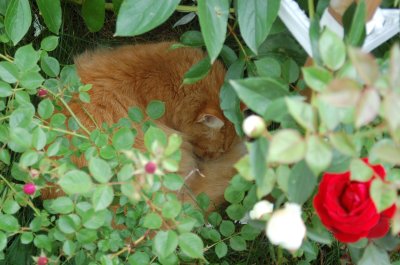
Cat sleeping under the rose and peony bushes

Dave wrote recently about a bobcat's daytime adventure Looking for Water. He speculated on the nature of feline vision:

Drinking from the creek is one thing, but still water must make a wild cat especially cautious. Can't you just see him, catching sight of this other cat in the water and jumping back, then maybe sneaking up on it and touching it with his paw?....The omniscient narrator finds himself unwilling to speculate further. It's all too easy for those of us who see in color to think we know exactly what we're looking at.

Comparative vision studies have always fascinated me. I have a pile of old photocopies of insect vision articles from my grad school days. Since I've been writing for the Web, I've been interested in the way visually impaired people use Web browsers, and the autism/special education gig has taught me about the pairing of visual impairment and autism. Dave set me searching for feline vision references, and I found several interesting things.

  • Are cats and dogs really color-blind? How do they know? Just what it says.
  • Feline vision--a cat's eye view talks about night vision and visual acuity.

    Cats give up the ability to see fine detail and rich colors in exchange for the ability to see in the dark. The level of retina illumination is about five times higher in your cat's eye than in yours. And all those rods pooling signals from minute amounts of light allow the cat to pick up the faintest light source. Nonetheless, some light still manages to pass between the rods and cones. Instead of letting it be absorbed at the back of the eye, as the human eye does, the cat has a structure called the tapetum lucidum that reflects light back to the receptors for a second chance to create a signal. The eye shine you see when you shine a light at a cat in the dark is the reflected light that has managed to elude the receptors in both directions and is bouncing back to you from the tapetum. The end result is that cats can see light at eight times dimmer illumination than you can!

    In summary, the cat's eye is specialized to see in dim and changing light. To achieve this it sacrifices the ability to focus close up, detail vision, and some color vision. It is the vision of a hunter active in both day and night, enabling it to detect movement under any lighting conditions, to use binocular vision to gauge distance, and to aim correctly to catch prey.

  • Vision In Dogs, Horses, and Cats, a veterinary eye care compares and contrasts vision:

    Dogs have cones that are receptive at 429 and 555 nm and are dichromats. All evidence suggests that the dog is dichromat with vision similar to a human who is red-green color blind. Cats are weak trichromats. Feline cones peak at 450, 500 and 555 nm. They live in a world of fuzzy pastels.

    Dogs and cats appear to respond to the blue and yellow short-wave length colors the best, but appear to have trouble with green and red. Both are also rod-dominant animals. As rods do not function in daylight these animals are dependent on their few cones for spatial and temporal visual resolution, which probably means that their blue and yellow visual world is a fuzzy blue and yellow world. What appears red to us is simply dark to the dog and cat, and a part of the green spectrum is indistinguishable from white. Colors that would appear very rich to us are more pastel-like to the cat. The cat sees a green, grassy lawn as a whitish lawn, and a green rose-bush as a whitish bush with dark flowers.

    Acuity is 30 cycles per degree (cpd) for humans, 18 cpd for horses, 12 cpd for dogs and 6 cpd for cats. Acuity in dogs is 0.4 times that of people, 0.67 times that of horses, and 2 times that of cats. Acuity in cats is 0.2 times that of people, 0.33 times that of horses, and 0.5 times that of dogs. If normal human vision is 20/20, then that of the dog is 20/50, the horse 20/33, and that of the cat is 20/100.

  • Ecology of Vision: Exploring the Fourth Dimension from the University of Bristol's Biological Sciences Department summarizes some comparative vision studies.
    As well as seeing very well in the ultraviolet, all bird species that have been studied have at least four types of cone. They have four, not three, dimensional color vision. Recent studies have confirmed tetra-chromacy in some fish and turtles, so perhaps we should not be surprised about this. It is mammals, including humans, that have poor color vision! Whilst UV reception increases the range of wavelengths over which birds can see, increased dimensionality produces a qualitative change in the nature of color perception that probably cannot be translated into human experience. Bird colors are not simply refinements of the hues that humans, or bees, see, these are hues unknown to any trichromat.
  • The Light and Vision section of Hyperphysics, hosted by Georgia State University's Department of Physics and Astronomy, is detailed, technical, and organized in an interesting way. The section The Color-Sensitive Cones discusses human vision.

Saturday, November 04, 2006

Hudson Super Wasp in Spice, WV

Hudson Super Wasp emblem

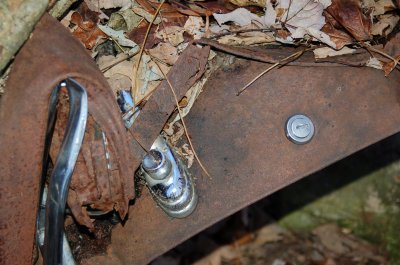
Our sweet little tractor is not the only vintage vehicle we have acquired recently. Near the old road that runs through our new property, there are the remains of a Hudson Super Wasp. It must have been a deep gleaming red when it rolled off the assembly line. We can only imagine the sad series of events that left it abandoned by a road that was itself abandoned years ago.

Hudson Super Wasp hood ornament

If you'd like to see a Hudson Super Wasp in good condition, check out these links.

Hudson Super Wasp door handle and lock

Friday, November 03, 2006

Our New 1946 Tractor

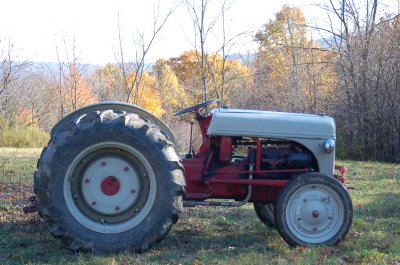
Ford 2N tractor, 1946, with view of Droop Mountain

We recently got a tractor. I can't explain, but most Iowa farm girls my age love tractors. I learned to drive on a tractor (in elementary school), and my first tasks involved backing wagons full of oats into grain elevators. Driving forward came much later, and automobiles hold little charm for me. Nonetheless, this is the first tractor I've ever bought. It's a 1946 Ford N2, with a four-cylinder engine that sounds just like a Model A Ford (at least as well as I can remember--in my childhood, there were still a few in use). Our tractor has an electric starter, but you can also start it with a crank.

Ford 2N tractor, 1946; front view

I can't contain myself. Isn't it just the cutest little thing? OK. That's out of my system. If you are interested in knowing more about these old Ford tractors (and there are many of them still in use in this part of the country), you can check out these links.

Ford 2N tractor, 1946, side view

Thursday, November 02, 2006

Tips On Matching Plaids

Over the years, I've sewn many garments out of plaid fabric, and I've never been entirely pleased with them. My most recent plaid shirts have not quite matched at the center fronts. They are better-matched than ready-to-wear shirts, but they do not reach the degree of plaid perfection my mother always aimed for. Since I have need of more shirts, and a store of plaid shirtings, I've been looking for advice and tips I haven't already tried. I didn't find much on the Internet that didn't duplicate what I already knew (Cut your pieces one at a time, don't put the boldest plaid line across the point of an ample bosom, and match the horizontal lines at sides and center fronts). However, these three articles offer good advice.

  • Matching Plaids When Making a Jacket You'll find an extensive set of directions, including tips on two-piece sleeves and vertical darts on jacket fronts and backs.
  • Free Sewing Tips: Matching Plaids This site tells how to match plaids at the center front of trousers. Plaid flannel pajama bottoms are shown. These are particularly easy because they are loosely fitted, and the center front seam has minimal curve.
  • Sewing on Plaids by Julie Culshaw This article is less project-specific, but includes tips on wearing plaids, choosing suitable patterns, and sewing techniques. Here's the advice I found most helpful:
    Use a walking foot to avoid seam slippage, which will cause your seams to be slightly unmatched. By far the most accurate method of sewing plaids is a method called "slip-basting". Place your two pieces of fabric together as they will be sewn. Then press back, with the iron, the seam allowance of the top piece. This allows you to see exactly where it will be sewn to the under piece. Now hand sew them together, right along that seam line, slipping through the fold of the top piece, then picking up about 1/8" of the bottom layer. This will hold the two layers in place until you sew them. This technique combined with a walking foot will take care of any seam slippage.

Wednesday, November 01, 2006

Ghost Flowers of the Forest

Indian pipe in Seneca State Forest, West Virginia

I thought these strange, subterranean plants would be a fitting topic for All Hallows Day, and that was before I remembered that "ghost flower" and "corpse plant" are alternative names. I've never heard anyone call them anything but "Indian pipe," but they are disquieting without the ghoulish monickers. What would possess a group of ericaceous plants to go underground, to live on mycelium, to dwell in eternal darkness? When I first heard of Baudelaire, these were the flowers of evil I pictured.

I wanted to check my taxonomic facts before I blogged. I remembered Lawrence's Taxonomy of Vascular Plants placed Indian pipe in Pyrolaceae, along with pipsissiwa, pyrola, and American wintergreen. My venerable field guides concurred, but I seemed to remember someone placing all the Pyrolaceae in the Ericaceae (heathers, rhododendrons, azaleas, blueberries). The seed capsules of the previous year's Indian pipe (below) do remind me of wintergreen, azalea, and mountain laurel capsules. Dead and dessicated, Indian pipe looks much less ghostly.

Indian pipe seed capsules, with new flower stalk emerging from ground

The Internet has frustrated me in my taxonomic inquiries. The Integrated Taxonomic Information Service places Monotropa uniflora in the Monotropaceae. All the strange, subterranean parasites are related to each other, but this classification gives no clue to their nearest green relations. The ITIS is not at all forthcoming about when and where this new family assignment was published, if, indeed, it is new, and not a throwback to some nineteenth century botanical splitter.

Still, I did find some interesting information about Indian pipes, which I present for your approval.

  • Monotropa uniflora, the ghost plant on Tom Volk's Fungi.net, has a consise explanation of Indian pipe's strange symbiosis.

    ...all of the monotropes are parasitic on fungi! These fungi are mycorrhizal with photosynthetic trees, and thus the energy ultimately comes from photosynthesis of the tree, passing through the mycorrhizal fungus on the way to the Monotropa.

    The tree, already providing energy to the fungus, is probably physiologically 'unaware' of the additional loss of carbon and it is likely that it is the fungus that controls the passage of carbon to Monotropa....

  • Wildflowers of North Carolina's Indian pipe page includes a Cherokee legend (told with a hint of condescension, yet interesting enough to quote here):

    Before selfishness came into the world-that was a long time ago- the Cherokee people were happy sharing the hunting and fishing places with their neighbors. All this changed when Selfishness came into the world and man began to quarrel. The Cherokee quarreled with tribes on the east. Finally the chiefs of several tribes met in council to try to settle the dispute. They smoked the pipe and continued to quarrel for seven days and seven nights. This displeased the Great Spirit because people are not supposed to smoke the pipe until they make peace. As he looked upon the old men with heads bowed, he decided to do something to remind people to smoke the pipe only at the time they make peace.

    The Great Spirit turned the old men into greyish flowers we now call "Indian Pipes" and he made them grow where friends and relatives have quarreled. He made the smoke hang over these mountains until all the people all over the world learn to live together in peace.

    told by Mary Chiltosky in the book, Cherokee Plants...

  • Keith Dawson's page on Indian pipes, recounts some medicinal uses explaining alternative names for the plant.

    The plant's flesh turns black when cut or even bruised. It also oozes a clear, gelatinous substance when picked or wounded. Such unattractive characteristics have earned the Indian pipe some unflattering names, like ghost flower and corpse plant. Indians employed it as an eye lotion -- whence the name, eyebright -- as well as for colds and fevers. Americans of the last century treated spasms, fainting spells, and nervous conditions with it -- thus the names convulsionroot, fitroot, and convulsionweed.

    He credits Hedgemaids and Fairy Candles: The Lives and Lore of North American Wildflowers, (Jack Sanders, 1993) for this information.
  • Indian Springs Herbal Encyclopedia lists these medicinal uses:

    American Indians used plant juice for inflamed eyes, bunions, and warts; drank tea for aches and pains due to colds. Root tea used for convulsions, fits, epilepsy; sedative. Physicians once used tea as antispasmodic, nervine, sedative for restlessness, pains, nervous irritability. As a folk remedy for sore eyes, the plant was soaked in rose water, then a cloth was soaked in the mixture and applied to the eyes. Water extracts are bactericidal.

    Warning! Safety undetermined; possibly toxic -- contains several glycosides.

    Maddeningly, I found these same words on several other Web sites. No one gave attribution, and all claimed global copyrights. Tsk, tsk.

Tuesday, October 31, 2006

Ghostly Doctor of Denmar

I've been saving this new Haunted Pocahontas County story for Halloween. It's another account from a local employee at Denmar State Prison, the former Denmar State Hospital. Before it was a prison, there were places in the old hospital where local workers were reluctant to go alone. One floor in particular made people uncomfortable, and there are stories of inexplicable voices and footsteps. Evidently this still continues now that the place is a prison.

Early in the morning, workers waiting for the elevator sometimes see the doors open to reveal a short, middle-aged black man wearing a white coat and a stethoscope. He looks up, perhaps in response to a "Good morning, Doctor," and then he disappears. My informant, who supervises in the kitchen, is one of those who has seen the apparition herself. The general consensus at the prison is that the ghost-doctor dates from Denmar's days as West Virginia's Colored Tuberculosis Sanitarium.

Deaths at the West Virginia Colored Tuberculosis Sanitarium at Denmar. West Virginia History Volume 56 (1997), pp. 88-121.
The West Virginia Legislature created the State Colored Tuberculosis Sanitarium in 1917. The Maryland Lumber Company sold 185 acres of land and numerous buildings in Denmar, Pocahontas County, to the West Virginia Board of Control. According to the 1918 West Virginia Legislative Hand Book, black tuberculosis patients, who were West Virginia residents, were eligible for admission to the sanitarium provided they could pay for their care. The Hand Book noted: "The reasonable expenses of poor persons admitted at the request of the authorities of any municipal corporation or county, shall be paid by such municipal corporation or county." The sanitarium admitted its first patients on January 31, 1919.

Sunday, October 29, 2006

My New Job-let

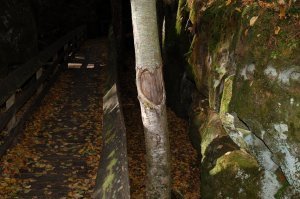
Boardwalk at Beartown State Park

I'm excited to be starting a new job-let, as an adjunct faculty member of Mountain State University. In a couple of weeks, I'll start teaching my first class in MSU's Spectrum Health Program. I'll be teaching the second semester of a four-semester program, including chemistry, math, and statistics. Here's an excerpt from their blurbs:

Mountain State University offers selected traditional and distance learning programs through extended learning locations. Cohorts are formed in various locations with groups of students who meet together once a week, to complete a sequence of courses leading to a degree. This type of learning is especially attractive to working adults, because of the accelerated nature of the programs and classes designed to accommodate work schedules....

The Spectrum Health orientation allows you to complete the general education requirements for many of the programs offered by MSU' School of Health Sciences. The LPN to BSN (Bachelor of Science in Nursing) program is an option for LPN's....

Yesterday I drove to Beckley for a Faculty Development Day, where I signed a contract and met about 20 other Spectrum faculty members. It was reassuring to talk to other people who have been teaching this way for a while. I've been anxious lately: What will happen if my substitute special ed gig continues indefinitely? Where can I get the Spectrum texts and materials? Will I have to buy a bunch of expensive Windows software? After yesterday, I'm excited and optimistic. I don't have to buy any nasty Microsoft stuff, and many of my fellow faculty are full-time teachers in public school. I can't deny that some of this warm glow is due to the nice Spectrum Director who provided yummy snacks every two hours during the meetings.

One nice discovery that will outlive yesterday's sugar high is that I will soon have access to the MSU library resources. Online journal subscriptions, an MSU library card, interlibrary loan--what a treat! I'll be getting a password in the next few days, I hope.

Tuesday, October 24, 2006

Holding a Gun To My Own Head

National Blog Posting Month

I've signed up for National Blog Posting Month (NaBloPoMo). I found the link at BlogHer yesterday. For me, the Q&A rang true:

What is it?

It's National Blog Posting Month!

Why...would I want to do that?

You started a blog to make yourself write more often?

NaBloPoMo is an alternative to November's NaNoWriMo, National Novel Writing Month, the program wherein you crank out a novel in thirty days.

Some of us lack the imagination, stamina, and self-destructive impulses required to write a novel that quickly, but, by Grabthar's Hammer, we can update our blogs every day for a month!

Yup. I started a blog to make myself write more often. Recent evidence to the contrary, it has motivated me to write more. People sign up for the "November is National Novel Writing Month(NaNoWriMo) to get over writer's block, or to prove to themselves that they can crank out the prose under pressure. Years of grant writing taught me two things: writer's block is a self-indulgence I can't afford, and I can crank out the prose (not good prose, necessarily, but prose to spec.). I don't need a goofy novel cluttering up my hard drive, but somehow, cluttering up blogger.com with daily postings doesn't bother me a bit.

I have some qualms....I looked at the list of participants' blogs, and noticed that they are a younger, "hipper" bunch than I usually pal around with. They have no recollection of the days when martinis were Squaresville, something with which the Man in the Grey Flannel Suit anesthetized himself. Still, I've signed up--if the cool kids won't eat lunch with me, well, I'll just read a book by myself, like I used to do.

Friday, October 20, 2006

Dying For the Weekend

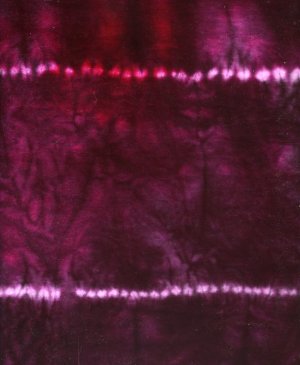
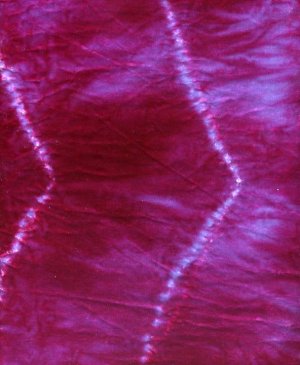
purple velvet scarf sample red and blue velvet scarf sample

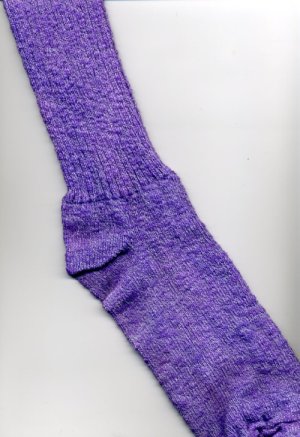
Last summer, in an attempt to "generate a new income stream," I decided to try dying silk velvet yardage and sew scarves from it. I hoped this project would pay for itself, and for a good electronic scale I could use for all my dying recipes. (Measuring spoons were increasingly inadequate for my purposes.) I had no sooner gotten my materials together than the substitute teacher gig turned up. Between the classroom and the kitchen (where I was frantically canning garden produce), the dying project dwindled from a scarf or two per weekend down to one dye pot with all my leftover cotton socks.

Cotton sock dyed purple

I did, however, file a couple of dying links.

  • Paula Burch's "All About Hand Dyeing" has been on my bookmarks list for years, but she's recently revamped her Web site, adding new information and improving the look and feel


  • Dharma Trading Company has all the cool stuff from their catalog in an easier-to-use format. They have also added a "Projects" section, with how-to's for many different projects.

Tuesday, October 17, 2006

Battle of Droop Mountain, Refought

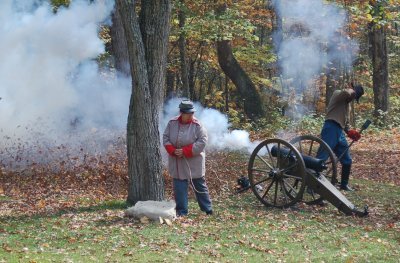
Firing the cannon

Every other year, Droop Mountain Battlefield State Park hosts a reinactment of the November 6, 1863 event for which it is named. Last weekend was the third one I'd attended. My first was the most dramatic, for me. I was going for my morning run on the park trails, when, out of the fog came a passle of Yankees on horseback. Understanding what was going on didn't make much difference. It was terrifying.

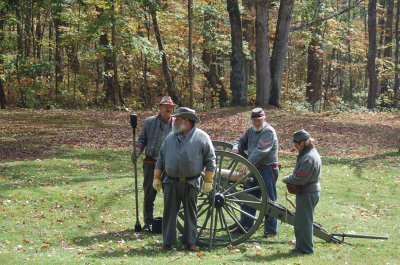
Waiting to fire the cannon

I'm not sure the reinactors get that excited anymore.

Watching from beside the cannon

Like the spectators, they look at the cannons like they would look at cars. "Will it start?"

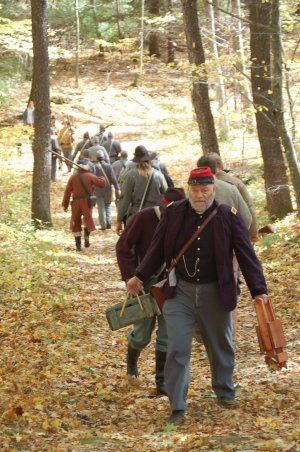
Reinactors head home

As I headed home through the park, the Yankees and the Rebels passed each other on their way to pack up and go home.

Thursday, October 12, 2006

Southern, or Appalachian?

Several months ago, I discovered a fascinating book, W.J Cash's The Mind of the South, published in 1941. I posted some interesting Web references here, and got a gracious comment from W.J Cash's great-niece, Mary K. Elkins, a talented Web designer.

Cash's book is a cultural history of the American South in the way that Gibbon's Rise and Fall of the Roman Empire is a history. Cash, a Southerner, critiques mid-twentieth-century problems such as toxic race relations, intractable rural poverty, sickly nostalgia for an imaginary past, and paralyzing class consciousness. Whether his history is accurate or not, his prose is compelling.

I heard echoes of the rhetoric of "Appalachian otherness" in Cash's analysis of eighteenth and nineteenth century Southern history. In fact, "The South," rather than "Our Southern Mountains," may be the real Land of the Nine-Fingered People. Here is one passage that took my fancy.

Again, if the Southern social order had blocked in the common Southerner, it had yet not sealed up the exit entirely. If he could not escape en masse, he could nevertheless escape as an individual. Always it was possible for the strong, craving lads who still thrust up from the old sturdy root-stock to make their way out and on...even...to carve out wealth and honor in the very oldest regions....But in their going these emergent ones naturally carried away with them practically the whole effective stock of those qualities which might have generated resentment and rebellion. Those who were left behind were the simplest of the simple men of this country--those who were inclined to accept whatever the day brought forth as in the nature of things--those whose vague ambition, though it might surge up in dreams now and then, was too weak ever to rise to a consistent lust for plantations and slaves, or anything else requiring an extended exercise of will--those who, sensing their own inadequacy, expected and were content with little.

Moreover, they were in general those in whom the frontier tradition was likely to run strongest; which is to say that they were often almost indifferent, even in their dreams, to the possession of plantations and slave and to the distinctions which such possessions set up. For it is characteristic of the frontier tradition everywhere that it places no such value on wealth and rank as they command in an old and stable society. Great personal courage, unusual physical powers, the ability to drink a quart of whisky or to lose the whole of one's capital on the turn of a card without the quiver of a muscle--these are at least as important as possessions, and infinitely more important than heraldic crests. In the South, if your neighbor overshadowed you in the number of his slaves, you could outshoot him or outfiddle him, and in your own eyes, and in those of many of your fellows, remain essentially as good a man as he.

Tuesday, October 10, 2006

Selling Myself Real Estate

Locust Creek in the clouds

Last week we bought the property adjacent to our Droop Mountain home. We were stunned to discover it was on the market, and were anxious to buy it, as it surrounds us on three sides. It hadn't been sold outside the family since the nineteenth century, and the only existing survey uses large chestnut trees as landmarks. Such extinct boundaries are not unusual in Pocahontas County.

This photograph, taken in October 2004 from my neighbor's yard, plays an interesting role in the purchase. We made a very good offer, and had been waiting two days without hearing anything from the seller. I opened up my copy of the Pocahontas Times, and saw the property listed with a very familiar photograph. There was this picture, taken from my Web page, without permission, and without attribution. When I checked the realtor's Web page, there was my picture again. Not only were they violating my copyright, but they were using my picture to solicit bidders to compete against my offer. Oh, did I mention that the photograph does not show the property in question?

I was rather upset when I went into the realtor's office the next day, between anxiety about the offer and outrage about the picture. The realtors were horrified. The property owner had given them a floppy disk, and said it was his picture, taken from his property. They also said that someone was in their office, making a competing offer on the same property. After a conference out of my hearing, they asked, "Would this problem go away if your offer were accepted?" I told them yes, went on home, and soon got a phone call telling me our offer was accepted. From there on out, everything moved along smoothly, and now we have taken down the fence that separated the new parcel from our old one.

Monday, October 09, 2006

Pepper Butter

This past weekend, I canned the last of the garden produce. I made "Pepper Butter"--an unusual spread made from hot peppers and prepared yellow mustard--for the first time, after getting the recipe from Penny Kershner of Frost. I'd never tasted anything like it, but recently, I discovered I had two similar recipes, for "Pepper Sandwich Spread" and for "Green Tomato Sandwich Spread," in my favorite canning book, Favorite Recipes of Home Economics Teachers: Canning, Preserving and Freezing Cookbook.(Favorite Recipes Press, Montgomery, Alabama, 1975)

Thickened like a gravy, this bright yellow stuff is hot, sweet, and sour. Penny's recipe produced eight pints for me, and it is even tastier than I remembered. Although all the different recipes say you can pour the hot liquid into scalded jars and seal, I went ahead and water-bathed the filled jars for 20 minutes, the way I usually treat my sweet pickles. I find my jars are more likely to seal successfully when I do this, and it didn't hurt the "pepper butter" a bit.

PEPPER BUTTER 60-80 hot peppers (heat intensity your choice) Wash, remove stems, and grind in food processor. If you prefer a milder spread, remove some of the seeds and placenta. 6 cups sugar 1 quart prepared yellow mustard 1 quart cider vinegar In your cooking kettle, mix sugar, mustard, and vinegar. Stir in ground peppers and bring mixture to a boil. Make a thickening of 1 1/2 cups flour and 1 1/4 cups water. Add some boiling mix from your kettle to the thickening, and stir until smooth. Add thickening mix to boiling liquid, stirring until combined. Boil mixture for 5 minutes, stirring to prevent the thick mixture from burning on the bottom. Place in canning jars and seal. To waterbath can, place the jars in a canner and boil for 20 minutes. Remove, and allow jars to cool and seal.

Sunday, October 08, 2006

Self-Censorship

I've been writing, but not posting, recently. I'm still substituting for a yet-to-be-hired teacher for special needs students, and I'm dealing with a lot more people on a daily basis than has been my habit for many years. I've started to "blog" all sorts of interesting, wonderful, appalling things that the folks at school say and do, and then pulled up short. It's been my policy to avoid writing about my friends and neighbors, except in very vague terms, to protect their privacy. (Except for the doily cheater, but hey, I don't know who she was, and how much consideration should you get for fraudulent display of doilies, anyway?) I don't think I have many (any?) local readers, but who would want to hear through the grapevine that "Bootsie has been spilling the beans concerning your life on the Internet"?

Pair this self-censorship with my uncertainty about the direction I want my "Web-presence" to take, and you get very few posts. Dave, of Via Negativa, has invited me to submit something to qarrtsiluni on their "Education" theme. I was very excited about this, but quickly found out my most interesting themes violated my students' privacy. They may be seven years old and illiterate now, but that could (God willing) change.

In a comment this summer Dave suggested

...your mission could be to portray Pocahontas County in such an unflattering light that the flood of tourists would dwindle to a trickle. You could just make stuff up, like James Dickey. The local chambers of commerce would hate you.
I have since given much thought to writing Southern Gothic horror stories about fictional Pocahontas County residents, even to nominating Droop Mountain as the very capitol of The Land of the Nine-Fingered People. I am blessed to have a reader who understands me so completely. However, I could never invent anything to rival the things people really say and do. To paraphrase Dr. Watson, "The world is not yet ready for the Denmar kangaroo incident."

Other bloggers have been writing about the limits of the stories they may tell. I was especially struck by prariemary's recent posts on the topic "Who Should Tell the Stories?"

Who owns what stories?...Repeatedly in early years, individuals came to the reservation, took notes...wrote them up, sold them to publishers as original works, and collected the income. None of that income was sent back to the tribal storytellers. Some of the white writers claimed to be scientists who would use the stories to analyze and record the society of the tribal people -- others were simply acquiring stories the same way they would acquire beadwork, attractive curiosities....they not only made money from the stories, but also drained them of significance.

Pocahontas County "informants," such as still-living members of the Hammons family, have voiced feelings of exploitation. Although I know for a fact that the Library of Congress boys made little or no money from the stories and music they got from Burl, Sherman, and Maggie, they did carve notches in their academic status gunstocks. If I were to tell you that Denmar kangaroo story, with all the flourishes and detail it deserves, would I be exploiting my neighbor down the mountain? (Never mind that I could not possibly tell it as well as he can.)

I think the solution is...taking time. Really listening. Spending the day. Becoming part of the scene....Learning what stories mean to the tellers of them. I think that whether one is IN or OUT of the group, one can witness. One has an active obligation to witness accurately and possibly to record that somehow. It is the way to wisdom.

Framing it that way, I think I may try to tell few more tales. If it starts to sound too much like Yoknapatawpha County, perhaps I'll start a second blog.

Monday, September 25, 2006

Talking to Myself

I continue to substitute for a yet-to-be-hired special education teacher, although the precise nature of the unfilled position continues to change. I've been at three different schools and I'm uncertain how many students I'll be working with next week. (I assume I will be working next week.)

Although the heavy lifting is over, and I am no longer physically exhausted when I get home, my daily activities still interfere with my writing habits. While my students have little in common with one another, there is a certain continuity. Most of them have difficulties processing spoken and written language. Whether they can't take in verbal information because their brains are different from most people, or because they are too angry, too anxious, or too distracted by ambient noise, they don't attend to what they are told. I speak slowly. I say simple things. I repeat myself. I repeat myself. I REPEAT myself. If a teacher fell in the classroom, would there be any sound? I come home with little faith in the whole process of communication. It seems more interesting to can tomatoes than to write.

On the other hand, this is reminding me just how amazing it is to be able to read. A visual representation of speech--how did someone come up with this? The non-reading adults I've worked with have completely different ways of thinking about words than readers (even poor readers). They are unaware of rhymes in song lyrics, incredulous that words can be broken apart into component sounds, and skeptical that a word and the thing it names can be separated. Several of my young students are struggling with these same concepts. Most people participating in the magical world of written language have forgotten they ever lived anywhere else. It's a gift to be reminded of that other condition, and the hard work involved in crossing that border.

Monday, September 04, 2006

Where I've Been Lately

The week before last, I got a call from the school board office asking if I was available to start the school year as a substitute teacher. They are advertising for an autism teacher, and need a substitute until the position is filled. I travel between two schools and have four (soon five) special needs students. There are no lesson plans, no schedule, no real classroom, and no instructions on how to procede. I won't know the job is over until they tell me "Don't come in tomorrow." Of course I said, "Sign me up!"

So far, the job includes much heavy lifting and some sprinting down the halls and sidewalks. I come home very tired each night, and have not made blogging a priority. I like these unanticpated opportunities, and so far, I'm enjoying the work. Interestingly, I'm already in trouble. Thursday afternoon, an irate parent marched into the principal's office complaining about my treatment of her child. I don't know the nature of her complaint, but I did hear she was roaming the hall threatening to "whup me," or some part thereof. The fourth day of school seems a little premature for complaints--I usually don't get criticism until I've actually done something. Still, you must admire a parent that cares enough to offer a pre-emptive "whuppin'."

The Last Barbeque of the Season

This summer, we've been searching for the ideal barbeque sauce. In honor of Labor Day, here are some things we've tried that we liked.

Michael Chiarello's Babyback Ribs with Espresso Barbecue Sauce
Espresso Barbecue Sauce:
4 tablespoons mashed and minced garlic
4 tablespoons extra-virgin olive oil
1 cup cider vinegar
1/2 cup soy sauce
2 cups ketchup
2 cups honey
Grey salt
2 demitasse cups espresso (or about 1/2 cup of strong coffee or instant espresso)
Fresh ground black pepper

Mash garlic with the side of a knife and then mince finely to release oils.

Add olive oil to a preheated saute pan. Add the garlic and saute until it gets light brown, about 1 minute. Add cider vinegar, soy sauce, ketchup, and honey and stir well. Add a pinch of grey salt, then whisk in the coffee. Add freshly ground black pepper, to taste. Bring to a simmer and simmer for 10 minutes.

Let cool and store in refrigerator for up to 2 weeks.

BOURBON BARBECUE SAUCE
2 cups ketchup
1/2 cup mild-flavored (light) molasses
1/3 cup bourbon
1/4 cup Dijon mustard
3 tablespoons hot pepper sauce
2 tablespoons Worcestershire sauce
2 teaspoons paprika
1 teaspoon garlic powder
1 teaspoon onion powder

Combine all ingredients in heavy large saucepan. Bring to boil over medium heat, stirring occasionally. Reduce heat to medium-low; simmer uncovered until sauce thickens and flavors blend, stirring frequently, about 15 minutes. (Can be made 1 week ahead. Cover; chill.)

Makes about 2 1/2 cups. Bon Appétit, July 2000. Steve Raichlen

Kicked Up Barbecue Sauce with Variations
2 cups favorite bottled barbecue sauce
1/2 cup dark brown sugar
1/3 cup minced onions
5 large cloves garlic, minced

Mix together all ingredients. Use immediately.

Asian-Style Barbecue Sauce
2 cups favorite bottled barbecue sauce
2 tablespoons soy sauce
1 teaspoon ground ginger
1 teaspoon garlic powder

Mix together all ingredients. Use immediately.

Raspberry Barbecue Sauce
2 cups favorite bottled barbecue sauce
1 package frozen red raspberries in syrup

Mix together all ingredients. Use immediately.

Bourbon Barbecue Sauce
2 cups favorite bottled barbecue sauce
1/4 cup bourbon

Mix together all ingredients. Use immediately.

Mustard-Style Barbecue Sauce
2 cups favorite bottled barbecue sauce
1 cup yellow mustard

Mix together all ingredients. Use immediately.

Here are some other barbeque sauce recipe collections.

Wednesday, August 23, 2006

Spinning My Tiny Dye Lots

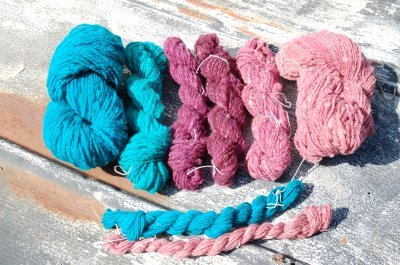
teal and pink yarns

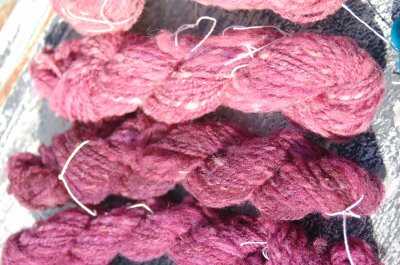
Here's what I've been up to the last few days--dying some local (burdock-laden) fleece in the crockpot, carding, spinning and plying it. I've been experimenting with series of color intensity, trying to get pretty pastels. The more intense colors continue to work better for me. It is encouraging, however, that the colors consistently look better in the spun yarn than in the fleece after carding.

assortment of pink yarns

Tuesday, August 22, 2006

Shitake Mushroom Harvest

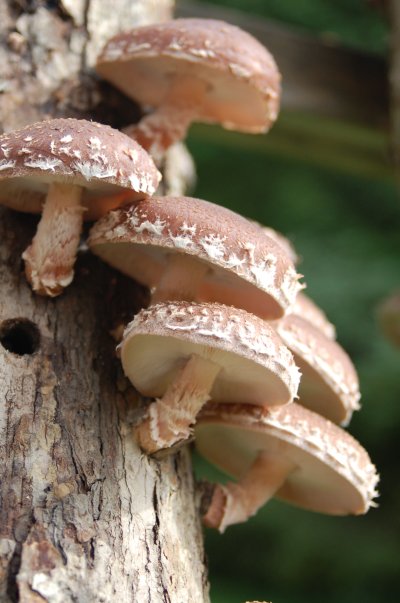
shitake mushrooms

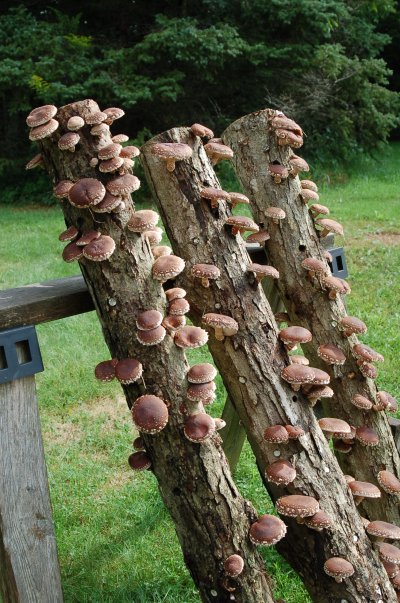
We've been growing shitake mushrooms for several years now. Some of the innoculated logs seemed to be on their last legs, and we were expecting to cull a number of them this fall. We have been pleasantly surprised--all 56 logs have produced like the ones below. We're currently drying them as fast as we can. This is in contrast to the garden--the vegetable garden, where all sorts of insects have been more fecund than most of my seeds and plants. Looks like we'll have something homegrown to eat this winter.

three shitake logs

Sunday, August 20, 2006

Death Trumpets

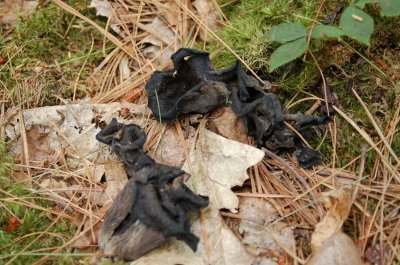
Earlier this month, we found these chanterelle mushrooms, which W.C. Roody's Mushrooms of West Virginia and the Central Appalachians calls Black Trumpets or Death Trumpets. Once I'd convinced myself that "Death Trumpets" referred to their funeral aspect and not to the results of ingestion, we tried cooking them. Although we had just a small handful, these chanterelles didn't reduce in volume when cooked. Their taste was very strong--much too strong to eat as a dish on their own. Our tiny handful should probably have been dried and used a teaspoon full at a time to flavor soups and egg dishes. Live and learn. I wonder if we'll ever find these again.

Tuesday, August 15, 2006

The Riddle of the Sphinx Moth

Droop Mountain sphinx moth, front view

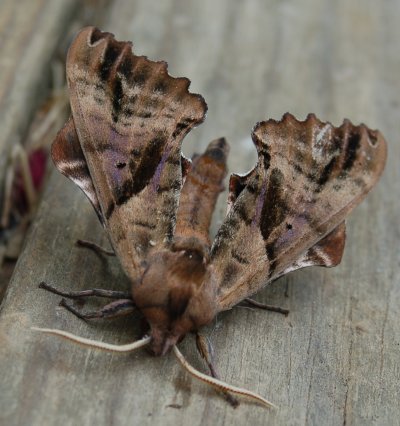
I see this sphinx moth species often this time of year. I don't have much lepidopteran expertise, and without the specimen in hand I'm not going to attempt an identification, but isn't it handsome? In the hope of a dumb-luck species identification, I googled around a bit, and stumbled on Pocahontas County, West Virginia Sphingidae. I don't see my front porch pet on that sight, but what are the odds of my finding a collection of Pocahontas County sphinx moth photos on a Prince Edward Island lep farmer's Web site?

Droop Mountain Sphinx, top view

Monday, August 14, 2006

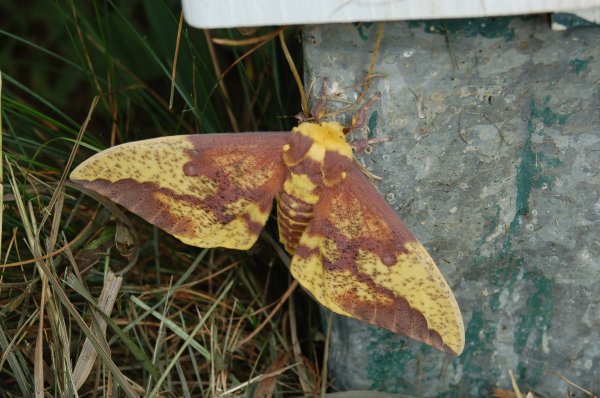
Imperial Moth, early August, 2006

Imperial Moth, Top view

This beauty was sitting on the corner of the house last week. I've always been a big fan of the giant silk moths. I don't see them every year, but besides this lovely Imperial, there have been a few Lunas fluttering around the windows at night.

Imperial Moth--side view Imperial Moth Eacles imperialis (Drury) (Saturniidae)

Sunday, August 13, 2006

Our Wicked Frontier Ways

A few weeks ago I finished Daniel Boone: The Life and Legend of an American Pioneer by John Mack Farahger. It attempts to separate fact from fiction and speculation, while treating the Daniel Boone folklore as an interesting phenomenon in itself. I learned that Boone had at least two West Virginia connections. His first "long hunt" was on Shenandoah Mountain, in West Virginia's Ridge and Valley region. Later, he and his family lived at Point Pleasant, home of The Mothman.

Boone seems to have been tarred with the same brush James Dickey used on later day natives of the back country. Here's a fascinating, wry quote from page 60 of my edition. (Note well the dig at William Byrd.)

Boone was...condemned by a number of his contemporaries as a man who "didn't live happily with his family, [and] didn't like to work." Such sentiments were akin to the criticism leveled by cultural outsiders at long hunters for the neglect of their families. In North Carolina backwoodsmen "live with less labor" than anywhere else he knew, said the Virginia aristocrat William Byrd, a man who knew whereof he spoke. They made "their Wives rise out of the Beds early in the morning, at the same time that they Lye and Snoer, till the Sun has run one third of his course, and disperst all the unwholesome Damps." Frontier men did "little of the work" around their farms, complained one missionary in the Yadkin settlements, leaving it all for their wives and children to perform, while they enjoyed themselves hunting. Consequently, the work around the home place was "poorly done," animals had to fend for themselves, even in winter, and Indian corn grew where there should have been good European wheat. It all added up to a pattern of "irregular living." "There are many hunters here who work little," wrote another preacher, but "live like Indians."

As this last remark suggests, the complaints amounted to the rejection of a way of life and had much in common with the European criticism of American Indians. The French emigrant Michel-Guillaume Jean de Crevocoeur described backwoodsmen as "new made Indians," "half cultivators and half hunters" who lived a "licentious, idle life." In the rush to commercial farming in the nineteenth century these criticisms were transformed into a cant, in which frontier ways were made to seem the very essence of barbarism and backwardness. In this climate of opinion, Boone supporters both inside and outside the family attempted to salvage the reputation of the Boone household by claiming that it had been run on solid Victorian principles....The most unfortunate thing about such special pleading was its anachronism, its irrelevance to the real conditions and dilemmas of frontier life.

Wednesday, August 09, 2006

An Adventure in Knitwear Design

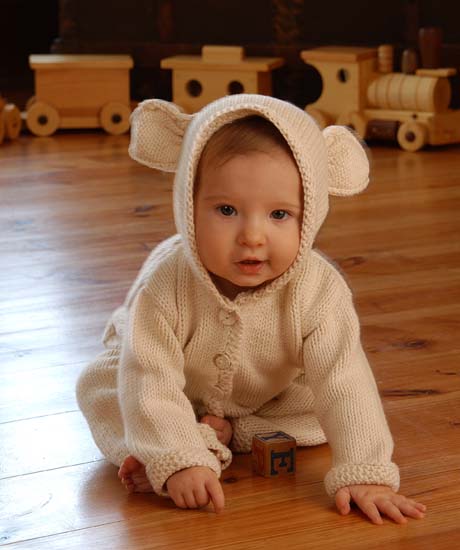
lamb's ear baby jacket

Last week, I got paid for writing a knitting pattern for this cute little sweater. Appalachian Baby Design sells this organic cotton Lamb's Ear Jacket as a ready-made item, and they wanted to add kits for knitters to their line of products. Ironically, the designer they paid in the first place provided a hand-knit sample; their production expert redesigned it for machine knitting; and last month I redesigned the machine knit sample and wrote hand knitting directions.

I'm not entirely sure what's going on with the company these days, but their Web site still describes them thus:

Appalachian By Design, the non-profit development and marketing company that markets Appalachian Baby Design, has devoted itself to making machine knitting a sustainable, home-based industry for women in rural Appalachia.

I've done work for them in the past, and found them a little "lethargic" in the check-cutting department. This time, I offered to take payment in product, and I was delighted to get over 10 pounds of white sport weight New Zealand wool yarn. I plan to dye this myself, and expect it could make about 40 pairs of Fair Isle socks, or heaven knows what else. It promises to keep me busy for years.

I was so excited about this wool that I found myself agreeing to other projects. That is why I am currently knitting garter stitch baby blanket in the same organic cotton. I'm ashamed to be "designing" something so boring, but it seems there are many happy knitters who make garter stitch scarf after garter stitch scarf. This kit is intended for people too timid to try a simple baby sweater. I was never a timid knitter, but by the time I started knitting, I had years of sewing experience under my belt, and, swaggering teenager that I was, I thought I could make anything out of fiber. At any rate, it is quite soft and pretty, and perhaps people will like it.

Thursday, July 27, 2006

Fairies' Purses Revisited

New Birds' Nest Fungus More Birds' Nest Fungi

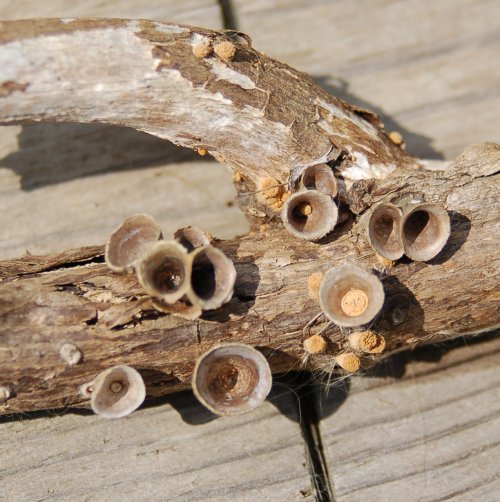
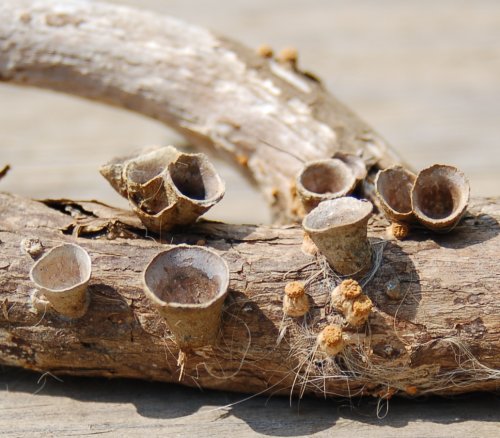
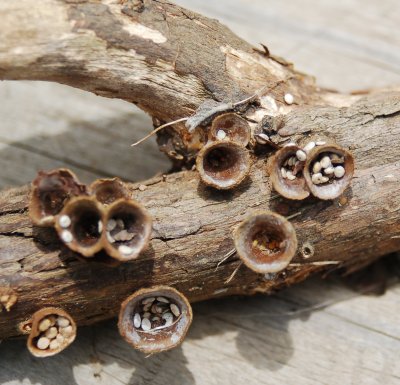
After an interlude of handbag stitching, there is a certain logic to revisiting my Fairies' Purse fungi. Several rains have splashed all the little funiculi "coins" out of the purses, but the rough orange blobs are fresh purses sprouting all over the stick. There's even a new purse growing inside an old one. You know from the previous birds' nest fungi post where the yellow fur came from.

Monday, July 24, 2006

Bib Overalls Pocket On a Patchwork Totebag

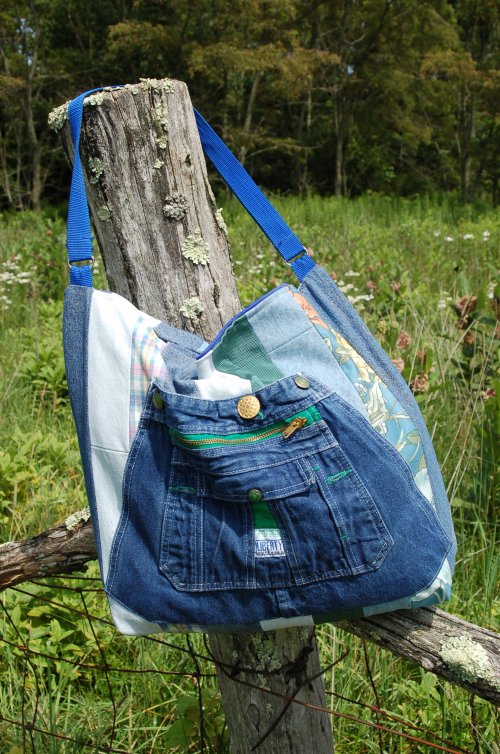
Bib Overall Pocket on patchwork tote bag

I sewed up this tote bag yesterday, after thinking about it for a couple of weeks. I had the bib from an old pair of overalls, and thought it would make a cute and useful exterior pocket. All the materials are reused. I haven't put in the lining yet, because I'm still trying to decide whether the flip side is too plain or not. I have plenty of work shirt buttons that would make an attractive decoration on the dark denim rectangles, but it might be too texture-y to be practical.

In the process of thinking about the design, I spent a little time looking at handmade handbag Web sites. This is an example of an activity greatly enhanced by my DSL connection. With dial-up, it would have taken me days to winnow through the search results and find this many nifty sites with inspiring photos and patterns. This took about an hour. In the end, I sewed the bag I originally envisioned, but I got some really interesting ideas for more projects.

Free Resources

Commercial Resources--Patterns, Hardware, and Handmade Bags

tote bag side tote bag back

Saturday, July 22, 2006

Bird's Nest Fungus (Nidulariaceae)

Bird's Nest Fungus

According to W.C. Roody's Mushrooms of West Virginia and the Central Appalachians, These are Crucibulum laeve, the Common Bird's Nest. Princess and the birds' nests I agree with him that "this little fungus is always a pleasure to find." These are growing on a butterfly bush stem, but I find them on rotting stuff pretty often here on Droop Mountain. One summer I uncovered a large scrap of plywood crowded with the little nests full of tiny "eggs." It looked like some miniature sea bird rookery. When it rains on these birds' nests, the peridioles (eggs) fly out, trailing their little spring-like "stems" or funiculi. The funiculi have sticky ends which adhere to larger objects, anchoring the spore-filled "eggs" to their new homes.

I've also heard these strange little basidiomycetes called "fairies' purses," with the "eggs" interpreted as tiny silver coins. You can see in the photo at left why subsequent pictures of these charming fungi will feature whisps of yellow fur.

Wednesday, July 19, 2006

Blogger's Block

Rhododendron at Allegheny Lodge

This weblog has been more miss than hit lately, due to upheavals in my technological life. After years of wishing, I finally bought a digital SLR camera, and it is complex enough to require much experimentation. It's also made necessary changes in the way I manage my hard drive "space," view my images, and edit them.

Just when I thought I was getting a handle on these changes, the phone company called to let me know DSL is available in my area. This was astonishing, and I expect it will enhance my computer experience eventually, but for now, it's made me reorganize my LAN, learn a lot about hardware and software firewalls (for both Linux and Macintosh), and spend hours reinstalling my Debian OS on two Pentium boxes. Soon, I'll have to change my web hosting arrangements.

These two technological upgrades ought to improve my Web presence and enhance my blogging experience eventually, but right now I feel a little overwhelmed and intimidated by the possibilities. Before, on a dial-up connection, it took about twenty minutes to upload an edited jpg file and an accompanying html file, so I had to prepare my material in advance. I wrote my html in Emacs (my text editor of choice, and the One True Religion). If I wanted to post a photo, I had to finish a roll of film, take it to the drugstore, get it back, scan the negative, and edit the image down to a quick-loading jpg file. This long process gave me several opportunities to review and edit the text, catch my habitual errors, and decide if the picture was worthwhile. Now I can upload any sort of crap as fast as I can type, and slap up any snapshot within minutes of clicking the shutter. I can review Web resources in minutes rather than hours, download podcasts and videos without planning my week around the process.

I don't usually have writer's block (or photographer's block), but this sudden wealth of possibilities has me frozen in place. I could really change the focus of my Web work, alter my pace, branch out into new content areas.... And while I've been dazed by all this, two of the bloggers I most enjoy have been musing on what blogs are, and what their blogs should be. Dave of Via Negativa recently observed:

The blogosphere has been billed as an alternative to the mainstream media, but in many ways, it's just as superficial. The emphasis remains on speed rather than accuracy, sensationalism rather than nuance, and two-sided conflicts rather than the full complexity of life as most of us experience it in our daily lives. Even for us non-political bloggers, there's a great temptation to simply post our latest snapshots, with a few accompanying sentences of breathless prose, and move on to something else. To try to see anything more fully, to observe it attentively and then take the time to describe or depict it with as much care and effort as we can muster seems almost counter-cultural. But if the bloggers I tend to read have anything in common, it might be precisely this, that they are dedicated to documenting what Barbara Brown Taylor refers to as "alternate reality."

Meanwhile, Lorianne of Hoarded Ordinaries has been examining the way her weblog has shifted its focus over the last three years.

...It's quick & easy to slap up a snapshot and say "I'm done blogging for the day"; it takes a bit more time, care, and attention to detail to craft a meaningful post that actually says something.

In my early days of photo-blogging, I justified my "quickie" photo posts by telling myself they were like postcards: although we all love to receive long, carefully-crafted letters, it's also great to get short postcards that assure us "The weather is great; wish you were here." In my mind, a frequently updated blog is more valuable than one that only occasionally posts new (albeit carefully crafted) material: in the blogosphere, frequent snacking seems to be "healthier" (and more popular with readers) than the bloggish equivalent of occasional elaborate feasts....

At a certain point, every writer asks herself, "What do I have to say that's unique to my background and expertise; what do I have to say that needs to be said?" ....these days I'm trying to watch which way the wind is blowing, trying to admit that everything, blogs included, change over time, with there inevitably being a time to be silent as well as a time to speak.

I promise that I will keep posting whether or not I figure out what my blog mission is or not. Perhaps the process will sort it out for me.

Thursday, July 13, 2006

Doily Fraud--The Seamy Underbelly of Pioneer Days

Last week I was asked to judge the knitting category in Marlinton's Pioneer Days Craft Show. When I arrived in town with my evaluation forms in hand, I discovered that there were no entries. The competition is generally referred to as the "Quilt Show," so I wasn't too surprised at this turn of events. Instead, I assisted the crochet category judge, a last-minute stand-in. There were about ten crochet entries, and I think we evaluated them fairly, with one possible exception.

It seems a cotton doily we ranked in the top four was suspect. According to the quilter who organized the show, the woman who brought in the doily entered it on behalf of her neighbor, along with another doily with a "Made in China" sticker still attached. The rules state that the entry must be your own work, an explicit addition after last year's scandal, in which it was revealed that the award-winning quilt was a purchased article.

Now, it costs $2 to enter an item in the show, and the winner's financial stakes are very low--less than the cost of a doily at Wal-Mart. What would motivate doily fraud? Bragging rights are limited, because one runs the risk of coming in third in a field of two. Myself, I've never entered an item in the show because once the competition is over, the display is not watched carefully, and much that is not nailed down in Marlinton disappears during Pioneer Days. (This is not typical--the rest of the year I leave my car unlocked without qualm. I blame the huge crowds from out of town.)

What kind of person commits doily fraud? My faith in needle artists is shaken. I have also been disturbed to learn of dissent and ill-feeling among the quilters in Pocahontas County. There are, it seems, quilters who would not interact with "that quilt show" for anything on earth. It's all rather disillusioning.

Monday, July 10, 2006

Same Old Stuff

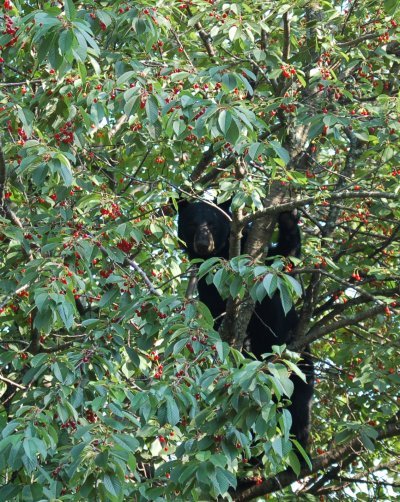
We continue with the cherry pitting obsession, but clearly, we are not alone in this.

Tuesday, July 04, 2006

Assassin Bugs and Bowls of Cherries

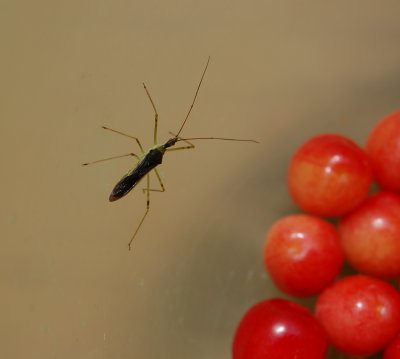
Zelus exsanguinus in a bowl of cherries

We're deep in the process of picking and pitting cherries, but this assassin bug (Zelus exsanguinus) distracted me for a few minutes. I don't see too many assassin bugs here on Droop Mountain, and they are my favorites. This subfamily (Harpactorinae) spends its time up on flowering plants and trees waiting for prey.