Tuesday, February 21, 2006

The Lighter Side of...Ed Friel

Book Cover: Lighter Side of Rectal Surgery

Here's another addition to my Literary Pocahontas County page: Ed Friel's personal memoir, The Lighter Side of Rectal Surgery (2003). I was a little reluctant to pick it up, since the title seemed to promise a very personal memoir indeed. However, it's quite an enjoyable book. Each chapter is an anecdote, told as if waiting in line at the Hillsboro store. In fact, Mr. Friel has certainly told some of these stories in that very place. This conversational style looks easy, but requires considerable skill to make it work.

Mr. Friel has done an excellent job of placing the book all over the county; if you visit here, you can probably find yourself a copy. Unfortunately, I have been unable to find a place where one could buy the book on the Internet. Mr. Friel does provide his e-mail address, so I expect he could tell you how to purchase his book if you're interested. Here it is: edfriel -at- sbcglobal -dot- net (replacing the words with the appropriate symbols, of course).

Sunday, February 19, 2006

Hillbilly Parfait Correlates Trashiness and Altitude

Locust Creek in the mist

The Little Shepherd of Kingdom Come (1898; America's first million-seller) is a novel, but John Fox Jr. takes pains to describe and explain the Kentucky countryside and inhabitants in long asides. Here he shares some eugenic and historic insights about Kentucky's mountaineers. The scene he describes is set around 1850, before the author was born.

When they arrived at the log school-house it was his turn to be shy and he hung back to let Melissa go in first. Within, there was no floor but the bare earth, no window but the cracks between the logs, and no desks but the flat sides of slabs, held up by wobbling pegs. On one side were girls in linsey and homespun: some thin, undersized, underfed, and with weak, dispirited eyes and yellow tousled hair; others, round-faced, round-eyed, dark, and sturdy; most of them large-waisted and round-shouldered -- especially the older ones -- from work in the fields; but, now and then, one like Melissa, the daughter of a valley farmer, erect, agile, spirited, intelligent. On the other side were the boys, in physical characteristics the same and suggesting the same social divisions: at the top the farmer -- now and then a slave-holder and perhaps of gentle blood -- who had dropped by the way on the westward march of civilization and had cleared some rich river bottom and a neighboring summit of the mountains, where he sent his sheep and cattle to graze; where a creek opened into this valley some free-settler, whose grandfather had fought at King's Mountain--usually of Scotch-Irish descent, often English, but sometimes German or sometimes even Huguenot--would have his rude home of logs; under him, and in wretched cabins at the head of the creek or on the washed spur of the mountain above, or in some "deadenin"' still higher up and swept by mists and low-trailing clouds, the poor white trash--worthless descendants of the servile and sometimes criminal class who might have traced their origin back to the slums of London; hand-to-mouth tenants of the valley-aristocrat, hewers of wood for him in the lowlands and upland guardians of his cattle and sheep.
(chapter III, page 34)

I'm fascinated by the correlation between genetics, trashiness and altitude. This looks like the sort of hypothesis we could test, provided we could quantify trashiness and identify genetic markers that would differentiate between Scotch-Irish, English, criminally servile Londoner, and "gentle" blood lines. Fox describes a three-tiered hillbilly parfait, with the white trash on top where the Cool Whip would go.

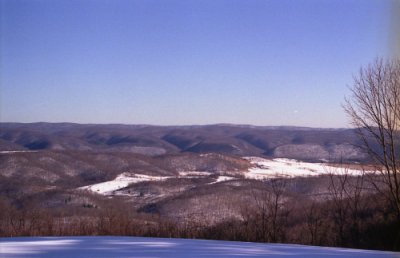
Whenever these blood line arguments come up (and they do oftener than a rational person would expect) I always hope that I'm a "worthless descendant of the servile and sometimes criminal class." People like that find a way to get along. Perhaps that's why I was immediately drawn to this narrow ridge that runs off the Droop Mountain plateau. It's the most "mist-swept" spot I could find for sale. (This is the view from my neighbor's yard. He has a few less trees than I do.)

Friday, February 17, 2006

The Little Shepherd of Kingdom Come

Book Cover: The Little Shepherd of Kingdom Come

A few months ago I read The Little Shepherd of Kingdom Come by John Fox, Jr. (1898). It is much cited among scholars of Appalachia, and was evidently a popular and influential book in its time. At least four major movies were based on elements of the plot, and Kentucky named Kingdom Come State Park after it.

With an elevation of 2,700 feet, Kingdom Come is Kentucky's highest state park. Resting near the Kentucky-Virginia border on the crest of Pine Mountain, the park offers scenic vistas second to none.

The park's name is from John Fox Jr.'s novel "The Little Shepherd of Kingdom Come," a book about an orphaned youth and his journey through the hills and into the furor of the Civil War. Extraordinary rock formations are featured at this park, including Log Rock, a natural sandstone bridge, and Raven Rock, a giant monolith that soars 290-feet into the air at a 45-degree angle.

I found it rough going, myself. I was stopping to make notes so often that I downloaded a Gutenberg project free text file, opened it in Emacs, and made "marginal" notes to my heart's content. I'm guessing the people who named Kingdom Come State Park after it never read it through. The plot is silly, the main character is despicable (he's not nice to his dog, for heaven's sake! A dog that makes Lassie and Rin Tin Tin look like lazy, stupid layabouts!), and the author slings offensive stereotypes about as freely as dew in the morning. This last bit is what makes it so much fun to quote. I'm afraid you'll be in for selected Appalachian tidbits from this volume for some time to come.

Here are a couple of Internet references to whet your appetite.

Tuesday, February 14, 2006

Hunting Trilobites (Not Quail)

Book Cover: Trilobites by  Riccardo Levi-Setti

West Virginia is a good place to hunt trilobites, although, inexplicably, I haven't been trilobite hunting since I moved here. I haven't been fishing much either, although I enjoy that as well. Nevertheless, I've mentioned trilobites as one of my "Natural history" interests on my biographical sketch outline, and, in the interests of fleshing out a real bio, as Jakob Neilsen recommends, here are a few notes and references on these charming animals.


  • Introduction to the Trilobita: Gone, but not forgotten. This is a resource of The University of California at Berkeley Museum of Paleontology. The site is huge, comprehensive, and everything I've seen so far is excellent, both interesting and accurate. The trilobite section is no exception.
  • A Guide to the Orders of Trilobites: A site devoted to understanding trilobites. I don't believe I've ever seen such a great personal site! Here is the author bio:
    This site's pages (and the majority of its figures) were designed and created by Dr. Sam Gon III, a biologist (PhD, Animal Behavior; MA, Zoology (Ecology, Behavior and Evolution) who is greatly intrigued by the expression of ancient biodiversity that trilobites represent. Sam's professional work is in the conservation of global biodiversity today. He serves as the Senior Scientist for The Nature Conservancy's Hawaii Field Office in Honolulu. Sam has long been interested in paleobiology, and in teaching himself about trilobites, using hyperlinks to cross-reference terminology and concepts, found himself developing something of potential interest to a broader audience. The site was unveiled in August 1999 and has attracted feedback from around the world, generating ongoing updates. For all the accolades this site has gathered, Sam is not a professional trilobitologist, but a devoted trilobitophile!
    There are trilobite walking animations, exhaustive discussions of morphology and paleoecology, taxonomy and nomenclature discussions, and links to many other sites. This site is worth a visit whether you are interested in trilobites or in what an enthusiast can do with a Web site when he sets his mind to it. This is what we hoped the Internet would be like.

Monday, February 13, 2006

Sharyn McCrumb's Ghost Riders

Book Cover: Ghost Riders

I just finished reading Sharyn McCrumb's Ghost Riders, the most recent of her "Ballads" novels, set in the mountains of East Tennessee and western North Carolina. Her books are fun to read, and she is meticulous about details, including history, biology, geology, and dialect.

Her early books, the Elizabeth McPherson series and the Jay Omega books (Bimbos of the Death Sun and Zombies of the Gene Pool) are mysteries. Previous volumes of the Southern Appalachian series follow Sheriff Spencer Arrowood through present-day investigations while describing parallel incidents from local history. There is always at least a hint of the supernatural in the plots, if only Nora Bonesteel's premonitions. Ghost Riders has the sheriff and other recurring characters, but there's not really a mystery this time, just juxtaposed narratives of Ms. McCrumb's modern-day characters and the historical Malinda Blalock and Zebulon Vance (a Civil War raider and the Confederate Governor of North Carolina). Some reviewers have criticized this absence, but I didn't miss the mystery. The historical narratives are so convincing and so interesting that I consider this book her best. It is quite an achievement to write a series that gets better and better. So many mystery series run downhill, as the author tries to keep the beloved characters moving forward in ways that the readers will like. (Patricia Cornwell comes to mind here, but I think even Miss Marple eventually ran out of steam.)

I was surprised that there were relatively few Internet references for Ms. McCrumb, considering how popular and how well-respected her books are.

Book Cover: Bimbos of the Death Sun Zombies of the Gene Pool

Sunday, February 12, 2006

Here Are Some Snows of Yesteryear

Snow on Locust Creek

It's still snowing here on Droop Mountain, and the grey clouds are so low you can't see beyond the clearing where my house stands. Pictures on days like these come out as black and white tangles of branches, and my camera is a vintage Olympus SLR, so there's none of that instant weather blogging at my house. Instead, I offer you a picture from last year: The Locust Creek area, taken from the neighbor's back yard.

Thursday, February 09, 2006

Milkweed Ladies Sail Away

Unpopped milkweed pod

Long before I was first entranced by milkweeds, Louise McNeill invited them to tea, and wrote them her first poem. In The Milkweed Ladies (1988, University of Pittsburgh Press), a brief but vivid memoir of a Pocahontas County childhood, McNeill relates the poem she composed as a child for her playhouse tea parties, where her guests were made of milkweed pod fluff:

Milkweed ladies so fair and fine,
Won't you have a sip of my columbine?
Or a thimble of thimbleberry wine?
Milkweed Ladies sail away

Nobody has described Pocahontas County more lovingly or more vividly than Ms. McNeill.

The farm, a wide plateau of rocky, loam-dark fields, lies above Swago Creek, along the Greenbrier River of West Virginia and some twenty-five to thirty miles north of the Virginia line. This patch of earth is held within a half-stadium of limestone cliffs and mountain pastures. On the surface, the Swago Farm is quiet and solid, green in summer and in winter deep with snow. It has its level fields, its fence rows and hilly pastures. There are some two hundred acres of trees and bluegrass, running water, and the winding, dusty paths that cattle and humans have kept open through the years. There are three small woodlands, two of them still virgin and mostly of oak. (p 3)

Milkweed Ladies have sailed away.

Until I was sixteen years old, until the roads came, the farm was about all I knew: our green meadows and hilly pastures, our storied old men, the great rolling seasons of moon and sunlight, our limestone cliffs and trickling springs....But before I grew up and went out into the world--and a bloody thing I found it--we were all at home there in our faded cottage in the meadow, all of us safe and warm. Sometimes now, a quiet sense comes to me, the cool mist blowing in my face as though I am walking through islands of fog and drifting downhill slowly southward until I feel the mountains behind my shoulder. (pp 5-7)

Because those years were the years of my childhood, I might tell them in a way that would break my heart. But my heart does not break. There is a kind of benison that falls sometimes on the fields and mountains....And though I realize that I am old now, so that the years play tricks on me, it is all still there sometimes, an unchanged presence, even the rat manure in the water spring; and sometimes we are still at home and it is summer. (p 31)

Wednesday, February 08, 2006

"The Mind of the South" on the Internet

Book Cover: The Mind of the South

Last week, while volunteering at my local library branch, I came across an interesting volume in the "for sale" section. Someone seems to have donated his or her collection of yellowed paperbacks from college days. Where else would these essay collections on John Milton have come from? Of course, I have my own set of yellowing paperbacks on John Milton, so I only purchased W.J. Cash's The Mind of the South (Vintage), published in 1941.

Book Cover: The Education of Henry Adams

I was initially interested when I spotted some favorite Appalachian stereotypes, but I soon found some insulting quotes from The Education of Henry Adams, and I was hooked. Clearly,W. J. Cash was an angry Southerner, but was he most angry at his fellow Southerners, or at dismissive Yankees like Mr. Adams?

I turned to an Internet search engine to find out what I could about Mr. Cash. Strangely, the top results were mostly content-free. Therefore, I'm assembling the fascinating resources I found in one of my little lists, for future reference.

  • Book Cover: W.J. Cash W.J. Cash: A Life by Bruce Clayton. (Not a close relative, but I will be checking the genealogy charts. After all, he's from Missouri.) Here's the Library Journal blurb on the amazon.com page:
    Clayton plumbs the mind and milieu of the man who authored The Mind of the South, a classic of historical literature never out of print since Knopf published it in 1941. Probing the book's autobiographical foundations, Clayton traces the steps of the South Carolinian born in 1900 and christened Joseph Wilbur Cash. From his reversal of names to Wilbur Joseph, through his college days at Wake Forest and his unhappy stint teaching English, to his years as a newspaperman, Cash comes to life in Clayton's prose as a sensitive and sympathetic Southern son seeking to explain himself and his native region. Clayton shows that the sense of sorrow and profound tragedy stalking Cash's South also haunted him to the day his wife found him hanged in their Mexico City apartment. Clayton's insights into the man and his time and place make this book essential for collections on the South.--Thomas J. Davis, Univ. at Buffalo, N.Y.
  • "Cash, W.J.." Encyclopedia Britannica. Short and sweet--three paragraphs. It describes his single book thus:
    In The Mind of the South, Cash tried to debunk the idea of an "aristocratic" Old South and a "progressive" New South and sought to describe the romanticism, antiintellectualism, and prejudice that he believed arose from a peculiar Southern climate, landscape, frontier violence, clannishness, and Calvinism.
  • Random House, Inc.'s Mind of the South page promotes Cash's book, saying:
    Ever since its publication in 1941, The Mind of the South has been recognized as a path-breaking work of scholarship and as a literary achievement of enormous eloquence and insight in its own right. From its investigation of the Southern class system to its pioneering assessments of the region's legacies of racism, religiosity, and romanticism, W. J. Cash's book defined the way in which millions of readers -- on both sides of the Mason-Dixon line -- would see the South for decades to come.
  • W. J. CASH: QUANDARIES OF THE MIND is a candidate for a "Websites that suck" listing, although it is consistently the first page Google returns. There is probably useful information here, but good luck trying to read the pages.
  • On Being Southern - perspectives from all over. This interesting collection of literary quotations is from the Hampstead, NC Chamber of Commerce web site. It features quotes from Cash, but includes many other interesting excerpts on the South. I would like to know more about the author of the page, but all I can find out is that he made the Hampstead Web page.
  • Typewriter used by W.J. Cash in the creation of "The Mind of the South." Yes, it is a photo of his typewriter. There is a typewriter like this in my past, but, alas, I have no photo to include in my personal archive.
  • Wilbur J. Cash Collection at the Wake Forest University Library. Google did not return this result in its first 100 hits, although it is the gateway to the most interesting and important Web site concerning W.J. Cash. I found it by backtracking from the typewriter photo. The Table of Contents to the W.J. Cash Collection lists their collection of Cash's papers available on the Internet as text and photos. I can't resist quoting this letter to Cash from Ellen Glasgow:
    You will see how carefully I have read your book when I pause to take issue with a quotation. Why, I wonder, should you accept Henry Adams as the final authority upon the Southern mind? "The Education " is one of my favorite books, and I am willing to admit that accuracy is often the point of offense in Henry Adams's malice. Nevertheless, I remember that there are unorthodox opinions concerning even in the mind of Adams. Do you recall an amusing passage in "New England: Indian Summer"? "He (John La Farge) dreamed ,after one of (their arguments) that he heard the mind of Adams making a great clatter in the room. He awoke,--it was only a rat."
    Amazing, eh? Ellen Glasgow dishing Henry Adams to W.J. Cash! I'm so glad I looked at that typewriter picture.
  • Internal orientalism in America: W.J. Cash's The Mind of the South and the spatial construction of American national identity. David R. Jansson, Department of Geography, The Pennsylvania State University, 302 Walker Bldg., University Park PA, 16802, USA Political Geography 22 (2003). This is the only interesting scholarly article I found that was freely available without a subscription. It's a .pdf file; I found it quite fascinating.

Tuesday, February 07, 2006

Entomological Fun With Asclepias syriaca

Monarch caterpillar on milkweed pod

I never pass a milkweed plant (unless I'm driving a car--I draw the line at braking for roadside weeds) without looking on the undersides of its upper leaves. Since I moved to Pocahontas County in 1999, my search has been in vain, until this past summer. I never found eggs, but this August, I discovered plenty of these handsome Monarch caterpillars. I don't know what was different this year.

When I was about fourteen, I discovered that you could pluck your milkweed with Monarch egg, bring it into the house, stick it in a Coke bottle filled with water, and, over the next two weeks, watch the caterpillar hatch, and grow, and munch away at the leaves. As the leaves disappear, you can move the caterpillars (I kept finding more) onto freshly picked plants. You need to sweep up the frass on the tabletop pretty often, but then the caterpillars pick a place to pupate, and you get to watch them split their skin down the back one last time, to reveal a translucent, green and gold chrysalis, which squirms itself into shape, and holds still. It's not long before the chrysalis turns black and orange, splits open again, and out crawls the long-legged, tiny-winged butterfly. It pumps up the tiny wings, gets nice and dry, and needs to be let outdoors.

I'm reasonably certain that kids today don't ever have this much fun.

Monday, February 06, 2006

Now Play It Like You Mean It

I was looking for a reference on the Internet the other day, and I found this, a peripherally related topic. This is from Roadside Theater's Web site, an essay entitled Art in a Democracy, by Dudley Cocke. (Text from The Drama Review, Fall 2004, Social Theatre, Vol. 48, Issue 3)

Locating Oneself in a Tradition

Thirty-odd years ago, a famous folksinger from California came to the coalfields of central Appalachia to perform in a high school auditorium. A big crowd was on hand as a local string band opened the concert. The local band, rising to the occasion, had the audience's rapt attention. The famous folksinger followed with some success. Backstage, she made a point to congratulate the local band on their performance, noting that she, too, often sang from the same Appalachian song book. She went on to say how keenly the audience had been listening to their music and wondered what their secret was. "What is that little something extra you seem to have?" she asked repeatedly, each time more emphatically. The local band looked at the floor as she pressed for an answer. Finally the fiddle player spoke up, "Well ma'am, the only difference that I could tell was that you were playing out front of them ol' songs, and we were right behind 'em."

Aha! I said to myself. This person is getting close to that indescribable something that traditional Appalachian string bands have that is missing in so many "revivalists'" performances. Perhaps he's defined it for me. Then, he goes on to quote Ralph Ellison.

Ralph Ellison deftly spins the fiddler's point:

There is a cruel contradiction implicit in the art form itself. For true jazz is an art of individual assertion within and against the group. Each true jazz moment (as distinct from the uninspired commercial performance) springs from a context in which each artist challenges all the rest, each solo flight, or improvisation, represents (like the successive canvases of a painter) a definition of his identity: as individual, as member of the collectivity, and as link in the chain of tradition. Thus, because jazz finds its very life in an endless improvisation upon traditional materials, the jazzman must lose his identity even as he finds it. (Ellison [1964] 1995:234)

Don't get me wrong, now. I admire Ralph Ellison up one side and down the other. "True jazz moment" versus "uninspired commercial performance" sounds like he's getting to the heart of the matter. I just have no idea how "each solo flight" is like "successive canvases of a painter," or is a definition of the musician's identity. Maybe it's true, but I'm no wiser than before.

Maybe you can't do better than John Blisard, who advises aspiring musicians: "Now, play it like you mean it."

Friday, February 03, 2006

Asclepias syriaca Inflorescences: "Such a Strange Flower"

Common Milkweed Inflorescences

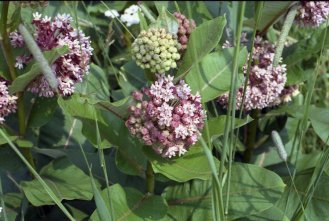
With the departure of the snow, I'm noticing all the opened milkweed seedpods along the roadsides and at the edges of my yard. It has me thinking about how they looked in July. They are such strange plants, oozing sticky bitter sap like Elmer's glue when you try (always unsuccessfully) to pull them out of your garden. These strange, fleshy flowers, the color of bruises, trap nectar-seeking insects by the leg. When the butterfly or wasp pulls its leg free, it drags out the pollinium, a pollen-filled ankle bracelet. Smaller, frailer insects, such as ants, can't extricate themselves, and they die like beavers in leghold traps.

My plant taxonomy professor told us that Linnaeus named these strange flowers Asclepias syriaca because he felt sure the North American herbarium specimens he received must have been mislabeled. The downy stems, the fleshy leaves and seed pods, these were clearly xeric adaptations found in desert plants. He opted for syriaca rather than the canadensis or virginica he used for so many North American species.

As usual, I've found a few interesting links, which I submit for your consideration.

Thursday, February 02, 2006

Reya's Bloggers (Silent) Poetry Reading

Anne, of Creating Text(iles), relayed an invitation (in honor of the Feast of St. Brigid) to a "bloggers' silent online poetry reading" hosted by Grace's Poppies. I was so excited that I posted three redundant comments to Grace's Poppies in an attempt to give her my correct Web address. They don't seem to go away gracefully.

Therefore, I am sitting here dressed in black, wearing a beret as I type a favorite poem by John Donne. I chose it for two reasons: it has an entomological theme, and I just don't have the stamina to type "An Anatomy of the World."

THE FLEA
by John Donne
Mark but this flea, and mark in this,
How little that which thou deniest me is;
It suck'd me first, and now sucks thee,
And in this flea our two bloods mingled be.
Thou know'st that this cannot be said
A sin, nor shame, nor loss of maidenhead;
    Yet this enjoys before it woo,
    And pamper'd swells with one blood made of two;
    And this, alas! is more than we would do.

O stay, three lives in one flea spare,
Where we almost, yea, more than married are.
This flea is you and I, and this
Our marriage bed, and marriage temple is.
Though parents grudge, and you, we're met,
And cloister'd in these living walls of jet.
    Though use make you apt to kill me,
    Let not to that self-murder added be,
    And sacrilege, three sins in killing three.

Cruel and sudden, hast thou since
Purpled thy nail in blood of innocence?
Wherein could this flea guilty be,
Except in that drop which it suck'd from thee?
Yet thou triumph'st, and say'st that thou
Find'st not thyself nor me the weaker now.
'Tis true; then learn how false fears be;
Just so much honour, when thou yield'st to me,
Will waste, as this flea's death took life from thee.

Wednesday, February 01, 2006

Dickens' Unflawed Heros

Book Cover: Dickens: A Biography

Here's another interesting quote from Fred Kaplan's Dickens : A Biography. I've always found Dicken's first person narrators, like David Copperfield and Arthur Clennam, problematic. While they are participants in the plot, their communications to the readers are a little too insightful for the limitations of their characters. Dickens seemed to feel quite comfortable with omniscient narrators ("A Christmas Carol," A Tale of Two Cities), and I wonder why he ever chose first person narratives. This quote suggests that he felt constrained by this technique, and he seems to have blamed his readers' and critics' moral requirements.

....Dickens was radically conservative in his combination of realistic psychological portraiture and moral idealism. To the realists, though, even his sharp psychological portraiture lacked a fullness of dimension that would make the depiction true to life. Clennam was an instance at hand, as Little Dorrit progressed. Despite his complications of history and character, Clennam embodies conventional decency, and never struggles with the anger, violence, vengefulness, sexual fulfillment, even self serving irrationality of the sort that such a man might naturally be expected to feel Having gone as far as he thought it sound to go, Dickens felt the frustration of his situation as a Victorian writer. If "the hero of an English book is always uninteresting--too good, not natural, etc....what a shining imposer you," the English critic, "must think yourself and what an ass you must think me, when you suppose that by putting a brazen face upon it you can blot out of my knowledge the fact that this same unnatural young gentleman (if to be decent is to be necessarily unnatural)...must be presented to you in that unnatural aspect by reason of your morality, and is not to have, I will not say any of the indecencies you like, but not even any of the experiences, trials, perplexities, and confusions inseparable from the making and unmaking of all men!"

Tuesday, January 31, 2006

Maurice Brooks Defines Appalachia for Me

Appalachia is defined in so many different ways. It's a cultural region, no it's an economic region, no, it's a mountain range. The only time I've ever felt clear on the concept was when I took a graduate class in biogeography. You could make vegetation maps, and classify an area, and know what you had. That's why I was so happy to find Maurice Brooks' The Appalachians. This 1965 book gives a clear, unambiguous biogeographic description of Appalachia, its extent, its history, and its special character. It never once mentions hillbillies, the Scotch-Irish, fiddle tunes preserved in amber, or any other imaginary phenomena.

For a better understanding of all that Appalachia includes, there must be mention of its principal mountains. Some, the low ranges of western Newfoundland and the Shickshocks in the Gaspe, for instance, have been noted. South of the Shickshocks are Quebec hills that rise above the St. Lawrence plain, the Notre Dame ranges attaining respectable heights.

In Maine there is the great modadnock of Katahdin, and farther west in that state lower Appalachian ridges. New Hampshire's White Mountains are splendid, one of Appalachia's finest features. The Green Mountains of Vermont extend from Quebec to Massachusetts, and southward in the latter state they are named the Berkshires, whose hills enter Connecticut and eastern New York.

New York's second mountains, the Catskills, are a part of Appalachia; its most extensive and elevated range, the Adirondacks, are not. These bold peaks, between the Hudson and the St. Lawrence, are a southward extension of the great Canadian Shield, most of which is in Canada but which again enters the United States in the highlands just south of Lake Superior. The Appalachians cannot claim the Adirondacks, and so they lose some of the finest of eastern peaks.

South of the Catskills, across northern New Jersey and eastern Pennsylvania, there are many Appalachian ridges, none of them high but making rugged country nevertheless. Scarcely noticeable among other ridges, the great Blue Ridge begins to rise south of Harrisburg, Pennsylvania, and it continues--sometimes as one main axis, sometimes as divided ranges--south to South Carolina, Georgia, and Alabama. In southwestern New York the Alleghenies begin, covering much of western Pennsylvania, western Maryland, eastern Ohio, West Virginia, and Virginia. The Great Smokies (actually a portion of one of the Blue Ridge divisions) lie farther west, and farther still, in eastern Kentucky, southwestern Virginia, and Tennessee, are the irregular masses of the Cumberlands. There are, of course, local divisions of all these ranges, and many of them will be mentioned in the proper context. Here we are concerned only with primary features.

pages 19, 20.

Monday, January 30, 2006

Maurice Brooks' The Appalachians

Russian olive berries

I was checking Dewey Decimal numbers on my local library's "West Virginia Collection" when I came across a very interesting misfiled book, The Appalachians, by Maurice Brooks (1965). It's a discussion of the biogeography (including flora, fauna, and geology) of the Appalachian Mountains.

Brooks grew up on French Creek in Upshur County, West Virginia, the son of an entomologist. Born in 1900, he went on collecting trips with his father from the time he was a child. He mentions a particularly exciting camping trip in Pocahontas County's Cranberry Glades, in which his father collected an unusual rodent, a yellow-nosed vole. The novel record attracted the attention of Arctic researcher Edward Preble, who came camping with them. Preble was a collaborator with Ernest Thompson Seton. Reading Brooks' book, realizing that he spent much of his professional life here in my neighborhood, I have an exciting connection with a prominent nineteenth century biologist. (I get excited over the strangest things, I know.) Brooks research interests were broad, encompassing ferns, forestry, ornithology, paleontology, bog ecology and mammalian physiology. He was the sort of naturalist I wanted to be when I was a teenager, before I had graduate faculty to tell me that such interests were "unprofessional." (Actually, I think they said things like "for losers" and "stupid," but let's give them the benefit of the doubt.)

This is exactly the book I have been wishing for. He defines in a biogeographic sense what Appalachia is, and discusses northern and southern localities, but he writes at length on the portion of West Virginia that was his home--Randolph, Pocahontas, Greenbrier, Monroe, and Upshur counties. I've got some local field trips planned for the warmer months this year.

Friday, January 27, 2006

DVD Pirates in West Virginia Capitol Building

I first heard about this story on This Week in Tech, podcast number 39. Slashdot showed me the link to the Charleston Gazette article (January 18, 2006). I'm quoting a big chunk of the article here because the Gazette's links go dead quickly, and I want to keep this around. I begin to see parallels between this and some computer "issues" I've observed in my part-time work for the state of West Virginia.

January 18, 2006: Makeshift studio, piracy software found at Capitol
By The Associated Press

State investigators have stumbled onto a basement office in the West Virginia Capitol outfitted with computers, video and audio gear, and software used to pirate movies and music recordings, according to a document obtained by The Associated Press.

Specifically, one hard drive contained approximately 40 full-length motion videos, state Chief Technology Officer Kyle Schafer said in the Jan. 5 memo to Administration Secretary Robert Ferguson. Two other hard drives contained over 3,500 MP3 music files consuming more than 14 [gigabytes] of hard drive space.

Hundreds of blank DVDs, CDs and jacket covers were also found, as was software commonly used to crack header codes on copyrighted materials such as movies and music to allow duplication, Schafer's memo said.

Ferguson confirmed Tuesday that his staff found the makeshift audio-video studio amid his widening probe into spending and other abuses at the state General Services Division.

The review found that someone in General Services sidestepped state purchasing rules to buy more than $88,000 worth of computers and related equipment over the last three years, including the items discovered in the basement office. Not all the purchased computers and gear can be located, Ferguson said.

General Services maintains the Capitol Complex grounds and buildings, among other duties. Yet Schafer's memo shows that it purchased $51,000 worth of computers during the 2005 budget year alone, compared to the $45,726 worth bought by the state auditor's office.

The [purchase] card system was abused, in what seems to be an intentional attempt to bypass rules to buy equipment that for General Services was outside the norm, Ferguson said. There was no question on what they could do with a P-card, in my opinion. As a Cabinet secretary, I would say that it was out of control.

Both the FBI and the Legislature's Commission on Special Investigations are investigating his department's finds, Ferguson said.

He declined to identify who made the purchases, or whose office contained the makeshift audio-video studio.

We will hold accountable those people who have abused the letter and the spirit of the law and undermined my responsibility to safeguard the resources of the state, Ferguson said.

Thursday, January 26, 2006

Shopping the Smithsonian

In contrast to yesterday's Library of Congress free resources, the Smithsonian Center for Folkife and Cultural Heritage is mostly a commercial site. They do have quality material for sale. I have several of their recordings and publications. However, I am disappointed that they they don't share any samples of traditional culture freely. Also, they list the Folklife Festivals for 2004 and 2005 in their upcoming highlights section. This seems like a bad sign. Here's something from their "About Us" section:

The Center's activities are funded by federal appropriations, Smithsonian trust funds, contracts and agreements with national, state, and local governments, foundation grants, gifts from individuals and corporations, income from the Festival, and Folkways product sales. The Center's experienced staff is culturally diverse and extremely productive, combining interdisciplinary scholars with technical specialists. The Center has distinguished advisors and cooperates with numerous international, state, local, and professional organizations.

Over the years, I had some short-term contract jobs at a couple of Smithsonian agencies in Washington, D.C. They are a strange mix of for-profit, federally-funded, and non-profit organization, and their administration seemed unintelligible when I worked there. Nevertheless, the Smithsonian Center for Folkife and Cultural Heritage is worth a look if you are ready to buy recordings.

Wednesday, January 25, 2006

American Folklife Center Online Presentations

Pete, Paris, and Neal Hammons

Another bulletin from my "Internet Resources on Traditional American Music and Craft" (or whatever it turns out to be): The American Folklife Center, part of the Library of Congress. In contrast to some federal agencies and research institutions, the Library of Congress has been steadily improving and adding to its Internet resources for many years. Here's a quote from their "mission statement" (Does that phrase give you the creeps? It does me.):

"The mission of the Library of Congress is to make its resources available and useful to Congress and the American people and to sustain and preserve a universal collection of knowledge and creativity for future generations. The goal of the Library's National Digital Library Program is to offer broad public access to a wide range of historical and cultural documents as a contribution to education and lifelong learning."

The American Folklife Center has made many interesting collections accessible for free on their American Folklife Center Online Presentations. One of particular interest for me is Fiddle Tunes of the Old Frontier: The Henry Reed Collection.

"Fiddle Tunes of the Old Frontier: The Henry Reed Collection is a multi-format ethnographic field collection of traditional fiddle tunes performed by Henry Reed of Glen Lyn, Virginia. Recorded by folklorist Alan Jabbour in 1966-67, when Reed was over eighty years old, the tunes represent the music and evoke the history and spirit of Virginia's Appalachian frontier. Many of the tunes have passed back into circulation during the fiddling revival of the later twentieth century. This online collection incorporates 184 original sound recordings, 19 pages of fieldnotes, and 69 musical transcriptions with descriptive notes on tune histories and musical features; an illustrated essay about Reed's life, art, and influence; a list of related publications; and a glossary of musical terms."

Henry Reed was a West Virginia fiddler from Monroe County. (Go out my driveway, turn left, keep going, and you'll be there in under an hour.) Alan Jabbour and The Fuzzy Mountain String Band made his acquaintance when he lived just over the West Virginia border in Virginia. This band made some of Reed's tunes standards among the "hippies" in the 1970's. (The "hippies" usually call themselves "revivalists," or something more dignified. They are people who play traditional Appalachian music, but were not raised in that tradition. Local musicians call them "hippies" to be kind, and "horseflies and chicken chokers" to be unkind.) Some of Reed's unique tunes, like "Over the Waterfall," have been played so much by outsiders that West Virginia musicians won't play them on a bet.

The upshot of this overexposure is that Henry Reed is not as well-known locally as he deserves to be. The .mp3 files in Fiddle Tunes of the Old Frontier: The Henry Reed Collection are gems, given away for free, and represent a chance to hear Reed's "licks" and interpretations of standard tunes, and some unusual melodies that are not widely played any more.

I'm making my way through other American Folklife Center Online Presentations a little at a time. I'm very impressed with the quality and variety. I should also point out that the Archive of Folk culture sells some recordings taken from their collections. You can sample the "Online Presentations," and browse for things you need at Folk Recordings Selected from the Archive of Folk Culture. The photo above is on the cover of "The Hammons Family: Traditions of a West Virginia Family and Friends," a favorite recording/publication of mine, and one I quoted extensively in Haunted Pocahontas County, "Signs and Wonders from the Hammons Family."

Tuesday, January 24, 2006

Little Joe the Wranger Lyrics

As part of my "Little Old Log Cabin in the Lane" lyric search, I hauled out my copy of Songs of the Cowboys, compiled by N. Howard (Jack) Thorp. This is a favorite song of mine, but I learned the words long before I ever found Thorp's book, and I don't have them quite right. The song appears in many collections of "traditional" songs (usually without attribution) and with various manglings of meaning. For example, Joe is often wearing "broken shoes," rather than "brogan shoes." I assume this is from people who don't know what brogans are. Another common deviation is that Joe is beaten by his stepfather, rather than stepmother, as Thorp wrote it. To me this is a radical change of meaning--a woman would have a hard time beating a teenage boy. Thorp's Little Joe was probably a younger child. Boys as young as eight worked cattle drives at the turn of the twentieth century. This is such an unattractive fact that people have probably suprpessed it, especially when we see what happens to poor Little Joe.

The detailed description of where Thorp first wrote and performed is probably provided because so many people believed it was a traditional song based on a particular incident. Many people who never met Thorp were certain they knew the song's author and the "real" Little Joe.

Little Joe the Wrangler
by N. Howard Thorp

Written by me on trail of herd of O Cattle from Chimney Lake, New Mexico to Higgins, Texas, 1898. On trail were the following men, all from Sacramento Mountains, or Crow Flat: Pap Logan, Bill Blevens, Will Brownfield, Will Fenton, Lije Colfelt, Tom Mews, Frank Jones, and myself. It was copyrighted and appeared in my first edition of "Songs of the Cowboys," published in 1908.

Little Joe, the wrangler, will never wrangle more;
His days with the "remuda"--they are done.
T'was a year ago last April he joined the outfit here,
A little "Texas stray" and all alone.

T'was long late in the evening he rode up to the herd
On a little old brown pony he called Chow;
With his brogan shoes and overalls a harder-looking kid,
You never in your life had seen before.

His saddle 't was a Southern kack built many years ago,
An O.K. spur on one foot idly hung,
While his "hot roll" in a cotton sack was loosely tied behind
And a canteen from the saddle horn he'd slung.

He said he had to leave his home, his daddy'd married twice, 
And his new ma beat him every day or two'
So he saddled up old Chow one night and "lit a shuck" this way--
Thought he'd try and paddle now his own canoe.

Said he'd try and do the best he could if we'd only give him work,
Though he didn't know "straight" up about a cow;
So the boss he cut him out a mount and kinder put him on,
For he sorter liked the little stray somehow.

Taught him how to herd the horses and learn to know them all,
To round 'em up by daylight; if he could
To follow the chuck-wagon adn to always hitch the team
And help the "cosinero" rustle wood.

We'd driven to Red River and the weather had been fine;
We were camped down on the south side in a bend, 
When a norther commenced blowing and we doubled up our guards,
For it took all hands to hold the cattle then.

Little Joe, the wrangler, was called out with the rest,
And scarcely had the kid got to the herd,
When the cattle they stampeded; like a hailstorm, long the flew,
And all of us were riding for the lead.

'Tween the streaks of lightning we could see a horse far out ahead--
'T was little Joe, the wrangler, in the lead;
He was riding "Old Blue Rocket" with his slicker 'bove his head,
Trying to check the leaders in their speed.

At last we got them milling and kinder quieted down, 
And the extra guard back to the camp did go;
But one of them was missin', and we all knew at a glance
'T was our little Texas stray--poor Wrangler Joe.

Next morning just at sunup we found where Rocket fell,
Down in a washout twenty feet below;
Beneath his horse, mashed to a pulp, his spurs had rung the knell
For our little Texas stray--poor Wrangler Joe.

Monday, January 23, 2006

Two Versions of Little Old Log Cabin in the Lane

With all the Web sites I've been visiting looking for "Little Old Log Cabin in the Lane" lyrics, I should report that I found what I was looking for, sort of. Below is a bluegrasser's version of the way the song is commonly sung today. I've corrected some misspellings and some words that didn't make sense. One of the good things about lyrics collections on the Internet is that anyone that knows something can make it available. One of the bad things about lyrics collections on the Internet is that anyone who thinks he knows something can slap it up without checking or editing. The more popular a topic is, it seems, the more mis-information is available. Bluegrass songs seem to be popular enough to accrue a lot of junk.

Oh I'm gettin' old and feeble and I cannot work no more
My rusty-bladed hoe I've laid to rest.
And my papa and my mama they are sleepin' side by side.
Their spirits now are roaming with the blest.

CHORUS:
   Oh the chimney's fallin' down and the roof is all caved in,
   Lettin' in the sunshine and the rain.
   And the only friend I've got left is that good old dog of mine
   In the little old log cabin in the lane.


Oh the path is all growed up now that led around the hill;
The fences they have all gone to decay.
And the creek is all dried up now where we used to go to mill,
And time has changed its course another way.

CHORUS

Oh I ain't got long to stay here; what little time I've got
I want to rest content wile I remain.
'Til death shall call this dog and me to find a better home
Than this little old log cabin in the lane. 

CHORUS

Below are Will Hays lyrics for the original song. As you can see, they are in minstrel show fake dialect, which these days is considered fairly offensive. The "modern" version looses this problematic feature, but it also gives up the poignant content. Singing the modern version, I imagine an older man living a simple, contented life in his old home, with his faithful dog. The original version is the voice of an elderly freed slave, slowly starving to death on the abandoned plantation. It's a strange mixture of contempt (the fake dialect) and pity.


"The Little Old Cabin in the Lane" (1871)
As Sung by Manning's Minstrels.
Words & Music by William Shakespeare Hays, 1837-1907

1.
I'm getting old and feeble now,
I cannot work no more,
I've laid de rusty bladed hoe to rest,
Ole massa an' ole miss's am dead,
dey're sleepin' side by side,
Deir spirits now are roaming wid de blest;
De scene am changed about de place,
de darkies are all gone,
I'll neber hear dem singin in the cane,
And I'se de only one dat's left
wid dis ole dog ob mine,
In de little old log cabin in de lane.

CHORUS
De chimney's falling down, and de roof is cavin' in,
I aint got long round her to remain,
But de angels watches over me when I lays down to sleep,
In de little old log cabin in de lane.

2.
Dar was a happy time to me,
'twas many years ago,
When de darkies used to gather round de door,
When dey used to dance an' sing at night,
I played de ole banjo,
But alas, I cannot play it anymore.
De hinges dey got rusted an' de door has tumbled down,
And de roof lets in de sunshine an' de rain,
An' de only friend I've got now is dis good ole dog ob mine,
In de little old log cabin in de lane.

(CHORUS)

3.
De footpath now is coverd o'er
dat led us round de hill,
And de fences all are going to decay,
An' de creek is all dried up
where we used to go to mill,
De time has turned its course an-od-der way.
But I aint got long to stay here, and what little time I got,
I'll try and be content-ed to remain
Till death shall call my dog an' me to find a better home
Dan dat little old log cabin in de lane.

(CHORUS)

Saturday, January 21, 2006

John Quincy Wolf Folklore Collection--A Fine Resource

In the course of my search for "Little Old Log Cabin in the Lane" lyrics, I found some good traditional music resources on the Web. Because search engines return so many "ungood" folk music resources, I thought I'd present a little "Show and Tell" about sites I can recommend. I plan to start an annotated list of resources on my Web pages soon.

John Quincy Wolf Folkore Collection: "This Website contains documents, audio recordings, and other materials from the John Quincy Wolf Folklore Collection, part of the Regional Studies Center at Lyon College. It is divided into eight topical sections...." Ozark Folksongs includes transcriptions and audio files for hundreds of songs collected from 1952-1970, and Sacred Harp features Wolf's recordings of Sacred Harp singings. Other interesting sections include "Memphis Blues" (recordings from Bukka White's visits to Wolf's classroom), "Life in the Leatherwoods," Wolf's folklore publications, and biographical materials.

I've been working my way through the song collection slowly. Even these small .mp3 files take a while with my dial-up connection. The first one I downloaded seems to be representative of the collection's high quality. "Little Log Cabin in the Lane Sung by: Gus Mahon" contains a temperance version of the song I've never heard anywhere else. Mr. Mahon is a fine traditional singer, and accompanies himself on the fiddle. As a bonus, he follows up with a very nice version of "The Eighth of January," a tune played here in Greenbrier and Pocahontas Counties.

Friday, January 20, 2006

Louise McNeill Meets a Local Color Author, But Doesn't Enjoy It

Book Cover: The Milkweed Ladies

You may have noticed that I collect quotes from the urban sophisticate set about natives of rural areas. Because Appalachia is a much disparaged rural region, I have quite a collection about my adopted home. From nineteenth century "local color" writers to modern horror movie screenplays (which are so often set in West Virginia that we laugh about it), there is an extensive literature detailing the shortcomings of those hillbillies. Pocahontas County native Louise McNeill describes her first encounter with this genre, at age eleven, in her memoir The Milkweed Ladies (University of Pittsburgh Press, 1988).

The summer I was eleven, we held a Vacation Bible School for the little children at the Lower Church. It was a new thing, and a lady came from way-off to hold the school. Hiram Barns, who lived in a neat painted cottage just above the village and was active in the church, had helped with all the plans. The lady's name was Miss Virginia, and Mr. and Mrs. Barns had her to stay with them and fixed their spare room all nice for her. Since I was a big girl then, I helped Miss Virginia with her teaching. She had colored paper and crayons for the little kids, and new songs to teach, and a little play to put on. I went down to the church every morning, and I loved Miss Virginia. She had a nice soft voice and curly hair and wore lace on her white blouse. I read to the little kids and helped them with their songs. Miss Virginia let me take them outdoors, where we sat in a circle on the grass near the graveyard, and I read them stories about Jesus. The children got to take their pictures home, and on the last day Miss Virginia had a program so all the mothers could come to see.

When Miss Virginia told us good-bye, I almost cried and could think of no one else for a week. Later, we began to hear things about her. It turned out that Miss Virginia had gone away and written a bad story about us in a church magazine. Hiram Barnes was a subscriber to the magazine; and when it came, there was a story about the community of S---, by Miss Virginia. In the story, she told how it was up in the mountains, how ignorant and crude the people were. She told about Hiram Barns's house and made fun of it and of how Mrs. Barns dipped snuff. Hiram Barns passed the magazine all around the neighborhood, and we all read what Miss Virginia thought about us. I felt sorrow and disillusionment, and, for the first time, I began to wonder about the people beyond Swago Crick.

Thursday, January 19, 2006

Charles Dickens Didn't Like the Country I Come From

Dickens' novels were my first taste of real, adult literature. I read Oliver Twist when I was ten, and while there were huge chunks of it I didn't understand (I imagined a beadle as half-human, half-insect), I felt pain for the hungry orphan, shuddered at Nancy's murder, and almost shed tears when Oliver's kin claimed him at last. By the time I was fourteen I had read David Copperfield over and over, and was deep into Bleak House. By the time I was sixteen, I was beginning to feel uncomfortable with the narrow range of female characters (saintly sisters, dopey wives, and dangerous viragos). Every few years I reread some of the books, and find amazing things I never noticed before.

Another thing that made me uncomfortable as a teenager was American Notes for General Circulation, Dickens' account of his first visit to North America in 1842. I was never able to finish reading it. I grew up on the prairie between the Missouri and Mississippi rivers, and all my ideas of natural beauty involved untamed grasslands, great sweeping expanses of sky, and lines of cottonwoods following seasonal creeks and wide, shallow rivers. The country I come from (and my ancestors, the European settlers) did not appeal to Mr. Dickens at all. Here's Fred Kaplan's (1988) rundown of the western leg of the American tour.

From Baltimore, he journeyed into an America whose boundary of comfort was the eastern seaboard and whose boundary of civilization was just slightly beyond the Mississippi, "the renowned father of waters." The railroad extended twelve miles west of Baltimore. After that, it was stagecoach and river travel only. On the seaboard, he had experienced the American experiment with democracy leavened by the high culture of the British inheritance. Traveling westward, he expected to see not so much the frontier but the wilderness, the exciting but comfortable European myth of the scenically sublime and exotic, a vast region of natural beauty suffused with transcendental power.

But his journey to St. Louis up the Mississippi, "the beastliest river in the world," was distressing. The constant jarring efforts, especially at night, to avoid the steamboat's colliding with floating logs, frightened him.....The farther he moved into unsettled, fragmentary communities, the more frightened he became. He had the sense of a society without supportive circles and communities of friends. In Cairo, Illinois, at the junction of the Ohio and Mississippi....he had found an epitome of ugliness that he afterward anathematized, "a dismal swamp, on which the half-built houses rot away...on ground so flat and low...a breeding place of fever, ague, and death...the hateful Mississippi circling and eddying before it...an ugly sepulchre, a grave uncheered by any gleam of promise: a place without one single quality, in earth or air or water, to commend it." The edge, the frontier, the open spaces, seemed to him empty or, even worse, savage. Deserted and decaying settlements along the riverbanks quickly slipped back into the wildness of nature. The settlers soon reverted to instinctive barbarism. Civilization was more fragile, more superficial, than he had imagined....

Despite all the adulation he had received on his journey,he felt even his professional self-definition challenged by this near-wilderness. Without community and hierarchy, the artist could have neither subject nor position. American individualism, in the marketplace, in politics, and now on the frontier, seemed to him anticommunal, intolerably lonely, brazenly selfish, inherently materialistic, and threateningly brutal. Ultimately, it emptied life of its highest joys. Such open spaces were a "great blank," a world of chaos, decay, and death, nature unredeemed by man and community. There could be no morality or God in such an unhierarchical society and in an empty continent. The frontiersmen, so different from the Yankees, seemed "heavy, dull, and ignorant," their manners increasingly offensive as he moved westward into a world that was paradoxically larger in its empty spaces but narrower, more confined, in barges, boats, and stagecoaches. It was difficult to be either a gentleman or an artist in such a world. The frontier was community at its most inchoate, landscape unredeemed by either man or God, a world of "swamps, bogs, and morasses" whose limitations were embodied in the country's commercialism, corrupt politics, and obsession with the inescapable issue of slavery. Despite all the similarities to English culture and corruption, he increasingly saw America as distinctive in its vices.

Dickens: A Biography by Fred Kaplan (1988) pages 136-138.

Wednesday, January 18, 2006

Which Little Old Log Cabin in the Lane?

A few weeks ago, I was playing music with some friends, when the fiddler started playing "The Little Old Log Cabin in the Lane." No one could remember very many words, so the next day, I went through my song books. I found the song in four different books, representing three different versions. I also had various sets of lyrics for "Little Old Sod Shanty on the Plain" and "Little Joe the Wrangler." Now, from fifteen years of faithful listening to The Dick Spotswood Show, I know that "Little Old Log Cabin in the Lane" is a composed song, by William Shakespeare Hays. "Little Old Sod Shanty on the Plain" is a nineteenth century parody, and various versions appear in folk song collections, like Vance Randolph's and the Lomaxes'. "Little Joe the Wrangler," which uses the same melody, was written by N. Howard (Jack) Thorp in 1908. It's my favorite cowboy ballad, and it has an anonymous parody, "Little Joe the Wrangler's Sister Nell." (When I say parody, I don't mean to imply that these songs are funny. Both cowboy ballads are tear-jerkers for sure.)

All this started me on an Internet search for "definitive" lyrics for "Little Old Log Cabin in the Lane." Here's what I found.

Monday, January 16, 2006

A Million Little Serpents and Rainbows

I hadn't intended to add to the buzz about James Frey's A Million Little Pieces (Oprah's Book Club). It looks like another mediocre (or worse) book getting too much attention. Truth or fiction, it'll decompose in the landfills by and by. Rebecca Blood's blog pointed me to The Smoking Gun's exhaustive demonstration that it is indeed fiction (or at least not true).

However, over at Via Negativa, Dave quotes a couple of bloggers who explain why it matters. To recovering addicts, Frey's dismissal of essential stages of recovery is an affront, and to writers of fiction, his sneaking fiction into the autobiography category is dishonest.

I'm still mad at Wade Davis for his voodoo fantasy, The Serpent and the Rainbow. I don't mind that he made lots of cash on the book and the movie rights. What galls me is that he got a PhD in ethnobotany from Harvard for a work of fiction. (Check out Robert Lawless's article for other reasons to be offended.) I had to present actual, factual data, and people checked up on me. Of course, I didn't go to Harvard.... And then there was Carlos Castenada. Whatever you think of his shaman's philosophy and insights, it seems like your informants ought to be real people if you're going to be awarded a PhD in anthropology. It all depends on how close to home the liar hits.

Friday, January 13, 2006

Charles Dickens and His Accordion

Book Cover: Dickens: A Biography

I've been reading Fred Kaplan's 1988 book, Dickens : A Biography. I was moved to run out and buy it not long after it was published, starving graduate student though I was. Strangely, I didn't begin to read it until this year. To my surprise, the New York Times Book Review articles that had inflamed my interest were still folded and tucked inside the end-papers. It is a fascinating book, although I wish I had waited to buy it until now, when cheap used copies are available. I could have bought a lot of groceries with that $24.95 back in grad school. It is a long, dense book, and the first half now bristles with little slips of paper and notes to myself. I have been particularly interested in the sections that deal with his American visits and his interest in "ragged schools" and social reform. But today, I present his interest in the accordion, acquired on his first American trip. (That's Kaplan's spelling of "accordian." I don't know if it's a typo, or if it has some arcane significance.)

Ironically, having come miserably on a British steamship, he returned happily and comfortably on an American sailing vessel that left New York on June 2, 1842. On shipboard, he played perpetually on an accordian that he had bought in March and on which every night he had played "Home Sweet Home" as they had traveled through America.

There's nothing like playing your squeezebox "perpetually" in a confined space to win friends and influence people. Concertina practice has contributed significantly to my own popularity.

Thursday, January 12, 2006

My Student Blogs!

I apologize to the Powers That Blog for my two-day absence from the Blogosphere. I was, instead, present in the material world (Pocahontas County) in my guise as substitute teacher for second and third graders, and as homebound teacher to a high school student. Teachers of young children have a perk that I never really appreciated before--they find out EVERYTHING that's going on in the community. Preschoolers and kindergarten classes are most forthcoming with the things their parents don't imagine they know, but the older children can give you better details, and answer questions. Never fear, parents of Pocahontas County! Your secrets will not be blogged (at least not in a recognizable way, I hope).

My high school student, on the other hand, has started her own blog. I'm very excited about this. I worked with her last year a bit, and I'm looking forward to her blog as a new way to share ideas and writing assignments.

Monday, January 09, 2006

The End of an Obsession

At last, I'm preparing to hang the remaining window quilts. I've shaken off the obsessive feeling, and am looking back at what was fun about this project. I learned how to do several things I haven't done before--foundation piecing, machine quilting (I've only tied patchwork projects in the past), machine embroidery, using embroidery thread on the sewing machine, and combining "incompatible" fabrics.

In looking for advice on these topics, I was quite disappointed at the scant resources on the Internet. While I found a few useful sites on quilting, most of the "machine embroidery," "embroidery thread," and "machine quilting" links were to commercial sites crying "Buy our pricy books and equipment!" I'm puzzled. Why is there such good stuff about knitting, and such junk about quilting, garment construction, and machine embroidery? Here's one theory: Knitting is popular among young folks, who haven't taken up those other crafts. Ladies my age, who learned to sew back in the day, are not computer literate. The Linux boys, for example, all use their moms as the metaphor for a clueless person who can't be expected to move from Windows to Open Source software. Perhaps they're right. The (male) computer scientists who controlled access to the Unix Big Iron back in my youth did try to keep us girls out. Maybe it worked better than my friends and I realized.

In any case, perhaps I should be writing sewing how-to's, and getting the word out that there is an amazing world of fabric out there, waiting to be turned into cool stuff the ready-to-wear folks can't even imagine. I have been working sporadically on a how-to for sewing new necklines into old turtlenecks, at the request of an anonymous commenter. I'll be moving this to the front burner shortly.

Friday, January 06, 2006

Annie Proulx--Nonfiction Titles

I've recently discovered that some of Annie Proulx's non-fiction is still in print and available. The Literary Encyclopedia's biography of Proulx presents this:

....in the mid-1970s, Proulx moved to Canaan on the US-Canada border, and the question of how to make a living while staying in a remote rural area seemed to be answered by writing. She wrote journalism and published a series of how-to manuals on cooking, gardening and wine-making. Even though this work was undertaken mainly as a means of financial support, it also reflected the author's interest in country life and self-sufficiency: "What interested me at this time was the back-to-the-land movement communes, gardening, architecture, the difficulty of maintaining a long, dirt-road driveway. Not only could I solve some of these problems in real life and observe what people were doing to make things work in rural situations, I could write about them and make some money," she said.
Book Cover: Great Grapes Book Cover: Making the Best Apple Cider Book Cover: Making, Using & Enjoying Sweet & Hard Cider

Several of these are available on amazon.com: Two "Storey's Country Wisdom Bullitens, A.53 Great Grapes" and A.47 Making the Best Apple Cider, and a co-authored book, Cider : Making, Using & Enjoying Sweet & Hard Cider, Third Edition". I look forward to reading these, along with her dairy foods cookbook and the treatise on maintaining country lanes and building serviceable gates. I expect she wrote well about these topics because she seems to have so much interest in, and respect for, writing of this sort. Here's a quote from her Missouri Review Interview.

Interviewer: Do you have a standard operating procedure in the way you work? Do you start with place, or history, or character and story, or is it different with each book?

Proulx: Where a story begins in the mind I am not sure: a memory of haystacks, maybe, or wheel ruts in the ruined stone, the ironies that fall out of the friction between past and present, some casual phrase overheard. But something kicks in, some powerful juxtaposition, and the whole book shapes itself up in the mind. I spend a year or two on the research and I begin with the place and what happened there before I fill notebooks with drawings and descriptions of rocks, water, people, names. I study photographs. From place come the characters, the way things happen, the story itself. For the sake of architecture, of balance, I write the ending first and then go to the beginning.

Interviewer: What's your approach to research?

Proulx: The research is ongoing and my great pleasure. Since geography and climate are intensely interesting to me, much time goes into the close examination of specific regions\u2014natural features of the landscape, human marks on it, earlier and prevailing economics based on raw materials, ethnic background of settlers.

Interviewer: Where do you go for that kind of information?

Proulx: I read manuals of work and repair, books of manners, dictionaries of slang, city directories, lists of occupational titles, geology, regional weather, botanists' plant guides, local histories, newspapers. I visit graveyards, collapsing cotton gins, photograph barns and houses, roadways. I listen to ordinary people speaking with one another in bars and stores, in laundromats. I read bulletin boards, scraps of paper I pick up from the ground. I paint landscapes because staring very hard at a place for twenty to thirty minutes and putting it on paper burns detail into the mind as no amount of scribbling can do.

Thursday, January 05, 2006

Annie Proulx Interview on Brokeback Mountain

I've found a couple more interesting Annie Proulx links, prompted by the release of the film "Brokeback Mountain," based on her short story of the same name. From advocate.com, 12/17/05-12/19/05, Annie Proulx tells the story behind "Brokeback Mountain." This is an Associated Press interview, and appears in a number of publications. It covers much the same ground as Planet Jackson Hole's interview with Annie Proulx December 7, 2005. Here are a couple of quotes to whet your appetite.

Planet Jackson Hole: How did you come to write "Brokeback Mountain"? What inspired the story?

Annie Proulx: "Brokeback Mountain" was/is one of a number of stories examining rural Western social situations. I was trained as an historian (French Annales school), and most of my writing is focused on rural North American hinterlands. The story was not "inspired," but the result of years of subliminal observation and thought, eventually brought to the point of writing. As I remarked in a 1999 interview with The Missouri Review, Place and history are central to the fiction I write, both in the broad, general sense and in detailed particulars. Rural North America, regional cultures, the images of an ideal and seemingly attainable world the characters cherish in their long views despite the rigid and difficult circumstances of their place and time interest me and are what I write about. I watch for the historical skew between what people have hoped for and who they thought they were and what befell them.

....

PJH: I think it's clear to anyone who reads "Brokeback Mountain" that above all it's a wrenching, starcrossed love story. It is about two cowboys, but it seems inaccurate to call it gay literature. How do you feel about the film being assailed as gay agitprop emerging from liberal Hollywood? Did you ever intend for the story to be controversial?

AP: Excuse me, but it is NOT a story about "two cowboys." It is a story about two inarticulate, confused Wyoming ranch kids in 1963 who have left home and who find themselves in a personal sexual situation they did not expect, understand nor can manage. The only work they find is herding sheep for a summer ­ some cowboys! Yet both are beguiled by the cowboy myth, as are most people who live in the state, and Ennis tries to be one but never gets beyond ranch hand work; Jack settles on rodeo as an expression of the Western ideal. It more or less works for him until he becomes a tractor salesman. Their relationship endures for 20 years, never resolved, never faced up to, always haunted by fear and confusion. How different readers take the story is a reflection of their own personal values, attitudes, hang-ups. It is my feeling that a story is not finished until it is read, and that the reader finishes it through his or her life experience, prejudices, world view and thoughts. Far from being "liberal," Hollywood was afraid of the script as were many actors and agents. Of course I knew the story would be seen as controversial. I doubted it would even be published, and was pleased when The New Yorker very quickly accepted it. In the years since the story was published in 1997 I have received many letters from gay and straight men, not a few Wyoming-born. Some said, "You told my story," some said "That is why I left Wyoming," and a number, from fathers, said "Now I understand the hell my son went through." I still get these heart breaking letters.

....

PJH: I've read you're a lover of coffee shops and yard sales ­ places where you can listen in on conversations, picking up on local dialects, aphorisms, story ideas. With your increasing notoriety, is it hard for you to stay anonymous in Wyoming so that you can move about unobtrusively as a writer?

AP: I don't love coffee shops, but I used to drive across the North American continent once a year, usually by back roads, and stopped at many cafes along the way where I did sometimes hear interesting things. One can hear equally interesting conversations in line at the grocery store and post office. Yard sales have been good places to find old books for me, especially valuable as so many small secondhand bookshops are disappearing. No, it is not difficult to move around Wyoming anonymously. Women of a certain age are invisible. And most Wyoming people don't give a damn whether you write novels or knit mittens.

Wednesday, January 04, 2006

That Pesky "About Me" Page

Here's the "About Me" list I've been fretting over for longer than you'd believe. It is arranged in order of writing difficulty, from easy to impossible.

Places I've lived

  • two miles north of Cromwell, Iowa
  • Ames, Iowa
  • Storrs, Connecticut
  • Washington, D.C. Metropolitan area, including Arlington, Virginia and The People's Republic of Takoma Park (Maryland)
  • Pocahontas County, West Virginia

Jobs I've Had (see my on-line resume for details)

  • Newspaper proofreader, technical editor
  • Sorter of dead mosquitoes and ceratapogonid midges
  • Insect collection technician
  • Zoo-keeper's assistant
  • College instructor
  • Teacher of all subjects, for all ages, K-12 subject matter
  • Molecular geneticist
  • Bacteriologist
  • Bioinformatician

Subjects I've Taught

  • Introductory Biology for Biology Majors, labs and lectures
  • Entomology labs
  • Scanning Electron Microscopy
  • Adult Basic Education, including math from addition through algebra and reading and writing at every level

Computer Experience

  • Fortran programming course, 1976: The joys of a public keypunch area
  • Life in Unix Big Iron Land, running Xedit and SAS
  • Exile to DOS and Apple OS's
  • The joys of GNU Unix on Sun workstations
  • Some unpleasant exposure to Microsoft Windows
  • A return to *nix Nirvana via OSX and Linux

Fiber Arts Interests and Experience

  • Sewing--garment construction, quilting
  • Knitting
  • Spinning wool yarn for knitters

Natural History Interests

  • Heteroptera, the True Bugs (accept no substitutes!)
  • The Burgess Shale
  • Trilobites
  • Mushrooms of West Virginia
  • Nature writing, particularly of Aldo Leopold, Loren Eiseley, Edwin Way Teale, Rachel Carson

Musical Interests and Obsessions

  • Baroque flute music
  • English concertina
  • Clawhammer banjo

Meaning of My Life

Tuesday, January 03, 2006

Is My Blog Unusable? (Just About.)

I take Web usability issues to heart. I live at the end of an old phone line on a ridge with no broadband options in my immediate future. I've worked with several people with disabilities, and if I live long enough, I expect that I'll develop a few myself. That's why, when Jakob Nielsen points out a usability issue, I try to follow his recommendations. Imagine my dismay when I discovered my weblog flaunts at least four (and as many as eight) of his Weblog Usability: The Top Ten Design Mistakes. I've been fretting about these for a couple of months, but with limited remediation.

His first two mistakes are the ones giving me the most trouble.

1. No Author Biographies

....It's a simple matter of trust. Anonymous writings have less credence than something that's signed. And, unless a person's extraordinarily famous, it's not enough to simply say that Joe Blogger writes the content. Readers want to know more about Joe. Does he have any credentials or experience in the field he's commenting on? (Even if you don't have formal credentials, readers will trust you more if you're honest about that fact, set forth your informal experience, and explain the reason for your enthusiasm.)

2. No Author Photo

Even weblogs that provide author bios often omit the author photo. A photo is important for two reasons:

  • It offers a more personable impression of the author. You enhance your credibility by the simple fact that you're not trying to hide. Also, users relate more easily to somebody they've seen.
  • It connects the virtual and physical worlds. People who've met you before will recognize your photo, and people who've read your site will recognize you when you meet in person (say, at a conference -- or the company cafeteria if you're an intranet blogger).

It seems very reasonable when he puts it like that. His own "Author Bio" is a professional resume, with a photographic studio portrait. I have a professional resume on my Web page, too. Turning it into text wouldn't be hard. However, I have yet to blog about bioinformatics, or the phylogeny of the Reduviidae. (Something to look forward to, folks!) Explaining my credentials for blogging about knitting, quilting, Appalachian identity or Pocahontas County lore is a project I don't know how to approach. I've taken a run at it already with profiles (and portraits) of my cats Conrad and Princess, but I can't seem to fit myself into narrative form.

I notice that many bloggers respond to this need with creative writing prompts like "100 Things About Me." I confess I'm not usually up for reading more than the first 10 things about them. Fred First, of Fragments from Floyd presents a similar exercise for Where I'm From, more poetic than Jakob Nielsen's format, but not necessarily what the reader needs to know in order to trust me. Being a linear thinker (I know, it's unwomanly. Story of my life. No girls in the computer center, Missy.), I've been working on a list of lists, in the hope that it'll turn into an outline I can flesh out later. Then, it's on to my photo collection, to pick out something from this century that actually looks like me, but which I still like. How many impossible tasks do I have to complete here, Jakob?

Monday, January 02, 2006

Annie Proulx--Internet Resources

As you might expect, a Google search returns many Annie Proulx links. Here is a list of links with interesting or unique content, with the "write my book report for me" and university plagiarism services removed.

  • Author Annie Proulx's official homepage. This site seems to be updated a few times a year. Ms. Proulx offers some very interesting essays here, on a wide assortment of topics. This is worth a visit.
  • New York Times' collection of articles and reviews. (Free but annoying registration required.) These go back to the early 1990's. While none of them are new, most of them are quite interesting. Try Inspiration? Head Down the Back Road, and Stop for the Yard Sales for a starter.
  • Wikipedia entry on Annie Proulx. Look here for your basic biographical information.
  • The Literary Encyclopedia on Annie Proulx. This article, by Aliki Varvogli, of the University of Dundee, goes beyond the Wikipedia bio for a brief discussion of Proulx's writings. However, the encyclopedia entries on her individual books require a paid membership. While I'm intrigued by the resources The Literary Encyclopedia offers, I'm not ready to sign up, reasonably priced as their subscription rates appear.
  • Annie Proulx's Musicology by Graeme Smith, September, 1996. Why an accordion? Mr. Smith has some ideas. Here's his abstract:
    The central protagonist of Annie Proulx's Great American Novel, Accordion Crimes, is a diatonic button accordion. In 1891, a Sicilian accordion player and maker meticulously puts together his master piece and, full of hope of musical fortune, takes the instrument with him to America. Over the next hundred years the instrument is owned by Texas Mexicans, Maine and Quebecois and Cajun French, Chicago Poles, Midwestern Germans and Irish. Eventually, the accordion disintegrates, perhaps a symbol of the disappearance of the working class subcultures in which it was played.
    I don't think I've ever run across the phrase "Great American Novel" used without irony. What do you suppose he means by it?
  • Missouri Review interview with Ms. Proulx (1999) Proulx discusses her writing at length in this interview. I found her views on fiction and history particularly insightful.

Sunday, January 01, 2006

E. Annie Proulx Fiction, Strange as Truth

Lately I've found my weblog entries expanding as I write. Several unfinished "essays" have been "in progress" since early November. With an eye toward more regular posting, I'm resolving to post more often, and to post smaller. For New Year's Day I'm presenting a single serving of the material I've been collecting on Annie Proulx. I had originally intended to post those choice quotes from Heart Songs, and accompany them with a list of her other books and links to informative Web sites. I've spent several hours on this so far, and the little project continues to grow. Today, I'm presenting the fiction links.

Book Cover: Postcards Book Cover: The Shipping News Book Cover: Accordion Crimes

Ms. Proulx's novels and short stories have been both popular and critically acclaimed, so my praise is redundant. Postcards, her first novel, won the 1993 PEN/Faulkner Award, and her second novel, The Shipping News, won the 1993 National Book Award and the 1994 Pulitzer Prize for Fiction. As a Proulx fan and devoted squeezebox player, I was waiting at the bookstore for Accordion Crimes when it was published. However, I think I like her short story collections best of all. Heart Songs and Other Stories (1988) is a vivid reminder for me of what rural New England was really like when I lived there. I've never been to Wyoming, but after reading Close Range : Wyoming Stories, I feel as if I have.

Book Cover: Heart Songs Book Cover: Close Range

There are more books I haven't read yet, including That Old Ace in the Hole : A Novel and Bad Dirt : Wyoming Stories 2. Since I moved to Pocahontas County, my book shopping has dropped off a bit. Fortunately for me, fiction like Proulx's is never dated.

Book Cover: That Old Ace in the Hole Book Cover: Bad Dirt