Thursday, December 21, 2006

Bigfoot Visits the Greenbrier

Last week, a friend told me about the Bigfoot Research Organization (BFRO) and their recent trip to Pocahontas County. BFRO says of itself:

As a result of the education and experience of its members and the quality of their efforts, the BFRO is widely considered as the most credible and respected investigative network involved in the study of this subject.
It seems these respected investigators had a Class 1A sighting of Bigfoot the middle of this past October. Although their West Virginia Expedition, Oct. 2006 Field Notes point out that "Bigfoot/sasquatch field research also bears a tricky responsibility...knowing which information to not release publicly, such as specific locations in sensitive areas, or any other information that could be used by people with violent intentions," their pictures and accounts show they camped in Watoga State Park, and hiked the Greenbrier River Trail, in our part of the county. In October, these parks are high traffic areas for leaf peepers and mountain bikers, and local folks (apparently including Bigfoot and family) like to get out and enjoy the pretty fall weather too. Although several of my neighbors practically live in the woods, winter and summer, without seeing anything more exotic than mountain lions, the BRFO party had no sooner stepped away from their camp site than they were assaulted by a band of rock-throwing Bigfoots (Bigfeet?).

On this expedition indicative sounds were heard each day within a five mile radius of the base camp. On Saturday night a group of thirteen (13) participants said they were approached and intimidated by 2-3 sasquatches on a trail along a tributary of the Greenbrier. The incident lasted 2 hours. During the encounter there was one brief Class A sighting by Patty Lee (NC-BFRO) when the headlamp of Olof Seaman (VA-BFRO) briefly illiminated a large sasquatch as he (Olof) moved along a trail back towards his group. Those who were present came away very excited (some were slightly traumatized) by the encounter. They were unanimously adamant that the sasquatches were trying to keep them "herded" together, by skillfully throwing large rocks in the paths of those who tried to separate and move away from the group. After two hours the activity ceased.
Peter, Paris and Neal Hammons

Now, rock-throwing primates are not in short supply locally, and word got around in the grapevine about BFRO's visit in advance. Perhaps Bigfoot overheard it in Hillsboro.

I would have advised any Bigfoot seekers to follow Burl Hammons advice and head to Fallen Timbers, at the head of the Cherry River where Pete and Paris Hammons, (pictured here) and their father, Jesse, encountered the Yayho. These men were born and raised in the woods in the mid-1800's, and lived by hunting. If they didn't know what some large animal was, it must have been a rare creature indeed.

Tuesday, December 05, 2006

Procrastination Is the Thief of Time

I've discovered that chemistry is a lot more interesting than I thought it was when I was taking courses in college, or when I was struggling to acquire lab skills ASAP in a series of different government research facilities. It makes all the difference in the world to have time to think about the subject. That is, once again, what I don't have enough of. And yet, I find myself putting off writing my lecture notes for Thursday night. Here are some suggestions for things to do instead of chemistry "homework."

  1. Search the Internet for useful and informative Web sites concerning chemistry. (See Monday, December 4 post)
  2. Write blog posts reminiscing about college days.
  3. Write lecture notes, homework, and exams for math and Information Technology classes. (The text for the math course is called "Math and Meds." How many times have you wished you had some meds to go with your math?)
  4. Notice that the kitchen is increasingly cleaner and more orderly. How is this happening? Could this be because those short breaks for tea and snacks are not so short after all?
  5. Make mental lists of sewing pattern alterations you'd like to try, socks you need to knit, recipes you need to write down.
  6. Blog about procrastination.

Monday, December 04, 2006

Let's Get Chemical

Today was the first day we had to turn up the wood stove and burn some serious firewood this season. While I was dreaming, last month, of curling up with The Education of Henry Adams, I have instead found myself writing lecture notes for the chemistry class I'm teaching. Now, I took three years of chemistry in college, and I worked in molecular genetics labs for ten or more years, but electron orbitals, redox, and radioactive isotope decay are things I've never had to explain to anyone else. That's a whole different level of intensity, and chemistry was never a favorite topic of mine. The text for the course seemed a little thin on some topics, so today I've been digging for links to fill in my memory gaps. Here's what I've found helpful:

  • General Chemistry Online from Fred Senese of the Chemistry Department of Frostburg State University. This is an attractive, fast-loading, very complete Web resource for chemistry students. This is the first place I'll be going for references.
  • ThinkQuest Library index for Chemistry has Web pages on many chemistry topics, suitable for high school and early college students. The quality is high on the topics I've read through so far, and I was amazed to discover that these are written by students as part of a project sponsored by Oracle Education Foundation's ThinkQuest.

    ThinkQuest inspires students to think, connect, create, and share. Students work in teams to build innovative and educational websites to share with the world. Along the way, they learn research, writing, teamwork, and technology skills and compete for exciting prizes. Sponsored by the Oracle Education Foundation, the competition offers a unique project-based learning experience to students and teachers across the globe. Everybody wins by having their completed websites published in the ThinkQuest Library, a rich online resource visited by millions monthly.

  • ChemTutor is a text-based reference, with very good information. I wasn't able to find out who is responsible for it, and I found that curious. Still, it's a good resource. It describes itself thus:
    Basic chemistry help is available here for high school or college students. Chemtutor begins with the fundamentals and gives expert help with the most difficult phases of understanding your first course in chemistry. Chemtutor is not necessarily a complete text for your course or a complete outline, but we are proud to offer some insightful help in the parts of primary chemistry that have been, from our experience, the hardest for students to grasp.
  • The Biology Project from the Department of Biochemistry and Molecular Biophysics, University of Arizona. This site includes tutorials for someone needing to review basic chemistry for the biological sciences. They are well-done, and short enough to avoid discouraging the chemo-phobe.
  • Curiosities Related to Chemistry from the Chemistry Teaching Resources, created by Knut Irgum and maintained by Svante Åberg at Umeå University, S-901 87 Umeå, Sweden. "This is an attempt to present a comprehensive list of chemistry teaching resources on the Internet." Sadly, quite a few of the links are dead, including the one I most wanted to revisit, that of some engineers at a Purdue University barbecue, lighting charcoal with liquid oxygen. Alas, it seems Perdue no longer wishes to display this early example of Internet viral video. (I first saw it about 11 years ago.) However, there are still links to alchemy, science jokes, and silly things students say to teachers. Lots of fun.

Friday, December 01, 2006

A Post a Day Keeps a Body In Motion

NaBloPoMo icon

I posted something to my weblog every day in the month of November. I hope this qualifies me to display some sort of emblem of accomplishment in my template, although our intrepid facilitator is still working on this. There is also a drawing for prizes for NaBloPoMo-ers, but I am afraid the prizes just drive home to me how old, unhip, and uncool I am. Ironic sock monkeys, gourmet dog treats, and free psychic readings via phone just don't hold a lot of attraction for me. I hope the people who win these prizes enjoy and appreciate them.

For my part, this exercise made me raise the priority of my personal writing projects. I was hoping it might free up some suppressed creativity, make me see my writing in a new light, or show me some previously unidentified topic that I want to write about. As far as I can tell now, it just got me posting every day, even when I didn't really have time, or a complete idea, or something worthwhile to say. I don't see any November posts about new, intriguing topics, or special insights into anything. Wait--I have three posts about internal combustion vehicles. I've never posted about things automotive before. What can this mean? Am I trying to get in touch with my inner grease monkey? Well, anyway, it's something new for me. And consider this: November is over, and I'm writing a new post. Perhaps a habit is born.

Because I was successful with this month-long commitment to a project, I have been thinking of trying it again. I have decided that, for the month of December, I will practice a tune a day (concertina, banjo, piano accordion, whatever feels right). While I have the technology to share this over the Web, I will refrain from doing so. (The definition of a gentleman is, after all, "A man who can play the accordion, but doesn't.") I might, if it seems the least bit interesting, list my December tunes in weekly blog entries.

Thursday, November 30, 2006

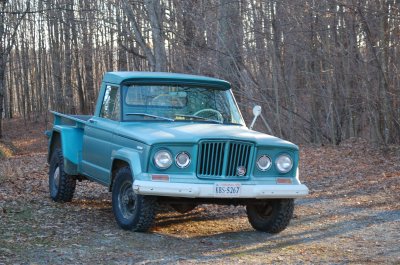
1966 Jeep Gladiator

1966 Jeep Gladiator

November seems to have been my month to write about classic vehicles. First Our New 1946 Ford Tractor, then the Hudson Super Wasp, and now this 1966 Jeep Gladiator, which came to visit us for Deer Season (the official holiday of West Virginia). This is in original condition, and had only 28,000 miles on it when our friend bought it from a little old lady who only took it to her hunting camp on Sundays. Isn't that color something?

Wednesday, November 29, 2006

Projectile Points

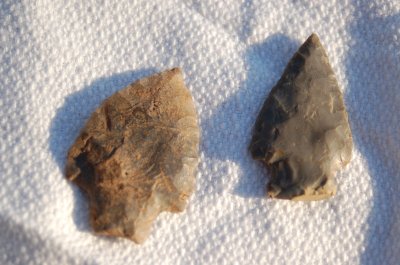
Projectile points from Droop Mountain and Caesar Mountain

The point on the left came out of our garden here five years ago, while the one on the right came from tilling a garden on Caesar Mountain about 30 years ago. They are both about two inches long. Both are still sharp enough to cut skin. (Don't even ask....) Someone who knows more than I do about such things tells me they are from the Archaic period, she guesses about 3000 years ago, and that they came from a flint quarry in what is now Greenbrier County. I haven't had too much luck finding out how these things (arrowheads? they seem very large for arrows) are classified through my local library, so I did some Internet poking about, and found these references.

Tuesday, November 28, 2006

Trilobite Hunting

My West Virginian trilobite

I collected this little trilobite alongside a road in the Eastern Panhandle of West Virginia in 1985. I wish I knew the locality but my field notes for that period of my life are quite sketchy. It was in the fall, and it was a cold, dreary day, but any details useful in finding the spot again are long lost. Check Paleoblog for an interesting sketch of trilobite hunting at the Earth's core. This is clearly a warmer climate than that I hunted in. If I were she, I would have put on my Daisy Mae outfit, for a less formal, more practical cartoon-lady look.

Monday, November 27, 2006

New Shirts on the Line

new shirts on the clothesline

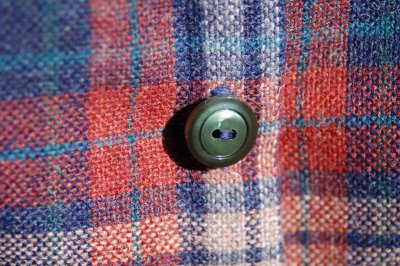
Here are the menswear shirts I've made in the last week. As three of them are relatively bold plaids, I tried some of the plaid-matching tips I accumulated earlier. The one that made the biggest difference for me was using a walking foot. I was able to avoid those annoying quarter-inch mismatches at the center fronts. I submit these nicely matched fronts, and their vintage buttons, for your inspection. This is probably the only time the shirts will be buttoned, as I usually wear them over a tee shirt or thin sweater, as a jacket. These were all recycled, flea market or otherwise salvaged fabrics.

center front button band center front button band on plaid jacket wool jacket, center front and button

Sunday, November 26, 2006

Waking Up Above the Fog

Foggy morning on Locust Creek, but clear on Droop

It often happens that the morning dawns bright and clear on top of Droop Mountain, but Hillsboro and the Little Levels District are shrouded in dense fog.

Saturday, November 25, 2006

Appalachian Origins, Revisited

For today's new insight into Appalachia, I need to thank Michael J. Ryan of Paleoblog for passing along a New Origin for the Appalachian Mountains. The original article is Acatlán Complex, southern Mexico: Record spanning the assembly and breakup of Pangea by R.D. Nance, et al. Geology 34:857-860 (2006). Dr. Ryan quotes from the press release:

According to the conventional map of 420 million years ago, two main land masses were separated by the Rheic Ocean. In the south sat Gondwana, a supercontinent consisting of South America, Africa, India, Australia and Antarctica. To the north was Laurussia, made up of North America, Greenland, Europe and part of Asia. The old map showed the Acátlan Complex attached to Laurussia. The complex broke off Gondwana about 80 million years earlier, drifted toward North America along with the other land masses, closing an older ocean, known as the Iapetus Ocean, as it did so. The collision created the Appalachian Mountains.

The new map looks rather different. Based on the new evidence the Acatlán Complex collision with Laurussia actually occurred about 120 million years later. The rocks once existed on an ancient ocean floor, but this ocean has proven to be the Rheic, not Iapetus as previously thought.

Same trilobites, different ocean.

Friday, November 24, 2006

Henry Adams on Southern Intellect

Blue bearded iris

In my on-going attempts to understand how people see Appalachia, and perhaps also the rural South, I give you this interesting excerpt from The Education of Henry Adams. It came to my attention as a quote in W.J. Cash's The Mind of the South. I include here a bit that came before Cash's quote, and a bit after, to show that Adams was not writing a meer screed against the Southern intellect, but finding fault with his own education. I hadn't read Adams' book since my undergraduate days ("Science and the Literary Imagination," Iowa State University, Winter term, 1977), and I'd forgotten what a strange, engaging book it is. Something else for the long winter evenings by the wood stove, perhaps.

Into this unusually dissolvent medium, chance insisted on enlarging Henry Adams's education by tossing a trio of Virginians as little fitted for it as Sioux Indians to a treadmill. By some further affinity, these three outsiders fell into relation with the Bostonians among whom Adams as a schoolboy belonged, and in the end with Adams himself, although they and he knew well how thin an edge of friendship separated them in 1856 from mortal enmity. One of the Virginians was the son of Colonel Robert E. Lee, of the Second United States Cavalry; the two others who seemed instinctively to form a staff for Lee, were town-Virginians from Petersburg. A fourth outsider came from Cincinnati and was half Kentuckian, N. L. Anderson, Longworth on the mother's side. For the first time Adams's education brought him in contact with new types and taught him their values. He saw the New England type measure itself with another, and he was part of the process.

Lee, known through life as "Roony," was a Virginian of the eighteenth century, much as Henry Adams was a Bostonian of the same age. Roony Lee had changed little from the type of his grandfather, Light Horse Harry. Tall, largely built, handsome, genial, with liberal Virginian openness towards all he liked, he had also the Virginian habit of command and took leadership as his natural habit. No one cared to contest it. None of the New Englanders wanted command. For a year, at least, Lee was the most popular and prominent young man in his class, but then seemed slowly to drop into the background. The habit of command was not enough, and the Virginian had little else. He was simple beyond analysis; so simple that even the simple New England student could not realize him. No one knew enough to know how ignorant he was; how childlike; how helpless before the relative complexity of a school. As an animal, the Southerner seemed to have every advantage, but even as an animal he steadily lost ground.

The lesson in education was vital to these young men, who who, within ten years, killed each other by scores in the act of testing their college conclusions. Strictly, the Southerner had no mind; he had temperament He was not a scholar; he had no intellectual training; he could not analyze an idea, and he could not even conceive of admitting two; but in life one could get along very well without ideas, if one had only the social instinct. Dozens of eminent statesmen were men of Lee's type, and maintained themselves well enough in the legislature, but college was a sharper test. The Virginian was weak in vice itself, though the Bostonian was hardly a master of crime. The habits of neither were good; both were apt to drink hard and to live low lives; but the Bostonian suffered less than the Virginian. Commonly the Bostonian could take some care of himself even in his worst stages, while the Virginian became quarrelsome and dangerous. When a Virginian had brooded a few days over an imaginary grief and substantial whiskey, none of his Northern friends could be sure that he might not be waiting, round the corner, with a knife or pistol, to revenge insult by the dry light of delirium tremens; and when things reached this condition, Lee had to exhaust his authority over his own staff. Lee was a gentleman of the old school, and, as every one knows, gentlemen of the old school drank almost as much as gentlemen of the new school; but this was not his trouble. He was sober even in the excessive violence of political feeling in those years; he kept his temper and his friends under control.

Adams liked the Virginians. No one was more obnoxious to them, by name and prejudice; yet their friendship was unbroken and even warm. At a moment when the immediate future posed no problem in education so vital as the relative energy and endurance of North and South, this momentary contact with Southern character was a sort of education for its own sake; but this was not all. No doubt the self-esteem of the Yankee, which tended naturally to self-distrust, was flattered by gaining the slow conviction that the Southerner, with his slave-owning limitations, was as little fit to succeed in the struggle of modern life as though he were still a maker of stone axes, living in caves, and hunting the bos primigenius, and that every quality in which he was strong, made him weaker; but Adams had begun to fear that even in this respect one eighteenth-century type might not differ deeply from another. Roony Lee had changed little from the Virginian of a century before; but Adams was himself a good deal nearer the type of his great-grandfather than to that of a railway superintendent. He was little more fit than the Virginians to deal with a future America which showed no fancy for the past. Already Northern society betrayed a preference for economists over diplomats or soldiers- one might even call it a jealousy- against which two eighteenth-century types had little chance to live, and which they had in common to fear.

Nothing short of this curious sympathy could have brought into close relations two young men so hostile as Roony Lee and Henry Adams, but the chief difference between them as collegians consisted only in their difference of scholarship: Lee was a total failure; Adams a partial one. Both failed, but Lee felt his failure more sensibly, so that he gladly seized the chance of escape by accepting a commission offered him by General Winfield Scott in the force then being organized against the Mormons. He asked Adams to write his letter of acceptance, which flattered Adams's vanity more than any Northern compliment could do, because, in days of violent political bitterness, it showed a certain amount of good temper. The diplomat felt his profession.

The Education of Henry Adams, Chapter 4, "Harvard College"

Thursday, November 23, 2006

Buckeggy?

White tailed deer, doe and fawn

I learned a new word this week: Buckeggy. I asked the people who used it how they would spell it, and, while no one had seen fit to write it until now, this was the consensus (although it might be hyphenated). It refers to what happens when an otherwise calm person sights a big buck while deer hunting, and gets too excited to aim and shoot. It affects kids and seasoned hunters alike. It seems to work like stage fright, and it has little to do with experience.

Happy Deer Season!

Wednesday, November 22, 2006

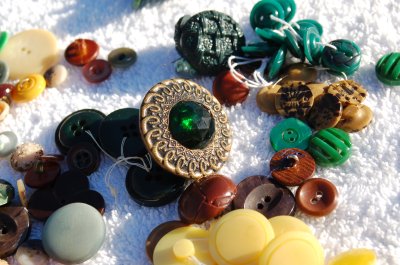
My Biography In Buttons

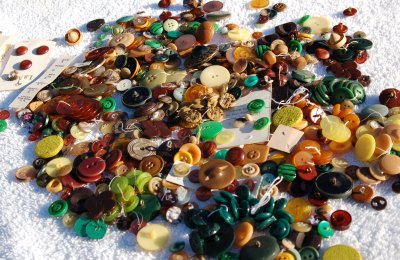
Buttons, brown, yellow, and green

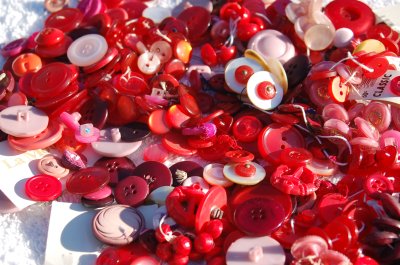
I spent an hour yesterday going through my button supply, looking for shirt buttons. I keep most of them in plastic zip lock bags, sorted by color, and yesterday, out of curiosity, I weighed the bags on my old kitchen scale. The main collection weighs 12 pounds, and I have a jar of white shirt buttons I didn't bother to include in that total. It's a lucky thing I hoard sewing notions, as good buttons are hard to find these days.

An antique button

The core of my button stash is inherited from my mom, who taught me to sew. I remember her running the Singer Featherweight at the kitchen table, pausing to showing me how to use a needle and thread on flannel shirt scraps. There's probably a law against giving preschoolers needles now, but I was hooked on textiles early. Most of the buttons are salvaged from worn-out clothes or left over from previous sewing projects. My mother pointed out some that came from her grandmother's dresses, and more from her own mother's wardrobe. (Someday I'll show you a few of the cotton scraps for quilts, spanning the 1890's to 1990's. The hoarding of sewing notions runs deep in my family.)

Part of the red button collection

Mom died ten years ago last month. She suffered dementia her last year, but even after she couldn't recognize people or speak, she would still reach out to visitors, and touch the buttons on their coats.

1950's era pink plastic buttons

Tuesday, November 21, 2006

My Persistent Assistant

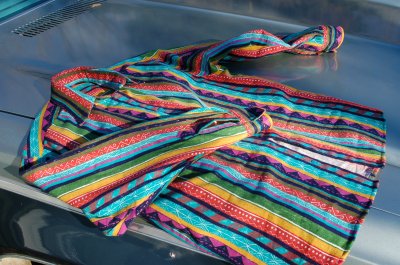
Flannel menswear shirt, on the hood of the El Camino

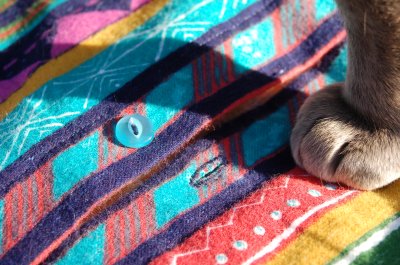
Here's the flannel shirt I started yesterday, displayed on the hood of my '77 El Camino. This is some flannel I bought several years ago in a junk shop where we were looking for tools. Washed and sewn, it looks better than I expected, especially considering its $2 price tag. I was especially pleased to find a nice color match in my vintage button collection.

Flannel shirt, button detail with paw

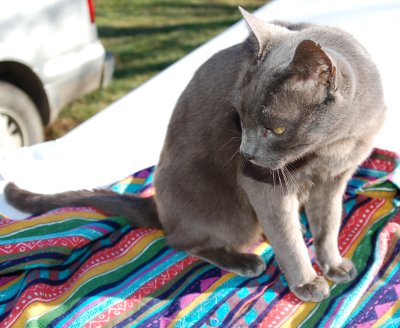
Of course, grey paws go well with any ensemble.

Flannel shirt, with grey cat

Monday, November 20, 2006

A Return to Textiles

KwikSew Men's Shirt Pattern

For the first time since early August, I've done some sewing. All my fiber arts web-rings notwithstanding, there hasn't been much textile activity on my weblog. I dyed some socks purple, I spun some burdock-laden fleece, but that's about it. No knit hats or velvet scarves for the local craft shop, no socks or mittens or new cardies for me.

Book Cover: Shirtmaking

Today, I sewed myself a flannel shirt. The summer before last, I immersed myself in shirtmaking, trying nifty techniques from David Page Coffin's Shirtmaking: Developing Skills for Fine Sewing. I tried all sorts of patterns, and made shirts for men and for women. I was pleased to find I remembered the techniques I wanted to use, in that "motor-memory" way.

Although the shirt is for me, I used Kwik-Sew pattern 2777, a men's oxford shirt. I skipped the front buttonband, because this is where my shirts show wear first, and I made different cuff plackets, from the pattern in the Coffin book. I think they make a tidier finish. I've tried many women's shirt patterns, and made scads of different alterations in the search for a perfect fit, but when it comes to a flannel shirt, I've gotten my favorite fit by simply sewing up a men's shirt with no fitting alterations at all. I'm not sure why. There seems to be a mystery involved in the fit of a shirt yoke.

Sunday, November 19, 2006

Calico Relish, For Cucumbers or Zucchini

To my surprise, my recipe posts have been getting visits and comments. This a favorite sweet pickle relish. It's good on hotdogs, and in potato salad and cold meat salads, such as ham, venison, and roast beef. It's easy and reliable, unlike many pickle recipes.

CALICO RELISH

4 c. ground onion
10 c. ground zucchini or cucumbers
5 tbsp. salt
2 1/4 c. vinegar
1 tbsp. nutmeg
1 tbsp. allspice
4 c. sugar
1 tbsp. cornstarch
2 tsp. celery seed
1/2 tsp. black pepper
1 tbsp. dry mustard
1 tbsp. turmeric
1 c. hot banana peppers, chopped
   (or about 2 tbsp. crushed dried red pepper)

Combine onions, zucchini and salt. Let stand overnight. 
Drain and rinse in cold water, then drain again. Place in 
large kettle, and add remaining ingredients. Bring to a 
boil; cook for thirty minutes. Place in hot sterilized 
jars; place sterilized lids and bands on jars, screwing 
bands tight. Makes about 5 pints.

I usually make a double batch, and waterbath can for 
15 minutes, so that the jars seal more reliably. The 
hot peppers and the allspice were my addition to the 
original, which came from "Favorite Recipes of Home 
Economics Teachers" (1975).

Saturday, November 18, 2006

Caesar Mountain and Viney Mountain

Our house from the new addition to the place

This week I found something interesting in Pocahontas Times' "Fifty Years Ago" feature which quotes from editor Cal Price. In 1956, Price wrote about a bit of history which I'd heard about often, but for which I had no reference. Because the "Pocahontas Times News Archives is now Paid Access only," I will quote the article at length.

An Old Timer

In a law suit at the October term of the Circuit Court reference was made to the Massenbird land lines. So, the question, what about such land lines on Droop Mountain, anyway?

Well, around the year 1839, a man named George Massenbird died at his home on Droop Mountain. He was a native of England, and had lived here for a good many years. He owned Caesar Mountain and Vina Mountain, and other land. The tradition is that these mountains were given to and named for two Massenbirds slaves-Caesar and Vina Freeman.

However a casual search of the records shows only one transaction. This is a deed from John and Jane Blair to George Massenbird for 250 acres. The date is August 29, 1829, and the consideration is $120.

In the year 1842, there is a Court record of the appraisement of property left by the late George Massenbird. No mention is made of real estate. The appraisement of personal items amounts to $19.62. 1/2. However, bonds payable in dollars were appraised at about $2600. There was in addition a bond appraised at 500 English pounds sterling. This was due from the estate of one of George Breckenburg, of Skendleby, England.

The personal items, appraised at $19.62 1/2 brought $12.71 1/4 at the sale. Here are the purchasers and items:

  • Nancy Ware bought two bunches of newspapers at 3 1/2 cents and 2 1/2 cents; wearing apparel at $1.34.
  • Sarah Freeman two lots of newspapers at 7 1/4 cents.
  • John Hill, 6 numbers of Methodist magazines, 16 cents; Watson's Wesley 34 cents.
  • Walton McClung, 7 numbers of Methodist magazines, 20 cents.
  • Thomas Casebolt, 8 numbers of Methodist magazines; 21 cents; one slate, 26 cents.
  • James Keener, Doctor Clark's sermons, $1.75.
  • Thomas Hill, Doctor Clark's Life, 38 cents; Doctor Clark's Commentary, $8.

George Massenbird was a native of England. Further than that, there is meager tradition of him, other than he lived the life of a country gentleman and at the end he gave freedom and land to his servants.

Caesar Mountain and Viney Mountain are ridges connected to Droop Mountain.

Friday, November 17, 2006

Pocahontas County Links

My original goal for my Website and for this weblog was to provide a counterbalance to the commercial view of Pocahontas County exemplified by The Pocahontas County Convention and Visitors Bureau (PCCVB) and Snowshoe Mountain Resort. I've assembled Pocahontas County link collections before, but I've never been satisfied with them. However, in the spirit of NaBloPoMo, I'm working with a deadline, and am therefore less fussy.

Here are some informative links about the county, mostly the work of people who live here. They are not slick, but they give a truer picture of the place than sites for tourists.

Thursday, November 16, 2006

Spiders, Past and Present

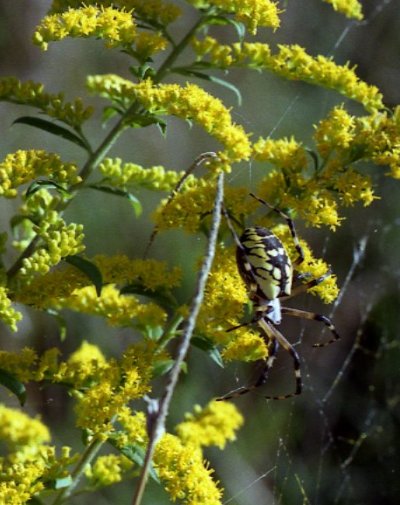
Orb weaving spider on goldenrod

I came across this on Slashdot the other day: "Build a Web spider on Linux: A simple spider and scraper collects Internet content." After reading through, I thought, "Wow! I could do that!" It's now on my (excessively long and ambitious) list of "Do It Yourself" projects. I was surprised to find that IBM's Web site includes developerWorks: IBM's resource for developers, and that this includes interesting how-to's and projects for a hobby-hacker such as myself. I was particularly interested in Web development: Resources for Web 2.0, Ajax, wikis, PHP, mashups, and other Web projects." It's quite a change from my mental picture of "Big Blue" as a bloated, arrogant presence sucking the blood out of small businesses and individual computer users. (Based on my experiences in the 1980's and early 1990's.) Thanks, IBM!

Orb weaving spider on goldenrod

Wednesday, November 15, 2006

Claude Levi-Strauss in the Fifth Grade

St. John's Wort flower

Just because I've been working in elementary and middle schools doesn't mean I haven't been expanding my cultural horizons. A few weeks ago, a professional dance company visited Marlinton Middle School. I was working with special needs fifth graders in their classroom, so I went to the gym with them to continue my mentoring. (It usually went like this: "Sit down!" "Pay attention!" "Sit down! Please!") The dancers had an interesting, age-appropriate program, and the kids were fascinated, if puzzled.

In homage to Brazil, the company presented a short dance called "Black Beans and White Rice." I expected some snappy Brazilian music to accompany a visual interpretation of Arroz com Feijao (Rice with Beans). It was much stranger than that. The dancers were accompanied by a recording of a lady reading an essay about Claude Lévi-Strauss and The Raw and the Cooked: Introduction to a Science of Mythology. It wasn't a rhythmic reading of poetry, it didn't feature dance-able background music. A lady (with a standard college-lecturer speaking style) read a long essay discussing the national dish of Brazil in a structuralist context.

I can't really tell you how the dance went. The kids enjoyed it, but I was distracted by a flashback to the 70's when, as a college senior, I took a graduate seminar in linguistic anthropology. We read The Raw and the Cooked: Introduction to a Science of Mythology by Claude Lévi-Strauss, along with some Piaget, some Chomsky....I was completely baffled. I read the texts, and diligently tried to understand them, but the class discussion featured a lot of terminology along the lines of this course description: Claude Levi-Strauss: The Structural Study of Myth. I had the feeling that the professor and the graduate students were talking in some sort of code. I couldn't even figure out how to ask them questions.

Subsequently, I've had this experience many times. Most often, the code-talkers are trying to make their area of expertise seem more complex and important than it actually is. Web 2.0 and education theory are two topics that have a considerable literature in this style, but there are offenders in every discipline. Looking back, I doubt the anthropologists were trying to exclude me. The students were practicing their fluency in technical jargon of their field, a skill every graduate student must acquire. If I had been less shy, and had asked stupid, clueless questions, I think they would have tried to help.

Food, however, is a universally-intelligible language. Here are some attempts to elucidate the structure of feijão.