Tuesday, October 31, 2006

Ghostly Doctor of Denmar

I've been saving this new Haunted Pocahontas County story for Halloween. It's another account from a local employee at Denmar State Prison, the former Denmar State Hospital. Before it was a prison, there were places in the old hospital where local workers were reluctant to go alone. One floor in particular made people uncomfortable, and there are stories of inexplicable voices and footsteps. Evidently this still continues now that the place is a prison.

Early in the morning, workers waiting for the elevator sometimes see the doors open to reveal a short, middle-aged black man wearing a white coat and a stethoscope. He looks up, perhaps in response to a "Good morning, Doctor," and then he disappears. My informant, who supervises in the kitchen, is one of those who has seen the apparition herself. The general consensus at the prison is that the ghost-doctor dates from Denmar's days as West Virginia's Colored Tuberculosis Sanitarium.

Deaths at the West Virginia Colored Tuberculosis Sanitarium at Denmar. West Virginia History Volume 56 (1997), pp. 88-121.
The West Virginia Legislature created the State Colored Tuberculosis Sanitarium in 1917. The Maryland Lumber Company sold 185 acres of land and numerous buildings in Denmar, Pocahontas County, to the West Virginia Board of Control. According to the 1918 West Virginia Legislative Hand Book, black tuberculosis patients, who were West Virginia residents, were eligible for admission to the sanitarium provided they could pay for their care. The Hand Book noted: "The reasonable expenses of poor persons admitted at the request of the authorities of any municipal corporation or county, shall be paid by such municipal corporation or county." The sanitarium admitted its first patients on January 31, 1919.

Sunday, October 29, 2006

My New Job-let

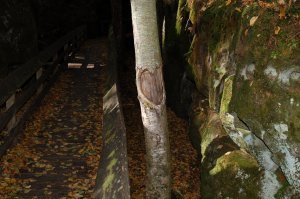
Boardwalk at Beartown State Park

I'm excited to be starting a new job-let, as an adjunct faculty member of Mountain State University. In a couple of weeks, I'll start teaching my first class in MSU's Spectrum Health Program. I'll be teaching the second semester of a four-semester program, including chemistry, math, and statistics. Here's an excerpt from their blurbs:

Mountain State University offers selected traditional and distance learning programs through extended learning locations. Cohorts are formed in various locations with groups of students who meet together once a week, to complete a sequence of courses leading to a degree. This type of learning is especially attractive to working adults, because of the accelerated nature of the programs and classes designed to accommodate work schedules....

The Spectrum Health orientation allows you to complete the general education requirements for many of the programs offered by MSU' School of Health Sciences. The LPN to BSN (Bachelor of Science in Nursing) program is an option for LPN's....

Yesterday I drove to Beckley for a Faculty Development Day, where I signed a contract and met about 20 other Spectrum faculty members. It was reassuring to talk to other people who have been teaching this way for a while. I've been anxious lately: What will happen if my substitute special ed gig continues indefinitely? Where can I get the Spectrum texts and materials? Will I have to buy a bunch of expensive Windows software? After yesterday, I'm excited and optimistic. I don't have to buy any nasty Microsoft stuff, and many of my fellow faculty are full-time teachers in public school. I can't deny that some of this warm glow is due to the nice Spectrum Director who provided yummy snacks every two hours during the meetings.

One nice discovery that will outlive yesterday's sugar high is that I will soon have access to the MSU library resources. Online journal subscriptions, an MSU library card, interlibrary loan--what a treat! I'll be getting a password in the next few days, I hope.

Tuesday, October 24, 2006

Holding a Gun To My Own Head

National Blog Posting Month

I've signed up for National Blog Posting Month (NaBloPoMo). I found the link at BlogHer yesterday. For me, the Q&A rang true:

What is it?

It's National Blog Posting Month!

Why...would I want to do that?

You started a blog to make yourself write more often?

NaBloPoMo is an alternative to November's NaNoWriMo, National Novel Writing Month, the program wherein you crank out a novel in thirty days.

Some of us lack the imagination, stamina, and self-destructive impulses required to write a novel that quickly, but, by Grabthar's Hammer, we can update our blogs every day for a month!

Yup. I started a blog to make myself write more often. Recent evidence to the contrary, it has motivated me to write more. People sign up for the "November is National Novel Writing Month(NaNoWriMo) to get over writer's block, or to prove to themselves that they can crank out the prose under pressure. Years of grant writing taught me two things: writer's block is a self-indulgence I can't afford, and I can crank out the prose (not good prose, necessarily, but prose to spec.). I don't need a goofy novel cluttering up my hard drive, but somehow, cluttering up blogger.com with daily postings doesn't bother me a bit.

I have some qualms....I looked at the list of participants' blogs, and noticed that they are a younger, "hipper" bunch than I usually pal around with. They have no recollection of the days when martinis were Squaresville, something with which the Man in the Grey Flannel Suit anesthetized himself. Still, I've signed up--if the cool kids won't eat lunch with me, well, I'll just read a book by myself, like I used to do.

Friday, October 20, 2006

Dying For the Weekend

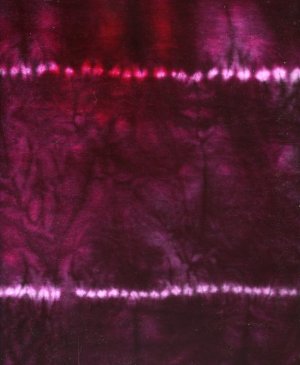
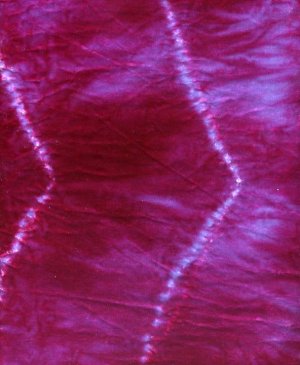
purple velvet scarf sample red and blue velvet scarf sample

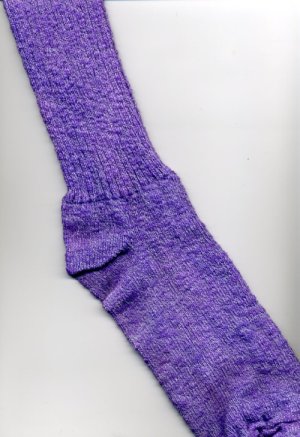
Last summer, in an attempt to "generate a new income stream," I decided to try dying silk velvet yardage and sew scarves from it. I hoped this project would pay for itself, and for a good electronic scale I could use for all my dying recipes. (Measuring spoons were increasingly inadequate for my purposes.) I had no sooner gotten my materials together than the substitute teacher gig turned up. Between the classroom and the kitchen (where I was frantically canning garden produce), the dying project dwindled from a scarf or two per weekend down to one dye pot with all my leftover cotton socks.

Cotton sock dyed purple

I did, however, file a couple of dying links.

  • Paula Burch's "All About Hand Dyeing" has been on my bookmarks list for years, but she's recently revamped her Web site, adding new information and improving the look and feel


  • Dharma Trading Company has all the cool stuff from their catalog in an easier-to-use format. They have also added a "Projects" section, with how-to's for many different projects.

Tuesday, October 17, 2006

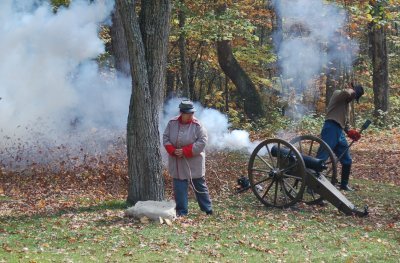
Battle of Droop Mountain, Refought

Firing the cannon

Every other year, Droop Mountain Battlefield State Park hosts a reinactment of the November 6, 1863 event for which it is named. Last weekend was the third one I'd attended. My first was the most dramatic, for me. I was going for my morning run on the park trails, when, out of the fog came a passle of Yankees on horseback. Understanding what was going on didn't make much difference. It was terrifying.

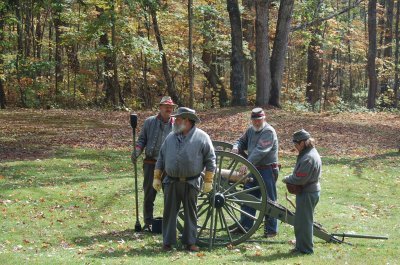
Waiting to fire the cannon

I'm not sure the reinactors get that excited anymore.

Watching from beside the cannon

Like the spectators, they look at the cannons like they would look at cars. "Will it start?"

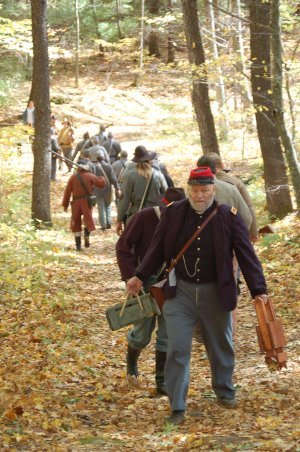
Reinactors head home

As I headed home through the park, the Yankees and the Rebels passed each other on their way to pack up and go home.

Thursday, October 12, 2006

Southern, or Appalachian?

Several months ago, I discovered a fascinating book, W.J Cash's The Mind of the South, published in 1941. I posted some interesting Web references here, and got a gracious comment from W.J Cash's great-niece, Mary K. Elkins, a talented Web designer.

Cash's book is a cultural history of the American South in the way that Gibbon's Rise and Fall of the Roman Empire is a history. Cash, a Southerner, critiques mid-twentieth-century problems such as toxic race relations, intractable rural poverty, sickly nostalgia for an imaginary past, and paralyzing class consciousness. Whether his history is accurate or not, his prose is compelling.

I heard echoes of the rhetoric of "Appalachian otherness" in Cash's analysis of eighteenth and nineteenth century Southern history. In fact, "The South," rather than "Our Southern Mountains," may be the real Land of the Nine-Fingered People. Here is one passage that took my fancy.

Again, if the Southern social order had blocked in the common Southerner, it had yet not sealed up the exit entirely. If he could not escape en masse, he could nevertheless escape as an individual. Always it was possible for the strong, craving lads who still thrust up from the old sturdy root-stock to make their way out and on...even...to carve out wealth and honor in the very oldest regions....But in their going these emergent ones naturally carried away with them practically the whole effective stock of those qualities which might have generated resentment and rebellion. Those who were left behind were the simplest of the simple men of this country--those who were inclined to accept whatever the day brought forth as in the nature of things--those whose vague ambition, though it might surge up in dreams now and then, was too weak ever to rise to a consistent lust for plantations and slaves, or anything else requiring an extended exercise of will--those who, sensing their own inadequacy, expected and were content with little.

Moreover, they were in general those in whom the frontier tradition was likely to run strongest; which is to say that they were often almost indifferent, even in their dreams, to the possession of plantations and slave and to the distinctions which such possessions set up. For it is characteristic of the frontier tradition everywhere that it places no such value on wealth and rank as they command in an old and stable society. Great personal courage, unusual physical powers, the ability to drink a quart of whisky or to lose the whole of one's capital on the turn of a card without the quiver of a muscle--these are at least as important as possessions, and infinitely more important than heraldic crests. In the South, if your neighbor overshadowed you in the number of his slaves, you could outshoot him or outfiddle him, and in your own eyes, and in those of many of your fellows, remain essentially as good a man as he.

Tuesday, October 10, 2006

Selling Myself Real Estate

Locust Creek in the clouds

Last week we bought the property adjacent to our Droop Mountain home. We were stunned to discover it was on the market, and were anxious to buy it, as it surrounds us on three sides. It hadn't been sold outside the family since the nineteenth century, and the only existing survey uses large chestnut trees as landmarks. Such extinct boundaries are not unusual in Pocahontas County.

This photograph, taken in October 2004 from my neighbor's yard, plays an interesting role in the purchase. We made a very good offer, and had been waiting two days without hearing anything from the seller. I opened up my copy of the Pocahontas Times, and saw the property listed with a very familiar photograph. There was this picture, taken from my Web page, without permission, and without attribution. When I checked the realtor's Web page, there was my picture again. Not only were they violating my copyright, but they were using my picture to solicit bidders to compete against my offer. Oh, did I mention that the photograph does not show the property in question?

I was rather upset when I went into the realtor's office the next day, between anxiety about the offer and outrage about the picture. The realtors were horrified. The property owner had given them a floppy disk, and said it was his picture, taken from his property. They also said that someone was in their office, making a competing offer on the same property. After a conference out of my hearing, they asked, "Would this problem go away if your offer were accepted?" I told them yes, went on home, and soon got a phone call telling me our offer was accepted. From there on out, everything moved along smoothly, and now we have taken down the fence that separated the new parcel from our old one.

Monday, October 09, 2006

Pepper Butter

This past weekend, I canned the last of the garden produce. I made "Pepper Butter"--an unusual spread made from hot peppers and prepared yellow mustard--for the first time, after getting the recipe from Penny Kershner of Frost. I'd never tasted anything like it, but recently, I discovered I had two similar recipes, for "Pepper Sandwich Spread" and for "Green Tomato Sandwich Spread," in my favorite canning book, Favorite Recipes of Home Economics Teachers: Canning, Preserving and Freezing Cookbook.(Favorite Recipes Press, Montgomery, Alabama, 1975)

Thickened like a gravy, this bright yellow stuff is hot, sweet, and sour. Penny's recipe produced eight pints for me, and it is even tastier than I remembered. Although all the different recipes say you can pour the hot liquid into scalded jars and seal, I went ahead and water-bathed the filled jars for 20 minutes, the way I usually treat my sweet pickles. I find my jars are more likely to seal successfully when I do this, and it didn't hurt the "pepper butter" a bit.

PEPPER BUTTER 60-80 hot peppers (heat intensity your choice) Wash, remove stems, and grind in food processor. If you prefer a milder spread, remove some of the seeds and placenta. 6 cups sugar 1 quart prepared yellow mustard 1 quart cider vinegar In your cooking kettle, mix sugar, mustard, and vinegar. Stir in ground peppers and bring mixture to a boil. Make a thickening of 1 1/2 cups flour and 1 1/4 cups water. Add some boiling mix from your kettle to the thickening, and stir until smooth. Add thickening mix to boiling liquid, stirring until combined. Boil mixture for 5 minutes, stirring to prevent the thick mixture from burning on the bottom. Place in canning jars and seal. To waterbath can, place the jars in a canner and boil for 20 minutes. Remove, and allow jars to cool and seal.

Sunday, October 08, 2006

Self-Censorship

I've been writing, but not posting, recently. I'm still substituting for a yet-to-be-hired teacher for special needs students, and I'm dealing with a lot more people on a daily basis than has been my habit for many years. I've started to "blog" all sorts of interesting, wonderful, appalling things that the folks at school say and do, and then pulled up short. It's been my policy to avoid writing about my friends and neighbors, except in very vague terms, to protect their privacy. (Except for the doily cheater, but hey, I don't know who she was, and how much consideration should you get for fraudulent display of doilies, anyway?) I don't think I have many (any?) local readers, but who would want to hear through the grapevine that "Bootsie has been spilling the beans concerning your life on the Internet"?

Pair this self-censorship with my uncertainty about the direction I want my "Web-presence" to take, and you get very few posts. Dave, of Via Negativa, has invited me to submit something to qarrtsiluni on their "Education" theme. I was very excited about this, but quickly found out my most interesting themes violated my students' privacy. They may be seven years old and illiterate now, but that could (God willing) change.

In a comment this summer Dave suggested

...your mission could be to portray Pocahontas County in such an unflattering light that the flood of tourists would dwindle to a trickle. You could just make stuff up, like James Dickey. The local chambers of commerce would hate you.
I have since given much thought to writing Southern Gothic horror stories about fictional Pocahontas County residents, even to nominating Droop Mountain as the very capitol of The Land of the Nine-Fingered People. I am blessed to have a reader who understands me so completely. However, I could never invent anything to rival the things people really say and do. To paraphrase Dr. Watson, "The world is not yet ready for the Denmar kangaroo incident."

Other bloggers have been writing about the limits of the stories they may tell. I was especially struck by prariemary's recent posts on the topic "Who Should Tell the Stories?"

Who owns what stories?...Repeatedly in early years, individuals came to the reservation, took notes...wrote them up, sold them to publishers as original works, and collected the income. None of that income was sent back to the tribal storytellers. Some of the white writers claimed to be scientists who would use the stories to analyze and record the society of the tribal people -- others were simply acquiring stories the same way they would acquire beadwork, attractive curiosities....they not only made money from the stories, but also drained them of significance.

Pocahontas County "informants," such as still-living members of the Hammons family, have voiced feelings of exploitation. Although I know for a fact that the Library of Congress boys made little or no money from the stories and music they got from Burl, Sherman, and Maggie, they did carve notches in their academic status gunstocks. If I were to tell you that Denmar kangaroo story, with all the flourishes and detail it deserves, would I be exploiting my neighbor down the mountain? (Never mind that I could not possibly tell it as well as he can.)

I think the solution is...taking time. Really listening. Spending the day. Becoming part of the scene....Learning what stories mean to the tellers of them. I think that whether one is IN or OUT of the group, one can witness. One has an active obligation to witness accurately and possibly to record that somehow. It is the way to wisdom.

Framing it that way, I think I may try to tell few more tales. If it starts to sound too much like Yoknapatawpha County, perhaps I'll start a second blog.

Monday, September 25, 2006

Talking to Myself

I continue to substitute for a yet-to-be-hired special education teacher, although the precise nature of the unfilled position continues to change. I've been at three different schools and I'm uncertain how many students I'll be working with next week. (I assume I will be working next week.)

Although the heavy lifting is over, and I am no longer physically exhausted when I get home, my daily activities still interfere with my writing habits. While my students have little in common with one another, there is a certain continuity. Most of them have difficulties processing spoken and written language. Whether they can't take in verbal information because their brains are different from most people, or because they are too angry, too anxious, or too distracted by ambient noise, they don't attend to what they are told. I speak slowly. I say simple things. I repeat myself. I repeat myself. I REPEAT myself. If a teacher fell in the classroom, would there be any sound? I come home with little faith in the whole process of communication. It seems more interesting to can tomatoes than to write.

On the other hand, this is reminding me just how amazing it is to be able to read. A visual representation of speech--how did someone come up with this? The non-reading adults I've worked with have completely different ways of thinking about words than readers (even poor readers). They are unaware of rhymes in song lyrics, incredulous that words can be broken apart into component sounds, and skeptical that a word and the thing it names can be separated. Several of my young students are struggling with these same concepts. Most people participating in the magical world of written language have forgotten they ever lived anywhere else. It's a gift to be reminded of that other condition, and the hard work involved in crossing that border.

Monday, September 04, 2006

Where I've Been Lately

The week before last, I got a call from the school board office asking if I was available to start the school year as a substitute teacher. They are advertising for an autism teacher, and need a substitute until the position is filled. I travel between two schools and have four (soon five) special needs students. There are no lesson plans, no schedule, no real classroom, and no instructions on how to procede. I won't know the job is over until they tell me "Don't come in tomorrow." Of course I said, "Sign me up!"

So far, the job includes much heavy lifting and some sprinting down the halls and sidewalks. I come home very tired each night, and have not made blogging a priority. I like these unanticpated opportunities, and so far, I'm enjoying the work. Interestingly, I'm already in trouble. Thursday afternoon, an irate parent marched into the principal's office complaining about my treatment of her child. I don't know the nature of her complaint, but I did hear she was roaming the hall threatening to "whup me," or some part thereof. The fourth day of school seems a little premature for complaints--I usually don't get criticism until I've actually done something. Still, you must admire a parent that cares enough to offer a pre-emptive "whuppin'."

The Last Barbeque of the Season

This summer, we've been searching for the ideal barbeque sauce. In honor of Labor Day, here are some things we've tried that we liked.

Michael Chiarello's Babyback Ribs with Espresso Barbecue Sauce
Espresso Barbecue Sauce:
4 tablespoons mashed and minced garlic
4 tablespoons extra-virgin olive oil
1 cup cider vinegar
1/2 cup soy sauce
2 cups ketchup
2 cups honey
Grey salt
2 demitasse cups espresso (or about 1/2 cup of strong coffee or instant espresso)
Fresh ground black pepper

Mash garlic with the side of a knife and then mince finely to release oils.

Add olive oil to a preheated saute pan. Add the garlic and saute until it gets light brown, about 1 minute. Add cider vinegar, soy sauce, ketchup, and honey and stir well. Add a pinch of grey salt, then whisk in the coffee. Add freshly ground black pepper, to taste. Bring to a simmer and simmer for 10 minutes.

Let cool and store in refrigerator for up to 2 weeks.

BOURBON BARBECUE SAUCE
2 cups ketchup
1/2 cup mild-flavored (light) molasses
1/3 cup bourbon
1/4 cup Dijon mustard
3 tablespoons hot pepper sauce
2 tablespoons Worcestershire sauce
2 teaspoons paprika
1 teaspoon garlic powder
1 teaspoon onion powder

Combine all ingredients in heavy large saucepan. Bring to boil over medium heat, stirring occasionally. Reduce heat to medium-low; simmer uncovered until sauce thickens and flavors blend, stirring frequently, about 15 minutes. (Can be made 1 week ahead. Cover; chill.)

Makes about 2 1/2 cups. Bon Appétit, July 2000. Steve Raichlen

Kicked Up Barbecue Sauce with Variations
2 cups favorite bottled barbecue sauce
1/2 cup dark brown sugar
1/3 cup minced onions
5 large cloves garlic, minced

Mix together all ingredients. Use immediately.

Asian-Style Barbecue Sauce
2 cups favorite bottled barbecue sauce
2 tablespoons soy sauce
1 teaspoon ground ginger
1 teaspoon garlic powder

Mix together all ingredients. Use immediately.

Raspberry Barbecue Sauce
2 cups favorite bottled barbecue sauce
1 package frozen red raspberries in syrup

Mix together all ingredients. Use immediately.

Bourbon Barbecue Sauce
2 cups favorite bottled barbecue sauce
1/4 cup bourbon

Mix together all ingredients. Use immediately.

Mustard-Style Barbecue Sauce
2 cups favorite bottled barbecue sauce
1 cup yellow mustard

Mix together all ingredients. Use immediately.

Here are some other barbeque sauce recipe collections.

Wednesday, August 23, 2006

Spinning My Tiny Dye Lots

teal and pink yarns

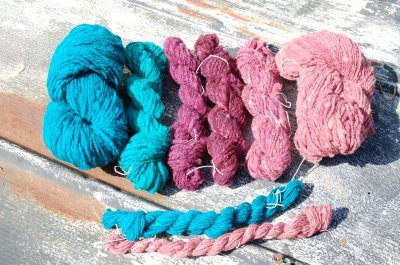
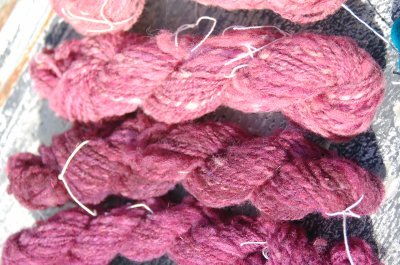
Here's what I've been up to the last few days--dying some local (burdock-laden) fleece in the crockpot, carding, spinning and plying it. I've been experimenting with series of color intensity, trying to get pretty pastels. The more intense colors continue to work better for me. It is encouraging, however, that the colors consistently look better in the spun yarn than in the fleece after carding.

assortment of pink yarns

Tuesday, August 22, 2006

Shitake Mushroom Harvest

shitake mushrooms

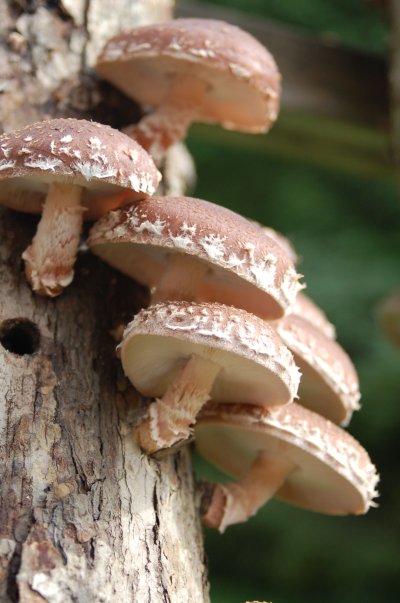
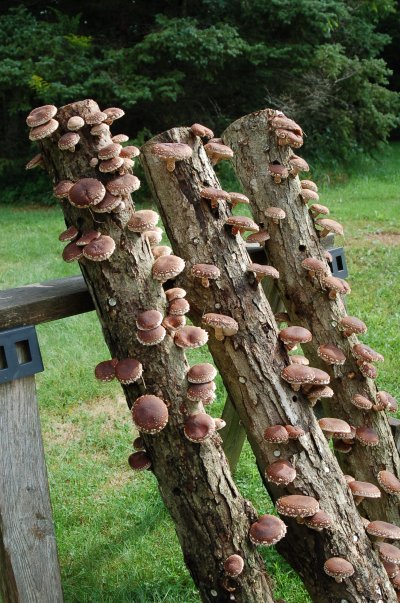
We've been growing shitake mushrooms for several years now. Some of the innoculated logs seemed to be on their last legs, and we were expecting to cull a number of them this fall. We have been pleasantly surprised--all 56 logs have produced like the ones below. We're currently drying them as fast as we can. This is in contrast to the garden--the vegetable garden, where all sorts of insects have been more fecund than most of my seeds and plants. Looks like we'll have something homegrown to eat this winter.

three shitake logs

Sunday, August 20, 2006

Death Trumpets

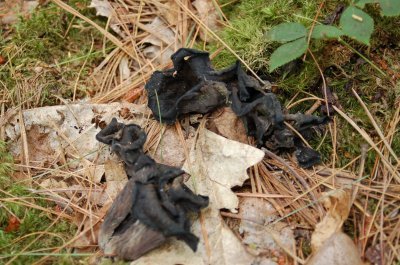
Earlier this month, we found these chanterelle mushrooms, which W.C. Roody's Mushrooms of West Virginia and the Central Appalachians calls Black Trumpets or Death Trumpets. Once I'd convinced myself that "Death Trumpets" referred to their funeral aspect and not to the results of ingestion, we tried cooking them. Although we had just a small handful, these chanterelles didn't reduce in volume when cooked. Their taste was very strong--much too strong to eat as a dish on their own. Our tiny handful should probably have been dried and used a teaspoon full at a time to flavor soups and egg dishes. Live and learn. I wonder if we'll ever find these again.

Tuesday, August 15, 2006

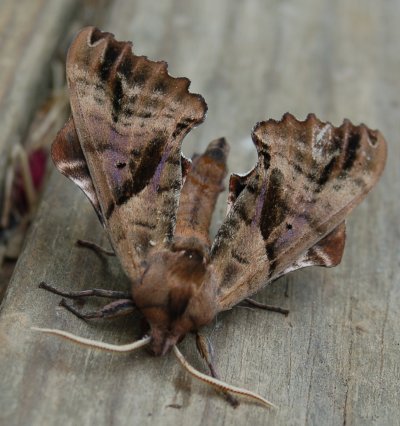
The Riddle of the Sphinx Moth

Droop Mountain sphinx moth, front view

I see this sphinx moth species often this time of year. I don't have much lepidopteran expertise, and without the specimen in hand I'm not going to attempt an identification, but isn't it handsome? In the hope of a dumb-luck species identification, I googled around a bit, and stumbled on Pocahontas County, West Virginia Sphingidae. I don't see my front porch pet on that sight, but what are the odds of my finding a collection of Pocahontas County sphinx moth photos on a Prince Edward Island lep farmer's Web site?

Droop Mountain Sphinx, top view

Monday, August 14, 2006

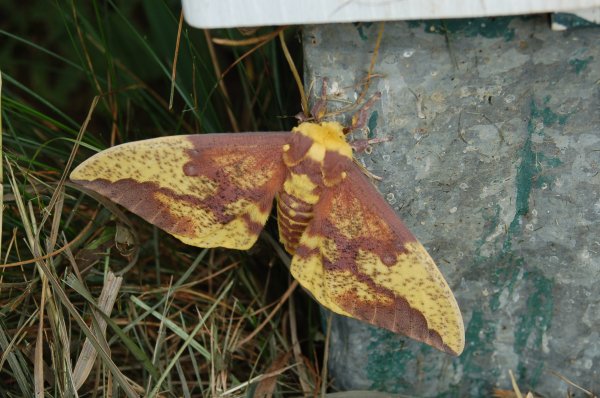
Imperial Moth, early August, 2006

Imperial Moth, Top view

This beauty was sitting on the corner of the house last week. I've always been a big fan of the giant silk moths. I don't see them every year, but besides this lovely Imperial, there have been a few Lunas fluttering around the windows at night.

Imperial Moth--side view Imperial Moth Eacles imperialis (Drury) (Saturniidae)

Sunday, August 13, 2006

Our Wicked Frontier Ways

A few weeks ago I finished Daniel Boone: The Life and Legend of an American Pioneer by John Mack Farahger. It attempts to separate fact from fiction and speculation, while treating the Daniel Boone folklore as an interesting phenomenon in itself. I learned that Boone had at least two West Virginia connections. His first "long hunt" was on Shenandoah Mountain, in West Virginia's Ridge and Valley region. Later, he and his family lived at Point Pleasant, home of The Mothman.

Boone seems to have been tarred with the same brush James Dickey used on later day natives of the back country. Here's a fascinating, wry quote from page 60 of my edition. (Note well the dig at William Byrd.)

Boone was...condemned by a number of his contemporaries as a man who "didn't live happily with his family, [and] didn't like to work." Such sentiments were akin to the criticism leveled by cultural outsiders at long hunters for the neglect of their families. In North Carolina backwoodsmen "live with less labor" than anywhere else he knew, said the Virginia aristocrat William Byrd, a man who knew whereof he spoke. They made "their Wives rise out of the Beds early in the morning, at the same time that they Lye and Snoer, till the Sun has run one third of his course, and disperst all the unwholesome Damps." Frontier men did "little of the work" around their farms, complained one missionary in the Yadkin settlements, leaving it all for their wives and children to perform, while they enjoyed themselves hunting. Consequently, the work around the home place was "poorly done," animals had to fend for themselves, even in winter, and Indian corn grew where there should have been good European wheat. It all added up to a pattern of "irregular living." "There are many hunters here who work little," wrote another preacher, but "live like Indians."

As this last remark suggests, the complaints amounted to the rejection of a way of life and had much in common with the European criticism of American Indians. The French emigrant Michel-Guillaume Jean de Crevocoeur described backwoodsmen as "new made Indians," "half cultivators and half hunters" who lived a "licentious, idle life." In the rush to commercial farming in the nineteenth century these criticisms were transformed into a cant, in which frontier ways were made to seem the very essence of barbarism and backwardness. In this climate of opinion, Boone supporters both inside and outside the family attempted to salvage the reputation of the Boone household by claiming that it had been run on solid Victorian principles....The most unfortunate thing about such special pleading was its anachronism, its irrelevance to the real conditions and dilemmas of frontier life.

Wednesday, August 09, 2006

An Adventure in Knitwear Design

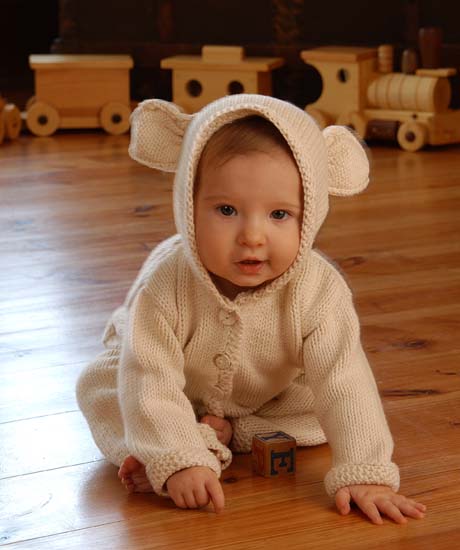
lamb's ear baby jacket

Last week, I got paid for writing a knitting pattern for this cute little sweater. Appalachian Baby Design sells this organic cotton Lamb's Ear Jacket as a ready-made item, and they wanted to add kits for knitters to their line of products. Ironically, the designer they paid in the first place provided a hand-knit sample; their production expert redesigned it for machine knitting; and last month I redesigned the machine knit sample and wrote hand knitting directions.

I'm not entirely sure what's going on with the company these days, but their Web site still describes them thus:

Appalachian By Design, the non-profit development and marketing company that markets Appalachian Baby Design, has devoted itself to making machine knitting a sustainable, home-based industry for women in rural Appalachia.

I've done work for them in the past, and found them a little "lethargic" in the check-cutting department. This time, I offered to take payment in product, and I was delighted to get over 10 pounds of white sport weight New Zealand wool yarn. I plan to dye this myself, and expect it could make about 40 pairs of Fair Isle socks, or heaven knows what else. It promises to keep me busy for years.

I was so excited about this wool that I found myself agreeing to other projects. That is why I am currently knitting garter stitch baby blanket in the same organic cotton. I'm ashamed to be "designing" something so boring, but it seems there are many happy knitters who make garter stitch scarf after garter stitch scarf. This kit is intended for people too timid to try a simple baby sweater. I was never a timid knitter, but by the time I started knitting, I had years of sewing experience under my belt, and, swaggering teenager that I was, I thought I could make anything out of fiber. At any rate, it is quite soft and pretty, and perhaps people will like it.

Thursday, July 27, 2006

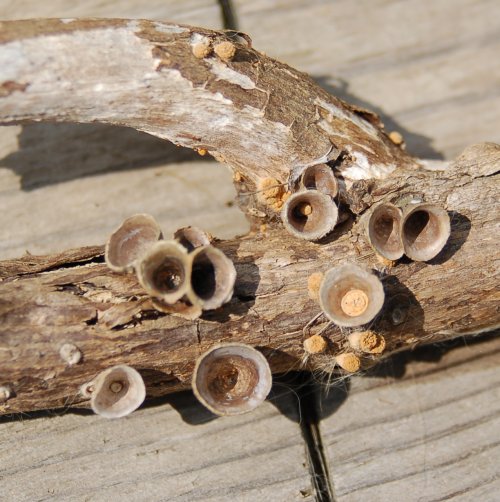
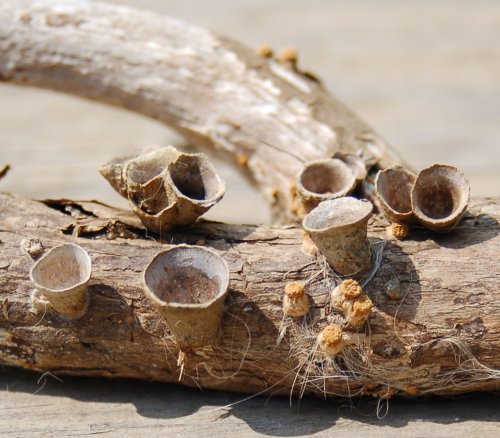
Fairies' Purses Revisited

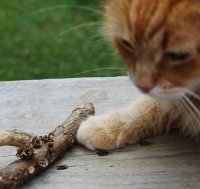
New Birds' Nest Fungus More Birds' Nest Fungi

After an interlude of handbag stitching, there is a certain logic to revisiting my Fairies' Purse fungi. Several rains have splashed all the little funiculi "coins" out of the purses, but the rough orange blobs are fresh purses sprouting all over the stick. There's even a new purse growing inside an old one. You know from the previous birds' nest fungi post where the yellow fur came from.