Tuesday, October 17, 2006

Battle of Droop Mountain, Refought

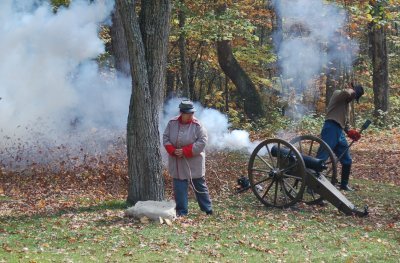
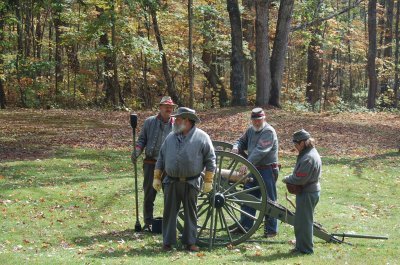
Firing the cannon

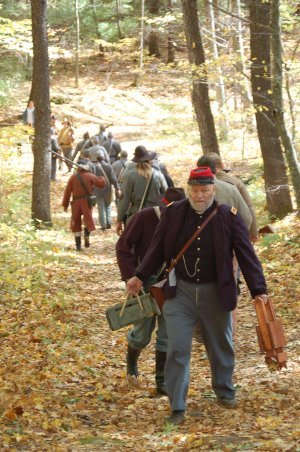
Every other year, Droop Mountain Battlefield State Park hosts a reinactment of the November 6, 1863 event for which it is named. Last weekend was the third one I'd attended. My first was the most dramatic, for me. I was going for my morning run on the park trails, when, out of the fog came a passle of Yankees on horseback. Understanding what was going on didn't make much difference. It was terrifying.

Waiting to fire the cannon

I'm not sure the reinactors get that excited anymore.

Watching from beside the cannon

Like the spectators, they look at the cannons like they would look at cars. "Will it start?"

Reinactors head home

As I headed home through the park, the Yankees and the Rebels passed each other on their way to pack up and go home.

Thursday, October 12, 2006

Southern, or Appalachian?

Several months ago, I discovered a fascinating book, W.J Cash's The Mind of the South, published in 1941. I posted some interesting Web references here, and got a gracious comment from W.J Cash's great-niece, Mary K. Elkins, a talented Web designer.

Cash's book is a cultural history of the American South in the way that Gibbon's Rise and Fall of the Roman Empire is a history. Cash, a Southerner, critiques mid-twentieth-century problems such as toxic race relations, intractable rural poverty, sickly nostalgia for an imaginary past, and paralyzing class consciousness. Whether his history is accurate or not, his prose is compelling.

I heard echoes of the rhetoric of "Appalachian otherness" in Cash's analysis of eighteenth and nineteenth century Southern history. In fact, "The South," rather than "Our Southern Mountains," may be the real Land of the Nine-Fingered People. Here is one passage that took my fancy.

Again, if the Southern social order had blocked in the common Southerner, it had yet not sealed up the exit entirely. If he could not escape en masse, he could nevertheless escape as an individual. Always it was possible for the strong, craving lads who still thrust up from the old sturdy root-stock to make their way out and on...even...to carve out wealth and honor in the very oldest regions....But in their going these emergent ones naturally carried away with them practically the whole effective stock of those qualities which might have generated resentment and rebellion. Those who were left behind were the simplest of the simple men of this country--those who were inclined to accept whatever the day brought forth as in the nature of things--those whose vague ambition, though it might surge up in dreams now and then, was too weak ever to rise to a consistent lust for plantations and slaves, or anything else requiring an extended exercise of will--those who, sensing their own inadequacy, expected and were content with little.

Moreover, they were in general those in whom the frontier tradition was likely to run strongest; which is to say that they were often almost indifferent, even in their dreams, to the possession of plantations and slave and to the distinctions which such possessions set up. For it is characteristic of the frontier tradition everywhere that it places no such value on wealth and rank as they command in an old and stable society. Great personal courage, unusual physical powers, the ability to drink a quart of whisky or to lose the whole of one's capital on the turn of a card without the quiver of a muscle--these are at least as important as possessions, and infinitely more important than heraldic crests. In the South, if your neighbor overshadowed you in the number of his slaves, you could outshoot him or outfiddle him, and in your own eyes, and in those of many of your fellows, remain essentially as good a man as he.

Tuesday, October 10, 2006

Selling Myself Real Estate

Locust Creek in the clouds

Last week we bought the property adjacent to our Droop Mountain home. We were stunned to discover it was on the market, and were anxious to buy it, as it surrounds us on three sides. It hadn't been sold outside the family since the nineteenth century, and the only existing survey uses large chestnut trees as landmarks. Such extinct boundaries are not unusual in Pocahontas County.

This photograph, taken in October 2004 from my neighbor's yard, plays an interesting role in the purchase. We made a very good offer, and had been waiting two days without hearing anything from the seller. I opened up my copy of the Pocahontas Times, and saw the property listed with a very familiar photograph. There was this picture, taken from my Web page, without permission, and without attribution. When I checked the realtor's Web page, there was my picture again. Not only were they violating my copyright, but they were using my picture to solicit bidders to compete against my offer. Oh, did I mention that the photograph does not show the property in question?

I was rather upset when I went into the realtor's office the next day, between anxiety about the offer and outrage about the picture. The realtors were horrified. The property owner had given them a floppy disk, and said it was his picture, taken from his property. They also said that someone was in their office, making a competing offer on the same property. After a conference out of my hearing, they asked, "Would this problem go away if your offer were accepted?" I told them yes, went on home, and soon got a phone call telling me our offer was accepted. From there on out, everything moved along smoothly, and now we have taken down the fence that separated the new parcel from our old one.

Monday, October 09, 2006

Pepper Butter

This past weekend, I canned the last of the garden produce. I made "Pepper Butter"--an unusual spread made from hot peppers and prepared yellow mustard--for the first time, after getting the recipe from Penny Kershner of Frost. I'd never tasted anything like it, but recently, I discovered I had two similar recipes, for "Pepper Sandwich Spread" and for "Green Tomato Sandwich Spread," in my favorite canning book, Favorite Recipes of Home Economics Teachers: Canning, Preserving and Freezing Cookbook.(Favorite Recipes Press, Montgomery, Alabama, 1975)

Thickened like a gravy, this bright yellow stuff is hot, sweet, and sour. Penny's recipe produced eight pints for me, and it is even tastier than I remembered. Although all the different recipes say you can pour the hot liquid into scalded jars and seal, I went ahead and water-bathed the filled jars for 20 minutes, the way I usually treat my sweet pickles. I find my jars are more likely to seal successfully when I do this, and it didn't hurt the "pepper butter" a bit.

PEPPER BUTTER 60-80 hot peppers (heat intensity your choice) Wash, remove stems, and grind in food processor. If you prefer a milder spread, remove some of the seeds and placenta. 6 cups sugar 1 quart prepared yellow mustard 1 quart cider vinegar In your cooking kettle, mix sugar, mustard, and vinegar. Stir in ground peppers and bring mixture to a boil. Make a thickening of 1 1/2 cups flour and 1 1/4 cups water. Add some boiling mix from your kettle to the thickening, and stir until smooth. Add thickening mix to boiling liquid, stirring until combined. Boil mixture for 5 minutes, stirring to prevent the thick mixture from burning on the bottom. Place in canning jars and seal. To waterbath can, place the jars in a canner and boil for 20 minutes. Remove, and allow jars to cool and seal.

Sunday, October 08, 2006

Self-Censorship

I've been writing, but not posting, recently. I'm still substituting for a yet-to-be-hired teacher for special needs students, and I'm dealing with a lot more people on a daily basis than has been my habit for many years. I've started to "blog" all sorts of interesting, wonderful, appalling things that the folks at school say and do, and then pulled up short. It's been my policy to avoid writing about my friends and neighbors, except in very vague terms, to protect their privacy. (Except for the doily cheater, but hey, I don't know who she was, and how much consideration should you get for fraudulent display of doilies, anyway?) I don't think I have many (any?) local readers, but who would want to hear through the grapevine that "Bootsie has been spilling the beans concerning your life on the Internet"?

Pair this self-censorship with my uncertainty about the direction I want my "Web-presence" to take, and you get very few posts. Dave, of Via Negativa, has invited me to submit something to qarrtsiluni on their "Education" theme. I was very excited about this, but quickly found out my most interesting themes violated my students' privacy. They may be seven years old and illiterate now, but that could (God willing) change.

In a comment this summer Dave suggested

...your mission could be to portray Pocahontas County in such an unflattering light that the flood of tourists would dwindle to a trickle. You could just make stuff up, like James Dickey. The local chambers of commerce would hate you.
I have since given much thought to writing Southern Gothic horror stories about fictional Pocahontas County residents, even to nominating Droop Mountain as the very capitol of The Land of the Nine-Fingered People. I am blessed to have a reader who understands me so completely. However, I could never invent anything to rival the things people really say and do. To paraphrase Dr. Watson, "The world is not yet ready for the Denmar kangaroo incident."

Other bloggers have been writing about the limits of the stories they may tell. I was especially struck by prariemary's recent posts on the topic "Who Should Tell the Stories?"

Who owns what stories?...Repeatedly in early years, individuals came to the reservation, took notes...wrote them up, sold them to publishers as original works, and collected the income. None of that income was sent back to the tribal storytellers. Some of the white writers claimed to be scientists who would use the stories to analyze and record the society of the tribal people -- others were simply acquiring stories the same way they would acquire beadwork, attractive curiosities....they not only made money from the stories, but also drained them of significance.

Pocahontas County "informants," such as still-living members of the Hammons family, have voiced feelings of exploitation. Although I know for a fact that the Library of Congress boys made little or no money from the stories and music they got from Burl, Sherman, and Maggie, they did carve notches in their academic status gunstocks. If I were to tell you that Denmar kangaroo story, with all the flourishes and detail it deserves, would I be exploiting my neighbor down the mountain? (Never mind that I could not possibly tell it as well as he can.)

I think the solution is...taking time. Really listening. Spending the day. Becoming part of the scene....Learning what stories mean to the tellers of them. I think that whether one is IN or OUT of the group, one can witness. One has an active obligation to witness accurately and possibly to record that somehow. It is the way to wisdom.

Framing it that way, I think I may try to tell few more tales. If it starts to sound too much like Yoknapatawpha County, perhaps I'll start a second blog.

Monday, September 25, 2006

Talking to Myself

I continue to substitute for a yet-to-be-hired special education teacher, although the precise nature of the unfilled position continues to change. I've been at three different schools and I'm uncertain how many students I'll be working with next week. (I assume I will be working next week.)

Although the heavy lifting is over, and I am no longer physically exhausted when I get home, my daily activities still interfere with my writing habits. While my students have little in common with one another, there is a certain continuity. Most of them have difficulties processing spoken and written language. Whether they can't take in verbal information because their brains are different from most people, or because they are too angry, too anxious, or too distracted by ambient noise, they don't attend to what they are told. I speak slowly. I say simple things. I repeat myself. I repeat myself. I REPEAT myself. If a teacher fell in the classroom, would there be any sound? I come home with little faith in the whole process of communication. It seems more interesting to can tomatoes than to write.

On the other hand, this is reminding me just how amazing it is to be able to read. A visual representation of speech--how did someone come up with this? The non-reading adults I've worked with have completely different ways of thinking about words than readers (even poor readers). They are unaware of rhymes in song lyrics, incredulous that words can be broken apart into component sounds, and skeptical that a word and the thing it names can be separated. Several of my young students are struggling with these same concepts. Most people participating in the magical world of written language have forgotten they ever lived anywhere else. It's a gift to be reminded of that other condition, and the hard work involved in crossing that border.

Monday, September 04, 2006

Where I've Been Lately

The week before last, I got a call from the school board office asking if I was available to start the school year as a substitute teacher. They are advertising for an autism teacher, and need a substitute until the position is filled. I travel between two schools and have four (soon five) special needs students. There are no lesson plans, no schedule, no real classroom, and no instructions on how to procede. I won't know the job is over until they tell me "Don't come in tomorrow." Of course I said, "Sign me up!"

So far, the job includes much heavy lifting and some sprinting down the halls and sidewalks. I come home very tired each night, and have not made blogging a priority. I like these unanticpated opportunities, and so far, I'm enjoying the work. Interestingly, I'm already in trouble. Thursday afternoon, an irate parent marched into the principal's office complaining about my treatment of her child. I don't know the nature of her complaint, but I did hear she was roaming the hall threatening to "whup me," or some part thereof. The fourth day of school seems a little premature for complaints--I usually don't get criticism until I've actually done something. Still, you must admire a parent that cares enough to offer a pre-emptive "whuppin'."

The Last Barbeque of the Season

This summer, we've been searching for the ideal barbeque sauce. In honor of Labor Day, here are some things we've tried that we liked.

Michael Chiarello's Babyback Ribs with Espresso Barbecue Sauce
Espresso Barbecue Sauce:
4 tablespoons mashed and minced garlic
4 tablespoons extra-virgin olive oil
1 cup cider vinegar
1/2 cup soy sauce
2 cups ketchup
2 cups honey
Grey salt
2 demitasse cups espresso (or about 1/2 cup of strong coffee or instant espresso)
Fresh ground black pepper

Mash garlic with the side of a knife and then mince finely to release oils.

Add olive oil to a preheated saute pan. Add the garlic and saute until it gets light brown, about 1 minute. Add cider vinegar, soy sauce, ketchup, and honey and stir well. Add a pinch of grey salt, then whisk in the coffee. Add freshly ground black pepper, to taste. Bring to a simmer and simmer for 10 minutes.

Let cool and store in refrigerator for up to 2 weeks.

BOURBON BARBECUE SAUCE
2 cups ketchup
1/2 cup mild-flavored (light) molasses
1/3 cup bourbon
1/4 cup Dijon mustard
3 tablespoons hot pepper sauce
2 tablespoons Worcestershire sauce
2 teaspoons paprika
1 teaspoon garlic powder
1 teaspoon onion powder

Combine all ingredients in heavy large saucepan. Bring to boil over medium heat, stirring occasionally. Reduce heat to medium-low; simmer uncovered until sauce thickens and flavors blend, stirring frequently, about 15 minutes. (Can be made 1 week ahead. Cover; chill.)

Makes about 2 1/2 cups. Bon Appétit, July 2000. Steve Raichlen

Kicked Up Barbecue Sauce with Variations
2 cups favorite bottled barbecue sauce
1/2 cup dark brown sugar
1/3 cup minced onions
5 large cloves garlic, minced

Mix together all ingredients. Use immediately.

Asian-Style Barbecue Sauce
2 cups favorite bottled barbecue sauce
2 tablespoons soy sauce
1 teaspoon ground ginger
1 teaspoon garlic powder

Mix together all ingredients. Use immediately.

Raspberry Barbecue Sauce
2 cups favorite bottled barbecue sauce
1 package frozen red raspberries in syrup

Mix together all ingredients. Use immediately.

Bourbon Barbecue Sauce
2 cups favorite bottled barbecue sauce
1/4 cup bourbon

Mix together all ingredients. Use immediately.

Mustard-Style Barbecue Sauce
2 cups favorite bottled barbecue sauce
1 cup yellow mustard

Mix together all ingredients. Use immediately.

Here are some other barbeque sauce recipe collections.

Wednesday, August 23, 2006

Spinning My Tiny Dye Lots

teal and pink yarns

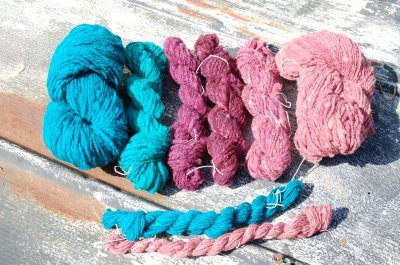
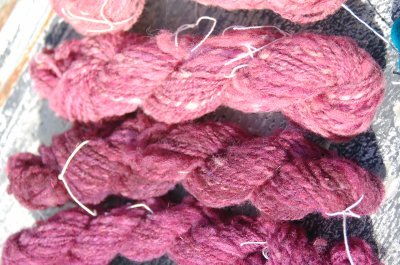
Here's what I've been up to the last few days--dying some local (burdock-laden) fleece in the crockpot, carding, spinning and plying it. I've been experimenting with series of color intensity, trying to get pretty pastels. The more intense colors continue to work better for me. It is encouraging, however, that the colors consistently look better in the spun yarn than in the fleece after carding.

assortment of pink yarns

Tuesday, August 22, 2006

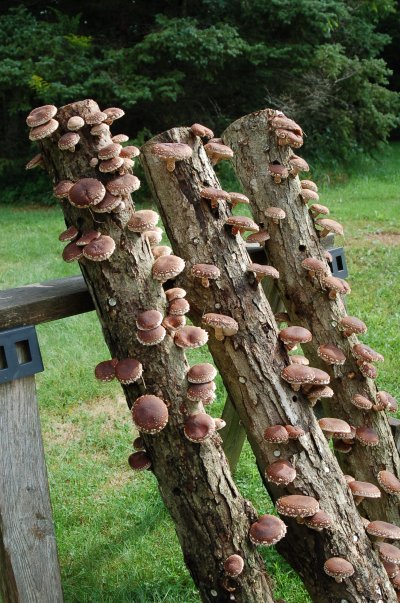
Shitake Mushroom Harvest

shitake mushrooms

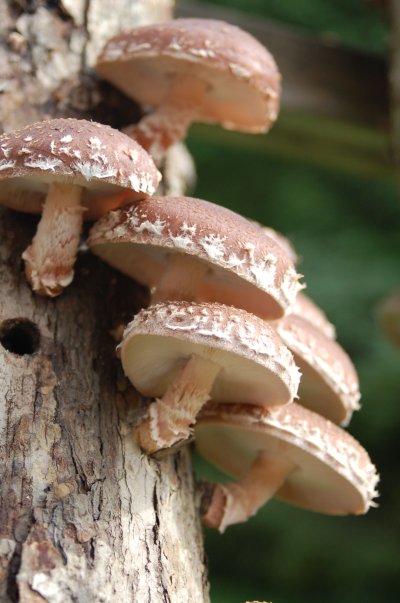
We've been growing shitake mushrooms for several years now. Some of the innoculated logs seemed to be on their last legs, and we were expecting to cull a number of them this fall. We have been pleasantly surprised--all 56 logs have produced like the ones below. We're currently drying them as fast as we can. This is in contrast to the garden--the vegetable garden, where all sorts of insects have been more fecund than most of my seeds and plants. Looks like we'll have something homegrown to eat this winter.

three shitake logs

Sunday, August 20, 2006

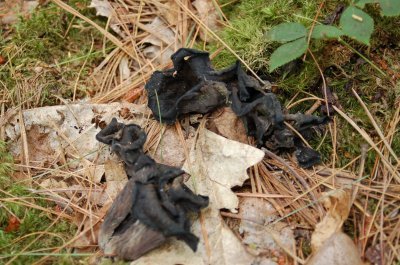
Death Trumpets

Earlier this month, we found these chanterelle mushrooms, which W.C. Roody's Mushrooms of West Virginia and the Central Appalachians calls Black Trumpets or Death Trumpets. Once I'd convinced myself that "Death Trumpets" referred to their funeral aspect and not to the results of ingestion, we tried cooking them. Although we had just a small handful, these chanterelles didn't reduce in volume when cooked. Their taste was very strong--much too strong to eat as a dish on their own. Our tiny handful should probably have been dried and used a teaspoon full at a time to flavor soups and egg dishes. Live and learn. I wonder if we'll ever find these again.

Tuesday, August 15, 2006

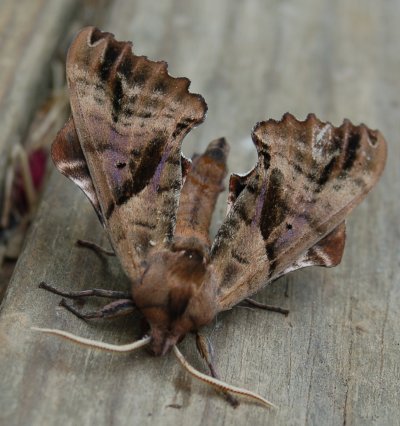
The Riddle of the Sphinx Moth

Droop Mountain sphinx moth, front view

I see this sphinx moth species often this time of year. I don't have much lepidopteran expertise, and without the specimen in hand I'm not going to attempt an identification, but isn't it handsome? In the hope of a dumb-luck species identification, I googled around a bit, and stumbled on Pocahontas County, West Virginia Sphingidae. I don't see my front porch pet on that sight, but what are the odds of my finding a collection of Pocahontas County sphinx moth photos on a Prince Edward Island lep farmer's Web site?

Droop Mountain Sphinx, top view

Monday, August 14, 2006

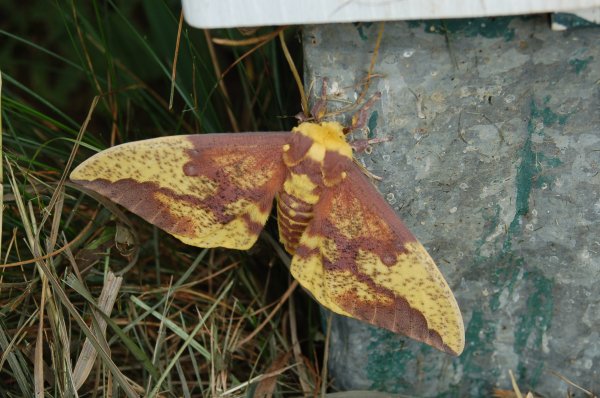
Imperial Moth, early August, 2006

Imperial Moth, Top view

This beauty was sitting on the corner of the house last week. I've always been a big fan of the giant silk moths. I don't see them every year, but besides this lovely Imperial, there have been a few Lunas fluttering around the windows at night.

Imperial Moth--side view Imperial Moth Eacles imperialis (Drury) (Saturniidae)

Sunday, August 13, 2006

Our Wicked Frontier Ways

A few weeks ago I finished Daniel Boone: The Life and Legend of an American Pioneer by John Mack Farahger. It attempts to separate fact from fiction and speculation, while treating the Daniel Boone folklore as an interesting phenomenon in itself. I learned that Boone had at least two West Virginia connections. His first "long hunt" was on Shenandoah Mountain, in West Virginia's Ridge and Valley region. Later, he and his family lived at Point Pleasant, home of The Mothman.

Boone seems to have been tarred with the same brush James Dickey used on later day natives of the back country. Here's a fascinating, wry quote from page 60 of my edition. (Note well the dig at William Byrd.)

Boone was...condemned by a number of his contemporaries as a man who "didn't live happily with his family, [and] didn't like to work." Such sentiments were akin to the criticism leveled by cultural outsiders at long hunters for the neglect of their families. In North Carolina backwoodsmen "live with less labor" than anywhere else he knew, said the Virginia aristocrat William Byrd, a man who knew whereof he spoke. They made "their Wives rise out of the Beds early in the morning, at the same time that they Lye and Snoer, till the Sun has run one third of his course, and disperst all the unwholesome Damps." Frontier men did "little of the work" around their farms, complained one missionary in the Yadkin settlements, leaving it all for their wives and children to perform, while they enjoyed themselves hunting. Consequently, the work around the home place was "poorly done," animals had to fend for themselves, even in winter, and Indian corn grew where there should have been good European wheat. It all added up to a pattern of "irregular living." "There are many hunters here who work little," wrote another preacher, but "live like Indians."

As this last remark suggests, the complaints amounted to the rejection of a way of life and had much in common with the European criticism of American Indians. The French emigrant Michel-Guillaume Jean de Crevocoeur described backwoodsmen as "new made Indians," "half cultivators and half hunters" who lived a "licentious, idle life." In the rush to commercial farming in the nineteenth century these criticisms were transformed into a cant, in which frontier ways were made to seem the very essence of barbarism and backwardness. In this climate of opinion, Boone supporters both inside and outside the family attempted to salvage the reputation of the Boone household by claiming that it had been run on solid Victorian principles....The most unfortunate thing about such special pleading was its anachronism, its irrelevance to the real conditions and dilemmas of frontier life.

Wednesday, August 09, 2006

An Adventure in Knitwear Design

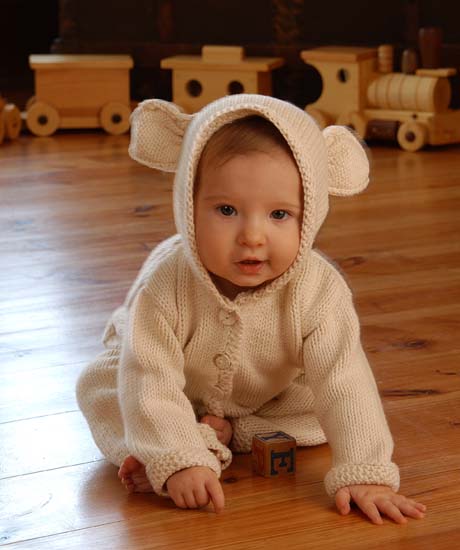
lamb's ear baby jacket

Last week, I got paid for writing a knitting pattern for this cute little sweater. Appalachian Baby Design sells this organic cotton Lamb's Ear Jacket as a ready-made item, and they wanted to add kits for knitters to their line of products. Ironically, the designer they paid in the first place provided a hand-knit sample; their production expert redesigned it for machine knitting; and last month I redesigned the machine knit sample and wrote hand knitting directions.

I'm not entirely sure what's going on with the company these days, but their Web site still describes them thus:

Appalachian By Design, the non-profit development and marketing company that markets Appalachian Baby Design, has devoted itself to making machine knitting a sustainable, home-based industry for women in rural Appalachia.

I've done work for them in the past, and found them a little "lethargic" in the check-cutting department. This time, I offered to take payment in product, and I was delighted to get over 10 pounds of white sport weight New Zealand wool yarn. I plan to dye this myself, and expect it could make about 40 pairs of Fair Isle socks, or heaven knows what else. It promises to keep me busy for years.

I was so excited about this wool that I found myself agreeing to other projects. That is why I am currently knitting garter stitch baby blanket in the same organic cotton. I'm ashamed to be "designing" something so boring, but it seems there are many happy knitters who make garter stitch scarf after garter stitch scarf. This kit is intended for people too timid to try a simple baby sweater. I was never a timid knitter, but by the time I started knitting, I had years of sewing experience under my belt, and, swaggering teenager that I was, I thought I could make anything out of fiber. At any rate, it is quite soft and pretty, and perhaps people will like it.

Thursday, July 27, 2006

Fairies' Purses Revisited

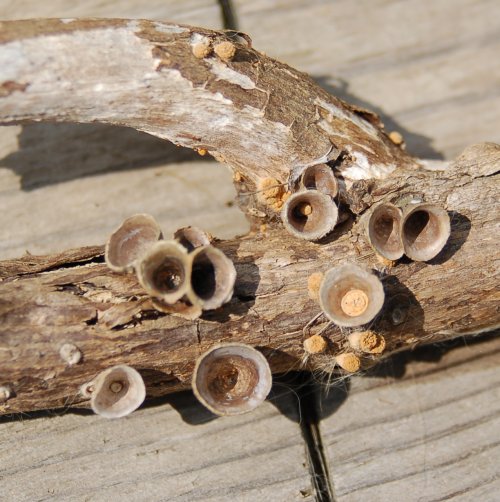
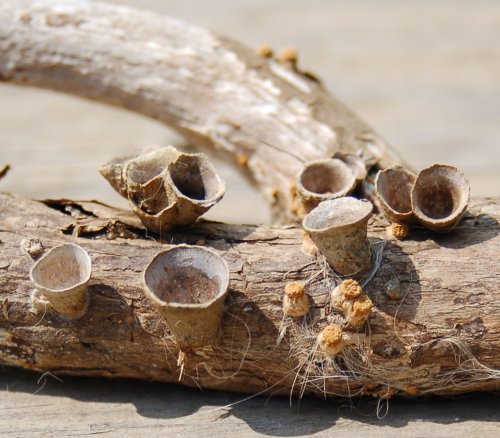
New Birds' Nest Fungus More Birds' Nest Fungi

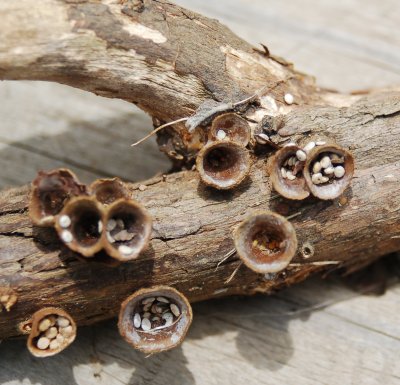
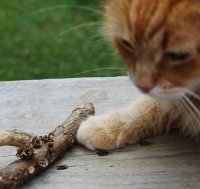
After an interlude of handbag stitching, there is a certain logic to revisiting my Fairies' Purse fungi. Several rains have splashed all the little funiculi "coins" out of the purses, but the rough orange blobs are fresh purses sprouting all over the stick. There's even a new purse growing inside an old one. You know from the previous birds' nest fungi post where the yellow fur came from.

Monday, July 24, 2006

Bib Overalls Pocket On a Patchwork Totebag

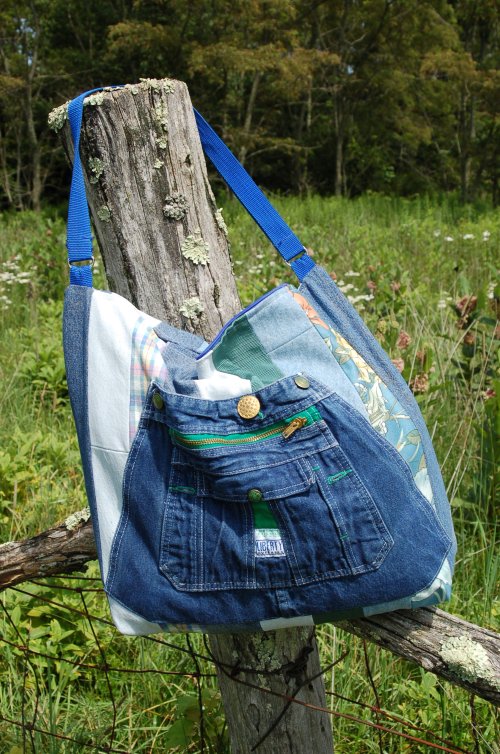
Bib Overall Pocket on patchwork tote bag

I sewed up this tote bag yesterday, after thinking about it for a couple of weeks. I had the bib from an old pair of overalls, and thought it would make a cute and useful exterior pocket. All the materials are reused. I haven't put in the lining yet, because I'm still trying to decide whether the flip side is too plain or not. I have plenty of work shirt buttons that would make an attractive decoration on the dark denim rectangles, but it might be too texture-y to be practical.

In the process of thinking about the design, I spent a little time looking at handmade handbag Web sites. This is an example of an activity greatly enhanced by my DSL connection. With dial-up, it would have taken me days to winnow through the search results and find this many nifty sites with inspiring photos and patterns. This took about an hour. In the end, I sewed the bag I originally envisioned, but I got some really interesting ideas for more projects.

Free Resources

Commercial Resources--Patterns, Hardware, and Handmade Bags

tote bag side tote bag back

Saturday, July 22, 2006

Bird's Nest Fungus (Nidulariaceae)

Bird's Nest Fungus

According to W.C. Roody's Mushrooms of West Virginia and the Central Appalachians, These are Crucibulum laeve, the Common Bird's Nest. Princess and the birds' nests I agree with him that "this little fungus is always a pleasure to find." These are growing on a butterfly bush stem, but I find them on rotting stuff pretty often here on Droop Mountain. One summer I uncovered a large scrap of plywood crowded with the little nests full of tiny "eggs." It looked like some miniature sea bird rookery. When it rains on these birds' nests, the peridioles (eggs) fly out, trailing their little spring-like "stems" or funiculi. The funiculi have sticky ends which adhere to larger objects, anchoring the spore-filled "eggs" to their new homes.

I've also heard these strange little basidiomycetes called "fairies' purses," with the "eggs" interpreted as tiny silver coins. You can see in the photo at left why subsequent pictures of these charming fungi will feature whisps of yellow fur.

Wednesday, July 19, 2006

Blogger's Block

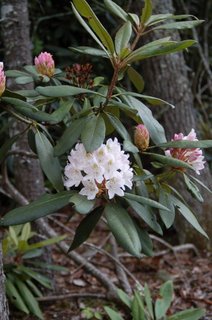
Rhododendron at Allegheny Lodge

This weblog has been more miss than hit lately, due to upheavals in my technological life. After years of wishing, I finally bought a digital SLR camera, and it is complex enough to require much experimentation. It's also made necessary changes in the way I manage my hard drive "space," view my images, and edit them.

Just when I thought I was getting a handle on these changes, the phone company called to let me know DSL is available in my area. This was astonishing, and I expect it will enhance my computer experience eventually, but for now, it's made me reorganize my LAN, learn a lot about hardware and software firewalls (for both Linux and Macintosh), and spend hours reinstalling my Debian OS on two Pentium boxes. Soon, I'll have to change my web hosting arrangements.

These two technological upgrades ought to improve my Web presence and enhance my blogging experience eventually, but right now I feel a little overwhelmed and intimidated by the possibilities. Before, on a dial-up connection, it took about twenty minutes to upload an edited jpg file and an accompanying html file, so I had to prepare my material in advance. I wrote my html in Emacs (my text editor of choice, and the One True Religion). If I wanted to post a photo, I had to finish a roll of film, take it to the drugstore, get it back, scan the negative, and edit the image down to a quick-loading jpg file. This long process gave me several opportunities to review and edit the text, catch my habitual errors, and decide if the picture was worthwhile. Now I can upload any sort of crap as fast as I can type, and slap up any snapshot within minutes of clicking the shutter. I can review Web resources in minutes rather than hours, download podcasts and videos without planning my week around the process.

I don't usually have writer's block (or photographer's block), but this sudden wealth of possibilities has me frozen in place. I could really change the focus of my Web work, alter my pace, branch out into new content areas.... And while I've been dazed by all this, two of the bloggers I most enjoy have been musing on what blogs are, and what their blogs should be. Dave of Via Negativa recently observed:

The blogosphere has been billed as an alternative to the mainstream media, but in many ways, it's just as superficial. The emphasis remains on speed rather than accuracy, sensationalism rather than nuance, and two-sided conflicts rather than the full complexity of life as most of us experience it in our daily lives. Even for us non-political bloggers, there's a great temptation to simply post our latest snapshots, with a few accompanying sentences of breathless prose, and move on to something else. To try to see anything more fully, to observe it attentively and then take the time to describe or depict it with as much care and effort as we can muster seems almost counter-cultural. But if the bloggers I tend to read have anything in common, it might be precisely this, that they are dedicated to documenting what Barbara Brown Taylor refers to as "alternate reality."

Meanwhile, Lorianne of Hoarded Ordinaries has been examining the way her weblog has shifted its focus over the last three years.

...It's quick & easy to slap up a snapshot and say "I'm done blogging for the day"; it takes a bit more time, care, and attention to detail to craft a meaningful post that actually says something.

In my early days of photo-blogging, I justified my "quickie" photo posts by telling myself they were like postcards: although we all love to receive long, carefully-crafted letters, it's also great to get short postcards that assure us "The weather is great; wish you were here." In my mind, a frequently updated blog is more valuable than one that only occasionally posts new (albeit carefully crafted) material: in the blogosphere, frequent snacking seems to be "healthier" (and more popular with readers) than the bloggish equivalent of occasional elaborate feasts....

At a certain point, every writer asks herself, "What do I have to say that's unique to my background and expertise; what do I have to say that needs to be said?" ....these days I'm trying to watch which way the wind is blowing, trying to admit that everything, blogs included, change over time, with there inevitably being a time to be silent as well as a time to speak.

I promise that I will keep posting whether or not I figure out what my blog mission is or not. Perhaps the process will sort it out for me.
Thursday, July 13, 2006

Doily Fraud--The Seamy Underbelly of Pioneer Days

Last week I was asked to judge the knitting category in Marlinton's Pioneer Days Craft Show. When I arrived in town with my evaluation forms in hand, I discovered that there were no entries. The competition is generally referred to as the "Quilt Show," so I wasn't too surprised at this turn of events. Instead, I assisted the crochet category judge, a last-minute stand-in. There were about ten crochet entries, and I think we evaluated them fairly, with one possible exception.

It seems a cotton doily we ranked in the top four was suspect. According to the quilter who organized the show, the woman who brought in the doily entered it on behalf of her neighbor, along with another doily with a "Made in China" sticker still attached. The rules state that the entry must be your own work, an explicit addition after last year's scandal, in which it was revealed that the award-winning quilt was a purchased article.

Now, it costs $2 to enter an item in the show, and the winner's financial stakes are very low--less than the cost of a doily at Wal-Mart. What would motivate doily fraud? Bragging rights are limited, because one runs the risk of coming in third in a field of two. Myself, I've never entered an item in the show because once the competition is over, the display is not watched carefully, and much that is not nailed down in Marlinton disappears during Pioneer Days. (This is not typical--the rest of the year I leave my car unlocked without qualm. I blame the huge crowds from out of town.)

What kind of person commits doily fraud? My faith in needle artists is shaken. I have also been disturbed to learn of dissent and ill-feeling among the quilters in Pocahontas County. There are, it seems, quilters who would not interact with "that quilt show" for anything on earth. It's all rather disillusioning.