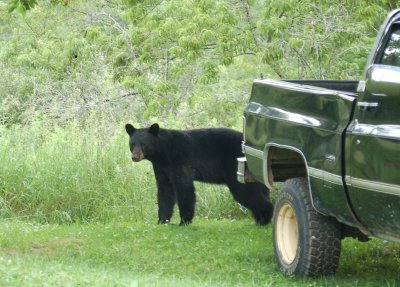
The bear was back again yesterday, and this time we saw him eating fallen cherries under our fruit trees. We like these cherries, too. They're flavorful, sour, and too small to pit with a cherry pitter, but they make the best pie I've ever tasted.

The bear was back again yesterday, and this time we saw him eating fallen cherries under our fruit trees. We like these cherries, too. They're flavorful, sour, and too small to pit with a cherry pitter, but they make the best pie I've ever tasted.
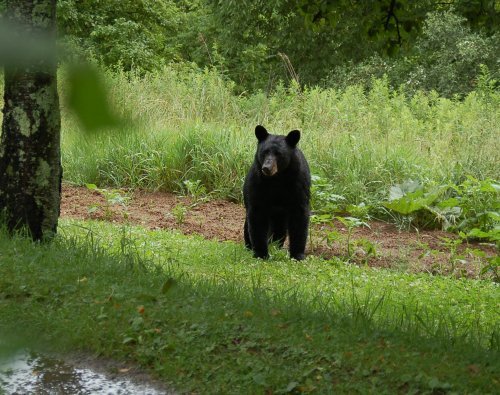
It stopped raining yesterday afternoon, and this fellow came up out of the brush to see what he could see. This always gets me pretty excited, and for the next week or so, every dark shadow and tree trunk is going to look like a bear to me. He left a few tracks in the potato patch, but nothing photograph-worthy.
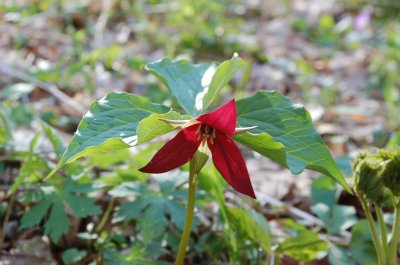
The top photograph is Painted Trillium, photographed in mid-May on Droop Mountain. This is the first time I've found it in bloom. For comparison, I give you Red Trillium from the headwaters of Williams River at the end of April.

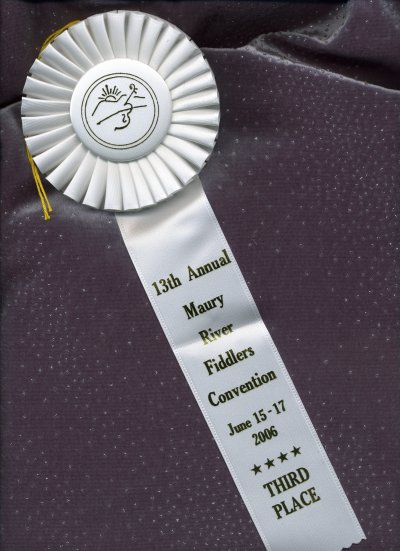
I entered the autoharp contest at the Maury River Fiddler's Convention last Thursday, as planned. I played "Chinkypin," it went pretty well, and I was tickled to get my camping fee refunded, in cash, immediately after I played. There were quite a few autoharp contestants, so I didn't harbor any illusions about winning. Imagine my surprise to find I'd finished in the money--third, to be precise. This was my first contest, and I have the feeling that it will be like that first free taste of an addictive drug.
On another exciting note, the phone company called me last week to let me know DSL is available in our area. They installed it Monday, and within an hour, the power went out and stayed out for eight hours. I couldn't help thinking this was the Universe reminding me that I still live in a remote, rural area, DSL notwithstanding. Since then, I've been busy working on my home network. I've been backing up data, updating my Debian installations, and tightening up security on the Mac. I'm just beginning to appreciate the many things I never investigated before due to lack of bandwidth. Yesterday, I downloaded Flashplayer, and was able to watch someone else's kitty take a drink of water from the tap on YouTube. The Internet is truly a miraculous tool!

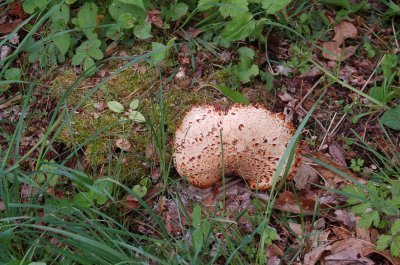
We collected these "specimens" (also known as "dinner")of pheasant's backs just before Memorial Day. According to W.C. Roody's excellent field guide, Mushrooms of West Virginia and the Central Appalachians, they are also known as "Dryad's Saddle" or Polyporus squamosus. It "appears fairly early in the spring and can be a consolation prize for the hapless morel hunter." Unfortunately, these were a little too old to be tasty, although they were still quite pretty. Pocahontas County mushroom hunters call them pheasant's backs because the scale pattern resembles the markings of a grouse. (To me, and to most Iowans my age, "pheasant" will always mean "ring-necked pheasant.")

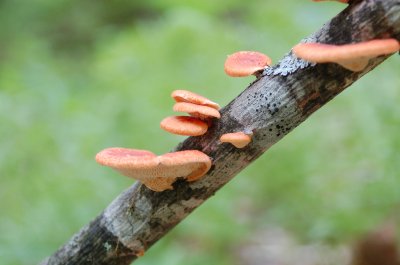
I hadn't intended to keep a photo blog, although recent trends contradict this. I have nothing against photo blogs, mind you. If I had broadband access, I'd probably follow lots of them. As it is, several of the weblogs in my "Blogroll" load so slowly that I often read the text and skip the photos.
Lately my self-allotted computer time has been taken up with photography and music matters. I've copied some vinyl and some audio tape to mp3's, and I've acquired a much-longed-for digital camera. These new projects have led to back-up and storage issues, which led to Linux updates, which led to hardware updates, which led to reorganizing my computer work area.... I'm almost done with this, I hope.
The computer audio projects were spurred by the start of the festival and picking season. This coming weekend, we are going to The 13th Annual Maury River Fiddlers' Convention in Buena Vista, Virginia. Our camping buddies, Mud Hole Control, won the Old-Time Band contest last year, and this year are the featured house band. We are always honored to be their hangers-on, and are particularly pleased that they are being honored.
Attendees who participate in the music contests get a discount on camping fees, so I signed up. Obviously, there is no concertina contest, but there is an autoharp contest, and that is an instrument I can play. (My banjo skills are not ready for prime time--more like early Sunday mornings when the infomercials come on.) That's what I've been spending my indoor hours on since the Vandalia Gathering--practicing two fiddle tunes on the autoharp. I'm going to play "Chinquapin" and/or "The Red-Haired Boy." They're not sounding too bad, but since I spent a couple of days working in the garden, my hands are getting very sore from practicing. Ironically, I took up the autoharp twelve years ago because it was the only instrument I could play wearing the carpal tunnel wrist braces necessitated by my bioinformatics job. Today I wish I still had the braces, but I think my ferret buried them not long after I moved to Pocahontas County.
If you're interested in the ins and outs of autoharps, I recommend these resources.
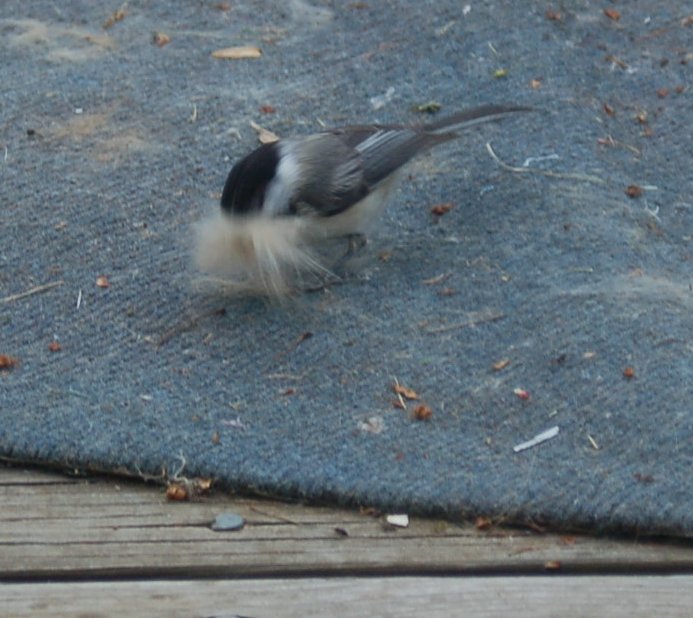
He's not "feathering his nest." He's not "woolgathering," because I left some carded sheep's fleece out in the yard, and it's never been touched. This black capped chickadee comes to our doormat every morning, and gathers up the fur thoughtfully shed there by my fuzzy yellow cat, Princess.

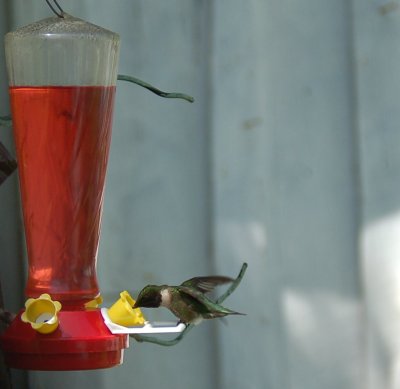
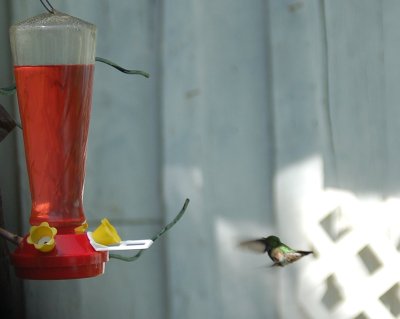
We continue to play with the new camera. What better way to test the stop-motion modes than a hummingbird? The lower photo shows the little guy flying backwards away from the feeder. We've noticed them doing this--they back away a couple of feet and take off in a different direction, and we're particularly pleased to catch this.

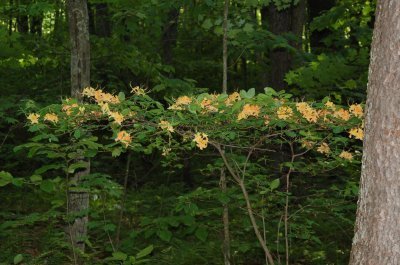
More photos, less text seems to be my rule these days. I try to limit my computer time each day, and lately, I have been doing a number of maintenance tasks. Hence the brief comments. These flame azaleas in the Droop Mountain Battlefield Park have bloomed profusely this year. People tell me the whole mountain was once covered with these (locally known as "honeysuckle"), but horticulturalists in the fifties and sixties paid a premium for them, so everybody dug them up and sold them.
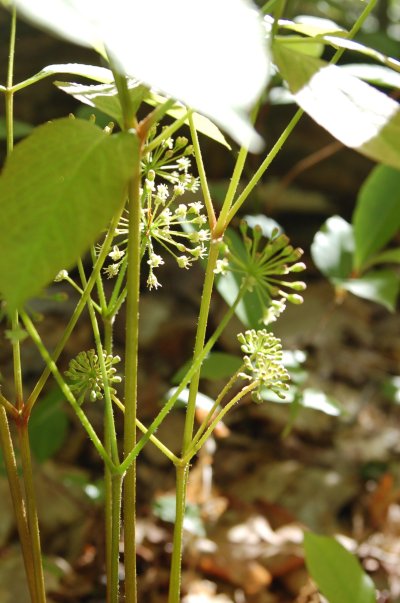
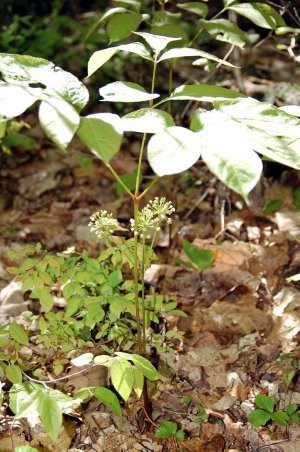
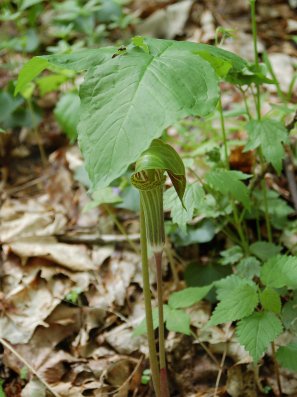
I've been walking by these for several years with scarcely a glance, assuming that the pinnately compound leaves belonged to some sort of hickory seedlings. This year, I caught them in bloom, and discovered that Droop Mountain is covered up with Wild Sarsaparilla (Aralia nudicaulis). This seems to be my year for finding plants in the ginseng family.

This spring has been spectacular for flowers. Where I usually see one or two blooms, or notice a plant without flowers, this year, everything seems to be taking its chance to bloom. I've seen these orchids before, but I've never caught them blooming. It's Showy Orchis, and there were dozens of plants in flower when I took this photo.
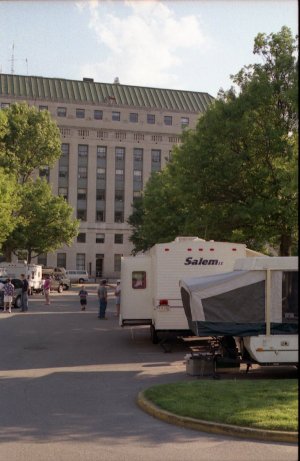
Last weekend, we took our pop-up camper to Charleston to the Vandalia Gathering, the premier West Virginia traditional music festival. Other festivals in West Virginia are bigger, but are often dominated by out-of-state musicians. If you place in a Vandalia music contest, (and many of our friends and neighbors did just that this year), you're one of the bright lights of West Virginia music for sure.
Our annual trip to the State Capitol Complex is a strange one. We live on beautiful Droop Mountain, and as we drive to Charleston on Friday, we meet the Charleston/Huntington traffic on its way to Pocahontas County to camp for the Memorial Day weekend. When we arrive, we put up our camper in this scenic location. In the top photo, you see the back of the Department of Motor Vehicles building. In the next photo you see how conveniently we are located to the railroad tracks and the interstate. It's a testimonial to the festival's fine music that we who live in "God's Country" camp on asphalt in the heat of the low country to participate.

I had a particularly good time in the picking sessions this year. I got to play quite a bit with musicians I admire. Because I play concertina (not an integral part of Appalachian string band music), I don't jump in unless invited, and I was tickled pink to be included. I've been much more interested in learning more tunes and practicing since I've been home.
This year we also picked up a guitar and string bass from the repair shop. My bass has been out of commission for so long I've forgotten what little I knew about playing, so I've been trying to get back in the groove with that as well.

Is James Dickey's Deliverance an adventure story set in the land of the nine-fingered people, where musicians are wall-eyed albino idiot-savants, and vicious, toothless hillbillies wait at every turn of the river to sodomize passing strangers? A lot of people think so (and we in Pocahontas County like to bring up the movie whenever we think we can scare off a skier or mountain biker). James Dickey's movie screenplay is set in that Appalachia, but I think his novel is a more complicated work. Dickey drops many hints that Ed's narrative is a pack of lies.
Ed tells us first off that he is an advertising executive--that is, a professional liar, a profit-motivated manipulator of opinion. Then, as Ed describes the unfolding events, he gives us hints that the story is unbelievable.
An old man with a straw hat and workshirt appeared at Lewis' window talking in. He looked like a hillbilly in some badly cast movie, a character actor too much in character to be believed. I wondered where the excitement was that intrigued Lewis so much; everything in Oree was sleepy and hookwormy and ugly, and most of all, inconsequential. Nobody worth a damn could ever come from such a place.
"Too much in character to be believed." The deformed, sickly farmers, each with a murdering relative in prison, the drunken old moonshiner screaming senselessly in the woods--are we meant to believe all this is real? Within a few minutes of pulling the canoe ashore to rest, Ed and Bobby are attacked. (What are the odds that they would pull up into a den of rapists? Or is the river lined on both sides with such men, waiting for tourists?) After Lewis kills one of the cretinous sodomites, Ed and his companions immediately begin to plan what lie they will tell when they reach the end of their trip. While Drew says they should go to the police and tell the truth, the others decide to conceal the body and pretend no rape occurred.
After they upset the canoes in the rapids, where Drew is killed and Lewis severely injured, Ed tracks down and kills the hillbilly he thinks shot Drew and is stalking the others. (Is it the sodomite rapist from upstream? He thinks so, but that man was toothless and unarmed; the man he kills has a rifle and dentures. Did he go home, change his clothes, put in his teeth, and get his gun? Could he have been an innocent bystander? The details of Ed's hunt grow steadily less plausible. And there is only a one in four chance that Drew would be the hillbilly sniper's first victim. How interesting that he was the one who wanted to tell the truth.) Ed conceals the second hillbilly's corpse, along with Drew, and plans the lie he and his friends will tell when they reach town. There are a few hitches, but they bluff their way through. Ultimately, Ed feels that the weekend trip, with all its killing and lying, has given him new resources of personal strength, confidence, and satisfaction.
Why should we believe Ed is telling us the truth, when he's lied to everybody else? What do the men's families know about what happened? Four men with bows and arrows, minimal canoing skills, and a lot of liquor go on a trip in the mountains. Only three of them come home. We really don't need any murderous hillbillies to make such a thing happen. Even the rape, if it happened, need not have involved local people who fortuitously appeared at the very spot chosen for an unplanned rest stop. As an additional flag to question Ed's veracity, Dickey's narrator describes feelings incongruous with his experiences. He despises the rape victim, even fantasizes about shooting him. He feels fulfilled by his successful man-hunt, and returns home to practice his art with renewed enthusiasm. Most people (including Dickey in his war poems) respond to such events with inappropriate hypervigilance, nightmares, guilt, and anxiety.
I don't know what "really" happened on the canoe trip. I wonder if Ed does? Is the ugliness of Appalachia a projection of Ed's (or Dickey's) inner ugliness? Did James Dickey know which of his own stories were true and which were fabrications? Amid these multiple, incompatible versions of people and events, any attempt at certainty would be attractive. Ed says of the map Lewis uses to invite him on the trip:
It was certainly not much from the standpoint of design....there was nothing to call you or stop you on one place or the other. Yet the eye could not leave the whole; there was a harmony of some kind. Maybe, I thought, it's because this tries to show what exists.

I continue to pick at James Dickey's vitriolic and stereotypic descriptions of Appalachian people in Deliverance. Did Dickey mean for us to take our narrator's account at face value? Many people interpret it that way. The Brothers Judd offer a synopsis/review typical of many readers.
...Georgia suburbanites in search of adventure...decide to canoe down the wild Cahulawasee River before it is dammed up forever. The boys, as most everyone knows from the terrific movie, soon stumble upon more adventure than they had anticipated and find themselves at war with several denizens of the backwoods country. These four men are forced to confront the central question at the core of the male being: how would I react if I was confronted by physical danger and heroism was required.
Ed, the narrator and hero of the book, finds upon returning home that his entire life has improved. By performing well during the crisis, he has built up a personal reservoir of confidence that he continues to draw upon....This is a great book and perhaps one of the last truly male works of literature that will be admitted to the canon.
Perhaps, because I am not truly male, I just can't believe that seeing my three buddies sodomized, maimed, and shot, killing a couple of hillbillies, and lying to the police are weekend experiences that will subsequently improve my work and my marriage, give me a personal reservoir of confidence, and clear up my toenail fungus. Maybe I am projecting my girlish prejudices upon Mr. Dickey, but I think he is a more sophisticated story teller than that. I base this on Mr. Dickey's fame as a liar.
Dickey himself suggested the title for Henry Hart's 2000 biography, James Dickey: The World As a Lie. It must have been truly nightmarish to determine the facts of Dickey's life, given the many versions of himself that Dickey presented. Rodney Welsh summarizes a few of the "discrepancies:"
Hart...has no problem, virtually from page one, uncovering traces of Dickey's multiple deceptions. He said he grew up in a German household and didn't speak English until he was five or six; actually he learned only a handful of German words. His household was wealthy, living on the profits of his grandfather's tonic company, but he pretended to far humbler beginnings. His father was a lawyer of no distinction, but Dickey claimed he was a "linthead" who worked in a cotton mill and "believed the way to settle trouble was with lynchings." Dickey's sister recalls how Dickey as a boy was repulsed by the cockfights his father would stage, but as a macho poet he expressed nothing but redneck pride. "My people were all hillbillies," he liked to tell interviewers. His mother read poetry to him from infancy, yet Dickey claimed many times he came to poetry independently. From childhood, he had fantasies about being a fighter pilot, and following World War II, lied about having been one.

Christopher Dickey's 1998 book, Summer of Deliverance: A Memoir of Father and Son deals in detail with Dickey's deceptions. The New York Times 1998 review is subtitled:"Liar and Son Christopher Dickey discovers the difference between the world as it was and the world as James Dickey said it was." The review ends with this:
What makes this angry, affectionate memoir both gut-wrenching and hypnotic is a deeper, more horrifying lie at its core -- the lie that was James Dickey's entire life and that consisted not of a single falsehood but of thousands of little daily distortions and contrivances and outright fabrications. Some were harmless, many hurtful, others deadly. At one point, the son writes, ''My father had begun to make himself up.'' In every sense except the artistic one, it seems, James Dickey never told the truth at all.


It's been a banner year for lilacs in Pocahontas County. All the bushes I've seen have been covered with blossoms, Even this old shrub in my yard, shaded by the cherry and apple trees, never pruned, has been heavy with flowers and overwhelmingly sweet-smelling. Usually, it manages half a dozen inflorescences, high out of reach of cameras and noses.
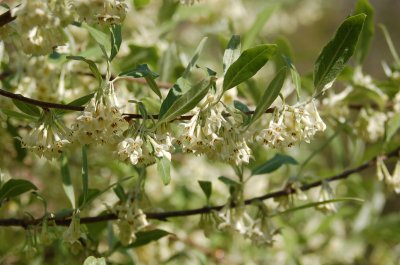
Then, just as the lilac scent began to fade, the pesky, invasive autumn olives began to bloom, and everything smelled sweet again. I just can't exterminate anything that smells this good, and gives the indigo buntings a place near the house where I can admire their color and song.
I don't seem to be able to read one book and then put it down and move on. For some time, I've been trying to interpret James Dickey's vitriolic descriptions of rural Southerners in Deliverance. Do we take at face value our more-or-less reliable narrator's description of the places he went and the people he encountered? Watching the movie (screenplay by Dickey himself, and he appears as the local sheriff toward the end), we see the events with our own eyes, so they are unambiguous. Are we meant to take the novel as a similarly straightforward account? Dickey was a poet and a professor, highly regarded by his students and by literary critics. I would expect that he paid careful attention to his word choice, and that passages such as this are meant to evoke skepticism.
"What's life like up there now?" I asked. "I mean, before you take to the mountains and set up the Kingdom of Sensibility?"
"Probably not too much different from what it's liable to be then," he said. "Some hunting and a lot of screwing and a little farming. Some whiskey-making. There's lots of music, it's practically coming out of the trees. Everybody plays something: the guitar, the banjo, the autoharp, the spoons, the dulcimer--or the dulcimore, as they call it. I'll be disappointed if Drew doesn't get to hear some of that stuff while we're up here. These are good people, Ed. But they're awfully clannish, they're set in their ways. They'll do what they want to do, no matter what. Every family I've ever met up here has at least one relative in the penitentiary. Some of them are in for murder. They don't think a lot about killing people up here. They really don't. But they'll generally leave you alone if you do the same thing, and if one of them likes you he'll do anything in the world for you. So will his family...."
Half hippie fantasy, half horror flick, Lewis's description is proven true by the book's events. I don't know what to think, so I keep reading. I've found several high-quality Internet resources about James Dickey the last couple of months, including some of Dickey's own prose and poetry. Here are my recommendations.
I mentioned Deliverance recently, in the context of entertainment suitable for discouraging unwanted tourism. I saw the movie when it first came out, but I'd not read James Dickey's novel until I found it at the local library book sale this past winter. I had started a blog entry about it, but soon realized it was too complex an issue for a short essay. I've been reading Dickey's poems, and some critical and biographical essays, and I'm quite intrigued.
Here's the passage that first caught my attention. Our narrator, Ed, is musing in the car as his buddy Lewis works out canoe trip logistics with the locals in Oree, their put-in point for canoeing the Cahulawassee river. Ed has already told us he is about 150 miles north of Atlanta, which puts him in the southernmost mountains of the Appalachians. (All the place names mentioned, except Atlanta, appear to be fictional.) Nothing bad has happened to Ed yet, but he has been ragging on rural Georgia for the previous twenty pages.

There is always something wrong with people in the country, I thought. In the comparatively few times I had ever been in the rural South I had been struck by the number of missing fingers. Offhand, I had counted around twenty, at least. There had also been several people with some form of crippling or twisting illness, and some blind or one-eyed. No adequate medical treatment, maybe. But there was something else. You'd think that farming was a healthy life, with fresh air and fresh food and plenty of exercise, but I never saw a farmer who didn't have something wrong with him, and most of the time obviously wrong; I never saw one who was physically powerful, either. Certainly there were none like Lewis. The work with the hands must be fantastically dangerous, in all that fresh air and sunshine, I thought: the catching of an arm in a tractor part somewhere off in the middle of a field where nothing happened but that the sun blazed back more fiercely down the open mouth of one's screams. And so many snakebites deep in the woods as one stepped over a rotten log, so many domestic animals suddenly turning and crushing one against the splintering side of a barn stall. I wanted none of it, and I didn't want to be around where it happened either. But I was there, and there was no way for me to escape, except by water, from the country of the nine-fingered people.
"Offhand," indeed. And, "no way to escape, except by water"--when he says this, he is sitting in a car in the county seat. It's not too late to find a pay phone and call his wife to come get him. This "country of the nine-fingered people" is not part of my space-time continuum.
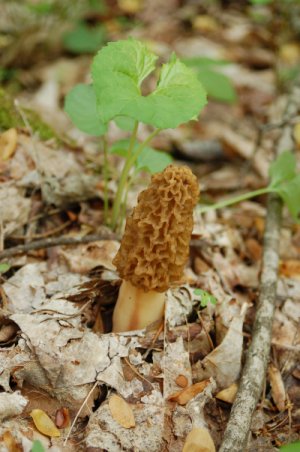
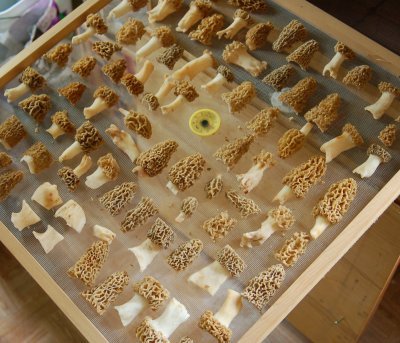
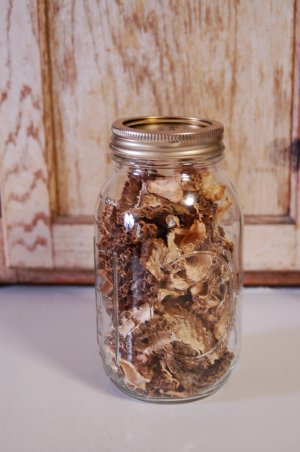
We've been making a few late passes through the woods, looking for the yellow morels. They've been scattered, but we've found enough to keep us looking. As we find them, we are drying them and storing them for later in the year. It's better than waiting for enough to make a skillet-full when hunting is this sparse, and we think that drying somehow intensifies the flavor. A sauce made from dried morels seems more flavorful than fresh, sauted morels. A morel in the dehydrator is worth two in the pan, perhaps.

Another mystery novel I read this week, under the guise of spring cleaning, was Anne Perry's A Sudden, Fearful Death. Like Ruth Rendell, Ms. Perry is much admired and much purchased, and I am happy to report that she is also a skillful writer. This novel is part of a Victorian London series centering around a retired policeman and a Crimean War veteran nurse. It is scrupulously free of anachronism, except, perhaps, for a sneaking disapproval of unjust policies and attitudes of the past. There may be no getting around that in a contemporary story. I'm not the fiction reader that I once was, or I would now be scouring bookstores and libraries for the rest of Perry's William Monk mysteries. (In any case, I would search in vain, for my local library now is the owner of one, count it, one, book in this series, the one I just finished.)
My Internet searches showed me that Anne Perry is interesting not only as an author, but also for her life story. Here are a few informative Web resources.


