Wednesday, August 23, 2006

Spinning My Tiny Dye Lots

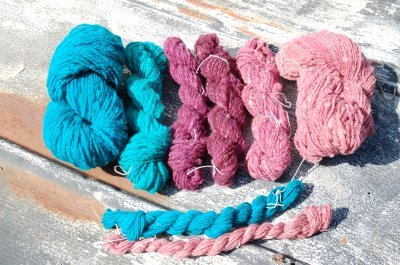
teal and pink yarns

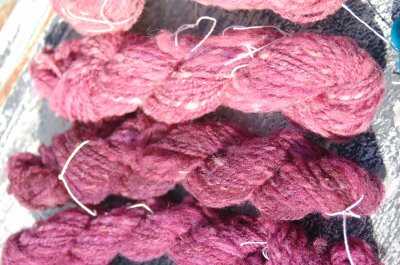
Here's what I've been up to the last few days--dying some local (burdock-laden) fleece in the crockpot, carding, spinning and plying it. I've been experimenting with series of color intensity, trying to get pretty pastels. The more intense colors continue to work better for me. It is encouraging, however, that the colors consistently look better in the spun yarn than in the fleece after carding.

assortment of pink yarns

Tuesday, August 22, 2006

Shitake Mushroom Harvest

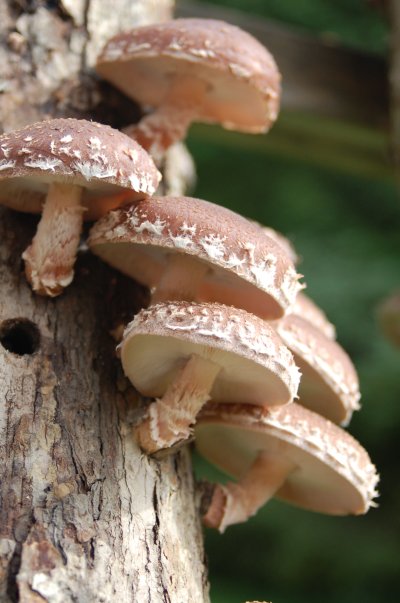
shitake mushrooms

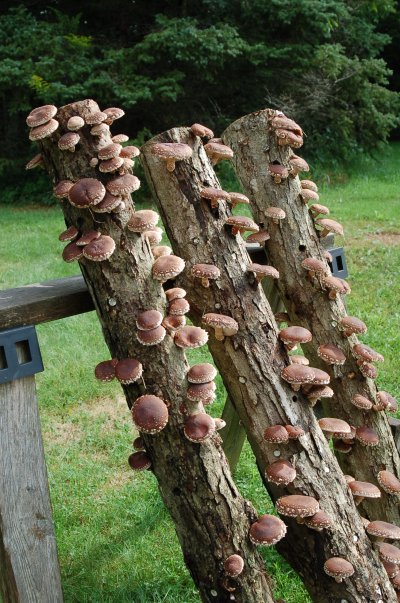
We've been growing shitake mushrooms for several years now. Some of the innoculated logs seemed to be on their last legs, and we were expecting to cull a number of them this fall. We have been pleasantly surprised--all 56 logs have produced like the ones below. We're currently drying them as fast as we can. This is in contrast to the garden--the vegetable garden, where all sorts of insects have been more fecund than most of my seeds and plants. Looks like we'll have something homegrown to eat this winter.

three shitake logs

Sunday, August 20, 2006

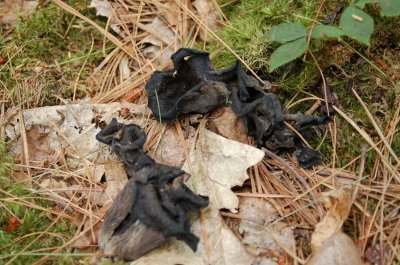
Death Trumpets

Earlier this month, we found these chanterelle mushrooms, which W.C. Roody's Mushrooms of West Virginia and the Central Appalachians calls Black Trumpets or Death Trumpets. Once I'd convinced myself that "Death Trumpets" referred to their funeral aspect and not to the results of ingestion, we tried cooking them. Although we had just a small handful, these chanterelles didn't reduce in volume when cooked. Their taste was very strong--much too strong to eat as a dish on their own. Our tiny handful should probably have been dried and used a teaspoon full at a time to flavor soups and egg dishes. Live and learn. I wonder if we'll ever find these again.

Tuesday, August 15, 2006

The Riddle of the Sphinx Moth

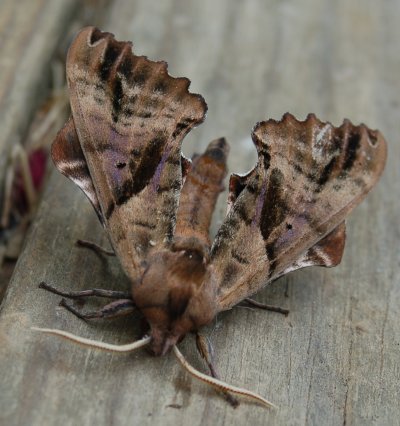
Droop Mountain sphinx moth, front view

I see this sphinx moth species often this time of year. I don't have much lepidopteran expertise, and without the specimen in hand I'm not going to attempt an identification, but isn't it handsome? In the hope of a dumb-luck species identification, I googled around a bit, and stumbled on Pocahontas County, West Virginia Sphingidae. I don't see my front porch pet on that sight, but what are the odds of my finding a collection of Pocahontas County sphinx moth photos on a Prince Edward Island lep farmer's Web site?

Droop Mountain Sphinx, top view

Monday, August 14, 2006

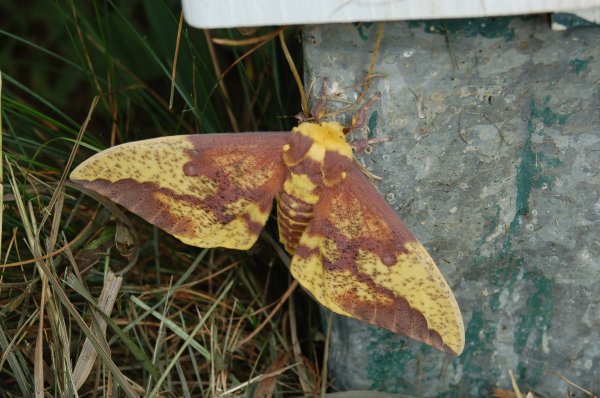
Imperial Moth, early August, 2006

Imperial Moth, Top view

This beauty was sitting on the corner of the house last week. I've always been a big fan of the giant silk moths. I don't see them every year, but besides this lovely Imperial, there have been a few Lunas fluttering around the windows at night.

Imperial Moth--side view Imperial Moth Eacles imperialis (Drury) (Saturniidae)

Sunday, August 13, 2006

Our Wicked Frontier Ways

A few weeks ago I finished Daniel Boone: The Life and Legend of an American Pioneer by John Mack Farahger. It attempts to separate fact from fiction and speculation, while treating the Daniel Boone folklore as an interesting phenomenon in itself. I learned that Boone had at least two West Virginia connections. His first "long hunt" was on Shenandoah Mountain, in West Virginia's Ridge and Valley region. Later, he and his family lived at Point Pleasant, home of The Mothman.

Boone seems to have been tarred with the same brush James Dickey used on later day natives of the back country. Here's a fascinating, wry quote from page 60 of my edition. (Note well the dig at William Byrd.)

Boone was...condemned by a number of his contemporaries as a man who "didn't live happily with his family, [and] didn't like to work." Such sentiments were akin to the criticism leveled by cultural outsiders at long hunters for the neglect of their families. In North Carolina backwoodsmen "live with less labor" than anywhere else he knew, said the Virginia aristocrat William Byrd, a man who knew whereof he spoke. They made "their Wives rise out of the Beds early in the morning, at the same time that they Lye and Snoer, till the Sun has run one third of his course, and disperst all the unwholesome Damps." Frontier men did "little of the work" around their farms, complained one missionary in the Yadkin settlements, leaving it all for their wives and children to perform, while they enjoyed themselves hunting. Consequently, the work around the home place was "poorly done," animals had to fend for themselves, even in winter, and Indian corn grew where there should have been good European wheat. It all added up to a pattern of "irregular living." "There are many hunters here who work little," wrote another preacher, but "live like Indians."

As this last remark suggests, the complaints amounted to the rejection of a way of life and had much in common with the European criticism of American Indians. The French emigrant Michel-Guillaume Jean de Crevocoeur described backwoodsmen as "new made Indians," "half cultivators and half hunters" who lived a "licentious, idle life." In the rush to commercial farming in the nineteenth century these criticisms were transformed into a cant, in which frontier ways were made to seem the very essence of barbarism and backwardness. In this climate of opinion, Boone supporters both inside and outside the family attempted to salvage the reputation of the Boone household by claiming that it had been run on solid Victorian principles....The most unfortunate thing about such special pleading was its anachronism, its irrelevance to the real conditions and dilemmas of frontier life.

Wednesday, August 09, 2006

An Adventure in Knitwear Design

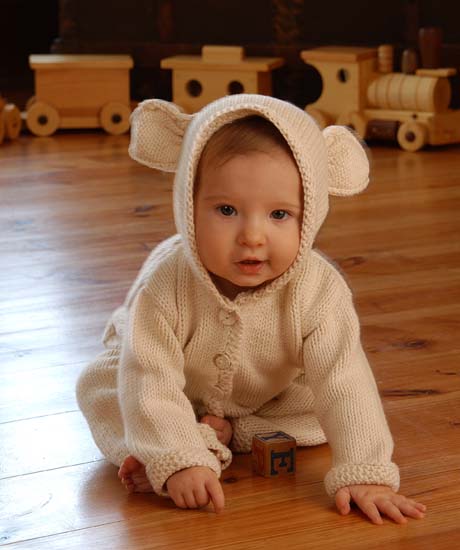
lamb's ear baby jacket

Last week, I got paid for writing a knitting pattern for this cute little sweater. Appalachian Baby Design sells this organic cotton Lamb's Ear Jacket as a ready-made item, and they wanted to add kits for knitters to their line of products. Ironically, the designer they paid in the first place provided a hand-knit sample; their production expert redesigned it for machine knitting; and last month I redesigned the machine knit sample and wrote hand knitting directions.

I'm not entirely sure what's going on with the company these days, but their Web site still describes them thus:

Appalachian By Design, the non-profit development and marketing company that markets Appalachian Baby Design, has devoted itself to making machine knitting a sustainable, home-based industry for women in rural Appalachia.

I've done work for them in the past, and found them a little "lethargic" in the check-cutting department. This time, I offered to take payment in product, and I was delighted to get over 10 pounds of white sport weight New Zealand wool yarn. I plan to dye this myself, and expect it could make about 40 pairs of Fair Isle socks, or heaven knows what else. It promises to keep me busy for years.

I was so excited about this wool that I found myself agreeing to other projects. That is why I am currently knitting garter stitch baby blanket in the same organic cotton. I'm ashamed to be "designing" something so boring, but it seems there are many happy knitters who make garter stitch scarf after garter stitch scarf. This kit is intended for people too timid to try a simple baby sweater. I was never a timid knitter, but by the time I started knitting, I had years of sewing experience under my belt, and, swaggering teenager that I was, I thought I could make anything out of fiber. At any rate, it is quite soft and pretty, and perhaps people will like it.

Thursday, July 27, 2006

Fairies' Purses Revisited

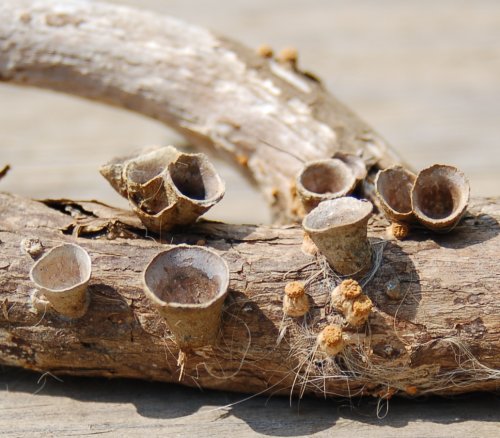
New Birds' Nest Fungus More Birds' Nest Fungi

After an interlude of handbag stitching, there is a certain logic to revisiting my Fairies' Purse fungi. Several rains have splashed all the little funiculi "coins" out of the purses, but the rough orange blobs are fresh purses sprouting all over the stick. There's even a new purse growing inside an old one. You know from the previous birds' nest fungi post where the yellow fur came from.

Monday, July 24, 2006

Bib Overalls Pocket On a Patchwork Totebag

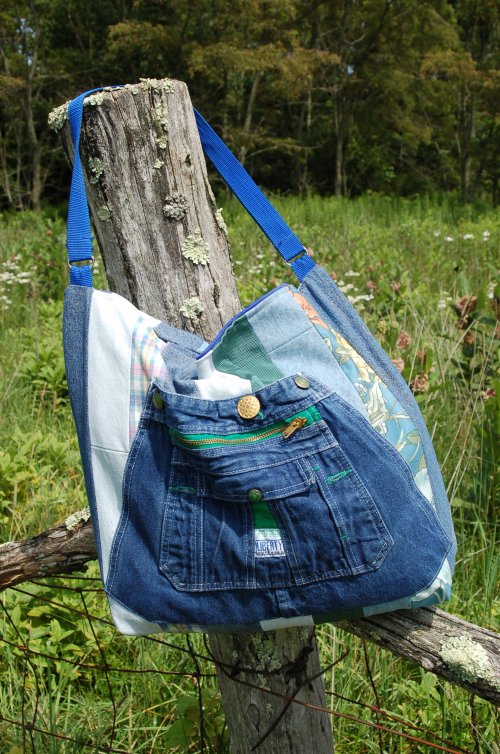
Bib Overall Pocket on patchwork tote bag

I sewed up this tote bag yesterday, after thinking about it for a couple of weeks. I had the bib from an old pair of overalls, and thought it would make a cute and useful exterior pocket. All the materials are reused. I haven't put in the lining yet, because I'm still trying to decide whether the flip side is too plain or not. I have plenty of work shirt buttons that would make an attractive decoration on the dark denim rectangles, but it might be too texture-y to be practical.

In the process of thinking about the design, I spent a little time looking at handmade handbag Web sites. This is an example of an activity greatly enhanced by my DSL connection. With dial-up, it would have taken me days to winnow through the search results and find this many nifty sites with inspiring photos and patterns. This took about an hour. In the end, I sewed the bag I originally envisioned, but I got some really interesting ideas for more projects.

Free Resources

Commercial Resources--Patterns, Hardware, and Handmade Bags

tote bag side tote bag back

Saturday, July 22, 2006

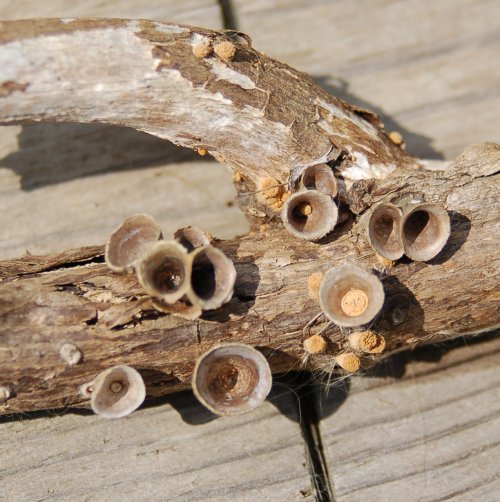
Bird's Nest Fungus (Nidulariaceae)

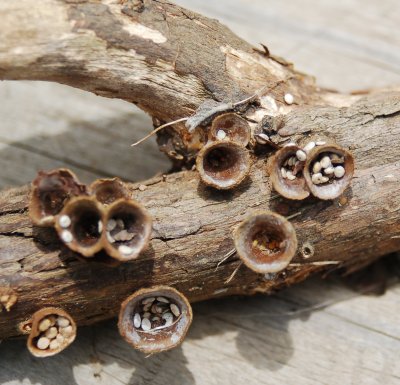
Bird's Nest Fungus

According to W.C. Roody's Mushrooms of West Virginia and the Central Appalachians, These are Crucibulum laeve, the Common Bird's Nest. Princess and the birds' nests I agree with him that "this little fungus is always a pleasure to find." These are growing on a butterfly bush stem, but I find them on rotting stuff pretty often here on Droop Mountain. One summer I uncovered a large scrap of plywood crowded with the little nests full of tiny "eggs." It looked like some miniature sea bird rookery. When it rains on these birds' nests, the peridioles (eggs) fly out, trailing their little spring-like "stems" or funiculi. The funiculi have sticky ends which adhere to larger objects, anchoring the spore-filled "eggs" to their new homes.

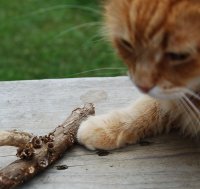
I've also heard these strange little basidiomycetes called "fairies' purses," with the "eggs" interpreted as tiny silver coins. You can see in the photo at left why subsequent pictures of these charming fungi will feature whisps of yellow fur.

Wednesday, July 19, 2006

Blogger's Block

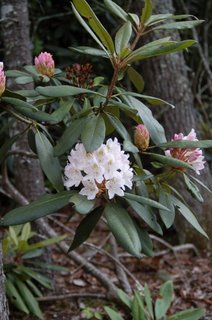
Rhododendron at Allegheny Lodge

This weblog has been more miss than hit lately, due to upheavals in my technological life. After years of wishing, I finally bought a digital SLR camera, and it is complex enough to require much experimentation. It's also made necessary changes in the way I manage my hard drive "space," view my images, and edit them.

Just when I thought I was getting a handle on these changes, the phone company called to let me know DSL is available in my area. This was astonishing, and I expect it will enhance my computer experience eventually, but for now, it's made me reorganize my LAN, learn a lot about hardware and software firewalls (for both Linux and Macintosh), and spend hours reinstalling my Debian OS on two Pentium boxes. Soon, I'll have to change my web hosting arrangements.

These two technological upgrades ought to improve my Web presence and enhance my blogging experience eventually, but right now I feel a little overwhelmed and intimidated by the possibilities. Before, on a dial-up connection, it took about twenty minutes to upload an edited jpg file and an accompanying html file, so I had to prepare my material in advance. I wrote my html in Emacs (my text editor of choice, and the One True Religion). If I wanted to post a photo, I had to finish a roll of film, take it to the drugstore, get it back, scan the negative, and edit the image down to a quick-loading jpg file. This long process gave me several opportunities to review and edit the text, catch my habitual errors, and decide if the picture was worthwhile. Now I can upload any sort of crap as fast as I can type, and slap up any snapshot within minutes of clicking the shutter. I can review Web resources in minutes rather than hours, download podcasts and videos without planning my week around the process.

I don't usually have writer's block (or photographer's block), but this sudden wealth of possibilities has me frozen in place. I could really change the focus of my Web work, alter my pace, branch out into new content areas.... And while I've been dazed by all this, two of the bloggers I most enjoy have been musing on what blogs are, and what their blogs should be. Dave of Via Negativa recently observed:

The blogosphere has been billed as an alternative to the mainstream media, but in many ways, it's just as superficial. The emphasis remains on speed rather than accuracy, sensationalism rather than nuance, and two-sided conflicts rather than the full complexity of life as most of us experience it in our daily lives. Even for us non-political bloggers, there's a great temptation to simply post our latest snapshots, with a few accompanying sentences of breathless prose, and move on to something else. To try to see anything more fully, to observe it attentively and then take the time to describe or depict it with as much care and effort as we can muster seems almost counter-cultural. But if the bloggers I tend to read have anything in common, it might be precisely this, that they are dedicated to documenting what Barbara Brown Taylor refers to as "alternate reality."

Meanwhile, Lorianne of Hoarded Ordinaries has been examining the way her weblog has shifted its focus over the last three years.

...It's quick & easy to slap up a snapshot and say "I'm done blogging for the day"; it takes a bit more time, care, and attention to detail to craft a meaningful post that actually says something.

In my early days of photo-blogging, I justified my "quickie" photo posts by telling myself they were like postcards: although we all love to receive long, carefully-crafted letters, it's also great to get short postcards that assure us "The weather is great; wish you were here." In my mind, a frequently updated blog is more valuable than one that only occasionally posts new (albeit carefully crafted) material: in the blogosphere, frequent snacking seems to be "healthier" (and more popular with readers) than the bloggish equivalent of occasional elaborate feasts....

At a certain point, every writer asks herself, "What do I have to say that's unique to my background and expertise; what do I have to say that needs to be said?" ....these days I'm trying to watch which way the wind is blowing, trying to admit that everything, blogs included, change over time, with there inevitably being a time to be silent as well as a time to speak.

I promise that I will keep posting whether or not I figure out what my blog mission is or not. Perhaps the process will sort it out for me.
Thursday, July 13, 2006

Doily Fraud--The Seamy Underbelly of Pioneer Days

Last week I was asked to judge the knitting category in Marlinton's Pioneer Days Craft Show. When I arrived in town with my evaluation forms in hand, I discovered that there were no entries. The competition is generally referred to as the "Quilt Show," so I wasn't too surprised at this turn of events. Instead, I assisted the crochet category judge, a last-minute stand-in. There were about ten crochet entries, and I think we evaluated them fairly, with one possible exception.

It seems a cotton doily we ranked in the top four was suspect. According to the quilter who organized the show, the woman who brought in the doily entered it on behalf of her neighbor, along with another doily with a "Made in China" sticker still attached. The rules state that the entry must be your own work, an explicit addition after last year's scandal, in which it was revealed that the award-winning quilt was a purchased article.

Now, it costs $2 to enter an item in the show, and the winner's financial stakes are very low--less than the cost of a doily at Wal-Mart. What would motivate doily fraud? Bragging rights are limited, because one runs the risk of coming in third in a field of two. Myself, I've never entered an item in the show because once the competition is over, the display is not watched carefully, and much that is not nailed down in Marlinton disappears during Pioneer Days. (This is not typical--the rest of the year I leave my car unlocked without qualm. I blame the huge crowds from out of town.)

What kind of person commits doily fraud? My faith in needle artists is shaken. I have also been disturbed to learn of dissent and ill-feeling among the quilters in Pocahontas County. There are, it seems, quilters who would not interact with "that quilt show" for anything on earth. It's all rather disillusioning.

Monday, July 10, 2006

Same Old Stuff

We continue with the cherry pitting obsession, but clearly, we are not alone in this.

Tuesday, July 04, 2006

Assassin Bugs and Bowls of Cherries

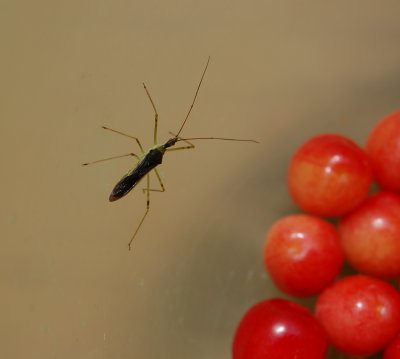
Zelus exsanguinus in a bowl of cherries

We're deep in the process of picking and pitting cherries, but this assassin bug (Zelus exsanguinus) distracted me for a few minutes. I don't see too many assassin bugs here on Droop Mountain, and they are my favorites. This subfamily (Harpactorinae) spends its time up on flowering plants and trees waiting for prey.

Thursday, June 29, 2006

He's Here For the Cherries

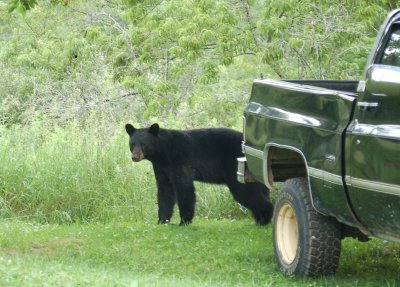
Black bear next to my truck

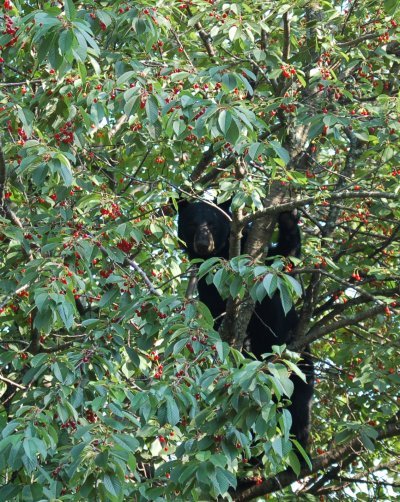
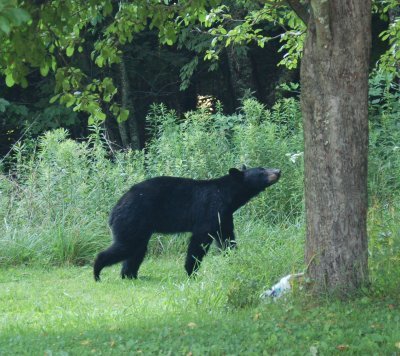
The bear was back again yesterday, and this time we saw him eating fallen cherries under our fruit trees. We like these cherries, too. They're flavorful, sour, and too small to pit with a cherry pitter, but they make the best pie I've ever tasted.

Sour pie cherries in our yard

Wednesday, June 28, 2006

Bear In the Tater Patch

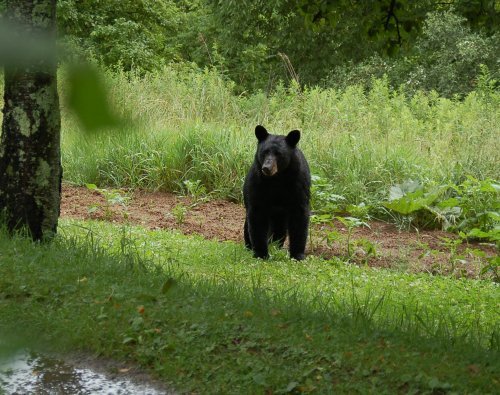
American black bear, in my potato patch

It stopped raining yesterday afternoon, and this fellow came up out of the brush to see what he could see. This always gets me pretty excited, and for the next week or so, every dark shadow and tree trunk is going to look like a bear to me. He left a few tracks in the potato patch, but nothing photograph-worthy.

Saturday, June 24, 2006

Black Walnut

Black walnut inflorescences from my yard, earlier this spring.

Thursday, June 22, 2006

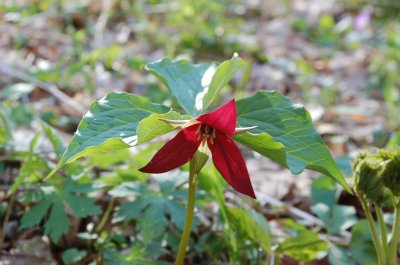
Two Trilliums (Trillia?)

The top photograph is Painted Trillium, photographed in mid-May on Droop Mountain. This is the first time I've found it in bloom. For comparison, I give you Red Trillium from the headwaters of Williams River at the end of April.

Painted Trillium Red Trillium, or Wakerobin

Wednesday, June 21, 2006

In the Money, and Out Again

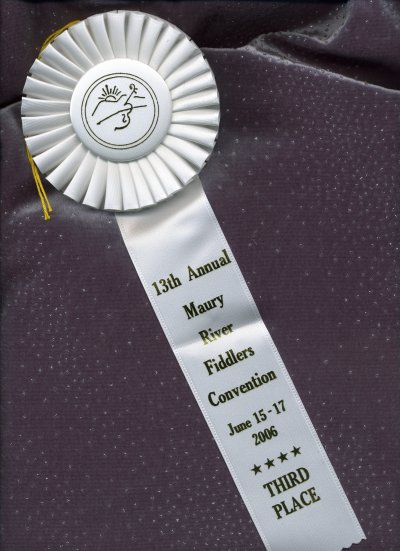
Maury River Fiddler's Convention prize ribbon

I entered the autoharp contest at the Maury River Fiddler's Convention last Thursday, as planned. I played "Chinkypin," it went pretty well, and I was tickled to get my camping fee refunded, in cash, immediately after I played. There were quite a few autoharp contestants, so I didn't harbor any illusions about winning. Imagine my surprise to find I'd finished in the money--third, to be precise. This was my first contest, and I have the feeling that it will be like that first free taste of an addictive drug.


On another exciting note, the phone company called me last week to let me know DSL is available in our area. They installed it Monday, and within an hour, the power went out and stayed out for eight hours. I couldn't help thinking this was the Universe reminding me that I still live in a remote, rural area, DSL notwithstanding. Since then, I've been busy working on my home network. I've been backing up data, updating my Debian installations, and tightening up security on the Mac. I'm just beginning to appreciate the many things I never investigated before due to lack of bandwidth. Yesterday, I downloaded Flashplayer, and was able to watch someone else's kitty take a drink of water from the tap on YouTube. The Internet is truly a miraculous tool!

Wednesday, June 14, 2006

The Dryad's Saddle

Bookcover: Roody's Mushrooms of West Virginia

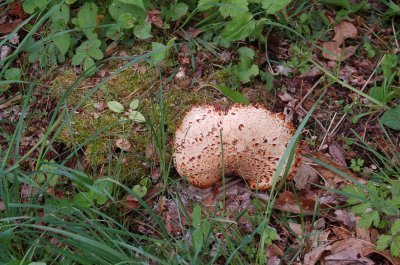
We collected these "specimens" (also known as "dinner")of pheasant's backs just before Memorial Day. According to W.C. Roody's excellent field guide, Mushrooms of West Virginia and the Central Appalachians, they are also known as "Dryad's Saddle" or Polyporus squamosus. It "appears fairly early in the spring and can be a consolation prize for the hapless morel hunter." Unfortunately, these were a little too old to be tasty, although they were still quite pretty. Pocahontas County mushroom hunters call them pheasant's backs because the scale pattern resembles the markings of a grouse. (To me, and to most Iowans my age, "pheasant" will always mean "ring-necked pheasant.")

Pheasant's back mushroom Pheasant's back mushroom, habitat shot