Showing posts sorted by relevance for query faulkner. Sort by date Show all posts

Thursday, July 24, 2008

Go Down Moses

I've built up a considerable collection of Faulkner posts, but here is another. I really enjoyed Go Down, Moses, and have finished it since my own personal bear adventure. I have to agree with Sherry Chandler's comment on that post: Go Down Moses is my favorite Faulkner. From the hunter mysticism of "The Bear" through all of the awful history of the Beauchamp family, this is Faulkner ringing his very best changes and using his full range of literary skill. Contrary to what most people think, Faulkner could write effectively in many different styles.

I've found a few more interesting Faulkner discussions since I last posted a list.

Thursday, June 19, 2008

Heavy In June, Light In August

Last week I read Faulkner's Light in August for the first time. Although I was an English major in college, I missed all the American authors. My faculty advisor was quite willing to let me sign up for all the century-by-century review classes on British lit, along with Chaucer, Milton, Donne, and Spenser, perhaps because he was a medievalist. I skipped modern writers, including the Americans, reasoning that I could read those by myself, any time, but where else would I get a chance to have someone lead me by the hand through all of Milton's English poems? How else was I going to get through "Paradise Regained?"

It wasn't a bad plan, and I have been enjoying Faulkner's novels as I am able to track down library books. However, I've been wondering what other people thought about Light in August. Once accustomed to literary criticism, I seem to be reluctant to give it up. That's why I've been poking around the Web looking for commentary on Faulkner in general, and this book in particular.

I've been surprised at how little "good stuff" is available. Last summer I gathered a collection of Faulkner links with helpful and interesting biographical information, bibliographies, and other assemblages of information. Beyond these, and the home pages of University of Michigan's Faulkner collection, all I find with straightforward search engines are plot summaries and simple-minded analyses of the most obvious literary devices: everything you need to cheat on your homework. I turned up a few links to scholarly articles, but these are all on for-pay academic journal Web pages, well beyond my budget.

What I was hoping for was some sort of feminist critique, because the women in Light in August are so varied and interesting, and Faulkner's attitude toward them seems so ambiguous to me. I reckon I'll just have to work it out for myself.

I did find this interesting experiment in exploiting the possibilities of presenting Faulkner's literature on the Web:The Sound and the Fury: a Hypertext Edition. Ed. Stoicheff, Muri, Deshaye, et al. Updated Mar. 2003. U of Saskatchewan. Here's how the editors describe their project:

William Faulkner's 1929 novel The Sound and the Fury is a complex text....[I]ts frequent use of stream of consciousness creates great narrative density; it is highly allusive and intertextual throughout...

It was this complexity that initially attracted the editors of this edition to the idea of placing The Sound and the Fury within a digital environment. The possibilities for visually displaying a text's information and structures in a hypertext format are rich and productive, and the first goal of this edition was to exploit those possibilities to display the novel's first, chronologically most difficult, section.

The presentation is quite fascinating--there are marginal links to literary references, critical essays, explanatory charts and graphs, as well as usual the collection of links.

Saturday, September 01, 2007

Revisiting William Faulkner

Book Cover: Absalom, Absalom!

Continuing my Gothic adventures, I've enjoyed reading William Faulkner's Absalom, Absalom! and The Sound and the Fury. My introduction to Faulkner was "A Rose For Emily" in a literature anthology which my mom, a high school teacher, brought home from school. Ten or eleven years old, I read it through as fast as I could, eager to find out what happened. I was horrified, nauseated, aghast as the townspeople forced open that upstairs bridal suite. That "long strand of iron grey hair" gave me nightmares for months. It was one of the finest literary experiences of my life.

Apprehension marked my subsequent reading of Faulkner, as if, on any random page, a decomposing Yankee might grin vacantly in wait. I read some more short stories, and, about 12 years ago, As I Lay Dying, but I always braced myself for a nasty shock.

Somewhere along the line, I lost that apprehension. Miss Rosa, of Absalom, Absalom! suffers more than Miss Emily, and her family's dreadful end is more horrifying than a poisoned triflin' Yankee. (And after all, didn't he ask for it?) The stories move me, but they don't freeze me in my tracks. Now, I focus on the characters who shake their heads, draw their conclusions, and clean up tragedy's aftermath. Patient, forbearing Dilsey of The Sound and the Fury seems the most interesting character, and I wonder where Miss Emily's elderly servant went, and what he thought all those years.

Monday, July 30, 2007

Curing My Fear of Fiction

All the talk about J. K. Rowling's enormously popular kids' books got me thinking that I hadn't read a book for fun in a very long time. I've been reading some of the books that "defined" the "Appalachian people," like John Fox Jr.'s The Little Shepherd of Kingdom Come and Emma Bell Miles' stories and fictionalized essays, and James Dickey's Deliverance, and I've been dutifully reading fictionalized accounts of local history by Pocahontas County natives G.D. McNeill (father of nationally recognized poet Louise McNeill) and W. E. Blackhurst. Our Pocahontas County authors seem to have admired Fox's prose, and emulated him by writing some of the most wretched dialogue ever to come off a vanity press. Add to that my distance-education research reading (much use of buzzwords like "user-defined," "multiple perspectives," "blended learning") and you have the roots of my reading disphoria.
Book Cover: Bellefleur

I already know Harry Potter's not the answer for me. Last fall, I sat in a middle-school library waiting for my students, picked up the first Rowling book, and put it down again after 30 pages. Unlike Harold (Harry?) Bloom, I don't think Harry Potter prefigures the end of Western Civilization, but it wasn't fun for me. I'll wait for the Cliff Notes. My local library has plenty of reading about Appalachia and Pocahontas County, and I am grateful, but those books are how I came to this dreary state of mind in the first place. The library's fiction collection is skewed toward recent best-sellers in genres I don't care for, so my next move was to search my shelves for novels I hadn't already read that might be, somehow, "fun."

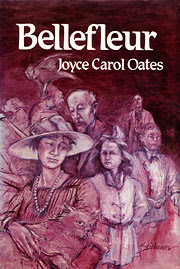
Usually, when I'm feeling grumpy, I reread old favorites (Austen, Dickens and Conrad, or perhaps John D. MacDonald or Tony Hillerman), but part of what I've been missing is that "What happens next?" feeling J. K. Rowling has been so concerned to preserve from "spoilers." I pulled out three books I thought might do the trick: E. R. Eddison's The Mezentian Gate, Faulkner's Absalom, Absalom! and Joyce Carol Oates' Bellefleur. I was surprised to find my unread novel collection so heavily skewed toward the Gothic.

First I opened E. R. Eddison's The Mezentian Gate. I found I had started it before and didn't finish it. The bookmark was a "STOP JOB" card, and the book was a Ballantine paperback with cover art by the same artist used for their Lord of the Rings edition. After I got over this seventies flashback, I discovered why I'd left off at page 73. Eddison's stylistic inspiration seems to be Gothic classics like The Castle of Otranto and The Duchess of Malfi, but he doesn't match their action-packed pace. Also, the made-up names make me giggle every time he introduces a new character. Rhodanthe of Upmire, daughter of Sidonius Parry.

I turned to Bellefleur next. I admire Joyce Carol Oates, but I tend to approach her novels the way I approach having blood drawn. It's a worthwhile endevour, but not usually fun. I was surprised to find that, although Bellefleur has its share of murders, rapes, agonies, and tortures, there is also mystery, magic, and mythology, adding a playful element where Oates winks at us. It's fiction, not a documentary.

On Celestial Timepiece, a Joyce Carol Oates page named after a quilt design in Bellefleur, I found an interesting essay by Oates from her "Preface to The [Franklin Library] First Edition" of Bellefleur:

The imaginative construction of a 'Gothic' novel involves the systematic transposition of realistic psychological and emotional experiences into 'Gothic' elements. We all experience mirrors that distort, we all age at different speeds, we have known people who want to suck our life's blood from us, like vampires; we feel haunted by the dead--if not precisely by the dead then by thoughts of them. We are forced at certain alarming periods in our lives not only to discover that other people are mysterious--and will remain mysterious--but that we ourselves, our motives, our passions, even our logic, are profoundly mysterious....If Gothicism has the power to move us (and it certainly has the power to fascinate the novelist) it is only because its roots are in psychological realism. Much of Bellefleur is a diary of my own life, and the lives of people I have known....

Bellefleur is more than a Gothic, of course, and it would be disingenuous of me to suggest otherwise. It is also a critique of America; but it is in the service of a vision of America that stresses, for all its pessimism, the ultimate freedom of the individual. One by one the Bellefleur children free themselves of their family's curse (or blessing); one by one they disappear into America, to define themselves for themselves. The castle is destroyed, the Bellefleur children live. Theirs is the privilege of youth; and the 'America' of my imagination, despite the incursions of recent decades, is a nation still characterized by youth. Our past may weigh heavily upon us but it cannot contain us, let alone shape our future. America is a tale still being told--in many voices--and nowhere near its conclusion.

So I can still enjoy fiction. On to Faulkner!

Tuesday, July 08, 2008

Phantom Bears In Our Dreams

I believe we have scared our bear away for the time-being. The bigger fellow in this picture visited us in 2006, the last time we had a big cherry crop. Whenever I see a real bear, for several days thereafter, I see phantom bears--every black shadow in the woods looks like a bear until I settle down again.

This time, I was pursued by phantom bears even in the book I'm reading: Faulkner's Go Down, Moses. I know I read "The Bear" in an anthology many years ago, but I didn't remember much about it. Obviously, that was before I lived in woods where phantoms come real.

....Then, standing beside Sam in the thick great gloom of ancient woods and the winter's dying afternoon, he looked quietly down at the rotted log scored and gutted with claw-marks and, in the wet earth beside it, the print of the enormous warped two-toed foot. Now he knew what he had heard in the hounds' voices in the woods that morning and what he had smelled when he peered under the kitchen where they huddled. It was in him too, a little different because they were brute beasts and he was not, but only a little different--an eagerness, passive; an abjectness, a sense of his own fragility and impotence against the timeless woods, yet without doubt or dread; a flavor like brass in the sudden run of saliva in his mouth, a hard sharp constriction either in his brain or his stomach, he could not tell which and it did not matter; he knew only that for the first time he realized that the bear which had run in his listening and loomed in his dreams since before he could remember and which therefore must have existed in the listening and the dreams of his cousin and Major de Spain and even old General Compson before they began to remember in their turn, was a mortal animal and that they had departed for the camp each November with no actual intention of slaying it, not because it could not be slain but because so far they had no actual hope of being able to.

Friday, August 08, 2008

Galluses and Coincidences

I learned a new word the other day in conversation: "galluses." A couple of questions later, I knew we were talking about suspenders for holding up one's britches, particularly when wearing a tool belt.

Here's the Wikipedia entry for Suspenders:

Suspenders or Galluses, known as Braces in British English, are elastic fabric straps worn over the shoulders to hold up trousers. The entire strap of braces may be elasticated, or only at attachment ends, with the most of the straps being of woven cloth with either a X-Back or Y-back crosspatch and leather end tabs. Braces typically attach to trousers with clips or, less commonly nowadays, with buttons. In British English the term suspenders or suspender belt refers to a garter belt, used to hold up stockings.

So here's another potentially embarrassing American English/British English confusion to add to "vests" and "knickers." An American gentleman, such as Larry King, looks dignified when he wears suspenders on his television show, while in Britian, a gentleman in suspenders is more likely to occur in a Benny Hill skit. But I digress.

Not three days after I learned the meaning of "galluses," I came across this passage in Collected Stories of William Faulkner:

There are other men among us now whose families are in want; men who, perhaps, would not work anyway, but who now, since the last few years, cannot find work. These all attain and hold to a certain respectability by acting as agents for the manufacturers of minor articles like soap and men's toilet accessories and kitchen objects, being seen constantly about the square and the streets carrying small black sample cases....

...."He's a man yet. Don't let hit fool you none because he claims he ain't strong enough to work. Maybe hit's because he ain't never wore his strength down toting around one of them little black satchels full of pink galluses and shaving soap...."

Friday, September 07, 2007

Tales of the Appalachian Grotesque

My Southern and Appalachian reading regime of the last few years has been heavy on the Gothic--grotesque themes. James Dickey, Edgar Allen Poe, Emma Bell Miles, William Faulkner, John Fox Jr.--all these writers paint the South and the Southern mountains as "a strange place and a peculiar people." Writers who hail from rural or small-town America often write stories with an element of horror. Joyce Carol Oates comes from upstate New York and Stephen King from small-town Maine. They also write Gothic tales, in very different styles.

I feel sure there's something to this, but I don't know what it is. That's why I've been reading about the topic. I found this interesting article: Reflections on the Grotesque by Joyce Carol Oates (April 1993). Originally published in Haunted: Tales of the Grotesque

What is the "grotesque"--and what is "horror"--in art? And why do these seemingly repellent states of mind possess, for some, an abiding attraction?

I take as the most profound mystery of our human experience the fact that, though we each exist subjectively, and know the world only through the prism of self, this "subjectivity" is inaccessible, thus unreal, and mysterious, to others. And the obverse--all others are, in the deepest sense, strangers....

This predilection for art that promises we will be frightened by it, shaken by it, at times repulsed by it seems to be as deeply imprinted in the human psyche as the counter-impulse toward daylight, rationality, scientific skepticism, truth and the "real."....[T]his is the forbidden truth, the unspeakable taboo--that evil is not always repellent but frequently attractive; that it has the power to make of us not simply victims, as nature and accident do, but active accomplices.

Children are particularly susceptible to images of the grotesque, for children are learning to monitor what is "real" and what is "not real"; what is benign, and what not. The mental experiences of very young children, afterward layered over by time and forgotten, must be a kaleidoscope of sensations, impressions, events, "images" linked with "meanings"--how to make sense of this blooming, buzzing universe?....

Sunday, January 01, 2006

E. Annie Proulx Fiction, Strange as Truth

Lately I've found my weblog entries expanding as I write. Several unfinished "essays" have been "in progress" since early November. With an eye toward more regular posting, I'm resolving to post more often, and to post smaller. For New Year's Day I'm presenting a single serving of the material I've been collecting on Annie Proulx. I had originally intended to post those choice quotes from Heart Songs, and accompany them with a list of her other books and links to informative Web sites. I've spent several hours on this so far, and the little project continues to grow. Today, I'm presenting the fiction links.

Book Cover: Postcards Book Cover: The Shipping News Book Cover: Accordion Crimes

Ms. Proulx's novels and short stories have been both popular and critically acclaimed, so my praise is redundant. Postcards, her first novel, won the 1993 PEN/Faulkner Award, and her second novel, The Shipping News, won the 1993 National Book Award and the 1994 Pulitzer Prize for Fiction. As a Proulx fan and devoted squeezebox player, I was waiting at the bookstore for Accordion Crimes when it was published. However, I think I like her short story collections best of all. Heart Songs and Other Stories (1988) is a vivid reminder for me of what rural New England was really like when I lived there. I've never been to Wyoming, but after reading Close Range : Wyoming Stories, I feel as if I have.

Book Cover: Heart Songs Book Cover: Close Range

There are more books I haven't read yet, including That Old Ace in the Hole : A Novel and Bad Dirt : Wyoming Stories 2. Since I moved to Pocahontas County, my book shopping has dropped off a bit. Fortunately for me, fiction like Proulx's is never dated.

Book Cover: That Old Ace in the Hole Book Cover: Bad Dirt