Sunday, January 16, 2011

2011: The Year In Trees

Marvin and Sherry clued me in to this interesting project, The Tree Year. Here's how it works:

The Tree Year

How to start:

  1. Pick a tree – either one you like a lot or one that you see every day on your way to work or that happens to live on your balcony.
  2. Observe it: every day or once a week or less. What grabs your attention? What kind of animals are and what kind of plants grow on it?
  3. Write about your observation, make sketches or take photographs and share it with us.

Now, I could get totally hung up at step 1, "Pick a tree." I am overwhelmed by my choices here on Droop Mountain. I was feeling a little panicky about picking a "good one." And what if my tree blew down in a high wind, or became firewood? However, the FAQ's inform me that we can "change the project idea [so] that it fits you." In fact, I see on the Tree Year site that Marvin has picked both a persimmon tree and a sweet gum tree.

Sherry has chosen a dogwood, another awesome tree. Before all the "good" trees are taken, I'm gonna call Staghorn Sumac! There's a stand here close to the house, and it does so many interesting things. Check these lichens on a sumac branch (from a post here in February, 2009). I'll probably never get a photograph of the pileated woodpeckers eating sumac fruits, but they do dine there regularly.

Thanks, Marvin and Sherry, for alerting me to this, and thanks to The Tree Year for the idea.

Wednesday, January 12, 2011

The Violets Bear It Away

Here's a picture of my grandmother, Florence Williamson Hunt, the postcard collector in my family. The postcard album I've been using to decorate my holiday postings for the last few years is something Florence put together while living with her parents on their farm, prior to her marriage in her early 30's. In this photograph, she's moved to town (Creston), widowed, and in her 70's.

Grandma had an extensive flower garden at "the house in town," and she had a large collection of African violets on her window sills. As a little girl, I fixated on these flowers with fuzzy foliage, and I've tried to grow them myself with limited success.

Fortunately, the office and bedroom in our new house have plenty of winter sunlight, and my current crop of African violets has been blooming quite cheerfully. I have Grandma's crocheted table toppers scattered among the houseplants.

Friday, January 07, 2011

A Glimpse of the Past, and Command Line Adventures

Kodachrome slide from 1951 or 1952. My Aunt Verla, Uncle Bill, and cousins Cathy, Bobby, and Denny. Aren't they cute?

The last few days I've been scanning a box of old Kodachrome slides my mom shot with her spiffy Exacta 35mm camera in the early 1950's. It's the camera I fell in love with as a teenager, using black and white film. A few years ago, I sold the camera on Ebay to a collector in Germany, sort of a photographic repatriation.

I've never seen these images before--they were something Mom always told me she'd show me someday, but it never happened, and it was purely by chance that I found and kept the metal slide box when I emptied her house in 1996.

It's sort of spooky to see images from her life long before she was my mother. In fact I was so focused on this glimpse into her life that I didn't notice I was scanning the images in a format my photo editing software doesn't much like. I want to print some of these pictures to send my cousins (Do you suppose they know how cute they were?), so I need to convert them to a different file format in batch mode.

Fortunately, I have ImageMagick on my Linux box already, and it has awesome command line tools (about which I know very little, so far). I do know how to convert a file format:

rebecca@hecate:~/Moms_slides$ convert covered_bridge.tiff covered_bridge.jpg

Of course, I need to do batches of convert. I could read the ImageMagick documentation (but if that were easy, I would have done it years ago). Or, I could make an executable file of convert commands, and run it. There was a time when I wrote sed and awk scripts in my sleep (I really did--I dreamed about shell scripts.) I was afraid I couldn't remember, but a little help.txt file in an archived directory jogged my memory, and I was back in business directly.

In the spirit of my help.txt files, where I kept a record of how I did whatever needed doing, here's how I converted a big pile of tiff image files to png image files.

rebecca@hecate:~/Pictures/Moms_slides$ ls *.tiff|
awk '{print "convert "$1, $1".png"}'|
sed s/.tiff.png/.png/ >temp
rebecca@hecate:~/Pictures/Moms_slides$ chmod +x temp
rebecca@hecate:~/Pictures/Moms_slides$ ./temp

And here's what the executable file looks like:

rebecca@hecate:~/Pictures/Moms_slides$ head temp
convert 5kids_easter2.tiff 5kids_easter2.png
convert 5kids_easter.tiff 5kids_easter.png
convert 5kids_pinecones.tiff 5kids_pinecones.png
convert 5kids_xmas.tiff 5kids_xmas.png
convert bill1.tiff bill1.png
convert bill2.tiff bill2.png
convert bill_junglegym.tiff bill_junglegym.png
convert bobby_blocks.tiff bobby_blocks.png
convert bobby_easter.tiff bobby_easter.png
convert bobby_junglegym.tiff bobby_junglegym.png

It took a lot longer to write up this help file than it did to convert 75 images to a format I can send to my printer. (For what it's worth, my photo editing software can read tiff files, just not the ones created by Xsane, the scanner software I use.)

Here are some Web resources on sed and awk that I wish had existed when I was learning those wonderful programs:

Wednesday, January 05, 2011

Why Don't I Like White Noise?

Sometimes I just feel perplexed by modern novels of the sort the New York Times reviews--the type that are chosen for literary prizes and taught in undergraduate literature classes. I'm not alone in this:

I'm going to wrestle once again with literary fiction, and ask once again what it is, and how it differs from other fiction, and why it is considered fine art, and why it is regarded as superior to other fiction, and why academics embrace it and teach it but won't teach popular fiction....I can't even get any agreed-upon definition of literary fiction. Its proponents usually tell me they know it when they see it, and are sure it is superior to popular fiction, but can't say why.

This is from a recent blog post by Richard S. Wheeler. I'm just a gal reading books in her woodland cabin (I do have a B.S. in English, but I spent most of my class time on "The Fairy Queen" and "Paradise Lost," with nothing more recent than George Eliot in my curriculum.) but Mr. Wheeler is a much-published novelist with some interesting insights, so I was surprised to find him in my same boat.

Sometimes I can see why a writer is admired, even if I can't bring myself to join in. John Updike's prose really impresses me--his descriptions of place and mood are vivid and I remember them years later, even though I could care less how Rabbit feels, or what happens to him. It's the same with Cormac McCarthy--that's mighty fine prose, but why are you telling me this?

I think it might be that I am not the intended audience for these sorts of books. Updike and McCarthy seem pretty concerned with what it means to be a man. That's probably not as important a topic to me as it is to them, although Ralph Ellison and Joseph Conrad and Feodor Dostoevsky engaged my interest in that same topic, and Franz Kafka drew me into what it means to stop being a man (and being a big bug instead).

Don Dilillo is a highly-regarded writer that I have avoided. A few months ago I decided to try again, and perhaps understand why I didn't connect with him. I got a copy of White Noise from my book trading site and read it through. If it hadn't been awarded the 1985 National Book Award, I wouldn't have gone past the first 50 pages. I understood it to be a satire on modern American society, including pop culture, consumerism, science, and medicine. These things are so often satirized that I didn't find much humor in this book--I'd heard these jokes before.

Maybe I would have been more amused if I'd read the book 25 years ago, I thought. I spent some time reading literary criticism on the Web, and found that the book is still assigned reading for many undergraduate classes, still the subject of literary criticism. (For example, Don Delillo's White noise: a reader's guide by Leonard Orr generously makes large chunks of text available on Google Books.) The folks who admire Delillo still like White Noise, so that's probably not my problem.

I think the reason I fail as Delillo's reader is my personal history as a science fiction reader, a disgruntled graduate student, an environmental scientist, a teacher of nursing students. Long before White Noise came out, I'd read several Philip K. Dick novels, especially The Three Stigmata of Palmer Eldrich and Do Androids Dream of Electric Sheep?. More distopian and more outrageous than White Noise, Philip K. Dick's genre fiction stole its thunder, at least for me. It seems to be fashionable to take Dick's fiction seriously these days, but back when I read it, in the late 70's, it was just some really weird stuff that most sci fi fans didn't much like.

The most helpful Don Delillo Web resource I found was Curt Gardner's Don DeLillo's America - A Don DeLillo Site. He has links to many interviews with, and essays by Don Delillo, as well as a bibliography and reviews both positive and negative. I found Mr. Delillo's essays (indexed in Don Dilillo on Writing) interesting and thoughtful, which made me particularly sorry I fail as his fan. This analysis of his novels was particularly helpful to me: What to Read: The brilliant. The pretty unbelievably good. The rough going. The completely avoidable. Our guide to the DeLillo oeuvre. Of White Noise, it says: "If you're going to like DeLillo, this is the book that will make it happen." I guess it's not going to happen, and maybe it just comes down to liking it, or not liking it.

Tuesday, January 04, 2011

Crochet Foundation Row and More Practice

My adventures in crochet are still mostly "skills-building," rather than inspired by projects. I made this small, buttoned purse to hold a lavender sachet in my sock drawer. The goal here was to get more practice working with inelastic thread and smallish steel hooks. I just made up the pattern as I went along, as you can probably guess. The shell-and-picot embellishments I added at the end are heavy and out of scale with the bag, but it's going to spend most of its time in a dark dresser drawer. Oh well.

My goal is to crochet with fine thread, like that used in this table topper from my grandma's collection of crocheted dresser scarves, tablecloths, and doilies.

Besides simple practice, I did learn a new technique with this project--the crochet foundation row, a project starter that skips the foundation chain. There are dozens of tutorials on YouTube, but for those of us who prefer written directions, the best explanation I've found is this: Tutorial: Foundation Single Crochet: "You can use foundation crochet to determine the size of a row when it's not set because the stitches are true-to-size unlike a chain, which is impossible to use as a row-length gauge." Futuregirl.com provides excellent written directions, and a brief history of the technique. I found a helpful forum discussion, too: In praise of the single crochet foundation row.

Monday, January 03, 2011

Pincushion of My Ancestors, Slipcovered and Starched

This pincushion has been on my to-repair list for years. In fact, I believe it was on my mother's to-repair list throughout my childhood, and may have been on my grandma's to-repair list before that.

Although my mom kept it with her sewing gear, it's not that sort of pincushion. It was made to sit on a lady's dresser, and to be stuck full of hatpins and the sorts of pins they used to fasten their apron tops to their dress bodice-fronts.

This particular pincushion was handmade at home, most likely as a gift. I believe it dates from my grandma's post-card collecting days, from around 1900 to 1915. (After she was grown up, but before she was married with kids.) The body of the cushion was machine- and hand-sewn of pink cotton sateen, and stuffed full of sawdust. The decorative cover is crocheted of very fine cotton thread. I washed it and starched it with spray starch, but I'll probably look for some stiffer starch to make the ruffles stand up better.

I had originally planned to make a new cushion to display the crocheted cover, but I had this pretty blue silk left over from re-covering a lamp shade. (The silk was salvaged from a favorite shirt.) It's a match for my bedroom walls, and it was a quick project to simply "slip-cover" the original cushion and pull the crocheted cover over the top.

Do you suppose crossing something off my late mother's "to-do" list has some sort of karmic significance beyond just finishing a sewing project?

Saturday, January 01, 2011

Happy New Year, 1911

"With Best New Year's Wishes--1911." The sentiment hasn't changed much in 100 years, with a four-leafed clover for luck. This card is addressed to "Miss F. Williamson, Williamson [the post office was in the store her uncles owned], Adams County, Iowa" and postmarked "St. Paul, MINNESOTA, Jan. 31, 1911, 2 pm." The message reads "Dear Florence, I wish you a Happy New Year. I am going to spend New Year's Eve skating. From Your Friend, Edna C."

Friday, December 31, 2010

A New Year Thought--3D Technology in 1913

"A New Year Thought and Wish" features a garland surrounding a verse: "To greet you now, kind words I send, and wish 'A Happy New Year, Friend.'" The leaves and stems of the garland are silvery, and the card has a strange texture that makes the leaf surfaces seem to "pop out" at the viewer. The postmark is "January 10, 1913, Des Moines, Iowa," and it is addressed to "Miss Florence Williamson, Prescott, Iowa, RR 1." I can't read the signature, but the message reads "How are you all? We are in usual health. Having a big poultry show. We heard some of you people were in Des Moines a while ago. That is not the way to treat your friends. A Happy Year to all."

Thursday, December 30, 2010

Merry Thoughts (With Wishbone and Pansies)

"Merry Thoughts--New Year's Greeting." It's another floral holiday card, this time with a golden good luck wishbone. The year is unreadable on this card, but it's addressed to "Mr. W. A. Williamson, Prescott, Iowa" and postmarked "Northeast Pennsylvania, December 28, 6 pm." The message is "Wishing you all a glad New Year--Maggie." I believe that would have been my great-grandfather's sister. I hope we all enjoy merry thoughts in the new year, and pansies too.

Wednesday, December 29, 2010

Happy Vintage New Year

My grandma's postcard album has more New Year's greetings than Christmas cards. I don't know if this represents personal preference or something cultural. Her father was from Scotland, and several of the cards have Hogmanay references. This card is just pretty and glittery, and too fragile to keep its glitter through the mail. It must have been hand delivered, for here is the back:

Tuesday, December 28, 2010

My Linux Year in Review

I haven't chronicled my Linux adventures since attempting to upgrade to Debian testing back in January. I depend on my blog to keep track of my Linux trials and tribulations in case I have to figure out later how I fixed (or messed up) some recurring problem. In January the update path from Debian Lenny to Debian Squeeze just wouldn't work on my hardware. After a couple of days of trying, I installed the latest Kubuntu and called it "good enough for now."

As spring progressed, I had continuing "challenges" using Kubuntu 9.10. Desktop compositing in KDE didn't work at first, then I got it going, then it gave up again. OpenOffice crashed consistently until I replaced the package openoffice.org-kde with openoffice.org-gtk.

The Ubuntu update process seemed too "pushy," with less user control than I was used to. As it updated Xorg and drivers, I began to have the sorts of problems with Kubuntu that had snagged the Debian stable-to-testing update process. Eventually, the update process removed the sound card driver and replaced it with one that didn't work at all. So I had flaky video, and no sound at all.

I tried a clean install of the next Kubuntu version, 10, but I still had no sound and video problems. By this time, I was really sick of KDE 4.4. The eye-candy was cute, but it really didn't add anything to my work process--in fact, it was mostly a distraction from productive work. Clearly, it was time for another shot at Debian testing. This time, the netinstall disk worked without a hitch, and I had Squeeze up and running in short order.

I didn't even bother to install KDE--I've just used Gnome, the Debian default desktop. I depend on several KDE-based programs, but I installed them with all the KDE libraries and programs they needed, and they have worked just fine.

This summer, I finally broke down and bought a laptop to use at my collection of part-time jobs. I teach college classes on Microsoft Office and Windows, and it became more and more burdensome without regular access to a Windows box. I originally planned to buy the Windows OS and make my desktop a dual boot machine, but that was just about as expensive as buying a laptop with Windows 7 already installed.

Turns out I don't hate Windows 7 nearly as much as XP or Vista (although I don't like it as well as 3.1, which let me use DOS whenever I got frustrated). The cherry on top was setting up my laptop to dual boot with Linux and Windows 7. I followed a tutorial from an Ubuntu group for setting up a dual boot. It was a tutorial for dummies in that it didn't explain what the various steps were doing, it just said "Do this. Now, do that." It worked and it didn't hurt my head, but now I wish I'd understood what I was doing.

Of course, I installed Debian on the laptop, not Ubuntu. (I don't follow instructions, even for dummies.) The only hitch I encountered was that after I ran an update on Windows 7, the boot loader was messed up. I was able to fix it by running the Debian netinstall disk I'd made, using "rescue mode." I reinstalled grub (the boot loader), and ran the command "grub-update."

It's probably lucky for me that I had that problem then, because this week, after running Debian testing updates on my desktop, I got a kernel panic upon rebooting. I reinstalled grub (the new, improved version, evidently), ran grub-update, and, after about 4 reboot attempts, it's back in business. I'm not sure why I had to reboot so many times before it worked, but that's what happened with the laptop, too.

Now I have a laptop, a working Windows machine, and no more classes to teach. I hope I can scare something up before my Windows OS and software are obsolete.

Monday, December 27, 2010

Little Sock Prints in the Snow

I got to knit someone else a pair of socks for Christmas! (I am not surrounded by sock petitioners, and I hesitate to force unwanted hand knits on people who prefer to toss cheap cotton socks in the washer and dryer and trash basket.)

This time, a durable pair of heavy wool socks (in a manly color) were required for rubber work boots in cold weather. I made these from a single four-ounce skein of Germantown wool--my favorite for warm utility wear. I knitted the heels and feet holding a single strand of wool and a strand of wooly nylon, and I knitted them tightly, as you can see from the way the ribbing compresses itself. I knocked these out in three evenings, and it was really fun to finish something so quickly.

Saturday, December 25, 2010

Christmas Greetings to My Friends (1912)

A particularly appropriate message--"Christmas Greetings to My Friend." This one is addressed to my grandma, Miss Florence Williamson, Route 3, Prescott, Iowa, and postmarked "Creston, Iowa, December 24, 1912." The message reads "How are you? It seems like years since I seen you. I have so much I want to tell you. You want to come down and see our new piano before it gets old. It does not seem like last Xmas, does it? We expect to be up New Years Night start New Years right. Come down soon. With love as ever, your friend, Mary B."

Friday, December 24, 2010

Periwinkles for Christmas

I don't know whether periwinkle flowers are traditionally associated with Christmas, but the floral holiday cards in my grandma's collection are favorites of mine. This one is postmarked "Bridgewater, IOWA", and reads "From your Cousin Margaret. Merry Christmas and Happy New Year."

Tuesday, December 21, 2010

Inquiry Concerning the Christmas Goose, 1908

Here's another postcard addressed to my grandma's mother, Agnes Williamson, postmarked Des Moines, Iowa, December 22, 1908. I can't make out the signature, but the message begins with business: "Are you going to have one of Florence's geese for dinner? I would like a piece."

Monday, December 20, 2010

Risque Christmas Cards, 1910

These two cards are not addressed to my grandma, but to her parents. They're both postmarked Dec. 22, 1910, and addressed to Prescott, Iowa. "Under the Mistletoe" is addressed to Mr. W. A. Williamson (my great-grandfather, born in Morayshire) and the hadwritten message reads "Here's to the man, braw and gay, That would take a wee sip on New Year's Day." The smoochy picture below is addressed to Mrs. W. A. Williamson and says simply, "Merry Christmas and Happy New Year." They're both signed "Agnes," and I believe that would have been Agnes Moore, school chum of my great-grandma (Agnes Williamson). I believe my mother (Agnes) was named after both those ladies.

Friday, December 17, 2010

Finishing (and Refinishing) Projects at Year's End

I'm not sure what spurred my current obsession with finishing, repairing, sorting, and putting away. Maybe it's been concern to finish things "before the snow flies." Maybe it's wrapping up projects before the year's end. Maybe the new house has inspired my inner "Becky HomeEcky." I hope it's not a sign I'm fixin' to die!

Whatever the explanation, I've been working on projects I've been meaning to get to for years. Here's a piece of furniture I found in the trash in Manhattan during the first Reagan administration. Although it wasn't damaged, its varnish was crazed and blackened, and its drawer pulls had been removed. I had some wooden drawer pulls I'd collected at my local landfill, and it went straight to my bedroom.

I salvaged quite a bit of furniture over the years, repaired and refinished most of it, but this item languished. It just didn't look that bad. About 10 years ago, I bought fancy brass drawer pulls for it, but postponed refinishing indefinitely.

During that last unexpected spell of warm weather in November, I hauled it out in the yard and stripped off the old varnish. I was really surprised by what was underneath! A bit of walnut colored stain and some tung oil, and it's quite pretty.

Tuesday, November 30, 2010

Silk Socks--Navy Pennants

Here are the latest socks from my collection of disappointing silk skeins. In the early 1990's I found several discounted skeins of "Grainy Silk," from Rowan yarns. They formed a series of different intensities of indigo dye, and I thought surely they'd make a lovely, subtly-shaded Fair Isles sweater vest. I swatched and swatched, but the yarn has no elasticity at all, and stranded knitting looked and felt quite dreadful.

Cables and twist-stitch patterns were equally unsuccessful. The only viable choice for patterning seems to be knit-purl patterns. I fell back on this "Pennants" pattern, which behaves as a ribbing, making the socks a little more flexible.

The afternoon sun makes the socks look black, but these skeins were actually the darkest of the indigo series.

Sunday, November 28, 2010

Label 'em Up, and Move 'em Out

It's come to my attention that my storage space is finite, the most crowded corners being occupied by fabric and fiber. With this in mind, I gathered up my odd skeins of hand spun wool yarns, priced them as if for a yard sale, and took them to a local shopkeeper. Of course, yarn needs a pretty label to make it look "real," so I spent an afternoon experimenting with the sidebar photograph I call "The View from Droop Mountain."

I printed this on pastel card stock, and wrote fiber content and care directions on the back. I think it looks OK.

Saturday, November 27, 2010

More Serger Practice, and a Grouse

I've become a bit more adventurous in my serger sewing. The last batch of tee-shirts were all sewn of cotton jersey, using a four-thread overlock stitch with just original "neutral" factory settings. This batch features different sorts of knits, including a thermal knit shirt and a nightgown (simply a knee-length tee-shirt, but with stretch lace instead of ribbing).

Princess, our yellow cat, interrupted this clothesline photo session by flushing a grouse hen from the tall grass. Mighty pretty feathers, but an disappointing hunt for Princess.

I've learned to adjust the differential feed for smooth, even seams on knits of different weights and textures--that thermal underwear fabric was pretty much a disaster on my standard sewing machine. I decided this pink ribbed neckline was fine without any top stitching at all.

There were, however, several serging disappointments. I had little success sewing lingerie elastic, and reverted to the standard machine to apply the leg and waistband elastic and decorative stretch lace on these underbritches. I'll some other elastic application methods soon.

Thursday, November 25, 2010

Happy Thanksgiving With Raptor

Thanksgiving postcards are uncommon in my grandma's album, but I am fascinated by the inclusion of non-turkey fowl in this one.

The back is postmarked "St. Paul, Minn., Nov. 27, 6:30 PM, 1912," and addressed to "Miss F. Williamson, Adams County, Iowa." The message reads:"Dear Florence, Received your postal some little time ago and was glad to hear from you. We wish you all a Happy Thanksgiving. Mother and I have been busy stuffing the turkey--Love to all. From Edna."

Happy Thanksgiving! We're enjoying a wild turkey this year, so there'll be no stuffing and few leftovers.

Tuesday, November 23, 2010

New Sewing Machine Alert

I had expected that by now I'd be back in the swing of blogging, but you may notice a 17-day gap since my last post. This is due in part to the recent unexpectedly nice weather. However, the main competition for blogging energy has been my new serger sewing machine. Much of my garment construction involves sewing knits, and I've wished since the 1980's that I had an overlocker/serger. I always told myself it was a frivolous luxury that I could do without.

I can't explain what mental switch flipped this fall. It had something to do with shopping for tractor parts, and chainsaw parts, and chainsaws, and tires, and car parts. Instead of saying "Must conserve dwindling funds," my brain said, "Hmmm...Wonder how much a new sewing machine costs?" Instantly, I was cruising Allbrands.com, where I found just the machine I'd been craving, a Juki MO 735 with all the trimmings, for less than I expected. This website looks like a vast, impersonal warehouse outlet, but they are also in-the-flesh sewing machine dealers in Louisiana. When I had trouble with the last sewing machine I bought from them (a "White" brand made by Husqvarna-Viking), I called their number and got to talk to a lovely man named Alex who walked me through fixing the problem.

The serger arrived right away, and I spent the first few days with it just threading it and reading the manual, and threading it again....Threading a serger is a very different affair than threading a sewing machine, and there are 27 different ways to thread this particular model, depending on what you want it to do.

These five men's' tee-shirts are my first project with the new machine. I know how to use the overlock stitch and coverstitch functions now, and I'm really thrilled with how much better the serger stitching works than the conventional sewing machine kluges I'd been using. The seams and hems lay flat and stretch exactly the right amount. Awesome. You can see I'm still learning to use the coverstitch, and my technique is a little wobbly, but I'm having a wonderful time!

Saturday, November 06, 2010

Firewood 2010

The woodpile this year looks particularly nice, something for which I can take no credit. (The new chainsaw does look proud of itself.) Last year, the wet summer and early snows cut firewood preparations short, but it looks like we will be better prepared this year.

Tuesday, November 02, 2010

Election Day, 2010

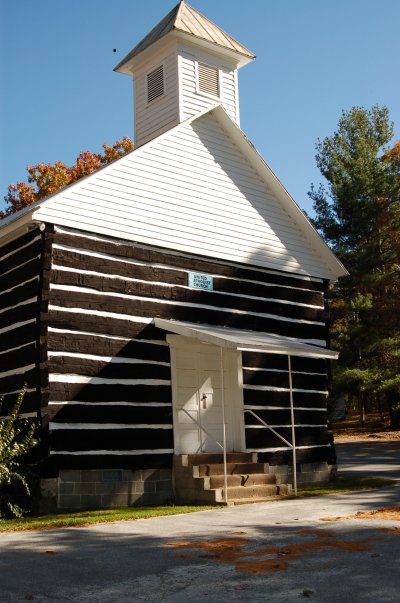
Mt. Olivet Methodist Church, Droop Mountain, WV

This is the most picturesque and also the most convenient polling place I've ever voted. The whole process took about 15 minutes, including travel time. I actually tried to early vote last week, but I happened to hit the courthouse around noon, and decided not to stand in line there. I hope your voting experience was also pleasant and stress free.

Monday, November 01, 2010

Silk Socks--Still More Stripes

More of the navy blue silk yarn, with more stripes of mohair scraps. This time, I made what Elizabeth Zimmermann called "Afterthought Heels," because I wanted to make sure I remembered how to do them.

Saturday, October 30, 2010

Silk Socks--More Bargain Shopping from Long Ago

There was a lovely yarn shop at Dupont Circle called The Woolgatherer, and I haunted the sale bins there in my grad school days. There was a line of Rowan yarns, silk and wool, with subtle mixes of glorious colors, priced well above my reach. It was seductive on the shelf, and I bought odd dye lot skeins as they turned up in the sale basket. Sadly, these subtle skeins produced knitted fabric that was simply "brown," or in this case, "navy blue." Pairing it with other colors failed to awaken the colorful slubs and neps.

I've used it as a background for these odds and ends of mohair. I love knitting Fair Isle patterns, but the silk yarn is too inelastic to make comfortable socks that way. The simple pattens here are slip-stitch.

Friday, October 29, 2010

The Year in Socks--Pink Mohair Pizazz

I bought this partial skein of variegated pink mohair yarn in the 1980's, long before the development of commercial self-striping yarns that are so popular now. It was on sale, and I was sure I would blend it with some other yarns for a lovely sweater. Unfortunately, the shades of pink never matched anything else (except this old quilt of mine).

Spring cleaning and organization inspired me to pair it with a partial skein of white to knit these striped socks. Of course, they're not simply striped--they're dappled, pink, "plotted and pieced—fold, fallow, and plough." They have pizazz.

Wednesday, October 27, 2010

The Joy of Gravel

Last fall, early snows kept us from graveling the driveway. We waded snow and mud until April, when it finally got dry enough to have this work done.

The muddy wagon ruts are replaced with a lovely, smooth driving surface, which we enjoyed at least as much as apple blossom season.

Friday, October 22, 2010

Taming Bookshelf Bulge

The last few months, I've been exploring the world of Internet book-swapping sites, specifically Bookmooch and Paperback Swap. To my surprise, I find I've given away 106 books since April. That means that I can request 106 books and some nice person will wrap each one up and stick it in the mail addressed to me. Pretty cool, eh?

Moving to the new house forced me to sort through my books, and identify the "keepers." Sadly, some old friends were in such poor condition they were of no use to anyone, and I reluctantly sent them to the landfill. (Sorry, Mr. Dickens. See you on Project Gutenberg!)

That left another large pile that I was not going to read again. They were unlikely to interest the local libraries or to sell on-line, but an enthusiastic friend had described Paperback Swap, so I thought somebody somewhere might be interested in a few of them.

I'd also heard of Bookmooch, and decided to try them both. I picked out the ten books I thought most desirable and listed them on both websites.

This was a mistake. I had a cookbook instantly scarfed up both places, so I had to refuse someone's request the very first thing. I've since discovered that Paperback Swap has an automatic hold feature, allowing people to reserve books they want in advance, while Bookmooch sends out emails to members if your book is on their "wish list." I have the best luck listing books on one swap site one day, the other the next. It's also not a good idea to list a lot of books at one time, unless you're feeling flush with cash. The weekend I listed 20 books at one time, I had a shocking total to pay at the post office.

I've found it worthwhile to participate in both sites. It's easier for me to find books I want instantly on Paperback Swap , while it's much easier for me to give books away on Bookmooch . Paperback Swap is a for-profit enterprise, with a slick e-commerce interface, automatic holds, and options to buy books through their site. They also have busy forums and a variety of ways for genre enthusiasts to interact.

Bookmooch is less slick, and has no commercial aspirations or detailed rules about the sorts of things you can list as a "book." I've given away vintage knitting brochures and magazines on Bookmooch--in fact, people started requesting them before I'd finished listing them. Bookmooch also lets you describe the book's condition in as much detail as you wish, so you can crow about a book's excellent condition or warn prospective moochers about its flaws. Paperback Swap has very specific rules about types and conditions of items that can be traded, but there's no simple way to add condition notes to your listing.

It seems I am no good at predicting what books people will request from me on either site. Most of the books I've given away are nonfiction--knitting, crochet, food, nature guides....but a bird book and a nutrition book have languished on my "bookshelf" for months with no takers. Some genre paperbacks aren't moving, while some obscure novels were requested right away.

The whole sorting process also left me with a pile of books I bought long ago but haven't read yet. These forgotten finds, along with some books I've mooched from the swapping sites, have given me a nice stack of "new" reads for the winter. If I don't like a book, or if I don't anticipate rereading it, I can offer it on line, and slow the inevitable bulging bookshelf syndrome.


Be a book trader at BookMooch.com

Thursday, October 21, 2010

Shaking Out the Cobwebs

I'm back! Don't adjust your RSS feed. Pocahontas County Fare is being served once again.

Gainful employment is a feast-or-famine affair around here, and for the last few months, I've enjoyed an over-full work schedule. At this point, I've enjoyed about as much as I can stand, so the upcoming work-hiatus is quite welcome.

Please excuse me while I knock down some cobwebs and sweep out the dead June bugs.

Friday, March 26, 2010

Don't Live Like a Lab Rat!

Earlier this week, Terry blogged about a Princeton study showing that All sweeteners are not created Equal. (Thanks, Terry!) The press release she cited begins:

A Princeton University research team has demonstrated that all sweeteners are not equal when it comes to weight gain: Rats with access to high-fructose corn syrup gained significantly more weight than those with access to table sugar, even when their overall caloric intake was the same.

In addition to causing significant weight gain in lab animals, long-term consumption of high-fructose corn syrup also led to abnormal increases in body fat, especially in the abdomen, and a rise in circulating blood fats called triglycerides. The researchers say the work sheds light on the factors contributing to obesity trends in the United States.

I was rather excited about this--I sometimes teach simultaneous biochemistry and statistics courses for nursing students, and a paper like this would be ideal--combining carbohydrate chemistry, data analysis, and dieting. It would be bound to pique their interest.

Unfortunately for my purposes, the press release veered into diet-guru pseudoscience right away, speculating that

as a result of the manufacturing process for high-fructose corn syrup, the fructose molecules in the sweetener are free and unbound, ready for absorption and utilization. In contrast, every fructose molecule in sucrose that comes from cane sugar or beet sugar is bound to a corresponding glucose molecule and must go through an extra metabolic step before it can be utilized.

Really, that's their explanation? Hydrolysis is an extra metabolic step here? I suspected that the researchers were not responsible for the flaky press release, so the next step should be the actual article. The press release said the article was published online Feb. 26, but it provided no link. Still, search engines soon took me to the abstract: High-fructose corn syrup causes characteristics of obesity in rats: Increased body weight, body fat and triglyceride levels. The abstract seems reasonable enough--no speculation about metabolic pathways, no suggestions that fructose calories are qualitatively different than sucrose calories. Unfortunately, the abstract is all you get from the publisher, unless you wish to purchase the full text for $31.50 USD. My adjunct professor status doesn't cover such costs.

Meanwhile, everywhere I looked, there were blog posts and science news articles concluding that if we switch to soda pop sweetened with sucrose, it will keep us from getting fat. Much as I would like to eat more sugar and lose weight, I'm pretty sure that's not going to happen.

As I went about trying to sort out this puzzle without spending $31.50, I found some helpful and interesting discussions of the article (listed in the links below), and this afternoon a Slashdot commenter provided a pre-print of the actual paper.

The press release conflated the two experiments described in the article, overstated the differences in weight gain, left out the data from female rats (which seemed to contradict the male rat results) and didn't mention how small (eight rats per group) the treatment groups were in the long term study. If you look at the table of final weights for the short-term study, the rats that had sucrose to drink 12 hours a day had the same mean final weight as the 24-hour-a-day corn-syrup drinkers. The group with a statistically significant difference was the 12-hour-a-day corn syrup drinkers, and their standard error bars came very close to overlap. Given that there were only 10 rats per treatment, I'd hardly call this a definitive finding.

The graph on the right shows the inconclusive results in female rats in the 6-month study. Over all, I'd say this is an interesting little study over-hyped by Princeton's PR department. If it's now true in science, as in Hollywood, that there is no such thing as bad publicity, these researchers can look forward to some more funding.

Here are some of the links I found informative or interesting.