Tuesday, May 23, 2006

Lies, Deliverance, and James Dickey

Book Cover: James Dickey--The World As a Lie

I continue to pick at James Dickey's vitriolic and stereotypic descriptions of Appalachian people in Deliverance. Did Dickey mean for us to take our narrator's account at face value? Many people interpret it that way. The Brothers Judd offer a synopsis/review typical of many readers.

...Georgia suburbanites in search of adventure...decide to canoe down the wild Cahulawasee River before it is dammed up forever. The boys, as most everyone knows from the terrific movie, soon stumble upon more adventure than they had anticipated and find themselves at war with several denizens of the backwoods country. These four men are forced to confront the central question at the core of the male being: how would I react if I was confronted by physical danger and heroism was required.

Ed, the narrator and hero of the book, finds upon returning home that his entire life has improved. By performing well during the crisis, he has built up a personal reservoir of confidence that he continues to draw upon....This is a great book and perhaps one of the last truly male works of literature that will be admitted to the canon.

Perhaps, because I am not truly male, I just can't believe that seeing my three buddies sodomized, maimed, and shot, killing a couple of hillbillies, and lying to the police are weekend experiences that will subsequently improve my work and my marriage, give me a personal reservoir of confidence, and clear up my toenail fungus. Maybe I am projecting my girlish prejudices upon Mr. Dickey, but I think he is a more sophisticated story teller than that. I base this on Mr. Dickey's fame as a liar.

Dickey himself suggested the title for Henry Hart's 2000 biography, James Dickey: The World As a Lie. It must have been truly nightmarish to determine the facts of Dickey's life, given the many versions of himself that Dickey presented. Rodney Welsh summarizes a few of the "discrepancies:"

Hart...has no problem, virtually from page one, uncovering traces of Dickey's multiple deceptions. He said he grew up in a German household and didn't speak English until he was five or six; actually he learned only a handful of German words. His household was wealthy, living on the profits of his grandfather's tonic company, but he pretended to far humbler beginnings. His father was a lawyer of no distinction, but Dickey claimed he was a "linthead" who worked in a cotton mill and "believed the way to settle trouble was with lynchings." Dickey's sister recalls how Dickey as a boy was repulsed by the cockfights his father would stage, but as a macho poet he expressed nothing but redneck pride. "My people were all hillbillies," he liked to tell interviewers. His mother read poetry to him from infancy, yet Dickey claimed many times he came to poetry independently. From childhood, he had fantasies about being a fighter pilot, and following World War II, lied about having been one.

Book Cover: Summer of Deliverance

Christopher Dickey's 1998 book, Summer of Deliverance: A Memoir of Father and Son deals in detail with Dickey's deceptions. The New York Times 1998 review is subtitled:"Liar and Son Christopher Dickey discovers the difference between the world as it was and the world as James Dickey said it was." The review ends with this:

What makes this angry, affectionate memoir both gut-wrenching and hypnotic is a deeper, more horrifying lie at its core -- the lie that was James Dickey's entire life and that consisted not of a single falsehood but of thousands of little daily distortions and contrivances and outright fabrications. Some were harmless, many hurtful, others deadly. At one point, the son writes, ''My father had begun to make himself up.'' In every sense except the artistic one, it seems, James Dickey never told the truth at all.

Monday, May 22, 2006

Sweet Scents of Spring

Lilac inflorescences Lilac flowers, up close

It's been a banner year for lilacs in Pocahontas County. All the bushes I've seen have been covered with blossoms, Even this old shrub in my yard, shaded by the cherry and apple trees, never pruned, has been heavy with flowers and overwhelmingly sweet-smelling. Usually, it manages half a dozen inflorescences, high out of reach of cameras and noses.

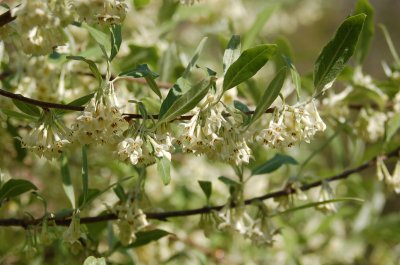
Then, just as the lilac scent began to fade, the pesky, invasive autumn olives began to bloom, and everything smelled sweet again. I just can't exterminate anything that smells this good, and gives the indigo buntings a place near the house where I can admire their color and song.

Fragrant autumn olive flowers

Wednesday, May 17, 2006

James Dickey: Some Links, Some Questions

Book Cover: Deliverance

I don't seem to be able to read one book and then put it down and move on. For some time, I've been trying to interpret James Dickey's vitriolic descriptions of rural Southerners in Deliverance. Do we take at face value our more-or-less reliable narrator's description of the places he went and the people he encountered? Watching the movie (screenplay by Dickey himself, and he appears as the local sheriff toward the end), we see the events with our own eyes, so they are unambiguous. Are we meant to take the novel as a similarly straightforward account? Dickey was a poet and a professor, highly regarded by his students and by literary critics. I would expect that he paid careful attention to his word choice, and that passages such as this are meant to evoke skepticism.

"What's life like up there now?" I asked. "I mean, before you take to the mountains and set up the Kingdom of Sensibility?"

"Probably not too much different from what it's liable to be then," he said. "Some hunting and a lot of screwing and a little farming. Some whiskey-making. There's lots of music, it's practically coming out of the trees. Everybody plays something: the guitar, the banjo, the autoharp, the spoons, the dulcimer--or the dulcimore, as they call it. I'll be disappointed if Drew doesn't get to hear some of that stuff while we're up here. These are good people, Ed. But they're awfully clannish, they're set in their ways. They'll do what they want to do, no matter what. Every family I've ever met up here has at least one relative in the penitentiary. Some of them are in for murder. They don't think a lot about killing people up here. They really don't. But they'll generally leave you alone if you do the same thing, and if one of them likes you he'll do anything in the world for you. So will his family...."

Half hippie fantasy, half horror flick, Lewis's description is proven true by the book's events. I don't know what to think, so I keep reading. I've found several high-quality Internet resources about James Dickey the last couple of months, including some of Dickey's own prose and poetry. Here are my recommendations.

Tuesday, May 16, 2006

Appalachia: Land of the Nine-Fingered People

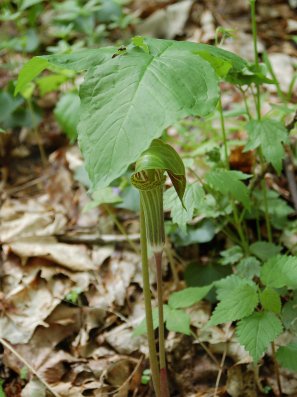
Jack in the pulpit, near Swago

I mentioned Deliverance recently, in the context of entertainment suitable for discouraging unwanted tourism. I saw the movie when it first came out, but I'd not read James Dickey's novel until I found it at the local library book sale this past winter. I had started a blog entry about it, but soon realized it was too complex an issue for a short essay. I've been reading Dickey's poems, and some critical and biographical essays, and I'm quite intrigued.

Here's the passage that first caught my attention. Our narrator, Ed, is musing in the car as his buddy Lewis works out canoe trip logistics with the locals in Oree, their put-in point for canoeing the Cahulawassee river. Ed has already told us he is about 150 miles north of Atlanta, which puts him in the southernmost mountains of the Appalachians. (All the place names mentioned, except Atlanta, appear to be fictional.) Nothing bad has happened to Ed yet, but he has been ragging on rural Georgia for the previous twenty pages.

DVD: Deliverance

There is always something wrong with people in the country, I thought. In the comparatively few times I had ever been in the rural South I had been struck by the number of missing fingers. Offhand, I had counted around twenty, at least. There had also been several people with some form of crippling or twisting illness, and some blind or one-eyed. No adequate medical treatment, maybe. But there was something else. You'd think that farming was a healthy life, with fresh air and fresh food and plenty of exercise, but I never saw a farmer who didn't have something wrong with him, and most of the time obviously wrong; I never saw one who was physically powerful, either. Certainly there were none like Lewis. The work with the hands must be fantastically dangerous, in all that fresh air and sunshine, I thought: the catching of an arm in a tractor part somewhere off in the middle of a field where nothing happened but that the sun blazed back more fiercely down the open mouth of one's screams. And so many snakebites deep in the woods as one stepped over a rotten log, so many domestic animals suddenly turning and crushing one against the splintering side of a barn stall. I wanted none of it, and I didn't want to be around where it happened either. But I was there, and there was no way for me to escape, except by water, from the country of the nine-fingered people.

"Offhand," indeed. And, "no way to escape, except by water"--when he says this, he is sitting in a car in the county seat. It's not too late to find a pay phone and call his wife to come get him. This "country of the nine-fingered people" is not part of my space-time continuum.

Monday, May 15, 2006

Further Adventures With Morels

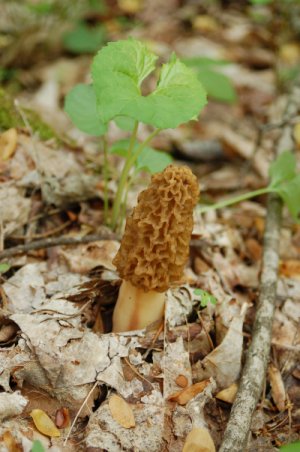
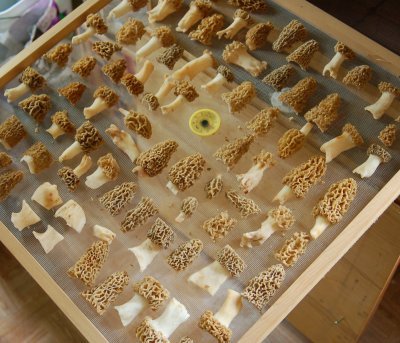
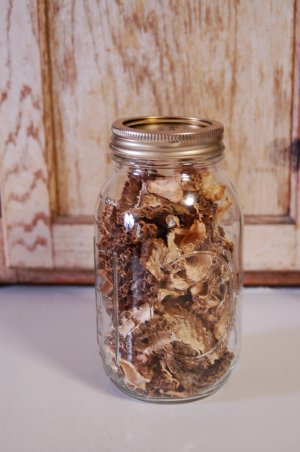
We've been making a few late passes through the woods, looking for the yellow morels. They've been scattered, but we've found enough to keep us looking. As we find them, we are drying them and storing them for later in the year. It's better than waiting for enough to make a skillet-full when hunting is this sparse, and we think that drying somehow intensifies the flavor. A sauce made from dried morels seems more flavorful than fresh, sauted morels. A morel in the dehydrator is worth two in the pan, perhaps.

yellow morel in its habitat morels going into the dehydrator dried morels to save for later

Sunday, May 14, 2006

More Mysteries: Anne Perry's A Sudden Fearful Death

Book Cover: A Sudden, Fearful Death

Another mystery novel I read this week, under the guise of spring cleaning, was Anne Perry's A Sudden, Fearful Death. Like Ruth Rendell, Ms. Perry is much admired and much purchased, and I am happy to report that she is also a skillful writer. This novel is part of a Victorian London series centering around a retired policeman and a Crimean War veteran nurse. It is scrupulously free of anachronism, except, perhaps, for a sneaking disapproval of unjust policies and attitudes of the past. There may be no getting around that in a contemporary story. I'm not the fiction reader that I once was, or I would now be scouring bookstores and libraries for the rest of Perry's William Monk mysteries. (In any case, I would search in vain, for my local library now is the owner of one, count it, one, book in this series, the one I just finished.)

My Internet searches showed me that Anne Perry is interesting not only as an author, but also for her life story. Here are a few informative Web resources.

  • The Wikipedia entry begins: "Anne Perry (born October 28, 1938), born Juliet Hulme in England, is a British historical novelist and convicted murderer (see also Parker-Hulme Murder)."
  • The Official Anne Perry Website is slick, attractive, and content-rich, but the home page took five full minutes to load on my dial-up connection, and it contained nothing more than an author photo and site navigation links. Bad webmaster! Shame, shame!
  • An interesting interview with Anne Perry, from Strand Magazine.

Saturday, May 13, 2006

Ruth Rendell's The Bridesmaid

Book Cover: The Bridesmaid

I was browsing my bookshelves Monday, looking for books to donate to my local library, when I came across The Bridesmaid, a book I'd bought a long time ago and never read. One thing leads to another, and before I knew it I was cuddled up to the wood stove, reading through the cold, rainy afternoon. I knew Ruth Rendell is very popular, and very successful, and I was delighted to discover that she is a skillful writer. It makes me think better of the whole book business, writers, buyers, and sellers.

The Bridesmaid is more of a suspense story than a mystery. While it takes the form of genre fiction, its characters and plot are beautifully developed, and the recurrent image of a Classical goddess, Flora, ties up the subplots elegantly. I believe if she were less popular and less well-marketed, Ms. Rendell would be considered a "serious" writer, fit for university literature classes. Of course, I've seen two (!) books of scholarly essays on Buffy the Vampire Slayer, so perhaps the best-seller listings no longer exclude books from the Literature department.

Some On-Line Resources on Ruth Rendell:

Thursday, May 11, 2006

Greenbrier Back Country: Here Be Cannibals

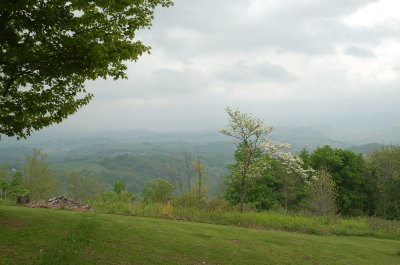
Greenbrier back country, as seen from the ridge where I live

Earlier this week I watched a teen horror movie on satellite TV: Wrong Turn, released in 2003. I'd been watching for it since I first saw it advertised, because the trailers revealed it was set in West Virginia and featured frightening hillbillies doing terrible things to vacationing suburbanites. With all the tourists visiting Pocahontas County (especially the despised skiers throwing their Starbucks cups and other trash out the car windows as they drive home from Snowshoe Resort) some local residents consider such cinema wish fulfillment. To my delight, the opening action sported this subtitle: "Greenbrier backcountry, West Virginia." (Check my photo at left--Greenbrier backcountry as seen from my neighbor's yard this morning.) Not only do Wrong Turn's hillbillies terrorize annoying city folk, but they do it in my backyard! While many writers have selected West Virginia as their setting for mayhem and uncivilized behavior, we believe this is the only movie that has the inbred mountain men actually eating the rich.

Movie Poster: Wrong Turn

Now, nobody viewing this movie could expect it to win a prize at Sundance, but some of the amazon.com reviewers consider the movie "good of its kind." Of course paid reviewers don't approve. For example, Fox Channel 11 out of Charleston, WV archived this review of the movie, in which reviewer Kenny Bass says:

"West Virginia doesn't inspire movie makers to spin tales of sophisticated romantic comedy or high flying action. No, instead we get "Wrong Turn." Set in the Greenbrier backcountry, it's the story of six young people stuck in the middle of the woods....it really doesn't bother me that "Wrong Turn" depicts West Virginians as toothless, mindless, cannibalistic, inbred hillbillies, hunting and eating innocent tourists, rafters and mountain climbers. No, what really upsets me is the movie isn't very good....Oh, and there's one final insult. It wasn't even filmed in West Virginia. They shot it in Canada. Thanks for nothing."

Here on Droop Mountain, in the Greenbrier backcountry, we consider Wrong Turn propaganda for our cause. We'd like to have it played continuously on cable TV at Snowshoe Resort, or perhaps it could alternate with "Deliverance."

Tuesday, May 09, 2006

Recalling Chickweed and Other Stellar Events

Star chickweed flowers

When I first noticed this stuff last spring on Williams River, I knew I ought to know what it was. I wish I had the recall to say "What a large and showy chickweed!" or something else on the mark. But I just fumbled around in the back rooms of my brain, muttering, "Looks like little stars...." Which, of course, is not true. After paging through a few field guides and floras this spring, I figured it out: Stellaria pubera, or great chickweed. "Chickweeds look like little stars" was how I once learned to remember the genus name Stellaria. So, I remembered the memory aide, but not the piece of information it was meant to retrieve. There was a university professor who used to tell us grad students, "I've forgotten more than you'll ever know." The guys used to get really aggravated. I laughed when he told me, and said, "Oh, no doubt. I've already forgotten more than I'll ever know." It was true then, and it's getting truer every day.

Monday, May 08, 2006

Understanding Joyce Carol Oates a Little Better

Run at the headwaters of the Williams River

I recently read Cathleen Shine's review, People Who Hurt People. She is writing about Joyce Carol Oates' new anthology, High Lonesome : Stories 1966-2006. This review articulated some aspects of Oates' writing that I had been struggling to understand, and I'm going to save a few quotes here to help in case the review disappears behind the New York Times' firewall. Of course, they may well keep it in their public book review archive section, along with this: (April 30, 2006) First Chapter: 'High Lonesome.'

Review by CATHLEEN SCHINE
Published: April 30, 2006
New York Times Book Review

For those of us who have stood before bookstore shelves lined with Joyce Carol Oates volumes, paralyzed with awe, wondering which of her more than 100 books we should open first, "High Lonesome," a new collection of 36 stories written between 1966 and 2006, is a welcome addition. The collection, which includes classic stories like "In the Region of Ice," which won the O. Henry prize in 1967, and the much anthologized "Where Are You Going, Where Have You Been?" as well as 11 new stories, spans Oates's career and gives a remarkably coherent picture of her work....

One of the most extraordinary aspects of Oates's intense and violent world of struggle is the absence of suspense. Her language lunges forward at a tense, breathless pace, as if she were writing a thriller, but Oates is actually a kind of a fatalist. Characters often question whether they have free will, and with good reason: they don't. The characters, the language and the stories all rush forward, but, like a herd of frightened animals, they are stampeding off the same high cliff. It is this fatalism combined with the suspenseful rhythm of her language that creates the odd, unsettling atmosphere of the stories. There are crimes here, but they will not be "solved" as they would be in police procedural. There is danger, but it will not be overcome as in a genre thriller. Her stories are closest, in terms of genre, to the great American horror stories of the 19th century, but here, too, with an important difference. When we read, say, Poe, we know the violence, creepy and disturbing, is a nightmare, a hellish and unusual event that entertains us and reminds us of the depths to which a human being can sink or be driven. In "High Lonesome," however, that depth of depravity is the definition of what it is to be human.

....Oates has been described as a social realist, but is more accurately described as a fantasist. The stories in fact are often told by fantasists, from the point of view of unreliable narrators, of uncomprehending children, of the unbalanced and the insane. And it is these people, and how they observe, who interest Oates. These stories are sensational in the true sense of the word. Oates's breathless prose swirls furiously around these lurid moments, moments when violence and voyeurism converge....everything is portentous for her....so many deaths, so many disturbed men, so many little girls. They all begin to seem the same, generic. That is, I think, Oates's point, that the threat of violence is the human condition, the thrill of violence is a human appetite. But this monochromatic view, however vivid the single color, may account for why Oates's stories can feel so impersonal....It is a world in which everyone is finally alone, on the edge of that black hole.

Sunday, May 07, 2006

Dwarf Ginseng

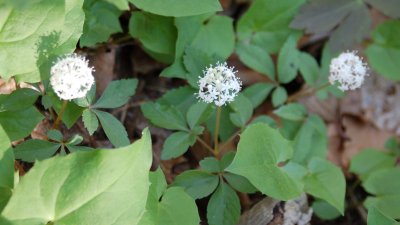
dwarf ginseng flowers

This is my third spring of trying to photograph and identify this handsome, small spring ephemeral. Last weekend gave me three sunny days for photography, and here it is: dwarf ginseng, Panax trifolius. I kept trying to reconcile the flowers with the Saxifragaceae, a mistake I made using the key in The Flora of West Virginia (WVU, 1972). When I finally read through all the "wrong" families, (my last resort--trial and error approach--it's a common flower, it has to be in here somewhere) I found it in the Araliaceae. Apparently, it has the panacea reputation of our other ginseng species, P. quinquefolia, and is recommended for everything from gout to existential malaise.

Thursday, May 04, 2006

Spring Beauty and Ethnobotany in Pocahontas County

Bed of Spring Beauty--Habitat shot

The spring beauty (Claytonia virginica) on Droop Mountain is bloomed out for this year, but at the headwaters of the Williams (about 800 feet higher than Droop), it's still in abundant flower. It's quite lovely, and has the interesting feature of having different chromosome numbers in different parts of the plant.

The day I unloaded the moving van at my house in 1999, a friend pointed out this plant in my yard, and observed to her 12-year-old son that it was edible. He asked her why he should remember that, and she said, "Because someday you may be hungry." Although she's only about 40, she grew up in the old-time way in Pocahontas County, without electricity or "modern conveniences." If her grandparents didn't grow it or make it, she did without it. To this day, she gathers and sells ramps, ginseng, Indian pipe, Podophylum, and anything else that grows in the woods that can bring in a dollar.

As a folklore informant, she has excellent credentials. However, I'm not about to cook up a mess of Claytonia and eat it on her advice, even though I have eaten other members of the Portulacaceae (purslane family). For one thing, she consistently called it "crowfoot." There is a genus of spring flowers called crowfoot (Ranunculus). Now, the buttercup family (Ranunculaceae) has some seriously poisonous members, and even though I think she has correctly identified an edible plant, and incorrectly remembered the name, I'm not going to experiment without some further confirmation, especially since I'm not going hungry.

Many of my mother's wildflower identifications were wrong. Sumac, ironweed, dock--she put all these names on the wrong plants. Lately, people I know have incorrectly identified skunk cabbage, jack-in-the-pulpit, white hellebore, poke, and Thalictrum dioicum. It's not a big deal--I've spent plenty of time hanging around the herbarium, keying things out. I have a good, cautious taxonomist's eye, and a healthy respect for plant secondary compounds. However, most of these "folk" misidentifications were either putatively poisonous or putatively edible. It's not good to mistake Indian poke for skunk cabbage if you're planning on cooking spring greens, because Indian poke (Veratrum viride) is one of those poisonous ranunculaceous plants, and skunk cabbage (Symplocarpus foetidus) is a tasty treat when picked early.

I guess I was just hoping to collect some interesting herbal folklore. Instead, I'm finding that sort of knowledge has been nearly lost here.

Tuesday, May 02, 2006

Anemone of the People

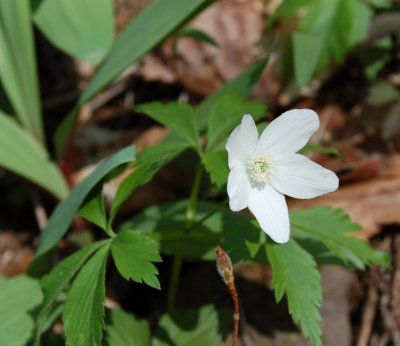
Windflower on Williams River

In an attempt to "Know My Spring Ephemerals," I've been spending some time with lenses, keys, and field guides this year. That's why I can say with some confidence that this lovely white flower, so abundant last weekend on the Williams River, is a wood anemone (also windflower, Anemone quinquefolia). You may recognize a few ramp leaves in the background.

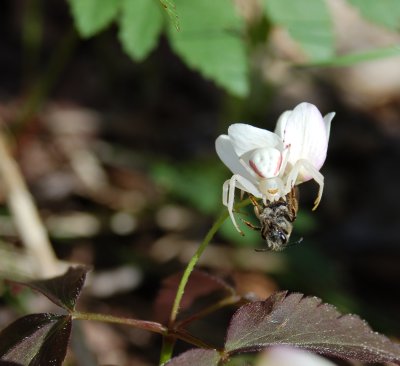
This flower was, however, the second one I hunkered down to photograph. The first windflower offered me the surprise below--a snowy white crab spider dining on a would-be pollinator. Notice the pink bars on the spider's side--these correspond to the pink edges of the anemone's petals while still in the bud. I'm accustomed to see golden crab spiders hiding on late summer asters and goldenrod, but this cryptic anemone spider was a new one for me.

Cryptic crab spider eating a pollinator on a windflower

Monday, May 01, 2006

Ramps, Camping, and Old-Time Music

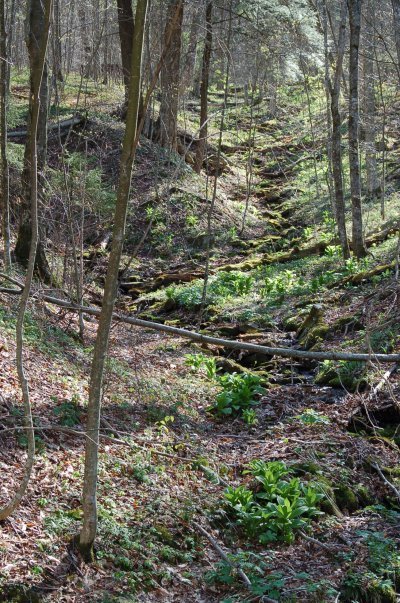
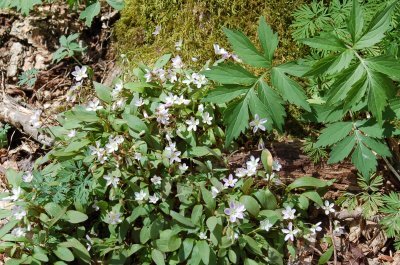
Ramps in their native habitat

Last weekend, we returned to Williams River to dig ramps, cook them, play music, and camp with our friends from Greenbrier County. In the last five years that I've gone, it's always been cloudy, rainy, cold, or snowing. This past weekend was sunny and delightful, and I took lots of pictures.

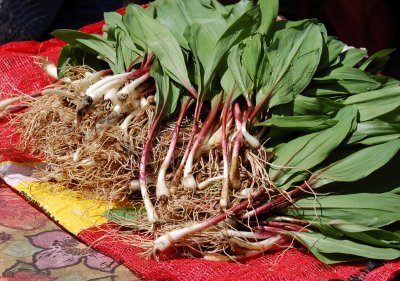
Above, you see ramps in their native habitat; here this includes some lovely dutchman's britches. Below are washed ramps, ready to cut up and cook, and below that, you see some of the cooking crew at work.

Ramps are more than a tasty spring treat; they are an Appalachian cultural phenomenon, and I'm afraid I'm not qualified to explain it. I'm just pleased to participate. As you can see, they are a sort of wild leek, and they are delicious cooked in eggs, potatoes, meatloaf, or on their own, as a vegetable dish. They are good raw, too, but they linger on your breath and your skin for days, like garlic, but much more pungent, so you need to make sure all your family eats them raw at the same time.

Ramps washed and ready to cut up Ramp cleaning crew

Wednesday, April 26, 2006

Please Bear With Me and My New Camera

Coming home on Droop Mountain

I'm afraid you'll have to bear with me as I become acquainted with my digital camera. Until this week, my blog photos were shot with my 35mm Olympus OS2 on print film, then developed at the local one-hour photo (but not printed), then scanned and Gimp-ed. As you might imagine, substantial delays between taking the picture and posting it were the rule. I've moved straight into digital SLR land with a Nikon and a nifty new lens, and there is so much new stuff to play with. Monday was a beautiful day, and between the sunshine and the trees, I became a little crazy over the many available shades of green.

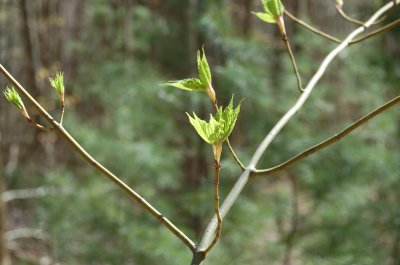
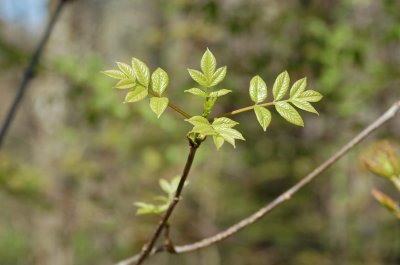
Striped maple leaves pinnately compound leaves coming out in the spring

Monday, April 24, 2006

Technology, High and Low

I've spent another week absorbed in technology. I've been researching why the sound acts strange on an old laptop, and upgrading my hardware with some more memory. It isn't interesting to report, but I do seem to become obsessed with a problem until it's solved. On a pleasurable note, I finally bought a digital camera, and it arrived Friday evening. Learning how it works is much more fun than tracking down the culprit in an IRQ conflict on that senescent laptop.

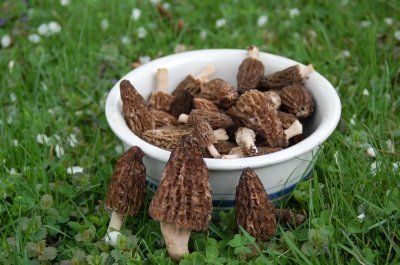
Friday morning we looked for mushrooms on Williams River. We found these black morels. I photographed them Saturday morning, after I got the new camera up and running, during a lull in the rain. The white petals are from the pear tree in the yard. Saturday night we enjoyed morels in a white sauce over pasta.

A bowl of black morels

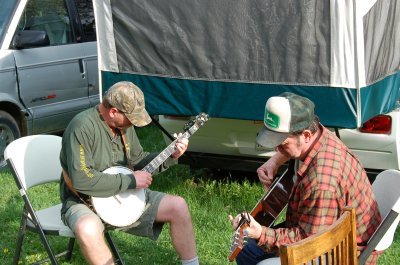
We had company on Saturday afternoon--quite an unusual occurrence. As a result, some nice traditional tunes were picked in our yard. The camper is popped up because we are working on an intractable electrical problem.

Tim and Larry picking some tunes in the yard

Sunday, April 16, 2006

Fun (?) With Debian Etch

I've been spending too much time with computers for the last week, none of it involving blog entries. When I quit my genomics job back in 1999, I vowed that I would never again spend 12-hour days at the computer. Well, except once in a while. Last weekend, I determined that I would update my Debian Linux machines. This turned into an obsessive activity much like last winter's quilting project.

My beloved home Linux machine (purchased new in 1998) has been running Debian Sarge (testing), installed early in 2005. Ever since the Debian folks moved Sarge to stable status, I've been unable to update any programs. It always comes down to some sort of problem with the kernel I'm using, or perhaps the xserver program. The new testing version, Etch, uses a 2.6 kernel and Xorg. Last Sunday, I went to the GED classroom and downloaded the latest Etch installation iso's. (The first three, anyway; it took about four hours.) This was probably my last chance to use the school system's broadband connection, so no more large downloads any time soon.

I couldn't get my USB external hard drive mounted on the Linux box in the classroom, because it's formatted as Unix File System, for use with my eMac. Strange as it seems, it's only simple to mount vfat external hard drives on Linux boxes. Rather than spend all night in the classroom, I carried home the computer, connected it to my LAN, and ftp'd the Etch iso's to my Mac, which sports a CD-burner. I burned the CD's and began to install Etch from scratch on the borrowed computer. Unfortunately, the i386 beta2 installer has an insurmountable problem: the new, groovey autopartitioner doesn't work, and there is no way to manually partition the hard drive once you begin the installation process. I spent some time on LinuxQuestions, and was disappointed to find the level of discourse has gone downhill in the last six months. When an online community grows quickly, it seems inevitable that the signal to noise ratio drops, and LinuxQuestions now has a fair number of people posting unhelpful responses.

I found one helpful suggestion: Install Debian stable, then move over to Etch. I spent several days working on this, and eventually decided it wasn't really worth the trouble. It took two nights to download the netinstall iso for Debian stable over my dialup connection, and doing a netinstall over dialup would tie up my phoneline for days. Using the Sarge netinstall iso followed by the Etch iso's seemed promising, and I even got Gnome 2.12 to load and work for a while, but after I restarted the computer, my xserver gave me lots of bogus error messages. Reconfiguring Xorg didn't help; it seems I would need to upgrade the kernel and get a different version of Xorg. I decided I would just postpone any kind of major upgrade on my main machine.

I enabled successful Net updates of individual programs by editing my /etc/apt/sources.list file, substituting "stable" for every occurence of "testing."

Meanwhile, I had messed up the Debian machine I'd borrowed. To get it back in shape before returning it, I thought I'd test Debian Stable using the 2.6 kernel. This turned out to cause problems with the Xfree86 xserver. I wasn't able to configure a left-handed mouse, or get sound to work properly.

So, after all those hours of work, I changed three words in a file on my home machine, and reinstalled the old version of Debian Sarge off the CD's I bought last year. Worthwhile? I hope so. I learned something, I fixed my main problem, and I found out I know more about Linux than some self-styled "experts."

Sunday, April 09, 2006

Sherry Chandler and the Historic Poets of Kentucky

Sherry Chandler's weblog is always worth reading. Lately, I've been enjoying her exploration of some early Kentucky writers. In the late eighteenth and early nineteenth centuries, these poets seem not to have considered themselves Appalachians or backwoodsmen. They are fascinating, and despite my days as an earnest undergrad in the English department, I've not heard of them before. It makes me wonder why the New England Yankees have so dominated American literature.

From The Drunken Poet of Danville, Thomas Johnson Jr., Sherry shares excerpts from "Kentucky Miscellany" (1789), published "while Kentucky was still a county of Virginia." The first poem is Johnson's satire on himself. The second is a satire on Brown and Wilkinson.

William Littell "was born in New Jersey in 1768 and came to Kentucky in 1801." She quotes from his "Festoons of Fancy." Gilbert Imlay"is [another] fascinating character. Idealistic enough to have won Mary Wollstonecraft and fathered her first child, opportunistic (or at least connected) enough to have moved through the height of the French Terror with impunity...."

I hope there is more to come. She does a fine job of providing context for these interesting poems and prose exceprts.

Saturday, April 08, 2006

Rereading Joseph Conrad

Book Cover: Lord Jim

I recently re-read Joseph Conrad's Lord Jim, and chased it with Jeffrey Meyers' Joseph Conrad : A Biography. Meyers' biography is excellent--neither too scholarly nor too superficial. It left me needing to reread Conrad's other books.

I read Lord Jim for the first time when I was about 12, and I found it an exciting adventure book. When I reread it in college, and then later, in graduate school, it was a fascinating exploration of how we understand who we are and come to grips with morality. Imagine my surprise to discover that it is actually a middle-aged person's reflection on how to live with ill-informed youthful choices, and how to face mortality. One constant in all my readings is my appreciation of Stein, the entomologist. Conrad is unique in understanding how romantic the pursuit of entomology is.

Book Cover: Joseph Conrad--A Biography

Electronic texts of Lord Jim are available from The Literature Network, Bibliomania, and Project Gutenberg. I prefer reading ink on paper, but it's much more fun to paste excerpts and personal notes in a text file than to try and crowd observations into margins. My marginal notes from a ten-years-distant reading are now completely obscure to me. I might as well have written "How true!!!"

Thursday, April 06, 2006

Collapse by Jared Diamond

Book Cover: Collapse

I just finished reading Jared Diamond's Collapse : How Societies Choose to Fail or Succeed. I haven't been reading many current books lately, but I found this in my local library. (Unfortunately, it was in the "Adult Fiction" section, so no one else was likely to find it.) I first encountered Diamond's popular writing in The American Museum of Natural History's slick monthly, "Natural History," in the 1980's. Although I was often familiar with his subject matter (evolution, ecology, biogeography), he frequently delighted me with his unusual perspective. He made me think about things differently. I've consistently liked his books, as well.

Collapse : How Societies Choose to Fail or Succeed has been much reviewed since its 2005 publication. Metacritic's collection includes some positive and some negative reviews. I thought a quick search might turn up some interesting links, but for the most part, the links were rather uninformative. Environmentalists think the book is too moderate, too critical of aboriginal peoples and too optimistic, and political conservatives feel it is too politically correct and environmentally alarmist. I found David Brin's essay interesting: A Glass Half Empty: Jared Diamond's COLLAPSE Shows Santayana was Right About that Little History Thing.

My graduate career started at a time when palynology was showing some new things about paleontology and archaeology. Whereas I grew up thinking aboriginal peoples had lived in harmony with their environments, it was becoming more obvious that extinction and habitat degradation always followed human colonization. Desertification followed the development of agriculture in Mesopotamia and the Near East, and Northern Europe had been steadily losing species for 5000 years. We primates are a messy bunch, and big groups of people make big messes. Jared Diamond puts a braver face on the future of our environment than I do. Perhaps he's whistling in the dark, but I hope he's right.

Tuesday, April 04, 2006

Droop Mountain's Scenic Attractions

Droop Mountain Park Lookout Tower

Droop Mountain boasts three state parks, spectacular views, many ghost sightings, a well-documented history, and wonderful flora and fauna, but surprisingly little interesting documentation on the Internet. Here is my own edited list of park links.

Droop Mountain Battlefield State Park

Beartown State Park is smaller, only about 100 acres, but when I need to take a visitor someplace outdoors, this park is always a good choice. It's main attraction is a boardwalk around interesting rock formations. WV Department of Natural Resources' Web page is apparently the source for the other Beartown Web pages I've seen.

The Greenbrier River Trail is a long, skinny park, following the course of the defunct Greenbrier Division of the C&O Railroad. The railroad drilled a tunnel through Droop Mountain at Roher (in Greenbrier County), and bikers get to ride their bikes in total darkness for a short ways. There are a number of businesses with Greenbrier River Trail Web pages, but Cherry Creek's Guide to the Greenbrier River Trail is one that has interesting information in addition to tour prices and contact information.

Monday, April 03, 2006

Jaye Slade Fletcher

Book Cover: Deadly Thrills

Jaye Slade Fletcher is the author of two true crime books: Deadly Thrills: True Story of Chicago's Most Shocking Killers (1995), and A Perfect Gentleman (1996). A retired Chicago police officer, Ms. Fletcher moved to Pocahontas County in the mid-1990's. She was among the first people I met when I moved here, as she sold me the house where I live now. I can't say I know her well, but she is a very interesting conversationalist.

Deadly Thrills has been well-reviewed, and an interesting summary is available at Court TV's Partners in Crime site. Lynard Barnes provides one of many positive reviews in 1996 at TG Book Reviews: Deadly Thrills by Jaye Slade Fletcher.

Jaye Slade Fletcher has managed to do a bit more than recount events leading up to the arrests of Robin Grecht and his three "helpers" for the murders of at least five young women....After Fletcher gives a brief history of the seemingly mundane life of Robin Grecht, she asks the rather straightforward question, "Does all this inevitably add up to a sadistic serial killer?" She....points out that we know very little about how a conscience is created in a person. Robin Grecht obviously did not have one. He was incapable of feeling empathy or compassion....

Book Cover: A Perfect Gentleman

Tracking the police work surrounding the Grecht murders is where Deadly Thrills is at its best. Fletcher, a career police officer as well as an author, provides a peek at the proverbial thin line a cop must walk in the pursuit of an investigation. On one side of that line is the world of the criminal, on the other, the world of ordinary law abiding citizens, the news media and of course the law enforcement community itself. Fletcher artfully weaves across the line, revealing strengths and weaknesses of police work. The strengths of course are the men and women who, year in and year out, stick to the job despite the hazards and the everyday good deeds that go unnoticed....

A Perfect Gentleman was not as widely reviewed, although one Amazon customer said: "In my opinion...Jaye's books have been every bit as well-written and engrossing as Ann Rule's. Jaye writes with an insight to be envied and her thorough research shows in every line." I have to admit that I don't have the stomach to read deeply about the mental processes of serial killers. When I moved in to Jaye's former house, I found she had left me more motion-sensor lights than Fort Knox. Every possum and deer was brightly illuminated, every night. Perhaps this type of research was disquieting, even for a former police officer.

Sunday, April 02, 2006

The Joys of Self-Publishing

I've been updating and adding to my "regular" Web pages recently, thinking about how I want them to develop, and what direction I intend for this weblog. The View From Droop Mountain, Literary Pocahontas County, and Rebecca's Linux Page have additions and corrections, and I'm currently revamping Musical Pocahontas County, although the changes are not yet in evidence. A new page, (Mis)Understanding Appalachia, is in the works.

It seems as though I'm not the only "place-blogger" thinking about publication these days. Dave, of Via Negativa, and the alliterative Fred First, of Fragments from Floyd, are both posting about publication. Dave's thoughts are more theoretical, while Fred wrestles with the minutia of a self-published book.

I've been a co-author on several scientific papers, and whether my research contribution was significant or marginal, I always had the misfortune to be heavily involved in manuscript preparation. (Never let the boys know you can type, or spell, or punctuate.) I know all too well the horror of seeing really stupid errors make it into print, despite dozens of rewrites and edits.

Although I edit everything I post at least three times before I let it go "live," I often see mistakes and clumsy phrasing when I look at this blog and at my Web pages. This is my favorite part of Web "publishing:" I can fix my mistakes anytime I find them. This fluidity also means I can start writing when I'm not entirely sure where I'm going, and still make the work in progress available to other people, who may give me interesting input and change my direction. Why would I want to write a book when I can have all this?

Tuesday, March 28, 2006

My House Is a Bird Blind

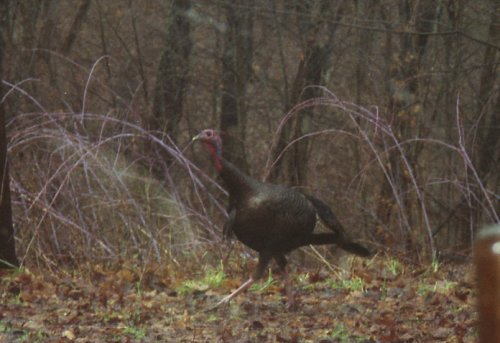
I don't think I'll ever get used to looking out the window and seeing wild birds this big.

Sunday, March 26, 2006

More Snow

Princess on the truck hood

In addition to rodent extermination and possum monitoring, Princess is always happy to consult on automotive issues.

Friday, March 24, 2006

Homer Riggleman's Quilting Memories

Here's an excerpt on quilt-making from Mr. Riggleman's account of life on Point Mountain in the 1890's.A West Virginia Mountaineer Remembers by Homer F. Riggleman. 1980. McClain Printing Company, Parsons, WV. 140 pp. Strictly speaking, this is a tied coverlet, not a quilt. I'd like to know whether the top or the backing were pieced, or made of whole cloth. Mrs. Riggleman sewed the children's clothing by hand at home, so she would have had fabric scraps to use up.

We didn't have sheets or blankets then; we used old-fashioned knotted quilts made of cotton or wool batting sewn between two layers of cloth. Mother made these quilts on a frame of poles or slats set to the width and length of the quilt to be made. The frame rested in a level position on two supports about three or four feet high. First, mother tacked the edges o f the bottom layer of cloth over the quilting frame; then she spread the top layer over the frame and sewed it along one side to the bottom layer. After folding the loose end back out of the way, she spread about a one inch layer of batting evenly over the bottom layer of cloth. Sometimes she used carded wool batting. When the batting was evenly spread, she turned the top layer of cloth back over the batting and fastened it temporarily around the edges.

Next the knotting began, and we older kids helped mother do this. We each threaded a heavy needle, called a darning needle, with twine string, and working along in rows, we tied the two layers of material together at points two to three inches apart. At each tie point, I pushed the needle down through both layers with one hand, and with the other hand under the frame, pulled the needle through, and then pushed it back up near the same point, through both layers of material. Then with both hands above the frame, I held the tail end of the string with one hand, and with the other pulled the needle on through and out until the string was taut. Then I tied both ends of the string together in a tight knot, cut the string (with the needle) near the knot, and proceeded to the next tie point. By working steadily, we could complete the knotting in a day or so, after which, Mother stitched the edges of the quilt together. The finished quilt was about an inch thick and very warm.

Quilts could be made by "quilting" instead of "knotting," but because the layers of such quilts were sewn together in continuous seams, using ordinary needle and thread, they required thousands of stitches. Such fancy quilts were not only much thinner and less warm, but took many days to make. As neither we nor our neighbors had any time to waste in those days, we made do with knotted quilts.

Monday, March 20, 2006

That's Because It IS Appalachia

Kentucky's Lexington Herald Leader ran an interesting AP article March 17, 2006: Candidate compares upstate N.Y. to Appalachia

ALBANY, N.Y. - Democratic candidate for governor Eliot Spitzer told a Manhattan gathering that the upstate economy is so bad that the region looks like Appalachia, a comment that an aide to one rival said insulted a vast part of the state....

"If you drive from Schenectady to Niagara Falls, you'll see an economy that is devastated," Spitzer says on the tape. "It looks like Appalachia. This is not the New York we dream of."

...."First he attacks our business community, then he trashes upstate," said Rob Ryan, spokesman for GOP candidate Randy Daniels, the former secretary of state appointed by Pataki. "It's becoming clear that Eliot Spitzer is simply not suited to be governor."

Now, a couple of years ago, I said to a rude West Virginian, "Where are you from, New York?" I couldn't have insulted her more. Regional insults are not solely the province of New Yorkers. (Plus, after living in New England for seven years, I know that there are lots of people ruder than New Yorkers, who, I have found, are helpful, resourceful, and funny on their home turf.)

I am only making a fuss over a matter of fact. I quote from the World Book Encyclopedia article on New York: "The Appalachian Plateau, also known as the Allegheny Plateau, covers half of the state, and is New York's largest land region." It includes the Finger Lakes, and the Catskills. Wouldn't you expect gubernatorial candidates and their senior staff to know where their states are located?

Saturday, March 18, 2006

Pearl S. Buck, New Icon of Fashion

The Keyboard Biologist has been working on a project with an intriguing name: The Pearl Buck Swing Jacket. By including a Pocahontas County author and beautiful and informative knitting photos, she's got my full attention. (I was also, once, a keyboard biologist, but they didn't keep the outside door shut, and I ran away.) I was curious about the sweater name. It comes from the Interweave Knits Winter 2005 issue, Pearl Buck Swing Jacket by Kate Gilbert: "Fine literature meets fine merino in a jacket inspired by The Good Earth." To me, swing jackets are more a 1950's retro look than a nineteenth century Chinese peasant look. Maybe the Mandarin collar is the connection. I confess the name made me think of those fox stoles Mrs. Buck and Mrs. Roosevelt used to sport in the 1930's. However, The Keyboard Biologist looks much more fetching as she models her knitting.

Thursday, March 16, 2006

Windmills In Our Backyards

Iowa windmill picture, 1970

This is the windmill that was in my backyard when I was growing up. Everybody had one. I always thought they were pretty, and I liked the many sounds they made as the wind changed direction and speed.

Lately, there has been some interest in locating windfarms in Greenbrier County, WV and Highland County, VA (both of them just over the border from Pocahontas). They would generate electricity and green points for a power company. A lot of people are opposed, claiming the windmills would degrade local land values, ruin the scenic vistas, and generally be bad. I've been trying to find out more about windfarms, so that I can come up with a better opinion than "I like windmills because they are pretty." Unfortunately, almost everything I've found on the Internet has been advocacy for the pro or the con position. Here are the best balanced informative sites I've found so far.

From what I've read so far, if care is taken in placing the windmills, they don't grind up migrating birds, cast flickering shadows over people's homes, or create loud noise. They do seem to kill a lot of bats, and no one knows why. You have to cut down trees on the windmill site, but they look a lot better than a strip mine, and you have the option of removing the windmills. There are several mountain tops around here that were strip mined in the seventies. Snowshoe Mountain, where the ski resort was built, is an example; so is Briery Knob. Trees will not grow on these sites again for hundreds of years. They might look nicer with windmills. I'm afraid I haven't developed that informed opinion yet.

Monday, March 13, 2006

The Bluegrass of Kentucky and John Fox Jr.

Antique Book Cover: Little Shepherd of Kingdom Come

Here's another strange and disturbing passage from The Little Shepherd of Kingdom Come by John Fox, Jr. (1898). While our hero, Chad Buford, embodies "the spirit of the old race that had laid dormant in the hills" of Appalachia, the Kentuckians of the Bluegrass are Nature's Chosen People, led into the Bluegrass Garden of Eden, and fenced in by "grey hill and shining river," so that they would remain untainted. Eugenic as it all sounds today, I think this sort of nineteenth century writing is the bedrock of modern characterizations of the nature of Appalachian people. Note the inevitable juxtaposistion of "sturdiness" and "Scotch-Irish."

God's Country!

No humor in that phrase to the Bluegrass Kentuckian! There never was--there is none now. To him, the land seems in all the New World, to have been the pet shrine of the Great Mother herself. She fashioned it with loving hands. She shut it in with a mighty barrier of mighty mountains to keep the mob out. She gave it the loving clasp of a mighty river, and spread broad, level prairies beyond that the mob might glide by, or be tempted to the other side, where the earth was level and there was no need to climb; that she might send priests from her shrine to reclaim Western wastes or let the weak or the unloving--if such could be--have easy access to another land.

In the beginning, such was her clear purpose to the Kentuckian's eye, she filled it with flowers and grass and trees, and fish and bird and wild beasts. Just as she made Eden for Adam and Eve. The red men fought for the Paradise--fought till it was drenched with blood, but no tribe, without mortal challenge from another straightway, could ever call a rood its own. Boone loved the land from the moment the eagle eye in his head swept its shaking wilderness from a mountain-top, and every man who followed him loved the land no less. And when the chosen came, they found the earth ready to receive them--lifted above the baneful breath of river-bottom and marshland, drained by rivers full of fish, filled with woods full of game, and underlaid--all--with thick, blue, limestone strata that, like some divine agent working in the dark, kept crumbling--ever crumbling--to enrich the soil and give bone-building virtue to every drop of water and every blade of grass. For those chosen people such, too, seemed her purpose--the Mother went to the race upon whom she had smiled a benediction for a thousand years--the race that obstacle but strengthens, that thrives best under an alien effort to kill, that has ever conquered its conquerors, and that seems bent on the task of carrying the best ideals any age has ever known back to the Old World from which it sprang. The Great Mother knows! Knows that her children must suffer, if they stray too far from her great teeming breasts. And how she has followed close when this Saxon race--her youngest born--seemed likely to stray too far--gathering its sons to her arms in virgin lands that they might suckle again and keep the old blood fresh and strong. Who could know what danger threatened it when she sent her blue-eyed men and women to people the wilderness of the New World? To climb the Alleghenies, spread through the wastes beyond, and plant their kind across a continent from sea to sea. Who knows what dangers threaten now, when, his task done, she seems to be opening the eastern gates of the earth with a gesture that seems to say--"Enter, reclaim, and dwell therein!"

One little race of that race in the New World, and one only, has she kept flesh of her flesh, bone of her bone--to that race only did she give no outside aid. She shut it in with gray hill and shining river. She shut it off from the mother state and the mother nation and left it to fight its own fight with savage nature, savage beast, and savage man. And thus she gave the little race strength of heart and body and brain, and taught it to stand together as she taught each man of the race to stand alone, protect his women, mind his own business, and meddle not at all; to think his own thoughts and die for them if need be, though he divided his own house against itself; taught the man to cleave to one woman, with the penalty of death if he strayed elsewhere; to keep her--and even himself--in dark ignorance of the sins against Herself for which she has slain other nations, and in that happy ignorance keeps them to-day, even while she is slaying elsewhere still.

And Nature holds the Kentuckians close even to-day--suckling at her breasts and living after her simple laws. What further use she may have for them is hid by the darkness of to-morrow, but before the Great War came she could look upon her work and say with a smile that it was good. The land was a great series of wooded parks such as one might have found in Merry England, except that worm fence and stone wall took the place of hedge along the highways. It was a land of peace and of a plenty that was close to easy luxury--for all. Poor whites were few, the beggar was unknown, and throughout the region there was no man, woman, or child, perhaps, who did not have enough to eat and to wear and a roof to cover his head, whether it was his own roof or not. If slavery had to be--then the fetters were forged light and hung loosely. And, broadcast, through the people, was the upright sturdiness of the Scotch-Irishman, without his narrowness and bigotry; the grace and chivalry of the Cavalier without his Quixotic sentiment and his weakness; the jovial good-nature of the English squire and the leavening spirit of a simple yeomanry that bore itself with unconscious tenacity to traditions that seeped from the very earth. And the wings of the eagle hovered over all.

For that land it was the flowering time of the age and the people; and the bud that was about to open into the perfect flower had its living symbol in the little creature racing over the bluegrass fields on a black pony, with a black velvet cap and a white nodding plume above her shaking curls, just as the little stranger who had floated down into those Elysian fields--with better blood in his veins than he knew--was a reincarnation perhaps of the spirit of the old race that had lain dormant in the hills. The long way from log-cabin to Greek portico had marked the progress of the generations before her, and, on this same way, the boy had set his sturdy feet.

page 101 Chapter X

Sunday, March 12, 2006

Randolph County Cooking, ~1895

Here's another excerpt from Homer Riggleman's memoir of his 1890's childhood home on Point Mountain in Randolph County, West Virginia. Here in Pocahontas County, stone fireplaces are uncommon. This may be because most of the log cabins have been torn down for salvage. Chestnut logs bring a good price, and people remove log cabins and reassemble them elsewhere. My house, of sawmill lumber, is dated 1911. In any case, I found the description of cooking with a fireplace quite interesting.

Our little log cabin stood in a four-acre clearing in the virgin forest. The little one-room log house was twenty by twenty-two feet with nine foot walls, and an A-shaped shingled roof. The main room was a combination kitchen, living room, and bedroom for father and mother. A tiny bedroom was boarded off in one corner for my sisters; we boys slept in the attic. There was a huge stone fireplace at one end, the opening of which was four feet wide by four feet high, and three or four feet to the back wall. A very old woodburning cookstove sat in one corner. The name of it was "Indiansla." But much of the cooking was done in the fireplace, especially in the winter.
Mother baked cornbread and roasted potatoes and other root vegetables in the hot coals of the fireplace. She cooked dried soup beans and bacon in a heavy iron pot that hung in the fireplace. She baked the bread in a heavy iron pan we called a "baker" or "Dutch oven" which had three short legs and a rimmed lid. First, mother raked hot coals out on the hearth and sat the baker in the coals. Then she poured sweetened cornpone dough in the greased oven, put the lid on, and raked more coals around and over the baker, replacing the coals as necessary until the bread was done. The smell of that food cooking nearly dove us kids crazy.

When everything was ready, Mother put the cornbread, the pot of beans, and the roasted potatoes on the table, and called everyone in. Father said grace, and we dug in. Now that was really living high on the hog.

A West Virginia Mountaineer Remembers by Homer F. Riggleman. 1980. McClain Printing Company, Parsons, WV. 140 pp.

Wednesday, March 08, 2006

Mary Moore, The Captive of Abb's Valley

Last week, my friendly neighborhood librarian showed me this interesting story: Mary Moore: The Captive of Abb's Valley." Abb's Valley is not too far from here, in Tazwell County, Virginia. It was a jolt to me to read that Native American tribes were still a powerful force in the Blue Ridge Valley after the end of the American Revolution. Much of what I've been reading about Appalachia glosses over this, and attributes the mountaineers' affinity for violence to an Old World tradition of blood feud. I'm not convinced that Appalachian people have (or had) a greater affinity for violence than other groups, but if they do (or if they did), there's nothing like on-going guerilla warfare to keep such a trait alive. Mary Moore's children, who grew up on tales of her harrowing experiences, found the Civil War fought in their back yards, by their own children. This seems much more likely to explain a readiness to violence than the persistence of sixteenth century Border Reiver folkways.

There is a Pocahontas County connection in all this. One of Mary Moore's sons, Rev. Samuel Brown (1806-1889), came to Little Levels, and founded the "Academy," a school for which the community was named. "Academy" was changed to "Hillsboro" in the late nineteenth century. Pearl Buck's mother, Carie Stulting Sydenstricker, was disturbed by this change when she came home for a visit from China.

Tuesday, March 07, 2006

W. E. Blackhurst, On Logging Pocahontas County

W.E. Blackhurst, a Pocahontas County native, devoted much of his life to documenting local history and observing local natural history. He was an English and Latin teacher at Greenbank High School for over 30 years, and he was active in the movement to create the Cass Scenic Railroad. He belongs on my Literary Pocahontas Page, and this is my first attempt at writing about him. This excerpt from the Preface for the posthumously published Afterglow: A Collection of Short Stories and Poems gives a quick rundown of his work:

Warren Blackhurst....wrote of the first great cuttings of the virgin forests, and in Riders of the Flood he told of the formations of the great rafts of logs, from the time they left the stump until they and their riders completed their journey of nearly a hundred miles down the Greenbrier River to the lumber mill at Ronceverte. In Mixed Harvest he told of the first timber surveys, the beginning of the sawmill town and the coming of the railroad which would supplant the river as a means of taking the lumber to market. He also told of the people who were there, and those who were drawn to the industry. Sawdust in Your Eyes depicts the social life of a lumber town when the twentieth century was young, and no one could tell it better; while Of Men and a Mighty Mountain weaves the biographies of the men who made the wheels of the lumber industry turn--from the head of the Company to the mill hand, and how the work of each contributed to the finished product. And through each book there runs a thread of romance, skillfully woven into stories of a great industry. Then there was the railroad, built just for logging, which was the forerunner of the Cass Scenic Railroad.

While there is much to learn about Pocahontas County here, I really wish Mr. Blackhurst had skipped that "thread of romance, skillfully woven into stories of a great industry." In fictionalizing his stories, he fell into some of the unfortunate habits of mid-twentieth centry popular novelists. The attempt at dialect, whether of Irish, Italians, blacks, or hillbillies, is poorly done and offensive. The characterization of the workers as simple and childlike makes my skin crawl. If you can wade through this stuff, which he doubtless included to make the stories more palatable to the "reading public," you can learn a lot about Pocahontas County, and about how logging changed the Appalachians.

Monday, March 06, 2006

Where Droop Mountain Fits

View from Droop Mountain

I've spent a lot of time trying to understand where Droop Mountain fits in the geology and biogeography of the Appalachians. Maurice Brooks' The Appalachians (1965) seems to place it either in the Allegheny Mountains or immediately west of it. Despite the hours I've spent with topo maps, I can't quite understand if Droop is in the Yew Pine Mountains, or between them and the Alleghenies. Despite finding Droop interesting enough to mention, Brooks never quite spells it out.

Brooks mentions an unnamed muskeg (a bog, like the Cranberry Glades) somewhere on Droop.

Mrs. Graham Netting found an orchid rarity, Small's twayblade (Listeria smallii), not known elsewhere in Cranberry but common in a rich (and unnamed muskeg on Droop Mountain, about twenty miles away. There are other plant specialties in these southern muskegs. The one on Droop Mountain, just mentioned, has thousands of plants of netted chain-fern (Woodwardia areolata), a species associated with coastal plains, seemingly out of place on a 3000-foot mountain....

Brooks' The Appalachians includes a very helpful breakdown of western Virginia and West Virginia in this passage:

The westward escarpment that defines the Shenandoah Valley is called North Mountain, and with it we may again take up the course of Paleozoic geology. Old Appalachia is to the east; the Great Valley and the ridges beyond are a part of New Appalachia, where rocks are sedimentary, and where the fossil record of ancient life has been preserved. In parts of the valley, and just westward, there are outcrops that date from the...Cambrian....

North Mountain (with its counterparts north and south) marks the beginning of a distinctive Appalachian topographic province, the Ridge and Valley Province. Comparatively low but steeply abrupt ridges are arranged parallel to each other on a northeast-southwest axis. Between these ridges are streams, tributaries of the Potomac River, which form a trellised drainage pattern....

Just over a hundred miles west from Washington, the Alleghenies rise abruptly one or two thousand feet above the Ridge and Valley Province. This escarpment marks the beginning of a new topographic province. On its higher expanses it recaptures much of the northern atmosphere that occurs on Blue Ridge summits, and it introduces many new plants and animals of boreal distribution. To add further to its biological significance, it shelters surprising numbers of plant and animal endemics. Greatest elevations normally occur along the axis ridge known as Allegheny Backbone, but there are also extensive areas above 4000 feet on such westward ridges as Cheat, Gauley, and Back Allegheny.

Along higher Allegheny crests there is a southward extension of the red spruce forest, so typical of Maine and New Brunswick. Here hermit and Swainson's thrushes nest, red crossbills occur at all seasons, and varying hares, brown in summer and white in winter, reach their farthest southward limits. Visitors will soon come to recognize the loosely cemented sand and coarse gravel, geologically Pottsville conglomerate, which outcrops on many of the higher Allegheny peaks. Another characteristic Mississippian formation is Greenbrier limestone, holding within its depths many of the caves which we shall be discussing in a later chapter. Some of Appalachia's finest ferns are at home on these limestone ledges.

Between high Allegheny ridges and the prairies of interior America is a region of eroded hills, which are dissected by streams that flow in almost every possible direction and then are finally drawn to the Ohio River. So broken and irregular is the topography that it takes close looking to see this area as a plateau, but actually the hilltops maintain remarkably even elevations. This is the Appalachian Plateau, with outcrops that date from the Pennsylvanian Period to the east and from the Permian to the west, where hills run out and the level lands begin.

Within Pennsylvanian formations are some of the richest coal beds the world holds. The Pittsburgh coal seam has often been called, and with justification, "the world's most valuable mineral deposit." This and other coal seams have profoundly affected the habitance and economy of the region, since the mining of coal is ever an ugly and destructive process. Still, there are forests in the coves, remarkably rich and varied ones, with trees that suggest regions farther north or farther south.

pages 13-17

Sunday, March 05, 2006

More Local Knitting History

I've been reading another interesting book: A West Virginia Mountaineer Remembers by Homer F. Riggleman. 1980. McClain Printing Company, Parsons, WV. 140 pp.

Homer Riggleman was born about 1890 in a log cabin on Point Mountain, in Randolph County, WV. Starting in the early 1970's, Mr. Riggleman dictated these reminiscences, and they were later transcribed and edited by Leslie Ware and Leonard Riggleman (Homer's younger brother). There are hunting stories, observations on how things were done in his childhood days, and descriptions of the various ways he made a living. The stories are vivid and detailed. If you can find the book, it's well worth reading.

Here is an entry for my "Knitting History" category, from pages 18 and 19. It demonstrates the quality of detail he brings to all his stories. This book is a little gem.

Mother knitted all the socks worn in our family. First, sheared sheep's wool was washed and all burrs and foreign objects picked from it. Then it was carded into fluffy rolls using steel brushes similar to curry combs used to brush horses. These fluffy rolls of wool were spun into yarn on the old spinning wheel, and the yarn wound up on a spool. Later mother knitted the yarn into socks using four long darning needles. All this took many hours; my sisters were helping mother make yarn and knit by they time they were thirteen or fourteen years old.

Usually the finished socks were dyed either red or brown. To make red dye, we boys gathered sumac berries, sumac bushes kept their berries all winter. The berries were boiled in a kettle of water until the water turned red, and then the socks were put in the kettle and boiled about ten minutes. The socks were then hung up to dry. They were now a beautiful brilliant red. To make brown dye, we used the bark of a walnut tree; otherwise, the dyeing process was the same.

Saturday, March 04, 2006

Elaeagnus umbellata, autumn olive

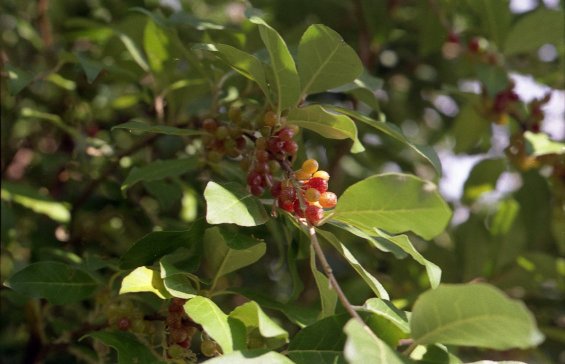
I have a little patch of cleared, level ground surrounded by trees and brush here on Droop Mountain, and much of the brush consists of this pretty plant, Elaeagnus umbellata, autumn olive. The USDA now classifies Elaeagnus umbellata as a noxious weed for the state of West Virginia, but in the 1970's in Pocahontas and Greenbrier counties, their Soil Conservation agency planted it as part of strip mine reclamation. It is invasive, it is hard to kill, but it has these really pretty, red berries, fragrant white flowers, and silvery leaves, and there is an indigo bunting that sits and sings for many hours each spring in one of these bushes.

I also remember it fondly from a graduate course in plant taxonomy, because the family is easy to identify by its elaeagnaceous hairs. They are much too small for my macro lens (I have the extension rings, but I'm too lazy and out of practice to work out a flash setup.) The photo I've linked to, from the Digital Flora of Texas Vascular Plant Image Library's Elaeagnaceae Page, hints at these scale-like hairs but does not do them justice. Take a strong hand lens and outdoor light, and have a look at any plant part this spring. Foliage, flowers, new twigs, fruits--all are covered with elegant, silvery elaeagnaceous hairs.

Until I started writing this entry, I was misidentifying the shrubs as Elaeagnus angustifolia, Russian olive. As "angustifolia" indicates, the leaves of Russian olive are more lanceolate than those of autumn olive. (Botanists use such poetic language. I would never otherwise have occasion to say "lanceolate.") According to the USDA Natural Resources Conservation service, Russian olive is not found in West Virginia, although it is recorded in all surrounding states. Sounds like a challenge, doesn't it?

Wednesday, March 01, 2006

Famous West Virginians

I've had a posting hiatus, but not for lack of time spent writing. I have a dozen posts started based on my recent Appalachian readings. They're interesting (at least to me), they're on topic, and they're just darn depressing. I haven't hit much lately (either on the bookshelves or on the Internet) that has been upbeat.

For that reason, I'm going to share with you an interesting, well-maintained, unpretentious Web site I found some time ago: Jeff Miller's West Virginia Pages. A native of Beckley, Mr. Miller has obviously put much work into this presentation, and addresses West Virginia place names, history, and government. My favorite section is the Famous West Virginians Pages. It lists "famous West Virginians -- people who were born in or lived in West Virginia." I'm just working my way through the alphabet.